Follow our blog on Twitter!

We’re interested in getting information to you as efficiently as possible. In the interest of this, we’ve opened up a Twitter account under the username shinpaideshou. Feel free to follow us on twitter to see our updates or subscribe for automatic emails via the sign-up button to the right. We hope to have more useful info and links go up on our twitter regularly! Please be patient while we learn the ropes. 🙂

Posted in announcements, social networking | Tagged | Leave a comment

The Job Hunt – Using Consulting Agencies

The job hunt can be daunting for anyone. Where to look? What’s out there? Is it right for you? To talk a little bit about one of the options people have when searching for bilingual jobs related to Japan, Steve Hashimawari is here as our first guest blogger to discuss the usefulness of consulting agencies in the job hunting process and tell us a bit about his own agency, Interplace Inc. We hope this will be a helpful guide to those looking for employment who are wondering where they can begin.

—

As we all know, the current state of the job market is not very amiable to the average job seeker at the moment.  Let’s face it, not many people have the luxury of waiting for that dream job, heck, most of us would be happy with the opportunity for an interview!  So how can we better our chances and what can we offer that a large majority of the unemployed population cannot?  How about a second language!  So, all you Japanese speakers let’s take a look at the positives.  In a recent ranking list of the main languages spoken in the U.S., Japanese was, are you ready…number 15! Right in between Persian and Hindi.  So it’s safe to say you have a valuable linguistic skill. Now, if we look at the rankings of the biggest economic powers in the world, after the U.S. and China, guess who comes next? Nope, not Wal-Mart. You guessed it. Japan.  So you possess a unique ability in a market of high demand.  Can you tell I’m an optimist?

So you have your degree in hand and can speak, read, and write Japanese.  Now what?  Here is where we come in. I represent a Japanese Bilingual Staffing Agency, Interplace Inc., as a Human Relations Consultant.  My company, Interplace Inc. (http://www.interplace-agency.com/), specializes in placing Japanese bilingual job seekers with Japanese companies in the U.S (日系企業) or with American companies who just need bilingual speakers in general.  Interplace Inc. has been in business for over 20 years, services over 2000 companies, and boasts over 20,000 people we have placed with jobs nationwide.  We are proud to say that we work with many of the major Japanese companies in any and every given industry from electronics manufacturing to financial planning institutions.  Our consultants are fully bilingual in the Japanese/English language and have many years of expertise in the field. As a result, our consultants have placed countless numbers of candidates in positions ranging from entry-level to executive-level with clients, both small and large, in various industries.

So why use a consulting company to find employment? Firstly, the service is entirely free for job seekers. We are essentially an employment agency who finds people jobs and receive our fees from the employer who asks for us to weed through countless resumes and screen and test applicants to find them the most suitable candidates for the position. We act as an intermediary between client company and applicant. Therefore it is a symbiotic relationship between us and those looking for jobs. We have countless listings of jobs from our valued clients that we can refer applicants to apply for and most importantly, without the applicants we would not be able to fill those empty positions for our clients. So, by working hard to make things easier for both our clients and our applicant base we believe we provide an invaluable service. For those of you who are unsure how to attain a job in this demoralizing job market, and trust me I have been there, I highly recommend using consulting services.  After all, how do you think I got this job?

If you would like a consultation please email us and forward your résumé in WORD format to OC@interplace-agency.com and feel free to visit us at www.interplace-agency.com.

Steve Hashimawari
橋廻 スティーブ
18552 MacArthur Blvd., Suite 497
Irvine, CA 92612
(949) 250-7290

—

If you are interested in being a guest writer on the blog, having us review your own Japan-related service, or simply including a link to your business on our website, be sure to contact us at shinpai.deshou@gmail.com.

Posted in CVs and resumes, interviewing, jobs, main posts | Tagged , , , , | 2 Comments

Blakemore Freeman Fellowships/Grants for Advanced Asian Language Study

Here is some information on two different types of funding for language study- one long-term, one short-term. Below are the criteria for people pursuing Japanese (although many other languages are also supported).

Many thanks to Playing with Hire for this and a variety of fellowship/grant links to come.

—

Blakemore Freeman Fellowships/Grants for Advanced Asian Language Study

Deadline: Dec. 30, 2010

Since 1990, the Blakemore Foundation has awarded over $12.3 million in grants to individuals pursuing professional, academic, or business careers that involve the regular use of an East or Southeast Asian language.

_
Fellowships:

Blakemore Freeman Fellowships fund a year of advanced language study at the Inter-University Center for Japanese Language Studies in Yokohama. The grants cover tuition and a stipend for related educational expenses, basic living costs and transportation, but do not include dependent expenses.

Eligibility:

  • pursuit of an academic, professional or business career that involves the regular use of a modern Asian language
  • a college undergraduate degree
  • be at or near an advanced level in the language as defined in the Grant Guidelines
  • be able to devote oneself exclusively to the language study during the term of the grant; grants are not intended for part-time study or research
  • be a U.S. citizen or permanent resident of the United States


_
Refresher Grants:

Blakemore Refresher Grants are for periods less than one academic year (minimum of two months – for example, the summer program for advanced language study at the Inter-University Center for Japanese Language Studies in Yokohama). Applicants for Refresher Grants must meet all the eligibility requirements for Blakemore Freeman Fellowships, and be a member of one of the following groups:

  • Former Blakemore Freeman Fellows;
  • Professors who are teaching in an Asian field at a university or college in the United States and post-doctoral professionals whose degree is in an Asian field
  • Graduates of the regular academic-year programs at the IUC in Yokohama, Japan


Selection Criteria:

Grants are highly competitive. Last year we were able to offer funding to less than 9% of applicants.  Applicants will be judged on having:

  • a focused, well-defined career objective involving Asia in which use of the language is an important aspect
  • the potential to make a significant contribution to a field of study or area of professional or business activity in an Asian country
  • prior experience in the country or involvement or participation in activities related to the country
  • good academic, professional or business background, appropriate to the career program

For application forms and further information see

http://www.blakemorefoundation.org

—
Blakemore Foundation
Griffith Way, Trustee
Cathy Scheibner, Administrative Assistant
1201 Third Avenue, Suite 4800
Seattle, WA 98101-3099
Phone: 206.359.3684
E-mail: blakemore@perkinscoie.com
Web: http://www.blakemorefoundation.org/

—

photo by OiMax


Posted in financial assistance, funding, language schools, living abroad, study abroad | Tagged , , , , , , , | Leave a comment

Blog Review: Playing with Hire

The future is about adventure. Without a doubt, people in area studies grab hold of a new language and often immerse themselves in new experiences and foreign lands. Playing with Hire is a site that, much like our own, hopes to showcase resources out there for people who want to confidently explore, travel, and learn while they engage in adventure.

The main page of this blog is divided into three sections: travel, ‘ships (fellowships/scholarships/etc.), and jobs, although these are just three of many tags used in frequent entries and many of these areas overlap. Although Playing with Hire is not specifically for Japanese language speakers, many of the opportunities advertised here are for people interested in Japan or are international programs applicable to Japanese language speakers.

What’s wonderful about Playing with Hire’s resources is the sheer variety and the mix of government-funded and non-government funded possibilities, especially volunteer service organizations. There are chances for artists to work with international culture programs through the U.S. Department of State as well as the opportunities like working with international non-governmental service organizations through Service Civil International. This site really drives home that the possibilities are numerous as they are fascinating.

And while many of us don’t have the time to wade through all of the information and application processes for these sites, Playing with Hire summarizes these programs well- what they are, who they’re for, and related deadlines. Students and scholars in Japanese Studies will find posts on the different Fulbright programs particularly useful.

Playing with Hire’s tagline “Bright ideas for fearless people” sums it up nicely. There is really something for everyone to boldly take control of their future. This site is not to be missed.

Posted in blogs, culture, funding, jobs, living abroad, study abroad, useful links | Tagged , , , , , , , , , | Leave a comment

Fun Link Friday: Rice Field Art

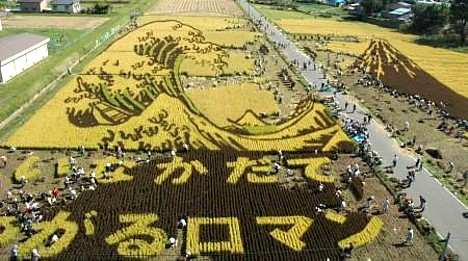
The harvest season is long gone, but the fun still remains! All across Japan, farmers have been engaging in a form of agricultural art: rice field art.

The first to pioneer this scene is the village of Inakadate, which has been doing rice field art since 1993. Other areas, such as Yonezawa in Yamagata prefecture and Nishio, in Aichi, have followed in kind. Originally conceived as a way for the small town of Inakadate to breathe new life into the atmosphere and beauty of their town, what began as simple designs has flourished into large-scale masterpieces of rice cultivation.

In 1997, Akio Nakayama, head of the rice planting project, said,

“In 1981, when we did construction work for a new road, we dug up some rice paddies that archaeologists dated as being about 2,000 years old. That impressed us local people a lot, because we realized how long people have been growing rice in this place. So then we thought that we had to do something involving rice to revitalize this area — and that was the origin of this project.”

So what sort of images do the farmers put in their fields? Everything from masterpieces of Japanese art…

…to Buddhist deities…

…to Napoleon?!

Farmers have to be careful about when and how they plant different varieties of rice to ensure that everything grows evenly and the picture becomes visible. The standard rice, tsugaru-roman, is green, and varieties of white, yellow, brown, and purple are ancient strains of rice buds.


If you have a chance to check out these amazing pieces of agricultural art while in Japan, be sure to do so while they’re at their peak in their best colors, because come September, the annual harvest begins and the pictures will be gone!

To see some past pictures of rice field art from Inakadate, check out their website here. There is also a bunch more pictures from the source links below. Be sure to check them out and look out for new pics next year!

Rice field images by year:

2007
2008
2009
2010

Additional source links:

http://blog.ratestogo.com/rice-field-art/
http://karaponeyami.blog.so-net.ne.jp/2009-07-05

Posted in culture, fun links | Tagged , , , , , | 2 Comments

Call for Papers: “In the Mix: Asian Popular Music”

A call for papers is out for what looks like an incredibly interesting conference to come on Asian popular music. Even if you’re not submitting a paper, save the date and register in the near future! There’s even a performance by a famous Japanese musician, DJ Krush. Plus, Princeton is a beautiful place to visit for a conference.

—

“In the Mix: Asian Popular Music” Conference

Princeton University

March 25 – 26th, 2011

A conference organized with support from the Department of East Asian Studies, the Department of Music, and the Princeton Institute for International and Regional Studies at Princeton University.

Special Talk and Performance: DJ Krush

Deadline for Submissions: November 30, 2010

We are pleased to invite abstract submissions for the conference, “In the Mix: Asian Popular Music,” which will take place on the campus of Princeton University on March 25–26, 2011.

Interest in Asian popular music—by which we are referencing both popular music in Asia itself and popular genres played by Asians outside of Asia—has grown internationally over the past decade, thanks to the global popularity of anime, video games, and other media, increased travel, and easy accessibility through the Internet, among other factors. In a world where global popular musics are decentralized into local scenes that are less influenced by North American trends than they might have been in the past, the study of Asian popular music invites negotiations among a diversity of theoretical viewpoints, methodologies, and disciplines, including globalization, gender, media and/or literary studies, anthropology, and musicology/ethnomusicology.

The conference aims to gather together scholars from a wide range of perspectives. We are also inviting musicians and music industry professionals to contribute their thoughts on their own experiences, thereby adding practical insight into the mix of scholarly discussions. In so doing, we seek to deepen our understanding of artists, musics, and scenes as perceived by fans, promoters, and academics in actual and theoretical contexts.

In addition to paper panels and discussions, the conference will include a special talk by DJ Krush—a pioneer of Japanese hip-hop and internationally known DJ/producer, known for his varied soundscapes of hip-hop beats and Japanese sonic references—followed by a performance by DJ Krush.

We welcome proposals for papers from scholars of all disciplines on any aspect of popular music in Asia or by Asians or Asian-Americans. Some suggested topics include:

-Histories of subcultural music scenes in Asia

-Asian hip-hop

-Questions of authenticity, hybridity, and the boundaries between subcultures

-Aesthetics and music

-Musical analyses

-Nationalism

-Reception of Asian or Asian-American popular music, within or outside of the home country

-Relations between theory and ethnography in the study of Asian popular music

-Interactions between digital culture and popular music

Submissions should comprise a paper title, an abstract of up to 250 words, a short bibliography of no more than a page, and a short biography of about 200 words, all in one .rtf or .doc file with the author’s lastname_firstname as the title. Submissions should be sent by e-mail to puasianpopconference@gmail.com by 30 November, 2010 and should include the title of the paper, name, affiliation, email address, and mailing address of the applicant. Please address any questions to the organizing committee at the email address above.

—
Organizing committee:

Richard Okada, Department of East Asian Studies
Noriko Manabe, Department of Music
Cameron Moore, Department of East Asian Studies


Posted in announcements, conferences, social networking | Tagged , , , , , , , , , | Leave a comment

Blog Review: JETs with J.D.s

Using Japanese with a very specific field in mind can be a challenge. Unless you’re pursuing translation or English-teaching positions (the standard answer for most who step out with a Japanese B.A.), it’s likely that you’ll have a difficult time trying to garner advice from someone who’s doing exactly what you are. Luckily, there are some sites like JETs with J.D.s out there which offer advice and resources for people pursuing both law and Japanese language.

The creator of this site offers information on entering law from the unique standpoint of someone who has JET programme experience. He discusses the finer points of what that experience means in terms of being prepared to enter law school and how it makes you a more (or less, depending on how you spin yourself) attractive candidate to schools. There are a lot of really unique resources here, such as Japanese law dictionaries, a list of Japanese legal associations, firms located in Tokyo, and Japanese pronunciation guides for law firms that any person entering this dual field will find enormously helpful. Personal advice as well as the advice available from top schools is provided for things like social networking and the interview process.

All of this is presented in a thorough, professional manner with lots of outgoing links for further info. If you’re entering law and have JET experience under your belt, or even if you just have Japanese language skills and entering law school has crossed your mind, checking out JETs with J.D.s is definite must.

—

photo by smlp.co.uk

Posted in blogs, useful links | Tagged , , , , | 1 Comment

Working in a Japanese Work Place

My first priority after college was to get a job. I was fresh out of school and it was not very difficult to keep my resume to a page in length. At times, I felt ANY job would be great so long as there was a paycheck and I could keep up with my student loan payments. I held fast and waited for the opportunity to achieve my goal of working within my field of Japanese Studies. Now that I had been hired by the Embassy of Japan, I was feeling really good. Unfortunately, that feeling of relief only lasts for so long because I had to actually do the job in a workplace that operated within an entirely different culture.

Point Number One: Patience is a virtue you have to embrace.

The most valuable lesson I learned in the beginning of my career as a Diplomatic Assistant was patience. I can`t stress enough how incredibly important patience is. When I got to work, my computer was not set up, there was no work set aside for me to do and I was expected to sit at my desk. I sat there with my excellent posture, fancy business attire, and attentive expression. They left me to sit there for a week with no guidance, no computer, and no work. At the time, I was more than a little frustrated. I spent my days memorizing faces, the layout of the Embassy and figuring out how to work my phone. I also took every opportunity I could to get to know the people around me. But, seriously, I was so bored and annoyed that it took every ounce of my extensive reserves of patience to get through this week.

I found out later that this is actually a stage that new employees usually go through and it is not at all uncommon in a Japanese workplace. It is the phase in which you are supposed to soak up your surroundings. They want you to sit there and get accustomed to your environment. I recommend that this is what you do if you find that you are given nothing to do right away. How you handle yourself during this time is taken into account. Again, do not be pushy. They know you are there. You will be asked several times if you are getting used to things yet. Your initial reaction may be “What is there to get used to?? I haven`t done anything yet!!” The reaction they are looking for is, “Yes I am beginning to feel comfortable here.” This stage varies in length for everyone.


Point Number Two: Trust is something that is earned not given.

This may be true in most situations but it is very important to remember always. At the Embassy, they began by giving me little things to do. It would take me all of two seconds to make a certain phone call or write a certain email but I took everything they gave me very seriously no matter what I thought of its individual importance. It took me about three months to build up enough trust to actually work on important documents and be the sole person responsible for arranging the itinerary for delegations. I had to prove that first I could make a reservation at a restaurant and I could request a quiet corner booth. Then, I was reliable enough to pass on information to the maître`d about the specific concerns and needs of the delegates. You get the picture. Step by step, I built up trust and I learned that if you do make a mistake, this is a major set-back. The trick to gaining back the good graces of your Japanese employer is to face your mistakes head-on and to be genuinely apologetic. They will not respect excuses or complaining from you even if you have legitimate reasons.

Point Number Three: Learn and Respect the Hierarchy.

You do not have to agree with it, but there is a definite hierarchy within Japanese workplaces that is far more defined and emphasized than American work places. Your Japanese co-workers will know where they stand within this hierarchy which has multiple levels. The most significant determinants of rank are age, position, and prestige. Generally the younger people have lower positions than the older people so this isn`t a problem but occasionally someone younger will ascend to a higher position. This is where it becomes tricky and the level of importance depends on the situation. Position or rank is the easiest way to determine who is in charge. The highest ranking person will always be given the priority. Finally, there is prestige. Even if two people have the same rank and are the same age there are certain fields that have more prestige than others. In that case, the more prestigious person becomes the higher ranking. If your field is more challenging or more sought after, you have more prestige.

Point Number Four: Learn to work with the Bureaucracy.

Efficiency has no place in a Japanese work environment. There are layers upon layers of built in steps one must go through first in order to complete the simplest of tasks, for example, ordering paper for business cards. Your boss is running low on business cards. What do you do? First, you tell him. Then he thinks about it and authorizes you to begin the process. You print the form which may or may not be entirely in Japanese. Then you fill out the form and this will require a few more trips to your boss because he has to tell you how many sheets of paper he needs, what kind of paper he needs and why he needs it. Then he can sign off on it. After he signs off on it, the paper has to be taken to another assistant who will have the head of the section sign off on it. This is then sent to another section that is in control of ordering supplies. They have to sign off on it and take it to their section head to sign off on it. Then the paper can be ordered. When the business paper arrives it is taken back to me. I can get it after signing another paper. Efficient right? Nothing can be done without going through a series of checks. This is a phenomenon that comes from the group oriented side of the culture. If twenty people do not sign off on it, then it is not legitimate. Very frustrating, and yet pointing out the inefficiency helps no one, least of all you. You are arguing against centuries of habit.

Conclusion

These are just a few of the differences you may encounter in a Japanese work environment. There are many significant differences but there are also many similarities. If you are a hardworking, sincere and honest person, you will be fine. Mistakes and misunderstandings happen and everyone is human. You may find that after a while, the similarities outweigh the differences. Effective communication can be achieved if you have an understanding of the four points I have listed. Have a great deal of patience so that you can build up trust while you learn where everyone stands in the hierarchy so you can operate effectively within it. Respect the differences between your culture and theirs while maintaining your own cultural identity. Keep these things in mind and you are at an excellent starting place for your new experiences working for the Japanese!

– Rachel

===

Rachel Reed graduated from Gettysburg College in 2008 with a BA in Japanese Studies. She worked as an Administrative Assistant in the Political Section at the Embassy of Japan in Washington DC for two years (2008-2010) and later worked as an Assistant Language Teacher with the JET program, in Gojome, a small, rural town in Akita Prefecture.

—

photo 1 by jackdoc101

photo 2 by SlipStreamJC

Posted in culture, embassy, jobs, main posts | Tagged , , , , , , , , | 2 Comments

Pacific Spaces: Comparisons and Connections across the Pacific Ocean in Early Modern and Modern Times

A west coast conference announcement!

—

Pacific Spaces: Comparisons and Connections across the Pacific Ocean in Early Modern and Modern Times

November 5-6, 2010

Location: Huntington Library, San Marino, CA.

The Pacific region has become increasingly prominent in contemporary global economics, politics, and cultural affairs.  Historical studies of these phenomena trace the evolution of Pacific connections and migrations in the early modern and modern eras.  This conference features scholarship that looks out from both Asia and the Americas in order to better understand how Pacific crossings fit into the regional histories of maritime Asia and the Americas.

Schedule of Events:

Friday, November 5, 2010

–  Welcome:  Robert C. Ritchie (The Huntington)
–  Remarks: R. Bin Wong (University of California, Los Angeles)
–  Session 1: Cultural Features of the China Trade

Moderator: John E. Wills, Jr. (University of Southern California)

  • “Pacific Overtures: America and the Trans-Pacific World of Goods” Kariann Yokota (Yale University)
  • “Object Lessons: The East Indies in the Anglo-American Imagination” Caroline Frank (Brown University)
  •  “Land-Rooted Turned Maritime Cargo: The Seng Story across the Pacific—Sino-American History” Hsiung Ping-chen (The Chinese University of Hong Kong)

–  Session 2:  The Trans-Pacific China Trade as an Extension of Maritime Asian Trade

Moderator: Jean-Laurent Rosenthal (California Institute of Technology)

  • “Archaeological Ceramics and Cultural Encounters in the Early Trans-Pacific Trade” Li Min (University of California, Los Angeles)
  • “Ryukyu Trade Networks and Transformation of China Seas Connection: 15th to 19th Centuries” Hamashita Takeshi (Sun Yat-Sen University)
  • “Shangchuan Island, Macau, and Chinese Porcelain Globalized in the 16th Century” Cheng Pei-kai (City University of Hong Kong)

Saturday, November 6, 2010

–  Session 3: American Settings for Asian Culture

Moderator: David Igler (University of California, Irvine)

  • “The Chinese Transnational Commercial Orbit, 1882-1940” Robert Chao Romero (University of California, Los Angeles)
  • “Angel Island: Immigrant Gateway to America” Erika Lee (University of Minnesota)
  • “Pacific Crossings: A Consideration” Gary Okihiro (Columbia University)

–  Session 4: Competing or Complementary Cartographies of the Pacific?

Moderator: R. Bin Wong

  • “Sea-space on Japanese Maps, 1600-1900” Kären Wigen (Stanford University)
  • “Competing Cartographies of the 18th-Century Pacific” Rainer Buschmann (Purdue University)

–  Roundtable Discussion/Response

  • Madeline Hsu (University of Texas, Austin)
  • David Igler
  • R. Bin Wong

This conference is funded by The John Haskell Kemble Endowment

********

Registration:

Pacific Spaces: Comparisons and Connections across the Pacific Ocean in Early Modern and Modern Times

 
Name(s):
Address:
Email/Phone:
Affiliation:
 

Conference registration and meals by reservation only.  No confirmation will be sent.

 
Conference registration: $25.00
(Graduate students free)
 

Buffet lunch (November 5) 16.50
Buffet lunch (November 6) 16.50
Vegetarian (circle one) Yes No

Total______


Please return form and check payable to “The Huntington” by October 29, 2010.

Mail to:
Susi Krasnoo, The Huntington
1151 Oxford Road
San Marino CA 91108.

Posted in announcements, conferences, graduate school, social networking | Tagged , , , , , , , , | Leave a comment

Fun Link Friday: Sushi Cat and デブ猫

Since everybody likes some fun, especially when dealing with the various stresses caused by deciding what to do with your life, every Friday we will be posting something neat related to Japan, just for the heck of it. Fun things online, information about (non-internet) Japanese games, wacky news- whatever we stumble across looking for the serious stuff.

This week? Sushi Cat! Do you like sushi? Cats? FAT cats? (Who doesn’t like fat cats?)

Check out this online flash game created by Armor Games in which you play as Sushi Cat, a fat cat looking for love who, for various silly reasons, needs to eat as much sushi as possible to win the girl.

http://armorgames.com/play/5379/sushi-cat

With each piece of sushi eaten Sushi Cat gets fatter, and there are bonus sushi that do special things. Fill up his belly to win! If there’s a good strategy to each level, I haven’t found it, ‘cause I’m just too busy wondering what direction he’ll bounce in next and if he’s too fat to get through obstacles

The game is simple but highly addictive! Luckily it’s also short.

Also lucky: there’s a sequel! Take Sushi Cat for more fat cat adventures on his island getaway honey moon.

http://armorgames.com/play/6301/sushi-cat-the-honeymoon

On a related note, Japan happens to LOVE fat cats. In fact, we’ve seen television specials just on “デブ猫” (debu neko, or tubby cats). If you cruise around the net a little, you can find people’s photo blogs of their fat cats (them rolling, being put in funny costumes…). In fact, you can even find something similar to old fashioned webrings (yeah, remember those?) dedicated to ranking the most popular デブ猫sites, like this one, “デブ猫ブログ村” (Fat Cat Blog Village).

And now you know, so you can more fully enjoy the hilarity of Sushi Cat’s デブ猫 status!

– Paula

Posted in culture, fun links | Tagged , , , , | 2 Comments