Position: Associate Director, University of Pittsburgh Asian Studies Center

University of Pittsburgh, University Center for International Studies

Associate Director, Asian Studies Center

University of Pittsburgh, University Center for International Studies seeks to fill the position of Associate Director (AD) of its Asian Studies Center (ASC).  With an international reputation for excellence, the Asian Studies Center has been designated a National Resource Center in East Asian Studies by the U.S. Department of Education. Organizationally, the Center is part of the University Center for International Studies.  The position is a full-time 12 month administrative position with start date of September 1, 2011. The AD reports to the Faculty Director of Asian Studies and has primary responsibility for grant proposal development, grant management, and grant administration.  The AD will supervise the administration of the ASC and will have major budgetary responsibilities. The AD will represent ASC on behalf of the director.  The position requires both domestic and foreign travel. A key skill is the ability to work with faculty in implementing the ASC agenda on such activities as the development of research, instructional and outreach programs as well as on ASC conferences and workshops. A Ph.D. in a relevant discipline would be highly desirable and fluency in a major Asian language will be viewed favorably.  The AD must have a minimum of five years of university experience and possess excellent administrative and computer skills. The salary minimum is $60,000, depending on qualifications and experience.

Applications will be reviewed until the position is filled. Please send a cover letter, vitae, and the names and contact information for three references to Dr. Jennifer Creamer, chair of the search committee, at ascad@pitt.edu.

The University of Pittsburgh is an Affirmative Action, Equal Opportunity Employer.

Contact: Dr. Jennifer Creamer

Website: http://www.ucis.pitt.edu/asc/

Posted in announcements, job openings, jobs | Tagged , , , , | Leave a comment

Symposium: The Art Theatre Guild of Japan: Spaces for Intercultural and Intermedial Cinema

The Centre for Media, Culture and Creative Practice, Birkbeck College, University of London

Symposium:

The Art Theatre Guild of Japan: Spaces for Intercultural and Intermedial Cinema
30th-31st July 2011

Gordon Square Cinema, Birkbeck College, University of London
Keynote Speaker: Roland Domenig (University of Vienna)
Confirmed Plenary Speaker: Hirasawa Go (Meiji Gakuin University)

More details will be announced at:
http://www.bbk.ac.uk/creative/news-events/atg

With the generous support of: The Japan Foundation
In collaboration with: Mixed Cinema Network, Close-Up Film Centre and the BFI
In Conjunction with:
The Art Theatre Guild of Japan Season (August: BFI Southbank)
Theatre Scorpio Retrospective: Japanese Independent and Underground Cinema of the 1960s and 1970s (July: Close-Up Film Centre)

To celebrate the arrival in London of the Art Theatre Guild of Japan (ATG) season at the BFI Southbank and the Theatre Scorpio retrospective programme at the Close-Up Film Centre in July and August 2011, this international symposium will explore the many faces of Japanese independent arts in the 1960s and 1970s.

Partly inspired by the BFI, ATG was inaugurated in 1961 to distribute and exhibit international new-wave films across Japan, generating an engagement with global film culture. In 1967 the organization began to assist in the production of local independent filmmakers’ projects, co-producing some of the most critically acclaimed works of the key directors of the era, including Oshima Nagisa, Susumu Hani, Yoshida Kiju, Terayama Shuji and Wakamatsu Koji, amongst many others. Furthermore, ATG, and in particular its centrepiece cinema Art Theatre Shinjuku Bunka and its underground space Sasori-za (Theatre Scorpio), instigated a dialogue between cinema and the other arts that reached previously unattained levels. ATG continued to co-produce key works in Japanese cinema for decades afterwards.

The symposium aims to contribute to the recent resurgence of critical and public interest in 1960s avant-garde culture across the globe, and place ATG’s phenomenal creative output in an international context. We would like to focus in particular on how cultural spaces, such as the Art Theatre Shinjuku Bunka, were key in yielding an atmosphere where a network of heterogeneous artistic voices could interact and collaborate, develop a relationship with their audience, and experience their art within an international forum. Although the focus will remain on the circui of ATG activities, the symposium aims to branch out further to explore alternative venues and fields of activity that were equally significant within the cultural climate.

Although all proposals will be considered, we particularly welcome papers that explore the following themes:

·Japanese Cinema of the 1960s/70s in an international context
·Japanese Cinema of the 1960s/70s and its relationship with other arts
· The meaning of independence in 1960s/70s Japanese culture industries
·Japanese experimental cinema and avant-garde  arts of the 1960s/70s
·The impact of ATG and other comparable cultural spaces on 1960s/70s Japan
·Examples of cross-medial collaborations
·Audiences of 1960s/70s Japanese arts and reception of such works in Japan and elsewhere
·Comparative studies of cultural venues
·Comparative studies of new wave films in world cinema
·Studies of key directors and collaborators (cinematographers, actors, art directors, etc.) of 1960s/1970s Japanese cinema.
·The resonance of Japanese 1960s culture in the world today

We welcome proposals from researchers at any stage of their project, and we will accept proposals from those within and beyond the academic field of film studies. Please send a 400-word abstract and 200-word (max) biography to atg.symposium@gmail.com.

Please note that selected papers will be considered for publication in a special issue of Vertigo Magazine dedicated to Theatre Scorpio.

For more information on Vertigo Magazine, published by Close-Up Film Centre, please visit: www.vertigomagazine.co.uk or www.closeupfilmcentre.com/

The deadline for application is 25th May 2011.

Successful candidates will be approached by 31st May 2011.To register a seat for the symposium or for any further questions, please contact the e-mail address above.

Posted in announcements, conferences | Tagged , , , , , , , , , , , , , , | Leave a comment

Call for Manuscripts: “Asian Visual and Performing Arts” EAA Spring 2012

Education About Asia (EAA) is the peer-reviewed teaching journal of the Association for Asian Studies. Our approximately 2,300 readers include undergraduate instructors as well as high school and middle school teachers. Our articles are intended to provide educators, who are often not specialists, with basic understanding of Asia-related content. Qualified referees evaluate all manuscripts submitted for consideration. Most of our subscribers teach and work in history, the social sciences, or the humanities.

We are in the process of developing a special section entitled “Asian Visual and Performing Arts” for the spring 2012 issue of EAA. In this special section, we invite authors to submit manuscripts that assist instructors and students in secondary school and college/university introductory survey courses in the humanities or social sciences to better understand Asian cultures through learning about the visual and performing arts. We welcome manuscripts from teachers, scholars, journalists, or others who have expertise in the topic.

Prospective authors should be aware that approximately fifty percent of our readers teach at the undergraduate level and the rest are secondary or middle school teachers. Please consult the EAA guidelines, available on the website under my signature before submitting a manuscript for this special section. Pay particular attention to feature and teaching resources manuscript word-count ranges. Prospective authors are also encouraged to share possible manuscript ideas with me via email. The deadline for initial submission of manuscripts is November 10, 2011.

http://www.asian-studies.org/EAA/Themes.htm

Lucien Ellington
Editor, Education About Asia
302 Pfeiffer Stagmaier Hall
University of Tennessee at Chattanooga
Chattanooga, TN 37403
Phone (423) 425-2118, Fax (423) 425-5441
email: l-ellington@comcast.net
Web Site: http://www.asian-studies.org/

Posted in announcements | Tagged , , , , , , , | Leave a comment

Fun Link Friday: Podcasts for Japanese Learners

by ky_olsen

Just a quick fun link this week, as wrapping up assignments and getting organized has unfortunately taken precedence! Something I’ve been trying to round up here and there is information on more web resources for improving your Japanese. While tidying up my bookmarks I came across this article, which I saved from earlier this year to investigate further:

http://yonasu.com/podcasts-for-japanese-language-learners/

The author, Philip Seyfi, put together a short list of some online podcasts, some aimed at beginners and some more advanced Japanese language students, meant to boost your listening comprehension and teach you some practical vocab and phrases for daily conversation. I must admit, with my research-oriented Japanese as a priority right now, I definitely plan to look more into these types of programs to make sure my skills don’t deteriorate any more than they already have! Hopefully we’ll be able to track down more of these for you in the future.

Improvements to the site and fresh content coming soon, so bear with us! Have a great weekend!

Posted in fun links, study tools, useful links | Tagged , , , | Leave a comment

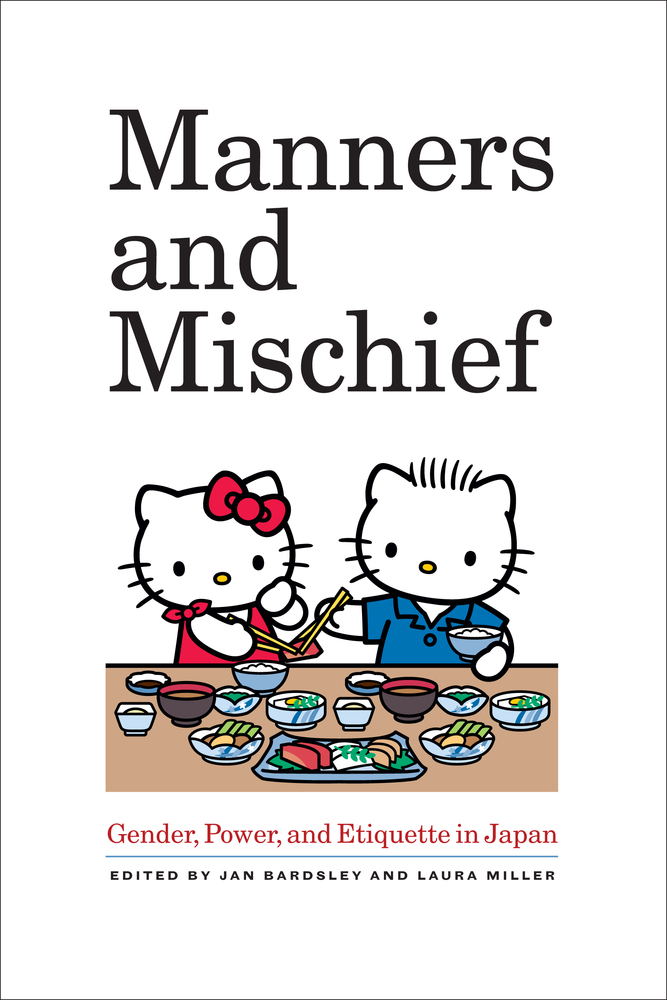
Book announcement: Manners and Mischief: Gender, Power, and Etiquette in Japan

Laura Miller and Jan Bardsley are pleased to announce the debut of our co-edited volume Manners and Mischief: Gender, Power, and Etiquette in Japan (UC Press, 2011). The book examines etiquette guides, advice literature, and other such instruction for behavior from the early modern period to the present day and discovers how manners do in fact make the nation. Eleven accessibly written essays consider a spectrum of cases, from the geisha party to gay bar cool, executive grooming, and good manners for subway travel. Together, they show that etiquette is much more than fussy rules for behavior. In fact the idiom of manners, packaged in conduct literature, reveals much about gender and class difference, notions of national identity, the dynamics of subversion and conformity, and more. This richly detailed work reveals how manners give meaning to everyday life and extraordinary occasions, and how they can illuminate larger social and cultural transformations.

For more about Manners& Mischief and order information, please visit the UC Press website: http://www.ucpress.edu/book.php?isbn=9780520267848

Posted in announcements, study tools | Tagged , , , , , , , , | 2 Comments

Call for Papers: Utopias and the Japanese Imaginary

The 16th Annual Graduate Student Symposium
UCLA Paul I. and Hisako Terasaki
Center for Japanese Studies

Not all people exist in the same now   – Ernst Bloch

Idealism and the desire for totalizing perfection is a motif that can be found across centuries and in every genre of Japanese cultural production; and yet each manifestation of ‘utopia’ embodies its own specific socio-historical moment, and similarly contains within it a specific socio-historical critique. Previous Terasaki Center Graduate Student Symposiums have focused on translation, space, politics, aesthetics, and history.  By exploring topics related to the conception of utopia and the social imaginary in Japan, we hope to create a dialogue that employs a different lens through which to view the idea of Japan. Under this broad and overarching theme, we encourage papers treating the engagement of a utopian mentality with relation (but not limited) to:  aesthetics, architecture, film, historiography, imperialism, literature, Orientalism, protest movements, religious movements.

The symposium will be held on Saturday, October 22nd at UCLA. The Center for Japanese Studies will provide round-trip airfare within the United States, two nights of lodging at UCLA guest housing, and most meals for selected participants.

Please send abstracts, an abbreviated Curriculum Vitae, and any questions, to symposium organizers Tanya Barnett (tanyab13@ucla.edu) and Emi Foulk (emi.foulk@gmail.com).  Abstracts should be approximately 200 words, and must be submitted by June 12th, 2011.

This is an announcement for an upcoming conference at the University of California San Diego about US-Japan Immigration.

Conference Title:  Immigration at the National and Local Level: The Impact on Future Economic Growth and Community Relations in Japan and the United States

Date:  Friday, May 6, 2011 and Saturday, May 7, 2011

Location:  The Institute of the Americas the Weaver Center at UC San Diego http://sciencestudies.ucsd.edu/Flyers/IOA-directions-map-1.pdf

More information can be found at: http://irps.ucsd.edu/media-center/conference-materials/japan-immigration/

To RSVP for the conference, please go to:  http://irps.ucsd.edu/media-center/events/events_2011041442260.htm

Mya Fisher
Lecturer
Department of Sociology
University of Wisconsin-Madison
8128 William H. Sewell Social Sciences Building
1180 Observatory Drive
Madison, WI 53706-1393
mfisher@ssc.wisc.edu

Posted in announcements, conferences | Tagged , , , , , | Leave a comment

Blog Review: Samurai Archives

As someone finishing up a Master’s degree in late medieval Japanese history, I understand how frustrating finding resources in English can be. Therefore, today we’re going to feature a site for studying Japanese history that I’ve too long neglected to feature on Shinpai deshou. The Samurai Archives Japanese History Webpage is a great place to start for both beginning and advanced learners.

As the title suggests, the focus of the site is on warriors and military aspects of Japan. However, this does not preclude a lot of other fantastic pieces of historical information, and the outgoing and related links open up the materials to a number of different fields. The SA website aims to be an extensive database of various historical aspects of “old Japan.” There are so many great features on this site I could probably break them each down into a separate post and ramble forever, but here are the main highlights:

The Samurai Archives Japanese History Wiki is a great work in progress attempting to create a reliable database of articles properly cited and fact-checked for students and scholars to cross-reference historical events, people, dates, and many other items. Only approved editors can contribute and copy-paste jobs from the actual Wikipedia aren’t allowed, so people serious about looking for dependable facts will find the SA wiki a great way to get started. The Japanese History Wiki is the source of many of the main sections of the Samurai Archives website, such as famous samurai, famous women, emperors and empresses, and samurai battles, but there are a number of other great collections of information featured on the main page.

For example, those researching individual figures can find material on famous Sengoku generals of certain major houses like the Oda, Takeda, Mōri, among others. If politics is your area, you can find selected translations of daimyo house codes and lists of who held Sengoku era ranks and titles. For those artistically inclined like myself, I found the images of family crests and banners particularly awesome. I didn’t invest in any books of that sort while I was in Japan, but it’s great to know that if I come across a crest (or, you know, a tenugui full of them) I need to identify there’s a one-stop resource online for it. Also great for reference materials are the genealogies for major families, glossary of terms list, and the reference page for Japanese historical names with their kanji. Although there’s plenty more to be added, for those getting started without much Japanese under their belts or having a problem identifying the specifics of a figure or battle from a frustrating Japanese text, these pages will be really useful to kick off from or fall back on.

The Samurai Archives also maintains a number of blogs on historical topics, including their main history blog, an ancient history blog (dealing largely with archaeology), and the Samurai Archives’ recent venture into history podcasts (just last month they covered the AAS conference in Honolulu, so keeping up with the SA podcast will be a great way to be up to date with what’s going on in the academic field as well!). Plus, there’s an online forum where you can get involved in the Samurai Archives community that has tons more information on a variety of topics.

Better stop here before my history geekery gets any more intense (the longer I browse their cafepress shop online the more I want to buy an Oda crest shirt…), but I highly suggest you check out the numerous pages Samurai Archives offers and bookmark it as a future resource for all kinds of historical research. There’s so much history yet to be covered and you can be sure that the website will only keep expanding to offer more great things. You can keep up with the Samurai Archives updates via their forums, twitter account or Facebook page.

Happy browsing!

Posted in blogs, study tools, useful links | Tagged , , , , , , , | Leave a comment

Job Opening: Two-year Postdoctoral Research Associate, East Asian Studies

Institution:   Princeton University
Location:   New Jersey, United States
Position:   Post-Doctoral Fellow

A postdoctoral research position, supported by the Andrew W. Mellon Foundation, is available in the Department of East Asian Studies at Princeton University. The successful candidate will collaborate to team teach in an interdisciplinary seminar course aimed at rethinking the intellectual and cultural history of early modern East Asia, 1500-1800. The candidate is also expected to pursue research that will make a significant contribution to the field of East Asian Studies in one or more selected disciplines in the humanities, with special attention to the history of science or medicine. The initial appointment is for one year, with the expectation of renewal for a second year pending satisfactory performance. Applicants must have received the PhD degree no later than July 1, 2011. Preference will be given to applicants who have held the Ph.D. degree for less than five years.

To apply, please visit http://jobs.princeton.edu (req. #0110166). Applications will be accepted until the position is filled.

Princeton University is an equal opportunity employer and complies with applicable EEO and affirmative action regulations.

Posted in announcements, job openings, jobs | Tagged , , , , , , | Leave a comment

Fun Link Friday: Nandoku Kanji

So you think you’re a kanji master? Why not put your skills to the test by quizzing yourself with some nandoku kanji (難読漢字)?

Nandoku kanji “difficult to read” kanji, single and compound characters that are not a part of the Tōyō kanji list (check out wikipedia for more information on Tōyō kanji ), that use nonstandard readings or that have fallen out of general use.

A search for 難読漢字 or even just 難読 on Google will get you a whole number of sites with lists and simple HTML games, but one free fun flash game I’d like to recommend is Puchi Game’s “Nandoku Kanji” typing quiz!

http://www.p-game.jp/game30/

The game is simple. Your digital teacher quizzes you on the readings of nandoku kanji and you type in the answer. If you’re correct the game quickly moves you to the next question but if you make even one mistake the reading is revealed and you’re given a second chance. The game allows users to input the readings in several styles of romanization (for example, し can be entered as shi, si or ci) so you can type in whatever standard you’re used to typing in!

If you’re new to nandoku kanji the game will probably seem overwhelming at first, but you can use it as a starting point to study. Although the time limit doesn’t allow you to spend too much time taking notes or looking up the English definitions for words you don’t know, during the quiz you can keep a memo pad or digital text file open to jot down a few words to look up afterwords. The good news is even if you are totally new to nandoku kanji the game repeats fairly often, so after playing and studying for awhile you’ll see your work paying off in your score!

Remember, nandoku kanji are difficult for even native Japanese speakers to read, they aren’t considered “hard to read” for nothing! But while you probably won’t be seeing nandoku kanji on the JLPT or in your favorite manga, if you’re up for a challenge they can be a fun way to test your kanji ability, learn some impressive words and surprise your friends and teachers.

And for those of you who are hooked on nandoku kanji, you might be interested in the Nandoku Kanji DS game. Much more involved than Puchi Game’s free typing quiz, the DS game has a greater number of kanji and tests players on the words in a variety of ways. You can play a free trial of the game online at Yahoo Games: free trial

Have fun!

Screencaps © 2004- MARIETTA CO.,LTD. All Rights Reserved.

Posted in fun links, study tools | Tagged , , , , , | 1 Comment

Call for Papers: Politics of Religion in Asia

Politics of Religion in Asia:
An International Conference Center for Asia and Pacific Studies
International Programs University of Iowa
Date: May 12-13, 2012

This conference will focus on the relationship between religion and politics in Asia, including but not limited to China, Hong Kong, Japan, South Korea, Taiwan, Singapore and India.  It intends to address two related topics: the development of religion and the role of religion in politics. We encourage paper proposals examining the above topics by relating to any aspect of state policy, economic modernization, and traditional culture. Both single-country and cross-country studies are welcome. We are particularly interested in theoretically informed studies using primary research materials.

The conference will pay for the participant’s airfare and lodging if his/her paper is accepted. The final papers will be published in an edited volume.

The deadline for submitting the paper proposal is October 1, 2011, and the deadline for submitting the conference paper is April 13, 2012.

The proposal should include:

  • Author’s name
  • Current job title
  • Institutional affiliation
  • Contact information (email, mailing address and phone number)
  • Paper abstract (100-300 words) Author’s CV (no more than 3 pages)

Please send your proposal via email to:

Professor Wenfang Tang
wenfang-tang@uiowa.edu
Department of Political Science
University of Iowa

Posted in announcements, conferences | Tagged , , , , | Leave a comment