Job Opening: Assistant Manager at a Japanese Trading Company

From the University of Michigan Center for Japanese Studies mailing list:

My name is Steve Bear, and I am a Partner with Wingate Dunross, Inc. headquartered here in Los Angeles, CA.  WDI is a retained executive search firm and we have recently been hired to conduct a national search for a leading global Japanese trading company to fill a full-time, permanent position for them in the greater Boston, MA area.

Our client’s business is focused in the aerospace/defense industry and they are looking for an Assistant Manager (or “Project Coordinator”) who will be able to support the company’s sales activities; assist in contract implementation and program management; provide logistical support and be involved in pursuing future business development activities.  In short they are looking for someone who can act as an “interface” to support their Senior Management and be a liaison to several large international companies they work with in the aerospace and defense industries (as well as to some government entities in Japan).

The main requirement for the position is the person needs to be fully bi-lingual in English and Japanese (speaking, reading and writing – fluently).  Furthermore, due to the technical nature of the work, they would prefer someone with 3 to 5 years of aerospace, defense, electronics or related industry experience working in the area of sales, marketing, business development, proposals, contracts or similar capacity.

The position will offer someone tremendous growth, stability and opportunity in addition to a competitive compensation and benefits package.

My contact information is as follows:

Steven T. Bear

Executive Vice President

Wingate Dunross, Inc.

28632 Roadside Drive, Suite 203

Agoura Hills, CA 91301

Phone: (818)597-3200 ext. 222

Fax: (818)597-3201

E-mail: steveb[AT]wdsearch[DOT]com

www.wdsearch.com

Posted in announcements, job openings, jobs | Tagged , , , , , , | Leave a comment

Intensive Summer Course: HIROSHIMA and PEACE – Graduate and Undergraduate

Hiroshima City University accepting applications

• Students from different countries come together for serious academic study and discussion, in English, of issues related to world peace.
• The content is timely and important in the current world situation (e.g., nuclear proliferation, threat of nuclear weapon use).
• Home-stay housing for foreign participants will be provided for free.

Period: July 27 to August 6, 2011

Venue: Hiroshima City University
Credit: 3 credits for both undergraduate and graduate students
Tuition and Material Fee: 20,000YEN for undergraduates and 21,000YEN for graduates.

The Faculty of International Studies, Hiroshima City University, is sponsoring the Intensive Summer Course: HIROSHIMA and PEACE, which is also accredited by the University of Hawaii at Manoa.  Participants in the “HIROSHIMA and PEACE” class will be exploring current peace-related issues, in English, under the guidance of researchers and scholars from a variety of disciplines, ranging from international relations (including issues related to Islam) and media studies to nuclear weapons and the environment. This course will be conducted in English, so the ability to use spoken and written English is essential.

UNDERGRADUATE LEVEL: The aim of this course is to provide students with a general understanding of the nature and attributes of war and peace by illuminating various aspects of wartime experiences, including the atomic bombing of Hiroshima, and, at the same time, to explore contemporary issues related to world peace in the era of globalization.

GRADUATE LEVEL: In addition to most of the undergraduate lectures and special programs, graduate students will attend several more advanced lectures and discussion sessions and will pursue research in a specialized area under the guidance of a faculty advisor.

The deadline to apply is May 20, 2011.  Family home-stays are being offered, along with a full range of extra-curricular activities, including participation in the August 6 ceremony commemorating the victims of the world’s first atomic bomb attack.

Detailed information including course descriptions is available at the

Website:

www.hiroshima-cu.ac.jp/Hiroshima-and-Peace/index.htm

Contact Information:

Office of Intensive Summer Course, Faculty of International Studies,
Hiroshima City University, Ozuka-higashi, Asaminami-ku, Hiroshima,
731-3194, JAPAN
Phone: +81-82-830-1505, fax: +81-82-830-1657
Email: Hiroshima-and-Peace@office.hiroshima-cu.ac.jp

Posted in announcements, graduate school, study abroad, summer program, undergraduate | Tagged , , , , | Leave a comment

Job Opening: East Asian History, Visiting Assistant Professor

Institution:   Colby College, Department of East Asian Studies
Location:   Maine, United States
Position:   Visiting Assistant Professor

The Departments of History and East Asian Studies at Colby College invite applications for a one-year Visiting Assistant Professor, beginning September 1, 2011.  Candidates should have a Ph.D. in history with a research interest in China, Japan, or Korea of any historical period, as well as a demonstrated commitment to liberal arts education. Teaching load is five courses, including a one-semester “Foundations of East Asia” and four 200- or 300-level history courses. Please send a letter of interest, CV, and three letters of recommendation to: Ankeney Weitz, Chair, East Asian Studies Department, Colby College, 5630 Mayflower Hill, Waterville, ME 04901.  Review of applications will begin on May 10, and will continue until the position is filled. Colby is an Equal Opportunity/Affirmative Action employer, committed to excellence through diversity, and strongly encourages applications and nominations of persons of color, women, and members of other under-represented groups. For more information about the

College, please visit the Colby Web site: www.colby.edu

Contact:  Please send a letter of interest, CV, and three letters of recommendation to:

Ankeney Weitz, Chair
East Asian Studies Department
Colby College
5630 Mayflower Hill, Waterville, ME 04901
Website: www.colby.edu

Posted in announcements, job openings, jobs | Tagged , , , , , | Leave a comment

Job Opening: Assistant Director, US Asia Technology Management Center

See the original posting and apply here. Posted at HigherEdJobs.com.

The US Asia Technology Management Center (US-ATMC) is an education and research center located within the Electrical Engineering Department in Stanford University School of Engineering. The US-ATMC programs focus on the integration of practical perspectives into international strategic technology management as well as the analysis of research trends in selected areas of leading-edge technologies. These initiatives contribute to Stanford’s research infrastructure as well as providing technology trends for the domestic and Asia-Pacific business community.

To assist us with these initiatives, we are actively recruiting for an Assistant Director to run existing programs and independently identify new programs and sponsors. This position reports into the Director of the US-ATMC and in his absence acts on his behalf. This is a collaborative working relationship with a high degree of autonomy within the parameter of the center’s program objectives. Under the general supervision of the Director, the Assistant Director plays an integral role in developing and delivering all of the US-ATMC’s programs and activities.

The Assistant Director cooperates closely with the Director in program planning; s/he takes independent initiative in identifying new opportunities, providing recommendations to the Director in regard to possible program themes, funding sources, partner organizations and guest speakers, and frameworks for external cooperation. The Assistant Director independently develops publicity, marketing, and business development options for these programs so as to maximize the cost-effectiveness of US-ATMC funds. S/he is also responsible for developing the public face of the US-ATMC in various media, including its Website.

The Assistant Director manages, and is responsible for, the smooth delivery of US-ATMC programs, including financial projections, budget execution, processing and support of Visiting Scholars from foreign countries, and negotiation with external vendors, the landlord and co-tenants of the off-campus office. S/he may participate directly in US-ATMC research efforts into areas such as Asia business and technology surveys and market projections, and s/he assists the Director in supervising the efforts of graduate student research assistants, guiding the activities of visiting scholars, and reporting to external sponsors. The Assistant Director supports the Director in all areas of the Director’s responsibilities, including both strategy and logistics.

Qualifications:

Our ideal candidate must have up-to-date knowledge and understanding of Asia business and technology issues and trends in the context of globalization, and the initiative to develop and implement programs to meet current and future needs. Must have superior organization and planning skills for program delivery. Must be accurate and detail oriented in handling logistics and fiscal matters. Needs a solid understanding of basic accounting and also Stanford University policies in regard to external relationships and funding. Knowledge and experience in developing marketing and publicity materials is essential. Experience with website development preferred. The ability to develop and maintain collegial relationships with individuals both internal and external to Stanford is essential to the success of this position. Advanced degree required with at least 3 years of related experience. Knowledge of Oracle Financials and ReportMart strongly preferred.

Posted in announcements, job openings, jobs | Tagged , , , , | Leave a comment

Japan Foundation Faculty Fellowship in Modern Japanese Cultural Studies

Institution Type:   University of California, Santa Barbara
Location:   California, United States
Position:   Fellow

Department of East Asian Languages and Cultural Studies
Japan Foundation Faculty Fellowship in Modern Japanese Cultural Studies

The UC Santa Barbara East Asian Languages and Cultural Studies Department invites applications for the Japan Foundation Faculty Fellowship.  This fellowship has a term of two years.  The fellowship offers recent Ph.D. recipients (degree awarded between January 1, 2007, and June 30, 2011) from the fields of cultural studies, literature, history, and related fields a unique opportunity to develop their research and teaching interests in association with the 2011/12 theme, “The Return of the Political in Cultural Studies.” The fellow will teach four courses each year relating to recent trends in Japanese Studies, including both lecture courses and seminars, and will have the opportunity to mentor current graduate students. Candidates with an interdisciplinary interest in the materiality of power relations and cultural processes; in transnational or translocal communities or social movement dynamics; and/or in minorities, mobility, and circulation in contemporary Japan are especially encouraged to apply.

The position requires full-time residence at UCSB during the academic year. Compensation includes an annual salary of $47,300.

Further information about the Department of East Asian Languages and Cultural Studies and its specializations may be found at http://www.eastasian.ucsb.edu/ .

The University of California is an Equal Opportunity/ Affirmative Action Employer. The department is interested in candidates who can contribute to the diversity and excellence of the academic community through research, teaching and service.

Please submit the following materials electronically to jffacultyfellows@eastasian.ucsb.edu by May 31, 2011.

1. Letter of application (with full contact information)
2. Curriculum Vitae
3. Dissertation abstract (1000 words)
4. Sample of written work (an article or chapter of not more than 35 pages)
5. Three letters of recommendation

Inquiries about the position may be directed to Professor ann-elise lewallen at lewallen@eastasian.ucsb.edu .

Contact: Inquiries about the position may be directed to Professor ann-elise lewallen at lewallen@eastasian.ucsb.edu .
Website: http://www.eastasian.ucsb.edu/.

Posted in announcements, funding, job openings, jobs | Tagged , , , , , , , , , , , | Leave a comment

Fun Link Friday: Anna the Red

Bento enthusiasts, Japanophiles, and gamers, take note! Whether you want to learn how to make fancy bento or just like looking at (and salivating over) Anna’s gorgeous kyaraben (character bento), check out http://www.annathered.com/ for bento-making, geekery, and fun. (All images are copyrighted Anna the Red and are linked back to their original posts.)

Perhaps the best part of this site is that Anna includes the instructions on how to make the components of the bento. You, too, can make Totoro inari-zushi, a Katamari full of curry, or a Domo-kun marshmallow. Beginner at bento? Start from the basics!

Also of note is Anna’s Ghibli Feast, a series of food items from Ghibli movies that she recreated, including two meals Marco eats  in Porco Rosso and the lunch Pazu shares with Sheeta in Laputa: Castle in the Sky.

Kiki's Delivery Service

In addition to the bento, Anna also makes plushies, often based on characters from video games.

Whether you’re making bento for yourself, your friends, or to 告白 to a special someone, check out Anna’s blog for inspiration and instructions! I know that if I were the heroine of an anime, all my love interest would have to do to win my heart is present me with one of these bento for the company hanami.  Itadakimasu!

-Leah

Would-be suitors: I’m partial to kabocha, strawberries, brown rice, and Miyazaki films.

Posted in culture, fun links | Tagged , , , , , , , , , | Leave a comment

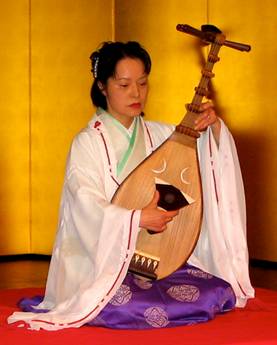
Live Webcast of Biwa Master Yoko Hiraoka performing Tale of the Heike

Information from the Illinois Japan Performing Arts Network website. This is a chance to see traditional Japanese performance that’s not to be missed!

—

Friday, April 29, 5:30 PM Central Daylight Time

Yoko Hiraoka

Heike Biwa

Peformed LIVE at Wittenberg University

Viewable Worldwide in real time via IJPAN webcast

Image from IJPAN

The elegiac melodies sung to the accompaniment of the biwa mourn and celebrate the warriors who gave their lives in the cataclysmic Genpei War (1180-1185), a civil war as traumatic for its times as the Asia-Pacific War was for ours.

On April 29, in the tradition of medieval performers who traveled throughout Japan reciting, singing, and memorializing the disquiet of war, its heroism and its folly, Yoko Hiraoka will perform three of the most famous and moving passages from The Tale of Heike —the 14th century compendium of elegiac tales—the opening “Gion Shoja,” and the battle scenes of “Ichinotani,” and the climactic “Dannoura.”

A native of Kyoto, Yoko Hiraoka is a senior master performer of Biwa, Koto, Shamisen and Jiuta voice. In addition to classical and modern training in koto and shamisen music, Ms. Hiraoka studied Chikuzen five-string Biwa for many years with Kōka Suga, the head of Kōmyōji-ryū Chikuzen Biwa and direct disciple of Yamazaki Kyokusui, honored as a Living National Treasure by the Japanese government. She has performed at the Art Institute of Chicago, Princeton University, Yale University, UCLA, Bowdoin, Smith and Colby Colleges, and many other major universities and music festivals throughout the country. Ms. Hiraoka currently teaches at Naropa University in Boulder, Colorado.

Ms. Hiraoka’s performance will be preceded by an introductory lecture by Elizabeth Oyler, Associate Professor of Japanese literature at the University of Illinois.
To access the live webcast of Ms. Hiraoka’s performance and Professor Oyler’s lecture, send an e-mail to ijpanproject@illinois.edu. Registration is free.

Posted in announcements, culture | Tagged , , , , , , , , | Leave a comment

Call for Articles: ‘Travelling’ in Asian, African and Latin American cinema

“Many Cinemas” is a forthcoming e-magazine (1st Issue announced: Spring 2011). It will dedicate its bi-annual issues the many cinemas of the non-western world, namely Asia, Africa, Latin America and other small cinema traditions.

“Many Cinemas” will be a magazine for film aesthetics, theory and analysis beyond the main stream film studies. Every issue will focus one specific topic, and we hope to publish different articles from each continent. The editors will select the proposals and accompany the publishing process. Afterward, “Many Cinemas” will be open peer reviewed, respectively commented.

*CFP TRAVELLING*

MANY CINEMAS seeks for articles on cinema which focus on travelling – and just like our maxim – in the non-western cinemas of the world like Asia, Africa and Latin America. Holiday, business, private matters. There are several reasons for travelling. The autumn edition of MANY CINEMAS will dedicate its issue to the topic “Travelling”.

Travelling: People undertake a journey to places, strange and not familiar to them. How do they act or behave in an unfamiliar environment and how does it take an impact on them? Cinema is close connected with travelling. It is a window to the world, both real and imaginary. The lights turn off and pictures appear which bring you to places far away.

We are interested in every aspect of travel in cinema.

Some possible topics are:

* How to travel in film, reasons, way of travelling, genre-questions?
* Travel in search of relatives, lovers or someone/something else?
* Exploring own roots – Culture and Identity
* Thoughts of travels
* Vehicles of voyage
* Travelogues
* Images of appearing and vanishing landscapes and people
* Travel and interruption
* Travelling Cinema

And for our rubric BEYOND THE SCREEN we are looking for articles which are loosely connected to film like music, dance, performance, visual culture…

We would like to invite you to participate to our second issue of our e-journal MANY CINEMAS. This time we are looking especially for participants writing on African, Arabian, Latin American, Chinese, or Japanese cinema.

After our first issue which will be published in End of May 2011, the second issue will take place in autumn 2011.

Please send us your proposal (300-500 words) and a brief CV until 15th May 2011. Do not hesitate to mail us, if you have some questions.

The later articles should have a length of 3000 to 4000 words. Please send your proposal to Helen Staufer and Michael Christopher

manycinemas@anpa.de

Announcement:

Issue 3 (Spring 2012): DREAD, GHOST, SPECTER and POSSESSION
Issue 4 (Autumn 2012): LOVE

manycinemas – a forthcoming e-magazine

Michael Christopher
Helen Staufer

Visit the website at http://www.manycinemas.de

Posted in announcements | Tagged , , , , , , , , , | Leave a comment

Job Opening: Adjunct Asian Language Faculty

For the original posting and to apply, see the DCCCD website.

Dallas County Community College District has openings for part-time teaching position (Hours Vary) in the World Language Department. Duties include but are not limited to:

* Adjunct instructors needed to teach Arabic, Chinese, Farsi, Japanese, Portuguese, Spanish and Vietnamese language courses.

Requirements:

* Masters degree or higher in the language to be taught or in the corresponding literature or Masters degree in any other discipline plus 18 graduate hours in the language to be taught or the corresponding literature. Demonstrated skill at working with diverse populations.
* Excellent interpersonal and communication skills.
* Official transcripts will be required.
* A criminal background check will be conducted.

For more information call Brookhaven College – 972-860-4813

Open Until Filled.

Posted in announcements, job openings, jobs | Tagged , , , , , , , | Leave a comment

Social Networking basics: Developing and maintaining relationships in Japanese Studies

IMG_9201Social networking is an essential skill that needs developing, no matter who you are. Academia itself is big, but the field of Japanese Studies is not; building and maintaining your relationships with faculty and staff in the field is one of, if not the greatest asset you’ll have in your academic (and perhaps even non-academic!) career. And in a field where everyone knows everyone, you’re going to want to be on the inside of that matrix of connections, getting to know the people who will be your closest colleagues and friends.

Let’s take it step by step: it usually begins in undergrad!

—

Undergraduate professors

At institutions large or small, your entry into the field of Japanese Studies has to start somewhere. For me, I was at a small liberal arts college, so there weren’t as many professors and definitely little chance of slipping under anyone’s radar–others may have to be more proactive. The connections I made here with my advisors and other professors in Japanese Studies were perhaps closer than one might find at a huge university (this was actually a goal of mine in choosing a small school). I had the chance to speak informally with my professors, go to dinners at their houses, babysit their kids, and even just drop by for a hello.

But, more importantly, I got my first introduction to the usefulness of an inside perspective on the field and where I wanted to go in it. From advice on whether I should enter graduate school at all to tweaking my application essays and the atmospheres of some of the schools I was applying to, my professors were there for me. And in forming a bond with them, my professors got to know me better, a great asset for recommendations. Three years have passed since I graduated, but I’ve run into my undergrad professors at conferences, met up with them while in Japan, and been fortunate enough to have them offer their advice on applying to Ph.D. programs and choosing schools. It would be a shame for anyone to think that undergrad is a time to just breeze through your first four years and not made solid connections with the wonderful people there to support you!

—

Graduate professors

The stakes go up in graduate school. Not only is your future career that much closer, but you enter a much more rigorous and emotionally trying stage of your life, where you feel yourself torn between the regular student you knew yourself to be and the scholar you want to become. Developing a close bond with professors is even more essential, and at times more difficult. Be sure to be present, be attentive, and ask lots of questions. Get things clarified if you don’t understand them, visit professors during their office hours with questions. The important thing is to make yourself visible and known to your professors (in a positive way, of course).

Essential tips:

Don’t take things too personally.

I, like millions of other grad students, have found myself frustrated by emails from professors. Or a lack of emails, for that matter. Did they get back to me at all? Did they answer all my questions? Was the reply brief/off-topic/blunt? Our own insecurities often get in the way of us realizing that professors are human, too. They have their teaching responsibilities, department responsibilities, their own research, outside commitments to journals and organizations, etc. etc. Yes, they have a commitment to your education as well, but it might not always be priority one on their list, and not for any fault of your own. Not only that, but some people are just not chatty, especially over the internet. I’ve gotten email replies from professors to three/four paragraph emails that are one- incomplete- sentence long—in the end, you’ve just got to live with it and move on.

Be patient with your professors and try not to be offended by a response that isn’t what you expected it to be. If you don’t understand, send a follow up question. If you don’t get a response within a reasonable amount of time, send another email politely asking again. Time and time again when professors have been late to reply to something and I sent an email to remind them or repeat my questions I have gotten responses like, “Thanks so much for reminding me,” “Thanks for always being on top of things,” and they don’t find it unusual at all that I checked back in. What you should NOT do is be snippy, especially via electronic communications. Nobody appreciates that and it can only brew bad blood between people who will likely have an impact on your future career.

Photo by Cara Photography

Maintain formalities.

The age of electronic communication is another thing to be careful of. As a graduate student, especially one in Japanese studies, I’m very aware of the professor-student hierarchy. Even with the undergrad professors that I know so well, I just can’t bring myself to call them anything but “sensei,” even if we are joking about sci-fi tv shows via Facebook. In any case, be careful to always address your professors with either “Professor” or “Dr.” per their preference unless they say otherwise. I tend to stick to the standard “Hello” and “Dear,” barring an instance where I’ve got either a long string of emails or rapid fire ones back and forth where my professor has initiated the usage of “Hi” as a greeting. Call me traditional, but better safe than sorry! These points are especially important when contacting professors you don’t personally know.

Get things done ahead of time. Make your own schedules!

With the amount of schedules, to-do lists, and white boards covered with notes to myself that I have on my walls, I wouldn’t be surprised if I have a mild form of OCD. But this is actually a great thing in graduate school, because there’s nothing more important than organization. Professors, who often have so many things on their plate I can’t imagine them keeping it all straight, have consistently been grateful that I come to them and communicated my own schedules for getting things done ahead of time. Professors love to see that you take initiative, consider the schedules of others, and can keep yourself organized and productive. Reducing your own chaos means reducing their chaos, so if you can get a draft of something to them a week before the draft is due, or get your recommendation materials to them at least three weeks before the deadline, do it! It reflects well on your ability to function as an academic and a person, which can only improve their esteem of you and the chances that they’ll have good things to say about you to others.

—

Scholars in other institutions

Speaking of others- one of the most important things to remember in academia, especially a field as small as Japanese Studies, is that everyone knows everyone. This became extremely clear to me when I had just finished touring Ph.D. programs before the Association for Asian Studies conference in Honolulu. I had just turned down one of the schools, but hadn’t yet written my thank you/apology letter to the researcher there, just the department secretary. Lo and behold, my advisor came back from AAS and said, “So, _______ mentioned to me that you turned them down already.” Cue mild heart attack. They were already talking with each other about me. I got on those emails fast.

As you create closer relationships with your professors, this can be a great asset. When I was looking at other schools to move on to Ph.D., my advisor had suggestions as to what researching with certain people might be like, what they knew about others working in JS, not just history, and his own experiences working with people. But this is a two way street- there’s no doubt in my mind that professors chat about their students and each other. Hey, we’re all human. But this is another reason to remember to be respectful, put a positive image of yourself out there, and avoid burning bridges within the field.

—

Your career and the internet

You can’t take back the internet!

This is something everyone should already be aware of, but it warrants repeating. Whether it’s a Livejournal, a Twitter, a Facebook page, an online forum/board for graduate students—the internet is forever. Even if you’ve said something about a professor or a program that you later regretted and deleted, it’s quite likely that someone read it, and you never know what might get repeated or to whom. A prospective student, a former student, a current student. You just don’t know. And some things are web-searchable, so typer beware! Don’t be disrespectful or insulting in a public forum, or if you absolutely have to write about it, it’s best not to name names.

Proofread everything!

Proofreading is another necessity of the digital world. Right now professors are from all different generations, and some have adapted to technology and communicating clearly through technology well. Others, not so much. And as I said before, you can never be sure exactly how to interpret what someone’s tone is via email, so it’s best to be very careful about what you yourself write and keep things formal if possible. When I’m sending out formal emails? I always have my best friend give them a quick read. “Am I asking this too bluntly?” “Does it sound like I’m irritated in this line?” “Do you think I should preface this request with something else?” And just as important, “Do I have any embarrassing typos?” Hey, nobody’s perfect. But the more clearly you get your ideas across without stepping on anyone’s toes, the more effectively you’ll be able to maintain good relationships with your professors.

—

These are just some of the basic things to think about as you move through your career in Japanese Studies. I hope it’s been a helpful guide for those do (or don’t!) think about how much effort should be put into your social network and relationships with professors and professionals. If you have any other comments or ideas, feel free to email us at shinpai.deshou@gmail.com or leave a comment below!

Posted in graduate school, social networking, undergraduate | Tagged , , , , , | 2 Comments