Announcement: JET Alum Academics Group on LinkedIn

From Jet Wit:

Steven Horowitz of JET Wit set up a new LinkedIn group for JETs, JET alums and friends of JET who work in academia or are interested in working in academia. This includes any professors, PhD candidates, masters degree students or anyone related in any way to research and academia. Join JET Alum Academics here.

Posted in announcements, JET, social networking | Tagged , , , , , | Leave a comment

Fun Link Friday: World Digital Library

Are you constantly berated by professors to use primary resources for your paper instead of general documents found from a Google search the night before it’s due? (We can tell. Trust us.) Are you a cultural history junkie? Do you have a natural curiousity to explore resources other countries have? Check out the World Digital Library as a place to find some awesome resources.

The World Digital Library (WDL) was initially proposed in 2005 by U.S. Librarian of Congress James H. Billington and officially launched in April of 2009. Contributors to the site are mainly libraries, archives, or other institutions that have cultural collections that can be shared on WDL. The National Diet Library, National Library of China, British Library, Yale University Library, and the Smithsonian are some of the contributing partners to WDL. Currently, the site is hosted and maintained by the United State Library of Congress.

The mission of the WDL is “to make available on the Internet, free of charge, primary resources from countries and cultures around the world. By doing so, the WDL hopes to:

  • Promote and develop international and intercultural understanding.
  • Expand the volume and variety of cultural content on the Internet.
  • Provide resources for educators, scholars, and general audiences.
  • Narrow the digital divide within and between countries.”

Currently, the site maintains 1,487 items ranging from time periods 8,000 BC to 2010 AD (With more items to be added over time). Users can browse resources available through the site by region, time period, topic, type, and originating institution. Additionally, users can search for resources in Arabic, Chinese, English, French, Portuguese, Russian, and Spanish. (Seriously, this is totally drool worthy. Could you imagine writing your thesis in the 80s? That’s pre-internet! You’d have to beg to access such documents beforehand and then travel to the libraries and read them. Under glass. Or use a microfiche. Your paper would take forever to write before your professor was wowed.)

As a user searches for resources, they can narrow their results with the faceted search side bar. The user is able to further narrow their results by place, time period, topic of interest, type of item, and originating institution. Currently, there are 34 items related to Japan. However, these 34 items include access to primary resources like an illustrated copy of Ogura hyakunin isshu (One 100 Poems by 100 Poets) dating from 1680, 師守記 (Diary of Moromori), or a (super-sexy) woodblock print of the warrior Asahina Kobayashi.

I encourage you to check out the World Digital Library. You’ll discover fantastic primary resources from not just your primary area of interest/study, but many other wonderful cultures. As this site grows and develops, I’m certain that more items will be added to build and develop cultural awareness and understanding.

– Tony Nguyen

Posted in culture, fun links, study tools, useful links | Tagged , , , , , , , , , | Leave a comment

Job Openings: Kindergarten and First-Grade Teachers, Hinoki International School

From the University of Michigan Center for Japanese Studies mailing list:

Positions: Kindergarten and First-Grade Teachers (English or Japanese)
Location: Hinoki International School, Livonia, MI

Hinoki International School has four positions (two of which will most likely be filled internally) open:  two of the positions are for teachers who will teach in English (kindergarten, first grade) and two are for teachers who teach content areas in Japanese (kindergarten, first grade).

View descriptions and apply at http://www.k12jobspot.com/?Keyword=hinoki.

Contact: Ted Delphia, Lead Administrator
Hinoki International School
9101 Hillcrest
Livonia, MI 48150
734 266 0611

Deadline: 3 June 2011
Job begins on 29 August 2011

Job Position: 1st Grade Teacher, Dual Immersion Bilingual Program (Japanese) (English)

Hinoki International School (HIS) is seeking candidates for two 1st grade teacher positions: one for English language instruction, and one for Japanese. HIS uses a two-way and/or dual immersion environment to promote Japanese and English development and, eventually, bilingual fluency and competency in both cultures.

Each position would be a co-teaching position with the other 1st grade teacher, and would be full time with half the time devoted to instruction, and the other half devoted to new curriculum refinement and development coordinated together with our academic advisory committee.

Basic Qualifications:

* Bachelor’s Degree and appropriate Teaching Certificate/Licensure;
* TESOL and/or experience in bilingual educational settings desirable;
* Demonstrated ability to communicate and work effectively with parents;
* Demonstrated ability to adapt to individuals specific needs;
* Demonstrated ability to adapt to differences and changes in characteristics of students, programs, leadership, staff and community;
* Demonstrated ability to utilize varied teaching methodologies to accommodate students’ unique learning styles;
* Demonstrated ability to evaluate tests and measurements of achievement;
* Demonstrated ability to work effectively as a team member;
* Must have native fluency level in position applied for (either Japanese or English);
* Basic ability to communicate in Japanese and English to all parents desirable;
* Must successfully complete criminal history and criminal background check.

Responsibilities include (but are not limited to):

* Strategically plan the year’s learning objectives and establishes and articulates long and short term goals for learning;
* Model enthusiasm for learning;
* Teach the curriculum provided for the grade level;
* Provide thoughtfully-prepared, high-quality lessons each day;
* Develop materials as needed for all academic subjects to ensure excellent opportunities for students to master material;
* Assess student learning and check frequently for mastery of material;
* Promote character development by establishing an atmosphere of integrity, high expectations, and sensitivity;
* Maintain a neat, orderly, functional, cheerful-looking classroom;
* Expectations for behavior and procedures are clearly and consistently communicated;
* Response to misbehavior is appropriate, consistent, and respectful;
* Understand and develop a positive two-way immersion learning environment in their class and the school as a whole;
* Work effectively with his/her grade level team (where applicable) and the rest of the staff team;
* Grow professionally through further academic studies;
* Assist the Lead Administrator in other duties as requested.

Besides best practices and content according to state standards, the program involves the following special features:

· Language development through meaningful purposes;

· Use of Sheltered instruction strategies;

· Flexible grouping and instructions;

· Active and cooperative learning practices;

· Well-planned curriculum with explicit language arts instruction in both languages;

· Content-based approach in curriculum for language development.

These features are supported by teachers in the following ways:

* Activating students’ prior knowledge and building background knowledge (through the first language where necessary);
* Modifying instruction to build sufficient redundancy into the instruction (e.g., through paraphrase, repetition, demonstration, gestures etc.);
* Use of graphic organizers to transmit conceptual content;
* Hands-on activities in content areas such as Science, Mathematics, and Social Studies;
* Cooperative learning and other forms of project work that encourage students to generate new knowledge rather than just consume information;
* Creative use of technology as a “cultural amplifier” (e.g., research using CD-ROM encyclopedias or the World Wide Web, word processing and data analysis programs to produce reports of project work, sister class networking with distant classes in pursuit of non-trivial bilingual projects, use of video cameras to create video “texts” for real audiences, etc.); and
* Integration of reading and writing in a wide variety of genres with all of the above.

APPLICATION

* Initial Candidates will need to submit a resume and 3 letters of reference.
* Japanese candidate must submit all materials in Japanese
* Final candidates will need to provide a copy of their portfolio achievements, as well as present a teaching demonstration of no more than 30 minutes in length (topic and guidelines will be provided ahead of the interview session).

Kindergarten Teacher (Japanese) (English)

Job Position: Kindergarten Teacher, Dual Immersion Bilingual Program

Hinoki International School (HIS) is seeking candidates for two Kindergarten teacher positions: one for English language instruction, and one for Japanese. HIS uses a two-way and/or dual immersion environment to promote Japanese and English development and, eventually, bilingual fluency and competency in both cultures.

Each position would be a co-teaching position with the other Kindergarten teacher, and would be full time with half the time devoted to instruction, and the other half devoted to new curriculum refinement and development coordinated together with our academic advisory committee.


Basic Qualifications:

* Bachelor’s Degree and appropriate Teaching Certificate/Licensure;
* TESOL and/or experience in bilingual educational settings desirable;
* Demonstrated ability to communicate and work effectively with parents;
* Demonstrated ability to adapt to individuals specific needs;
* Demonstrated ability to adapt to differences and changes in characteristics of students, programs, leadership, staff and community;
* Demonstrated ability to utilize varied teaching methodologies to accommodate students’ unique learning styles;
* Demonstrated ability to evaluate tests and measurements of achievement;
* Demonstrated ability to work effectively as a team member;
* Must have native fluency level in position applied for (either Japanese or English);
* Basic ability to communicate in Japanese and English to all parents desirable;
* Must successfully complete criminal history and criminal background check.

Responsibilities include (but are not limited to):

* Strategically plan the year’s learning objectives and establishes and articulates long and short term goals for learning;
* Model enthusiasm for learning;
* Teach the curriculum provided for the grade level;
* Provide thoughtfully-prepared, high-quality lessons each day;
* Develop materials as needed for all academic subjects to ensure excellent opportunities for students to master material;
* Assess student learning and check frequently for mastery of material;
* Promote character development by establishing an atmosphere of integrity, high expectations, and sensitivity;
* Maintain a neat, orderly, functional, cheerful-looking classroom;
* Expectations for behavior and procedures are clearly and consistently communicated;
* Response to misbehavior is appropriate, consistent, and respectful;
* Understand and develop a positive two-way immersion learning environment in their class and the school as a whole;
* Work effectively with his/her grade level team (where applicable) and the rest of the staff team;
* Grow professionally through further academic studies;
* Assist the Lead Administrator in other duties as requested.

Besides best practices and content according to state standards, the program involves the following special features:

· Language development through meaningful purposes;

· Use of Sheltered instruction strategies;

· Flexible grouping and instructions;

· Active and cooperative learning practices;

· Well-planned curriculum with explicit language arts instruction in both languages;

· Content-based approach in curriculum for language development.

These features are supported by teachers in the following ways:

* Activating students’ prior knowledge and building background knowledge (through the first language where necessary);

* Modifying instruction to build sufficient redundancy into the instruction (e.g., through paraphrase, repetition, demonstration, gestures etc.);
* Use of graphic organizers to transmit conceptual content;
* Hands-on activities in content areas such as Science, Mathematics, and Social Studies;
* Cooperative learning and other forms of project work that encourage students to generate new knowledge rather than just consume information;
* Creative use of technology as a “cultural amplifier” (e.g., research using CD-ROM encyclopedias or the World Wide Web, word processing and data analysis programs to produce reports of project work, sister class networking with distant classes in pursuit of non-trivial bilingual projects, use of video cameras to create video “texts” for real audiences, etc.); and
* Integration of reading and writing in a wide variety of genres with all of the above.


APPLICATION

* Initial Candidates will need to submit a resume and 3 letters of reference.
* Japanese candidate must submit all materials in Japanese
* Final candidates will need to provide a copy of their portfolio achievements, as well as present a teaching demonstration of no more than 30 minutes in length (topic and guidelines will be provided ahead of the interview session).

Posted in announcements, job openings, jobs | Tagged , , , , , , | Leave a comment

Job Opening: Adjunct Instructor/Assistant Professor of Japanese Language & Literature

Online application at The University of Montana’s website.

Position: Adjunct Instructor/Assistant Professor of Japanese Language & Literature
Institution: The University of Montana
Location: Missoula, MT
Application Due: Open Until Filled

Job Description

The University of Montana seeks to appoint an adjunct instructor or adjunct assistant professor (depending on qualifications) of Japanese language and literature, beginning Fall, 2011. This is a one-year appointment with the possibility of renewal. ABD, Ph.D preferred; will consider M.A., in Japanese Language and Literature. Native or near-native fluency in both Japanese and English is essential.

Evidence of prior successful university-level language teaching experience (literature teaching experience also desirable). Research interest in an area of 20th–century Japanese literature OR medieval/early modern (Edo) literature is particularly sought.

Courses to include Japanese language (experience teaching with the Yookoso textbook highly desirable), Japanese literature (including a survey course taught in English), and introduction to Japanese civilization (taught in English).

Screening will begin on May 5, 2011 and continue until position is filled.

HOW TO APPLY

Upload the following materials: *Please note: only five (5) attachments are allowed per application. Please combine documents accordingly.

Letter of intent
Curriculum Vitae (CV)
Copy of recent teaching evaluations

Please send the following items via mail to
Professor Linda Gillison, Chair
Department of Modern and Classical Languages and Literatures
University of Montana
Missoula, MT 59812

Three (3) current letters of reference
DVD demonstrating teaching a university-level Japanese class


Required Skills

Native or near-native fluency in both Japanese and English is essential.
Evidence of prior successful university-level language teaching experience (literature teaching experience also desirable).
Research interest in an area of 20th–century Japanese literature OR medieval/early modern (Edo) literature is particularly sought.

Required Experience

ABD, Ph.D preferred; will consider M.A., in Japanese Language and Literature.

Posted in announcements, job openings, jobs | Tagged , , , , , , , , , | Leave a comment

Job Opening: Japanese Instructor

Full information and application at HigherEdJobs.com.

Position: Part-Time/Adjunct Japanese Instructor
Institution: Community College of Aurora
Location: Aurora, CO
Application Due: Open Until Filled
Anticipated Start Date: August 2011

The Position
Due to the continued growth in our language programs, we are anticipating that at some point in the future there may be an opportunity to offer various Japanese classes. If you would like to be added to our pool of applicants for these positions, please follow the application instructions listed below. Should a position become available, you may be contacted for an interview.

The Community College of Aurora is looking for innovative faculty to teach these courses when they are open. We are also looking for faculty who believe in the success of all students, while maintaining the educational standards set forth by the Performing Arts and Humanities department. Specifically, we are looking for instructors who are able to assist novice and intermediate students in developing language and communication skills.

Duties and Responsibilities

  • Provide instruction in assigned classes according to established course model syllabus. This position will teach assigned classes in keeping with community college philosophy while upholding the values of the college, and abide by all relevant college and CCCS and SBCCOE policies and procedures. At the beginning of the course, the instructor will provide students and division with a syllabus for the course, attend program / departmental / divisional / instruction-wide meetings, and required faculty development activities such as Desire To Learn training, New Faculty Orientation, and Mid-Semester tune-up during the first year.
  • In addition, the instructor will evaluate student performance in accordance with student learning outcomes as stated in the course syllabus, maintain accurate and updated records of attendance and grading of students and submit required records according to published deadlines as well as conduct student evaluations of instruction as required by the college.

In order to perform the essential functions of this position, the individual must possess the ability to effectively communicate, concentrate, pay attention to detail, instruct/teach and demonstrate strong interpersonal skills. Ability to lead with vision and possess innovative qualities will be extremely valuable.

Minimum Qualifications
Master’s in Japanese or 18 graduate credits in Japanese language.

Preferred Qualifications
Experience teaching Japanese at the secondary or post-secondary level.

Salary: $634.00 per credit hour

Application Process

To apply, send a letter of application specifically addressing the position requirements and a professional resume to Ana[DOT]Martin[AT]CCAurora[DOT]edu.

US Mail: Community College of Aurora
Attn: Ana Martin-Mejia
16000 E. CentreTech Pkwy.
Aurora, CO 80011-9036

Deadline to Submit Application Material

Positions are open until filled. Application review will begin immediately.


Posted in announcements, job openings, jobs | Tagged , , , , , | Leave a comment

Job Opening: Foreign Languages Lecturer Pool

See original posting and apply at Central Washington University’s website. Via HigherEdJobs.com.

Institution: Central Washington University
Location: Ellensburg, WA
Position:   Lecturer (Faculty, Non Tenure)
Type: Part-Time/Adjunct

The Foreign Language department at CWU is accepting applications to fill current and future full-time and part-time appointment lecturer positions to teach classes in the courses/subject areas listed below. This list is not all inclusive: other courses/subject areas may become available within the department.

American Sign Language – 1st and 2nd year Courses
Chinese – 1st and 2nd year Courses
French – 1st and 2nd year Courses
German – 1st and 2nd year Courses
Japanese – 1st and 2nd year Courses
Latin – 1st and 2nd year Courses
Russian – 1st and 2nd year Courses
Spanish – 1st and 2nd year Courses

Required Qualifications – Master’s degree

Preferred Qualifications – Demonstrated teaching effectiveness at the college level

This announcement will be used to develop a pool of applicants for positions in the department of Foreign Languages through March 2012. Selected applicants may be called on short notice to fill lecturer vacancies on a quarter-by-quarter basis.

Screening of applications begins immediately and will continue as needed. The number of lecturer positions filled varies from quarter to quarter, depending upon the needs of the department. Positions typically start at the beginning of an academic quarter. Your application will be maintained in this pool for consideration through March 2012.

Individuals in the current pool must renew their application for inclusion in the CWU lecturer pool each year by reapplying to the pool.

More departmental information can be viewed at the website: http://www.cwu.edu/~forlang

To Apply
To be considered for full-time, part-time and annual appointment lecturer positions, applicants must apply on-line and attach

– A letter of application;
– Resume or vitae; and
– Contact information (names, address, phone number, and e-mail address) for three professional references.

In addition to your on-line application, and prior to application review, a transcript that verifies the highest degree that qualifies you for teaching in this field/discipline must be received at:

Office of the Dean
College of Arts and Humanities
Central Washington University
400 E. University Way
Ellensburg, WA 98926-7518

Note: Although copies of transcripts are acceptable for application purposes, all job offers are contingent upon receipt of an original certified transcript. Current employees of CWU who have an original certified transcript on file are not required to submit a transcript.

Direct inquiries to
Joshua S. Nelson
(509)-963-1768
nelsonj@cwu.edu

Screening applications will begin immediately and continue as needed.

Posted in announcements, job openings, jobs | Tagged , , , , , , | Leave a comment

Social Media in Japan as a Resource

by Chuck D.

By Joi

Since the very creation of the Internet, users have been looking for new, creative, and convenient ways to provide and look up information. Jumping forward about two decades, we are now at a time of information overload. Nearly anything and everything can be literally found on the Internet. But now that we know the information is definitely out there and accessible, how do we, as pursuers of knowledge and specific interests (and in this blog’s case Japanese related studies), go about excavating the hidden treasures among the garbage and spam filling our inbox? We all know that “google it” is the generic answer, but even googling something has its limitations. At the end of this post, I hope to at least give you some possible new methods of obtaining the information that you seek.

So why go through the trouble of a social media site instead of doing a direct search query? Ok. Let’s say you do a query on a search engine like, ummm Google, and you do find a website that has information you need. After exhausting that website’s information, more often than not, you have to go back to your search client and look through the results or enter a new search query in order to find additional info. But with social media, more specifically with a SNS (Social Networking Service), the source of your information may have additional sources ready at hand for you to seamlessly connect to.

And with that, we come to the ever-important concept of the “connection.” It is these very connections, or a network of other users, that differentiates SNS from simple websites. The driving force behind SNS’s and their networks of users sharing information is the shared interests of each connected user. In its simplest form, it is a medium where two friends share information that they find relevant to each other. In a more complex system, a researcher in Japanese related studies would be able to find other experts regarding his/her research from across the globe. Let’s take a look at two systems in Japan that may help you get connected in your search relating to Japanese studies.

 Mixi

Simply put, Mixi is known as the “Japanese Facebook,” but with more actual blog posts by its users and a “footprint” feature that shows which users have taken a look at your page and at what time. I’ll save the reason behind that specific feature for another time and go straight to the possible untapped resource within this SNS aside from the obvious blog posts and status updates within.

Mixi’s Community feature is a place where users of specific interests join up, gather, and converse. There you can easily search for a group of enthusiasts who have a wealth of background and information for whatever you may be looking for. And, if not, they are more than likely to give you a connection of theirs that would have information on what you are looking for.

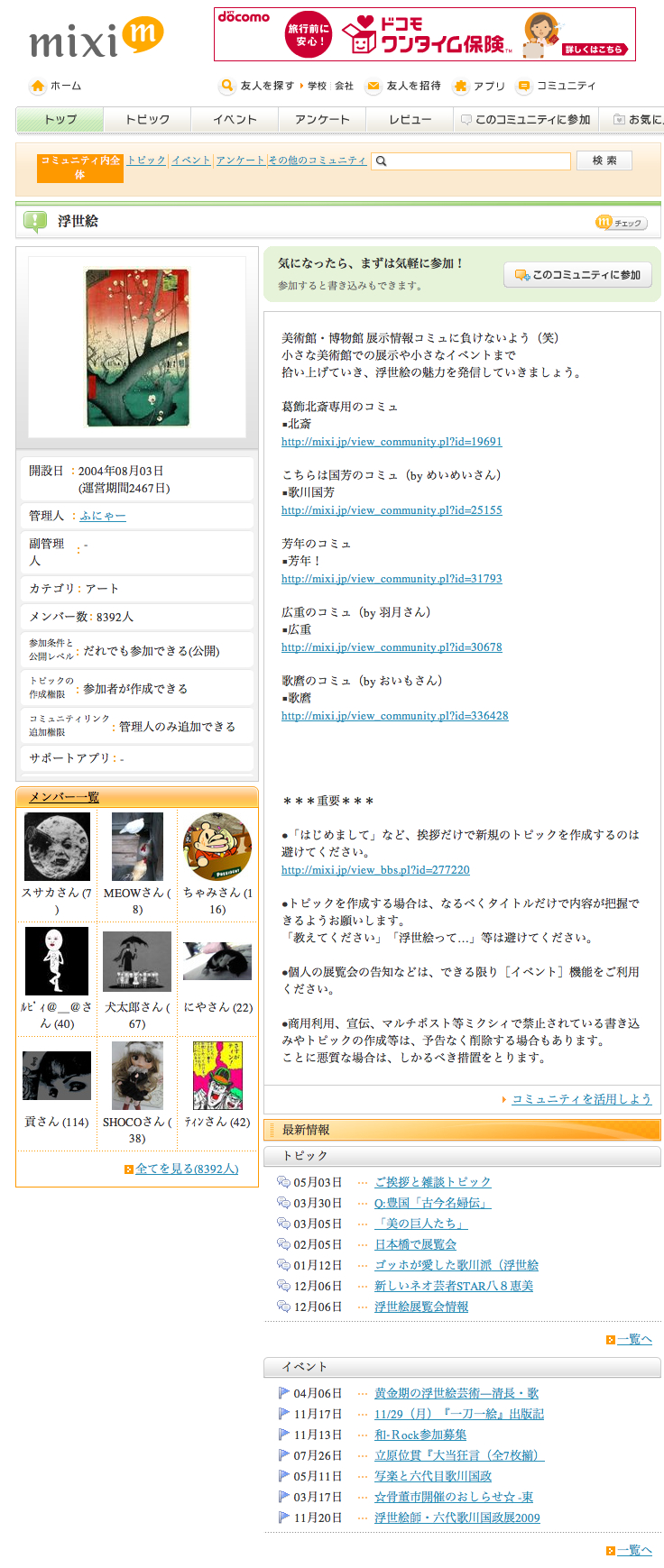
As seen in the screen capture to the right, with a simple search of ukiyo-e in the Community feature search bar, this ukiyo-e group was first on the results lists, boasting more than 8,000 members. Obviously, all of these members are not academic specialists, but rather users who just have a simple interest in ukiyo-e. However, it is more than likely that there are at least a few specialists within this community. By either replying in one of the topic discussions or creating one yourself, you can directly reach out to all the users involved in this community. Another useful tip would be to just message the community’s administrator and they should be able to at least direct you to a source or expert in whatever you are searching for. Just remember that not everything someone says on the Internet is a verifiable fact, so what you find should be a good starting point for your research, but not necessarily definitive information on the topic.

Twitter

Twitter is relatively new to Japan, having started its platform there in late 2008* (Asiajin). But since its inception, it has shown the most tremendous growth and increase in users among Japanese with an Internet connection. Twitter is ranked second only to Denmark with a penetration reach of 26.6% of its total Internet population* (comScore) and is second to only the United States with 18% of the twitter share market* (Semiocast). So what do these numbers mean? It simply means that a lot of Japanese people use Twitter and they use it quite often. With only a 140-character limit for a status update or “tweet” (more if using an additional client), Japanese users have been effectively using twitter to spread news and information within minutes of its occurrence.  This access of real-time information is Twitter’s strength that even the almighty Google has trouble competing with. Now, armed with a slew of celebrities and politicians, Twitter can directly connect you to people you never thought possible. Famous people in Japan like singer Hamasaki Ayumi (Twitter ayumi_19980408) and Softbank President Son Masayoshi (Twitter masason) are notorious for replying to their followers’ tweets.

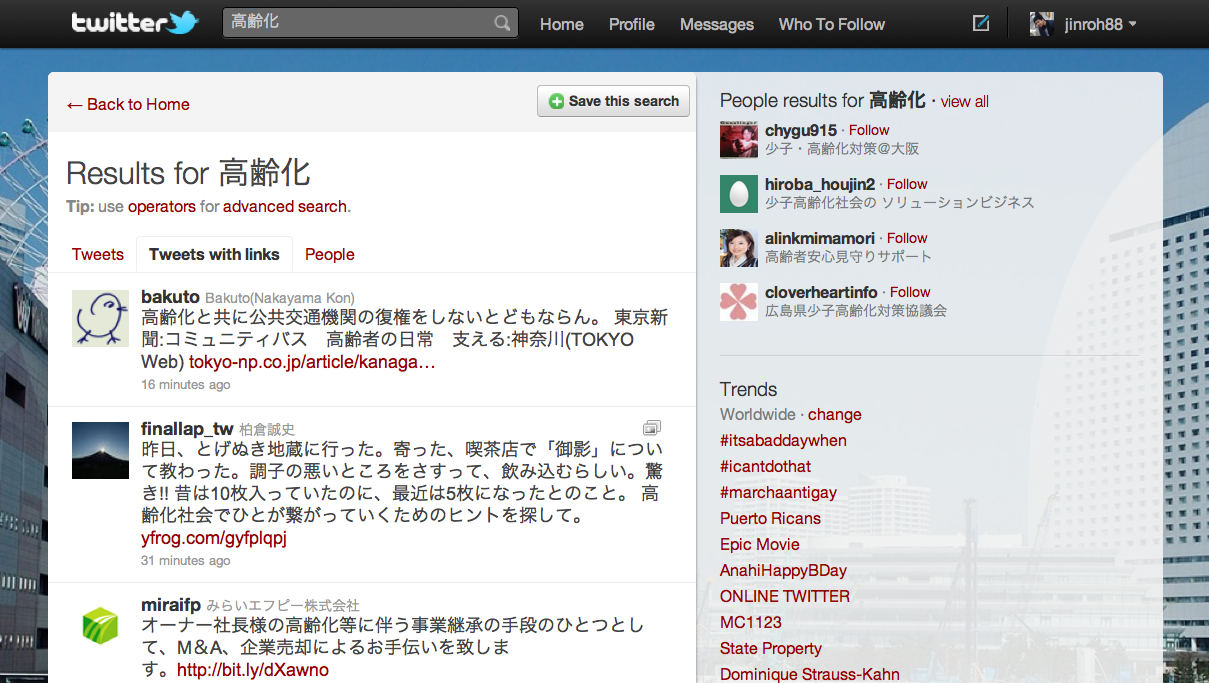
In the following screen capture, a search query for 高齢化 koureika (aging population) was entered and links to the latest news article on koureika was given. The first link from the results of the query under the “Tweets with links” section was an article about supporting the elderly with community buses in Kanagawa-ken geared specifically at the elderly. At the time this screen capture was taken, the article was only less than a couple hours old. This is a prime example of Twitter used as a resource for current/real-time information.

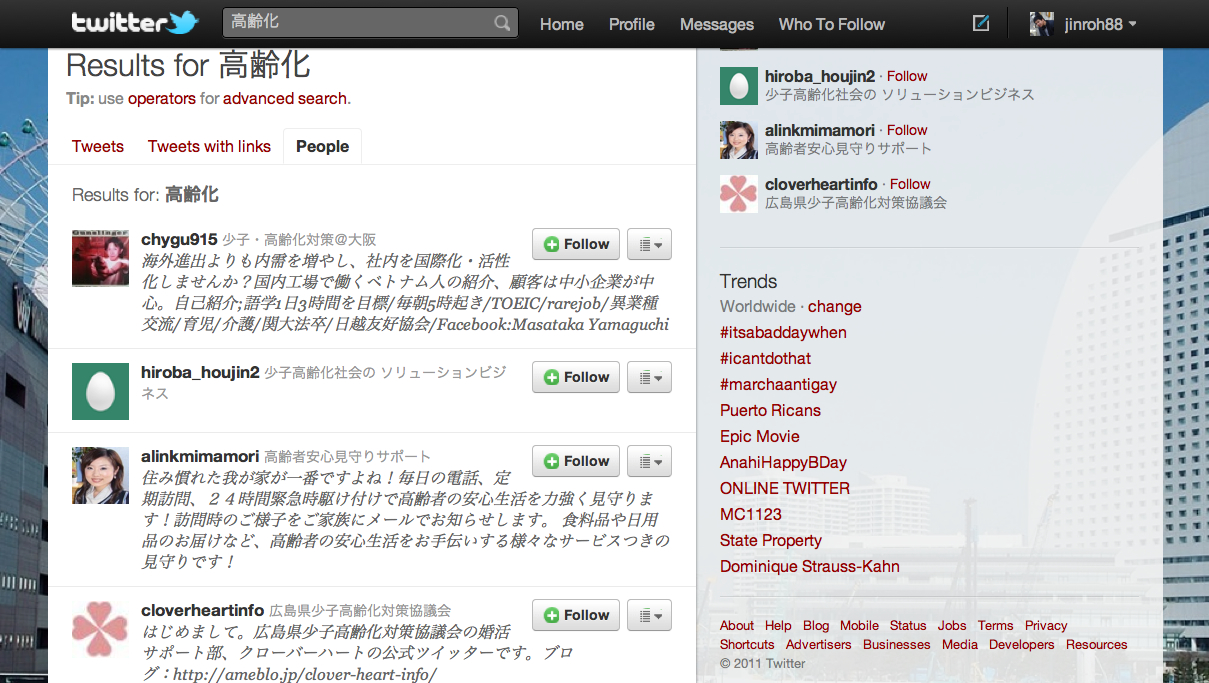
But if you are looking for something more than real-time information, Twitter can also be a useful resource that can directly connect you to primary and secondary sources of information. With the same search query for koureika, the subsection of “People” or “Who to Follow” shows some user profiles that actually deal with this subject. And these users aren’t only individuals, but groups as well (the group shown in the screen cap is Hiroshima-ken Shoshika Koureika Taisaku Kyoukai (the Hiroshima Prefecture Association for the Prevention of Declining Birthrate and Aging Population) . These users are definitely a source of information who can also direct you to other sources.

Hopefully, you can give these features a try and utilize them to your own advantage in Japanese studies. We know that the information is out there and available, but being able to access it in an effective way just makes one’s life more convenient. And with Japan’s social media environment expanding exponentially, connecting to that information is only a couple clicks away.

Chuck D. is a contributor for the website Tokyograph.com. Founded in 2006, Tokyograph.com is a news and information website dedicated to Japanese pop culture.

Posted in culture, graduate school, living abroad, main posts, social networking, study tools, undergraduate, useful links | Tagged , , , , , , , | 1 Comment

Job Opening: Associate Faculty Pool, Japanese Language

Detailed information and application form available at the West Valley-Mission Community College website (opens as a pdf). Via HigherEdJobs.com.

Institution: West Valley-Mission Community College District
Location: Saratoga, CA
Position: Japanese Associate Faculty Pool
Type: Part-time (adjunct)

FOREIGN LANGUAGE – Japanese
Associate Faculty Pool

The Mission College Foreign Language Department is seeking qualified instructors to serve as associate faculty to teach Japanese courses on a part-time contract basis. Applicants who possess the knowledge, skills, ability, and life experiences to address the cultural and educational needs of linguistically and culturally diverse student populations are encouraged to apply.

APPLICATION DEADLINE: Wednesday, May 25, 2011 5:00 P.M.

Job Number: 1011F045
Please put this number on the application.

ASSIGNMENT
Assignment may include day and/or evening classes, Mondays through Saturdays as needed during spring, summer, fall and/or winter sessions. This recruitment process is to pre-qualify you for possible future assignments. Successful completion will result in your name joining a pool of instructors qualified to teach Japanese courses in the Foreign Language Department at Mission College.

SALARY
Salary is based on a percentage of workload up to a maximum of 60% (percent). Salary is prorated based on a minimum salary range of $18,261 – $21,688; maximum earnable up to $29,559.

MINIMUM QUALIFICATIONS
– Master’s degree in the language being taught OR
– Bachelor’s degree in the language being taught AND Master’s degree in another language or linguistics OR
– Possess a valid California Community College Instructor’s Credential in A Foreign Language, Ancient or Modern OR
– The equivalent of the above. Degrees must be earned from an accredited institution. Candidates with degrees not identical to the required state or local qualifications must apply for equivalency by completing the equivalency form, which is part of the application package. This form must be completed for employment consideration.
– Candidates with foreign degrees must provide official certification of equivalency to U.S. degrees by a certified U.S. credential review service. Simple translation of the language on foreign diplomas, transcripts, coursework, or similar will NOT suffice; thus, will cause the application packet to be judged as incomplete.
– Demonstrated ability to effectively teach, counsel, or work with persons of diverse socioeconomic, cultural, disability and ethnic backgrounds.

DESIRED QUALIFICATIONS
– Experience in teaching Japanese language and culture preferably at a community college level.
– Bachelor’s or Master’s degree in a Foreign Language/Literature or equivalent.
– Teaching, training, and/or cultural life experiences, which enable one to teach, tutor, and mentor students from diverse language, cultural, ethnic, socioeconomic, or educational backgrounds. Applicants who possess the knowledge, skills, ability, and life experiences to address the cultural and educational needs of linguistically and culturally distinctive students as well as the traditional student.
– Ability to take an active role in working with faculty, student groups, and college support services, particularly within the Department and the Division.
– Solid knowledge of English, both written and spoken, is highly desirable.

DUTIES AND RESPONSIBILITIES
– Provide instruction for assigned courses. This includes preparation, in-class activities, evaluation of students’ work, consultation with students outside of class, maintenance of currency in the subjects taught and other efforts related to the teaching of the assigned classes.
– Maintain accurate class and other records conforming to state requirements and stated District and college needs.
– Submit, when due, all necessary reports such as attendance, grade reports, rosters and class schedules.
– Follow course outlines as filed in the appropriate instruction offices.
– Maintain office hours each week, at .5 hours per week per section.
– Observe, support and enforce the regulations, policies and programs of the District and college.
– Provide each student with a written course syllabus at the beginning of the course, as per instructions in the Faculty Handbook.
– Refer students to appropriate college sources for information on counseling and other student services.
– Assist students by providing advice on requirements for successful achievement in the member’s area of expertise.
– Work cooperatively and as a team player within the college’s Foreign Language Department and the college community.
– Foster an environment that protects academic freedom within the college community.
– Foster a positive working environment that is free from harassment, prejudice and/or bias.
– Demonstrate a respect for the dignity of each individual.

APPLICATION DOCUMENTATION
Documents to be considered for this position must be received in the District Human Resources Department, West Valley-Mission Community College District, 14000 Fruitvale Avenue, Saratoga, CA 95070-5698 (West Valley College Campus – Administration Building by Lot 4) on the date and time noted above.

REQUIRED DOCUMENTS

To insure fairness and consistency to all candidates, do not submit materials other than those identified below. Submit all application materials in the following order:
– A completed West Valley-Mission Community College District Academic Faculty Employment Application (see attached).
– A current, typed, detailed resume.
– A completed Supplemental Questionnaire (see attached).
– A completed Equivalency Form (see attached), if applicable.
– Legible copies of ALL college transcripts (BA, MA &PhD for disciplines requiring an MA degree; AA, BA, MA, & PhD for disciplines not requiring an MA degree) to verify all degrees earned and college coursework taken. Certified copies of transcripts will be required at time of hire. Copies of diplomas, grade reports, graduation petitions, transcript evaluation requests, or similar documents WILL NOT BE ACCEPTED IN LIEU OF TRANSCRIPTS.
– If applicable, U.S. Equivalency Certification for foreign degrees.
– A completed Personal Data Report Form (see attached).

NOTE: All required documents must be submitted with your application packet; otherwise, your application will be considered incomplete and will not receive further consideration.

OPTIONAL DOCUMENTS
– Copies of licenses and certificates you possess as related to this position.
– Voluntary identification form (for statistical purposes only and will be kept confidentially in the Human Resources Department).

APPLICATION INFORMATION
– Submission of complete application documents to Human Resources by the deadline is the applicant’s responsibility. Postmarks will not be accepted.
– Incomplete or late documents will not receive committee consideration.
– Application documents will not be sent to applicants or received by Human Resources via email or fax.
– All materials in your file become District property, will not be returned, and will be considered for this vacancy only.
– Current employees must provide documentation and materials in the same manner and degree of detail as any other applicant.
– If transcripts are required, include copies of ALL college transcripts with application packet to verify all degrees earned and college coursework taken. Please note: Certified copies will be required at time of hire.
– Copies of diplomas, grade reports, graduation petitions, transcript evaluation requests, or similar documents WILL NOT BE ACCEPTED IN LIEU OF TRANSCRIPTS.
– Foreign transcripts and degrees require official certification of equivalency to U.S. transcripts and degrees by a certified U.S. review service at the time of application.
– Un-requested documents, such as cover letters, letters of recommendation, and any other documents that are not specifically asked for under Required Documents, will be removed from the application packet.
– DO NOT STAPLE DOCUMENTS TOGETHER. USE A PAPERCLIP OR OTHER MEANS OF BINDING.
– Reasonable accommodations may be made to enable individuals with disabilities to perform the essential functions.
– West Valley-Mission Community College District will not sponsor any visa applications.

INFORMATION AND APPLICATION MATERIALS MAY BE OBTAINED FROM:

HUMAN RESOURCES
West Valley-Mission Community College District
14000 Fruitvale Avenue
Saratoga, CA 95070-5698
http://www.wvmccd.cc.ca.us/hr/

Posted in announcements, job openings, jobs | Tagged , , , , | Leave a comment

What’s new here at Shinpai Deshou?

As promised, we are slowly working on some renovations here at Shinpai Deshou, with more expected as we get fresh content ready for your over the summer. Here’s what’s new this week:

  • We’ve made minor updates to our “About us” and “FAQ” sections.
  • We fixed a minor bug in the design so our parent dropdown menus don’t have annoying links to nowhere! (that was bugging the heck outta me)
  • We have a new look! If you look at our articles via your Google Reader or email subscription, come on down to the main page and see the new big banner, wider content area, and expanded menu.
  • We added new menu options, namely a place for Fun Link Friday articles, and our “Posts” section is now renamed “Articles” (something the width of our old menu wouldn’t allow!).
  • Our Funding section is now conveniently organized into “Graduate/Professionals” “Undergraduates” and “Summer Study/Research” funding sections to help you navigate financial opportunities without clicking every link. We’re still thinking of ways to refine our categorizing system to make this more specific, but little steps to start!
  • We also added topical subcategories “By Field” in our “Study Resources” menu to make navigation easier.

That’s it for now! Hope these make your browsing experience a little better. There’s more to come and we’re working on planning out some future content, so look forward to more great things soon! If you have any comments or suggestions, leave us a comment here on the site or feel free to email us at shinpai.deshou@gmail.com. 🙂

Posted in announcements, site maintenance | Tagged | 2 Comments

Conference Announcement: “The Early Modern ‘Medieval’: Reconstructing Japanese Pasts”

General announcement aside, this looks like an *amazing* conference (although as a medievalist and a future PhD student at Michigan, I’m a little biased…). Be sure to save the date!

—

Location: Michigan League, the University of Michigan, Ann Arbor, Michigan
Dates: October 6-9, 2011

In the early seventeenth century, Japan entered a period of prolonged, relative stability under the dominion of the Tokugawa shoguns and other regional lords. This sustained period of peace, usually known by scholars as “early modern,” lasted until the mid-nineteenth century, and witnessed revolutions in printing, literacy, consumer culture, and scholarship in countless fields. The artifacts of this whirlwind of production were particularly shaped by their creators’ need to legitimize their present by reviving and revising motifs from earlier eras. Creators drew heavily from the period known to scholars as “medieval Japan” (c.1200-1600). Writers and artists across early modern Japan appropriated medieval terminology and reinterpreted the words and images to fit their own political, artistic, or social-economic agendas. These projects reconstructed the history of medieval men and women of all walks of life—from samurai to outcastes, from pirates to merchants, and from warrior monks to tea masters.

The chronological division between medieval and early modern times in traditional periodization reflects the actual transition of the country from war to peace. But the division between periods has also had the effect of impeding connections in pedagogy, research, and publication across the chronological boundary.  Scholars today on either side of the medieval-early modern divide share only rarely their sources or interpretations with each other.  Japanese academic institutions maintain a discrete section for each of the two periods.  As a result, relationships between the materials produced in each period have often been overlooked. Potentially more dangerous than the shape these particular chronological fields have taken is the impact this split has had on how modernity is understood.  Modern Japan unwittingly and uncritically claims itself to be the heir of an early modern that in fact projected imaginary histories onto its past in order to fit early modern agendas.

This conference features keynote presentations by Professor Kurushima Noriko of the Historiographical Institute, University of Tokyo, and Professor Umezawa Fumiko of Keisen University; and panel presentations by Professors Kevin Carr, Thomas Conlan, David Eason, Suzanne Gay, Thomas Keirstead, Morten Oxenbøll, MorganPitelka, Eric Rath, Peter Shapinsky, David Spafford, Hitomi Tonomura, Melanie Trede, and Reinhard Zöllner. In addition, each speaker will offer a short presentation of the primary source that was used to formulate her/his argument.

The conference is open to the public. More details to come soon. Save the date!

Posted in announcements, conferences, social networking | Tagged , , , , , , , , , | Leave a comment