SECAAS prize competition announcement​

The Southeast Conference of the Association for Asian Studies (SECAAS) announces two annual prizes for scholarly excellence in Asian Studies: the SECAAS book prize and the SECAAS article prize.  For the 2011 competition, nominated works must bear a 2010 copyright date.  Nominations should be made directly by the author, who must be a member of SECAAS.  Books and articles nominated may address contemporary or historical topics in Asian Studies in either the social sciences or humanities.  Translations from an Asian language into English are eligible only if they include a substantial introduction, annotation, and critical apparatus. Multi-authored collections of essays will be considered for the books prize only if there is substantial involvement by multiple SECAAS members: individual essays should be nominated for the article prize.  Nominations for the article prize (essays of less than 15,000 words) may be submitted via e-mail as a pdf file.  Please use “SECAAS Article Prize” as the subject line.  Books should be submitted as hardcopy, except for volumes published only as e-books.

Authors should send one copy of each work nominated, clearly labeled as either “SECAAS Book Prize” or “SECAAS Article Prize” to each of the three members of the prize committee by October 1, 2011.

Mark Ravina, Department of History, Emory University, Atlanta GA 30322 histmr@emory.edu

Cheryl Crowley, REALC, Emory University, Atlanta GA 30322 ccrowle@emory.edu

Dan Metraux, Department of Asian Studies, Mary Baldwin College, Staunton, VA 24402-1500 dmetraux@mbc.edu

The recipients will be announced at the SECAAS annual meeting in Greenville SC on January 14, 2012.

Mark Ravina
Professor of History
Department of History
Emory University
Atlanta, GA 30322
404.727.4025
histmr@emory.edu

Posted in announcements | Tagged , , | Leave a comment

Job opening: Sociology: Full-time Position (Associate or Assistant Professor)

Institution Type:   Akita International University, Faculty of International Liberal Arts
Location:   Japan
Position:   Assistant Professor, Associate Professor

Sociology

Public University Corporation / Akita International University (AIU)

The Faculty of International Liberal Arts invites applications for a position in Sociology at the Full, Associate, or Assistant Professor rank beginning April 1, 2012.

Akita International University is a highly selective, public institution committed to liberal arts education, located in Akita Prefecture, Japan, in which the sole language of instruction is English. AIU enrolls 800 Japan-based undergraduate students and 200 short-term international exchange students from all over the world. 60 Japanese and international students enroll in the professional graduate school. For more information please refer to http://www.aiu.ac.jp/

Appointment will be made on a three-year, fixed-term contract basis, and is renewable up to two times subject to mutual agreement with the possibility of tenure. Salary is competitive, commensurate with qualifications and experience. The substantive field of specialization within Sociology is open. We are seeking experienced candidates with exceptionally strong research and teaching record, with Ph.D. degree or equivalent qualification in Sociology or a closely related field.

A successful candidate is expected to teach the following courses:

Sociology
Sociology of Globalization
Ideas and Theories in the Social Sciences
Research Methods in the Social Sciences

Applicants should send: (1) a cover letter, (2) Curriculum Vitae, (3) a statement of research and teaching interests, (4) a sample of three works including at least one extensive research article, and should arrange that three letters of reference are sent to:

Sociology Position Search Committee
c/o Division of Academic Affairs
Akita International University
Yuwa, Akita-city 010-1292 Japan
TEL: +81-18-886-5930
FAX: +81-18-886-5910

E-MAIL: positionaiu0809@aiu.ac.jp

Application materials can be sent by e-mail or fax, if the originals follow in regular mail. Those materials will not be returned and will be used for selecting a qualified candidate only.

Review of applications will begin September 1, 2011 and will continue until the position is filled. After screening, selected applicants will be invited to interview (including teaching demonstration) at AIU.  A round-trip airfare between Akita and the candidate’s residence will be paid.

Contact:

Sociology Position Search Committee
c/o Division of Academic Affairs
Akita International University
Yuwa, Akita-city 010-1292 Japan
TEL: +81-18-886-5930
FAX: +81-18-886-5910
E-MAIL: positionaiu0809@aiu.ac.jp
Website: http://www.aiu.ac.jp/

Posted in announcements, job openings, jobs, living abroad | Tagged , , , , , , , | Leave a comment

Book announcement: Cultivating Commons: Joint Ownership of Arable Land in Early Modern Japan

Philip C. Brown

Cultivating Commons challenges the common understanding of Japanese economic and social history by uncovering diverse landholding practices in early modern Japan. In this first extended treatment of multiple systems of farm­land ownership, Philip Brown argues that it was joint landownership of arable land, not virtually private landownership, that characterized a few large areas of Japan in the early modern period and even survived in some places down to the late twentieth century.

The practice adapted to changing political and economic circumstances and was compat­ible with increasing farm involvement in the market. Brown shows that land rights were the product of villages and, to some degree, daimyo policies and not the outcome of hegemons’ and shoguns’ cadastral surveys. Joint ownership ex­hibited none of the “tragedy of the commons” predicted by much social science theory and in fact explicitly structured a number of practices compatible with longer-term investment in and maintenance of arable land.

Exploring early modern society from the ground up, this work provides new perspectives on how villagers organized themselves and their lands, and how their practices were articulated (or were not articulated) to higher layers of administration.  It employs an unusually wide array of sources and methodologies: In addition to manuscripts from local archives, it exploits interviews with modern informants who used joint ownership and a combination of mod­ern geographical tools (hazard maps, soil maps, digital elevation models, geographic information systems tech­nologies) to investigate the degree to which the most common form of joint ownership reflected efforts to amelio­rate flood and landslide hazard risk as well as microclimate variation. Further it explores the nature of Japanese agri­cultural practice, its demand on natu­ral resources, and the role of broader environmental factors―all of which infuse the study with new environmen­tal perspectives and approaches.

Cultivating Commons will be welcomed by Japanese historians, those in other regional-national fields, and social scientists concerned with issues of resource management, economic development, and rural society.

PHILIP C. BROWN is professor of Japanese history at The Ohio State University.

http://www.uhpress.hawaii.edu/shopcore/978-0-8248-3392-3/

Posted in announcements | Tagged , , , , , , , , | Leave a comment

Fun Link Friday: Tokyo’s Themed Restaurants

Just when you think traveling abroad and experiencing a new civilization is a big enough of a culture shock, the Japanese whip out some new trick.  Behold, the themed restaurant.  The article is a bit dated, but I can testify that many of these places still are out there, waiting for you to become an active participant in your meal.

http://www.guardian.co.uk/travel/2008/nov/27/tokyo-theme-restaurants-japan-food

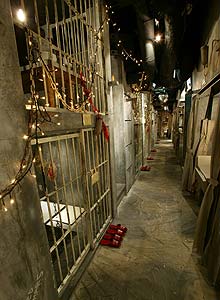
Alcatraz ER for all your prison dining needs...

My personal favorite is Alcatraz-ER.  The restaurant wraps around the second floor of a building tucked into a Shibuya back alley.  You go up the elevator only to be welcomed by noises considerably more intense than your typical haunted house.  If it had been open at the time I went, I have a feeling I’d have no choice but to go inside and be pleasantly terrified throughout my meal.  As luck would have it, this particular restaurant sticks to its haunting theme and opens after the sun goes down.  I ran to an Irish pub down the road instead and felt safe with my fish and chips.

However, come late October, when the air is crisp and the leaves swirl, I will head back for a proper Halloween feast.  Also, hoping to hit #1 “Wizard of the Opera” soon too…looks like Disneyland for grown-ups!

For more fun travel tips and wierd places to eat out in Tokyo, take a look at http://www.cnngo.com/tokyo.  This is easily one of my favorite segments on CNN when I’m at work.  It gives some pretty good ideas of what to do where and has completely motivated me to travel to Singapore… not like that was going to be a challenge.

Stop in at the Vampire Cafe for a Bloody Mary

Another article outlining some of the crazy theme restaurants in the Tokyo area is this list of five: http://www.cnngo.com/tokyo/eat/wild-weird-and-scary-tokyos-5-strangest-theme-restaurants-426893  which features some like “Ninja” and “Arabian Rock,” which all sound as equally cooky and worth a stop in just to say you did. Have any experiences at these theme restaurants or any others? Drop us a comment and let us know how crazy it was!

Posted in culture, fun links, living abroad | Tagged , , , , | 3 Comments

Call for Papers: 2012 Association for Asian Studies Annual Conference

Toronto, Canada    March 15-18, 2012

The Association for Asian Studies (AAS) would like to invite colleagues to submit proposals for the 2012 Annual Conference. The 2012 Annual Conference will be held at the Sheraton Centre Toronto Hotel in Toronto, Canada, March 15-18, 2012.

All proposals should be sent electronically through the AAS website.  Please make sure to review all instructions and guidelines carefully before submitting your proposals.

Click here to access the Call for Papers or go to http://www.asian-studies.org/Conference/2012-Call-for-Papers.htm

The deadline for proposal submission is Thursday, August 4, 2011.

We look forward to seeing you in Toronto!

Association for Asian Studies
825 Victors Way, Suite 310
Ann Arbor, MI 48108 USA
Tel: (734) 665-2490
Fax: (734) 665-3801
www.asian-studies.org

Posted in announcements, conferences | Tagged , , , , | Leave a comment

Job openings: Japanese embassy in Washington DC

There are two full-time positions available at the Embassy of Japan in DC and one unpaid internship available at the Japan Information and Culture Center (JICC).

Economic Section Administrative Assistant:

http://www.us.emb-japan.go.jp/english/html/econopen062711.html

Political Section Administrative Assistant:

http://www.us.emb-japan.go.jp/english/html/politicalopen062911.html

JICC Internship:

http://www.us.emb-japan.go.jp/english/html/Summer%202011%20Internship.pdf

If you are interested, please hurry and e-mail your application in! The deadline to apply for the position in the Economic Section and for the fall JICC internship is Friday, July 8th, 2011.

Posted in announcements, embassy, job openings, jobs | Tagged , , , , | Leave a comment

IUC Series: IUC-sponsored housing: Star Heights

Another guest writer, Alissa Murray was one of many students who chose IUC-sponsored housing during her stay in Yokohama at the Inter-University Center for Japanese Language Studies. We should have one more housing post on the way, followed by one on funding, so stay tuned!

—

Star Heights from the outside

When attending the Inter-University Center for Japanese Language Studies, one option for housing is to apply to stay in apartments found through the Center itself. During my year in Yokohama, I stayed in Star Heights, one of those Center apartments. If you’re wondering if the Center apartments are for you, here’s what you need to know:

Finding the Apartment

If you want to stay in one of the IUC apartments, you must apply fairly early; also be aware that, because Center apartments have much lower rent than average, there is usually a lottery to select who gets to stay in them. Signing up for the list is not a guarantee you’ll be selected. However, if you’re lucky enough to be chosen, all the hard work is done for you: the deals are made with the landlord/lady, and the apartment is ready to go whenever you choose to arrive. Almost all my utilities (except internet) were arranged before my arrival, and the house comes furnished there was no need to worry about furniture rental.

Pros: All the work is done for you – this is one of the easiest housing options.
Cons: No guarantee you’ll be selected in the lottery, and even if you are, you may not get your first choice of apartment.

The Apartment

Cooking area of the kitchen

Star Heights was an old building; on the rickety side, with thin walls and old appliances, and a little difficult to keep clean. The first floor did have some trouble with insects – though I lived on the second floor, and we had barely any. Once of the biggest advantages was the size, especially considering the low rent; there were two sizeable 6-tatami bedrooms, a small kitchen, a toilet and a nice, if old, shower/bath. Usually two Center students share the apartment, each taking one bedroom (I lived with my husband, so we used one bedroom as a living room; though each room has plenty of space for one person).

The other huge advantage of a Center apartment is that it comes furnished; ours had futons, sheets and blankets, new towels, chairs and tables, a TV and a fully supplied kitchen. The items are, like the apartment itself, generally old and a little flimsy – but they do the trick, and you don’t have to pay extra for them. There were functioning air conditioners/heaters in both rooms, and we were definitely glad for them at the height of both summer and winter, with the walls as thin as they were.

Because several of the apartments in the complex are reserved for Center students, Star Heights was one of two fairly common gathering spots for Center kids outside of the school– this is a great advantage for socializing and/or studying.

Pros: Spacious even when shared by two students; fully furnished; convenient location.
Cons: Not the newest or cleanest place once could choose to stay. Thin walls can make for noise and some trouble regulating heat.

The Neighborhood

The landlady lives right next-door, which is especially convenient for rent payment or if you have any questions or concerns. She wasn’t always easy to track down, but was always extremely helpful, and because she’s accustomed to Center students she’s attuned to, and understanding of, common troubles that foreign student renters may have.

The area comes across as suburban, though it is only 10 minutes from downtown Yokohama and 30 from Shibuya in Tokyo. There’s a fair amount of green, and mostly families live nearby. Aside from a few children the area is usually quiet and the neighbors friendly.

Within 5 minutes walk of the apartment are a train station, two grocery stores, two drug stores, a post office, a park, a water park, several little bars and a handful of cheap and tasty restaurants. There are also tons of little shops, which are open during the day and fun to peruse.

This isn’t, however, downtown; if you’re looking for restaurants, clubs, theaters, sight-seeing, or other evening/weekend entertainment, you’ll have to hop a train and look elsewhere; and if you’re out past midnight, you’re pretty much stuck out all night.

Pros: Quiet, nice area with all the basic necessities very nearby.
Cons: Not within easy walking distance of much else – you won’t find much going on here after 9 PM.

Transportation

The local train station is Myorenji Eki, on the Toyoko Line (which becomes the Minato-Mirai Line at Yokohama Station to the south). Trains arrive regularly, though Express trains don’t stop at Myorenji – you’ll have to go a few stops north or south to switch to one if you want it.

Myorenji is about 15 minutes away from Minato-Mirai Station (where the IUC is located); 10 minutes away from downtown Yokohama; and about 30 minutes away from Shibuya station in the opposite direction if you switch to an Express train. It’s an extremely convenient location, especially for those who plan to be in Tokyo often.

The only downside is that once the Toyoko Line becomes the privately-owned Minato-Mirai Line, the price of the fare nearly doubles, which makes this line more expensive than the JR lines used by many other Center students. You’ll definitely want to buy commuter passes (as much as a 6-month pass at once) to save as much money as possible.

Pros: Extremely convenient train line; there’s also a bus stop nearby.
Cons: The line is one of the more expensive available.

Expenses

Rent for my husband and I was 78,000 yen, or $700-800, per month. Usually that would be split between two IUC students, for closer to $400/month each.

Rent doesn’t include utilities – you’ll be receiving bills for your water, gas, and electricity separately. These are roughly comparable to the same bills in the States, depending on how much you use the heater, etc. Even with these included, it’s still the cheapest option available (other than a homestay).

Your internet costs will depend on the provider you choose. We set up hikari-fiber internet, one of the fastest available, and set it up to use a wireless router we brought from home. All five Center students staying in the complex then used the wireless, and we split the cost. This was a very cheap way to go, though the speed was highly unreliable at times.

Overall Impression: This is by far your least expensive option if you plan to stay in an apartment. The location is nice, quiet and convenient, you get to stay with other students, and the space is large and fully furnished. If you don’t mind an older, run-down space, it’s worth putting your name into the lottery for a Center apartment.

If you have any questions or comments, feel free to reply to the article below!

-Alissa

Posted in graduate school, housing, language schools, living abroad, main posts, program review, undergraduate | Tagged , , , , , | 10 Comments

Job Opening: History of Japanese Interactions with the World or History of Japan

Institution: International Christian University, Department of History
Position:   Assistant Professor, Associate Professor, Full Professor

The Department of History at the International Christian University seeks candidates for a full-time position at the rank of Assistant Professor or above in the history of Japanese interactions with the outside world, particularly, but not limited to Asia. The official job advertisement reads: “History of Japanese Interactions with the world or History of Japan, Asia.” The candidate should be able to lecture in English, but necessarily have research and speaking skills in Japanese. The deadline for applications is September 20, 2011 with the hope that the successful candidate may begin teaching from September 1, 2012.

Contact: Professor Kikuchi Hideaki
Chair, Department of History
International Christian University
3-10-2 Osawa, Mitaka-shi, Tokyo 181-8585, Japan
email: history@icu.ac.jp

Website: http://subsite.icu.ac.jp/gjg/KOBO/rekishie.html

Posted in announcements, job openings, jobs | Tagged , , , , , , , , , | Leave a comment

Opportunities for Scholars, Institute for Advanced Study, School of Historical Studies

Location:  New Jersey, United States

The Institute is an independent private institution founded in 1930 to create a community of scholars focused on intellectual inquiry, free from teaching and other university obligations. Scholars from around the world come to the Institute to pursue their own research. Candidates of any nationality may apply for a single term or a full academic year. Scholars may apply for a stipend, but those with sabbatical funding, other grants, retirement funding or other means are also invited to apply for a non-stipendiary membership. Some short-term visitorships (for less than a full term, and without stipend) are also available on an ad-hoc basis. Open to all fields of historical research, the School of Historical Studies’ principal interests are the history of western, near eastern and Asian civilizations, with particular emphasis upon Greek and Roman civilization, the history of Europe (medieval, early modern, and modern), the Islamic world, East Asian studies, the history of art, the history of science, philosophy, modern international relations, and music studies. Residence in Princeton during term time is required. The only other obligation of Members is to pursue their own research. The Ph.D. (or equivalent) and substantial publications are required. Information and application forms may be found on the School’s web site, http://www.hs.ias.edu, or contact the School of Historical Studies, Institute for Advanced Study, Einstein Dr., Princeton, N.J. 08540 (E-mail address: mzelazny@ias.edu ).

Deadline: November 1 2011.

Administrative Officer
School of Historical Studies
Institute for Advanced Study
Einstein Drive
Princeton, NJ 08540
Email: mzelazny@ias.edu
Visit the website at http://www.hs.ias.edu/Announcement12-13.pdf

Posted in announcements, study tools | Tagged , , , , , , , | Leave a comment

Book announcement: On the Front Lines of Forging a Global Society: Japanese and American Coworkers in Japan

by Adam Komisarof

As globalization advances and national borders become increasingly porous, Japan is now facing the human reality of these rapid changes: greater cultural diversity in the work force,which brings the concomitant challenge of how to integrate multicultural workers into their organizations of employment. Japan is also admitting foreign workers to compensate for a labor shortage as its retiree population grows and birth rate declines–thus intensifying the demographic shift towards greater numbers of long-term and permanent economic migrants.  To better facilitate this movement towards a more diverse society, it is critical to examine which factors have contributed thus far to creating smooth mutual acculturation processes for foreign workers and Japanese people vs. those which have not.

Therefore, the aim of this book is to assess the extent and manner in which the degree of compatibility of Japanese and American coworkers’ acculturation strategies affects their quality of intercultural relations (including job effectiveness), with the broader goal of building inclusive organizational spaces where both American and Japanese employees enjoy camaraderie, opportunities for advancement, and productive daily work lives.

On the Front Lines of Forging a Global Society contributes to both theoretical and methodological developments in the study of acculturation. On the theoretical level,revisions are made to the Interactive Acculturation Model, one of the premier theories in the acculturation field.  New ground is broken in methodology by using the Vancouver Index of Acculturation (a leading acculturation strategy assessment instrument) as a tool to characterize perceptions of cultural outgroup members’ acculturation strategies.  Furthermore, quantitative and qualitative methods are utilized to gain a more nuanced picture of the current state of American-Japanese intercultural relations and to generate numerous insights as to how they may be improved.

In the final chapter, practical advice is offered to cultivate betterJapanese-American intercultural communication. Therefore, this book is intended for not only acculturation researchers, but also for administrators, teachers, and business people interested in promoting more effective American-Japanese communication.  As the research findings are applicable to other cultural groups besides Americans (particularly Western ones), this work is also written for people from other nations who are curious about and/or professionally involved with Japan.  The author’s hope is that this volume will aid both researchers and practitioners alike in their quests to facilitate smoother intercultural relations between Japanese and Americans, as well as Japanese andother non-Japanese ethnocultural groups.

ADAM KOMISAROF is an associate professor of intercultural communication at Reitaku University.

ISBN 978-4-89205-602-4C3036
Reitaku University Press
http://www.rup.reitaku.jp/mokuroku/shoseki_215.htm 

Posted in announcements | Tagged , , , , , , , , | Leave a comment