IUC Series: 10-month program (Part 1)

We’ve already covered a variety of topics about the Inter-University Center for Japanese Language studies, including introductory information, apartments vs. monthly mansions, IUC-sponsored housing (Star Heights and Toriumi Haimu), and the summer program, but most students are interested in hearing the nitty-gritty details about the 10-month program that starts in September. How difficult is it? What’s the entrance exam like? What courses are offered? What can I expect? Can I do individual research while I’m there? These are all important and valid questions that the official websites do not offer in detail, partly because the content of IUC coursework varies somewhat from year to year. In the next two articles, I’d like to address my own experience in the IUC 10-month program and outline the coursework that was offered during the year. Part 1 of this article will discuss the entrance exam and quarters 1 and 2, and next week’s article will discuss quarters 3 and 4 and the final project/presentation. Enjoy!
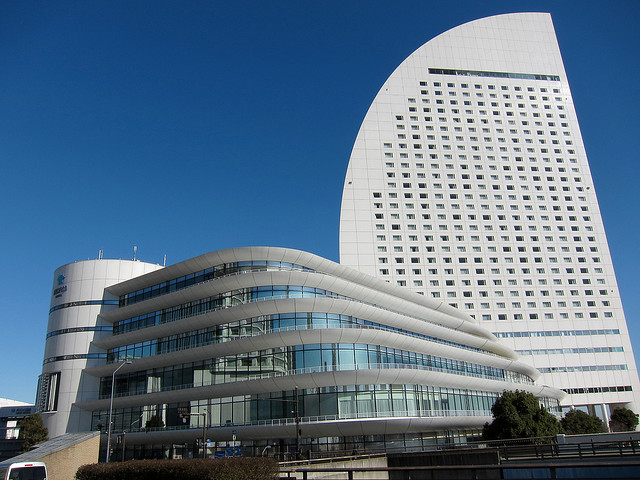
Photo by horschmology

For a broad description of coursework for the IUC 10-month program, you can look at the English-language website run by the Center here. As the site describes:

IUC’s 10-month, intensive program starts in September and ends in early June. Classes are conducted from 9:30 am to 3:00 pm, Monday through Friday. Wednesday afternoons are reserved for extra-curricular activities. The number of classes per week is reduced in the latter half of the program to accommodate the increase in specialized study and tutorial instruction. Students admitted to the Center should be prepared to devote themselves full time to language study. The workload does not leave time for dissertation research or for outside employment.

Classes actually begin at 10:00am, but you’re expected to come in around 9:30am to work on your kanji exercises. More on that later. There are roughly 6-8 students in each class. My year had the record-breaking attendance of 59 students total. Also remember that there is a language pledge—no English (or any other language) is to be spoken to teachers or classmates from the moment step into the Center until the moment you step out! 🙂

The Entrance Exam

Every student who enters the IUC 10-month program is given two packets of review materials one is expected to master before the entrance exam. The first of these packets includes basic grammar 基礎文法, basic verbs 基礎動詞, basic nouns基礎名詞, and basic kanji 基礎漢字, while the second is Basic Situational Japanese (a series of dialogues about daily life in Japan and the Yokohama area). You are expected to know all the materials in the first packet in order to take the exam (and function successfully at the same level as other students in your class!) and the second is more for your reference and general practice.
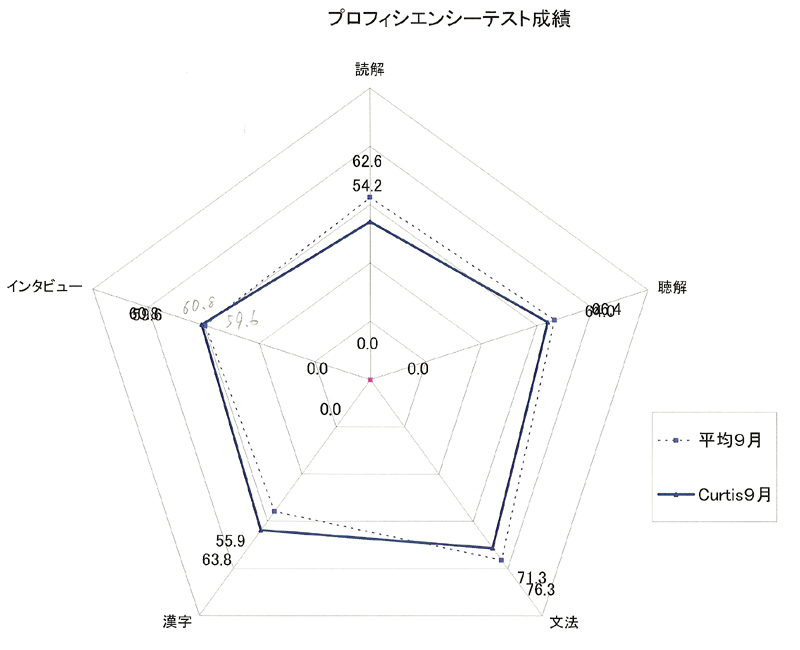
The exam itself is five parts and takes roughly three hours (with breaks) to complete. You are tested on grammar, listening comprehension, reading comprehension, kanji, and have an oral interview separately. There is also a one page take-home essay to evaluate your writing skills. The IUC then maps your results (you are not expected to get 100%!) on a 5 point spider web chart (seen on the right) that gives your own score along with the class average. My results were just below the class average, which placed me (as in the summer program) in the mid-level classes. When you finish the 10-month program you also take a substantially shorter exit proficiency exam that covers only listening comprehension, reading comprehension, kanji, and an interview.

The purpose of the entrance exam is to measure everyone’s proficiency levels in order to appropriately group students into classes as well as provide a baseline for judging improvement at the end of the program. As with the summer program, classes are divided roughly into lower, middle, and upper level groups (although you will not be told which one you are in) for grammar classes. However, this is no reason to panic! Part of the reason for separating students into these initial groups is to effectively mix things up later. As the program progresses, IUC challenges students by putting lower-level students in with mid-level, mid-level with high-level, etc. Plus, your electives disregard these separations entirely and you’re likely to have a class at least once with nearly every single person in the program. Also, regardless of how you’re grouped during one quarter for your grammar class, each quarter your professor and classmates will change for every course.

On the courses by quarter! Bear in mind that my descriptions are only meant as a rough template of the coursework at the IUC. Your individual experience will vary.

Quarter 1
(in my year, 9/7/09 – 10/30/09)

The focus of the first quarter of the 10-month program is building a foundation for the skills you’ll later use for more advanced work and research. Keeping in mind that how the IUC sets up classes is variable from year to year, here I’d like to go over my schedule.  In the morning, I had Grammar Review 文法復習from 10:00am – 10:50am and Formal Expressions 待遇表現from 11:00am – 11:50am.
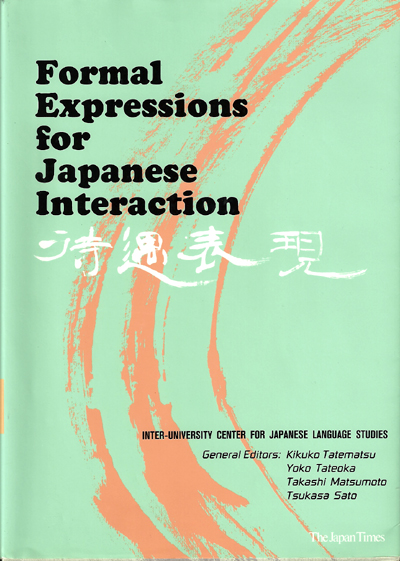
Most grammar classes* go through the entirety of the IUC textbook Introduction to Advanced Spoken Japanese, which covers everything from particles to causative-passive. Essentially, the textbook covers in a single volume what most English textbooks provide in their entirety (JSL 1-4, Yookoso 1-2, Genki 1-2, etc). Depending on what level class you’re in, the pace with which you move through this book will be different, but you will finish all of it so that all students can be said to have the same foundation to build on. You will also work with the formal expressions 待遇表現 textbook to learn honorific and humble phrases for everyday situations. This part of class involves a lot of memorization and role play and you’ll discuss variations on things you can say in formal situations (like calling a company to request a meeting for research) and in a pinch (like having an emergency and calling the IUC secretary to request that they pass a message along to your instructor about something). It’s very useful and during the first quarter my class covered chapters 1-10. You will have two intructors (or sometimes three) that rotate handling your morning classes.

*I’ve been told that the advanced classes did not use the ASJ book directly, but were given a folder that included excerpts from the book as well as other materials. They also may not have used the formal expressions text as much either.

For me, class content for the Grammar Review 文法復習and Formal Expressions 待遇表現 classes was as follows:

–          lessons from Introduction to Advanced Spoken Japanese textbook
–          speeches (1 person per day, 5-10 minutes) + discussion
–          daily ASJ grammar quizzes
–          daily listening quizzes
–          待遇表現 lessons
–          daily email/letter/role play/composition assignments due outside of class

At the end of the quarter, there is an exam on the Introduction to Advanced Spoken Japanese materials and待遇表現 materials.

Keep in mind that the content varies depending on how advanced your class is and whatever the teachers assign. I know that some of the higher classes had daily essays and speeches for pretty much everyone.

The afternoon class was Applied Japanese Skills総合運用1 from 1:30pm – 3:00pm. This class aims to familiarize you with comprehension of formal texts and materials, such as news articles and news reports. The class kicks off with an interview project where you are paired with someone else and assigned at random to conduct an interview of two IUC instructors, which you then have to report on later to the class as a mini-speech. Your afternoon instructor will be different than your morning professors.

In my 総合運用class, we focused on reading news articles and listening to news reports, and then had extensive discussions of the content. The goal was to become accustomed to the styles these materials are written in, expand our vocabulary, and improve our listening skills. We read personal essays, newspaper articles on disasters, watched videos and listened to audio clips on varying topics. Our class content was roughly as follows:

–          news articles
–          interview project
–          watch videos
–          listen to/watch news reports
–          daily vocabulary/kanji/grammar quizzes
–          speeches on news articles (5-10 mins) + discussion

Again, how the class is structured and run varies depending on the instructor. Mine liked to have students discuss the meaning of key vocabulary from articles with each other and do expanded projects with our mini article speeches. We read our speech reporting on a news topic out loud once, then gave handouts of the speech with vocabulary eliminated from the script in order to test the listening comprehension skills of the listeners. Based on what was heard, students asked the speaker what they thought the article meant, posing questions and attempting to fill in the blanks with vocabulary.

Quarter 2
(in my year, 11/9/09 – 12/22/09)

During the second quarter, students begin to delve more deeply into grammatical patterns and language usage. Three courses are offered: Conjunctive Expressions 接続表現, Integrated Japanese Advanced Course 1 統合日本語, and Applied Japanese Skills II.

The former two are your morning classes, again taught by a pair of teachers that rotate which days they teach. You use three textbooks, Conjunctive Expressions in Japanese, Integrated Japanese Advanced Course: Volume One, and Formal Expressions for Japanese Interaction (待遇表現). The conjunctive expressions course, especially, is incredibly useful, as it teaches you all the finer points of when and how to use connective words like それで、それから、そして、そうすると、ところで, and tons of others both formal and informal. I can safely say it was one of the most useful courses I had while at the IUC.

In the IJAC section, we worked on the following:

–          textbook lessons
–          speeches (2 people per day, 5-10 mins) + discussion
–          daily vocabulary quizzes
–          待遇表現 chapters 11-12
–          daily composition assignments due outside of class

Again, your individual class/teachers will vary the content. But the IJAC textbook is the first of two that will be used and is an excellent resource for advanced grammar explanations, contextual usage of vocabulary and grammar patterns, and the finer point of comparing similar patterns (the bane of every student of Japanese).

The afternoon class is, like in quarter 1, a course that focuses on practical applications of your Japanese with formal materials like news reports and newspapers. You’ll have a whole new set of teachers and classmates, and in my case we had three teachers that rotated during the week. We covered:

–          daily news articles
–          daily videos (listening)
–          speeches (1 person + discussion leader administering class)
–          weekly vocabulary/kanji quizzes

My class covered topics like how culture spreads and its impact on society, the education system, foreigners and citizenship, women and the workplace, and others. Each year teachers update the materials and may change it, so keep in mind that this is just an example.

SKIP

In addition to all of your work in class, the IUC expects you to engage in SKIP (Special Kanji Intensive Program) activities on your own time. Divided into 143 lessons that each have a quiz, you study kanji outside of class. The IUC website perhaps summarizes it best:

This program, pursued by students throughout the year, is one of the most important features of the Center program. Using the Kanji in Context Center texts, published by the Japan Times, students are able to systematically study the 1,947 kanji used in modern Japanese. The materials focus not only on the study of each individual kanji, but also on the vocabulary in which the kanji are used. The Center now has available a computer-based version of Kanji in Context which enables students to do highly efficient flash-card recognition of kanji/kana and students are exposed to a wide range of vocabulary throughout the year. By combining this with intensive study of individual kanji using Kanji in Context, students have the opportunity to totally master kanji before the year is over.

There’s a grading folder used to turn in your SKIP quizzes, which will be stamped each time you finish a lesson. Since you go at your own pace and it’s not graded, not everyone will finish SKIP (although it’s a very good idea to do it while you have the motivation in Japan!). Plus, once a month the IUC has an afternoon class used to review SKIP and ask questions about kanji, grouping students by the number of chapters they’ve completed.

—

Photo by Jixar

The first two quarters of work at the IUC are, some say, the most strenuous and difficult. While getting adjusted to life in Japan and life on the IUC schedule, you cover a very broad amount of material while learning (or relearning) things in depth and filling in gaps in your Japanese education. There’s a heavy emphasis on grammar, vocabulary and kanji, and, as you can tell from my lists of class responsibilities, a lot more speeches than you’re likely used to. These two quarters are meant to be very intensive to provide a solid foundation for your more individualized work in the second half of the program. If you apply yourself, you’ll definitely progress, and steadily at that. Just be careful not to burn yourself out!

I hope this was a decent introduction to what things are like for the first half of the IUC program. The next post on the 10-month program will have to do with the final two quarters (including elective and extracurricular courses!) and the dreaded final project.

If you have any questions feel free to leave a comment on this post or email us at shinpai.deshou@gmail.com. Also feel free to drop us a line to let us know you found this stuff useful. We like to know we’re helping you guys out! 🙂

Posted in graduate school, language schools, living abroad, main posts, program review, study abroad, study tools, textbooks, undergraduate | Tagged , , , , , , , , | 22 Comments

Call For Papers: Transnational Boys’ Love Fan Studies

TWC (Transformative Works and Cultures) Special Issue CFP: Transnational Boys’ Love Fan Studies (March 2013)

Edited by Kazumi Nagaike and Katsuhiko Suganuma, Oita University

http://journal.transformativeworks.org/index.php/twc/announcement/view/19

“BL” (Boys’ Love), a genre of male homosexual narratives (consisting of manga, novels, animations, games, films, and so forth) written by and for women, has recently been acknowledged, by Japanese and non-Japanese scholars alike, as a significant component of Japanese popular culture. The aesthetic and style of Japanese BL have also been assumed, deployed and transformed by female fans transnationally. The current thrust of transnational BL practices raises a number of important issues relating to socio/cultural constructs of BL localization and globalization.

Scholarly endeavors in relation to BL can be enriched by further research concerning the activities of transnational BL fans, fan communities, fandom, and the production of fan fiction. Most previous BL fan studies have remained circumscribed to Japan and North America. Therefore, in order to further develop transnational BL fan studies, we are seeking contributors who are engaged in the exploration of non-Japanese and non-North American contexts (e.g. Europe, the Asia-Pacific region, Africa, and others). Transnational BL fan studies may also be incorporated into the broader socio/political critical frameworks offered by studies in economics, gender/sexuality, race/class, and other areas.

We welcome submissions dealing with, but not limited to, the following topics:

1)      Case-studies and ethnographic examinations of BL fans, specifically examining fans’ sex/gender, age, occupation, class, race/ethnicity, et cetera.
2)      Local ethnographies relating to BL fans’ production, distribution, and use of these materials.
3)      Discussions concerning the ways in which broadly framed socio/political issues or forms of consciousness (e.g. gender/sexuality formations, authorities’ interference, censorship, and so forth) impact fans’ BL activities.
4)      Media and social responses to fans’ involvement in BL activities.
5)      Commercial aspects of BL and fans’ contribution to the development of BL economics.
6)      The integration of research on BL fans into a wider discussion of social theory, differing cultural discourses, and globalization.
7)      Discussions concerning the ways in which BL fans’ forms of production, distribution, and consumption might challenge traditional notions of Author, Reader, and Text.
8)      Theoretical overviews reflecting traditional/contemporary ideas of fandom, fans, fan communities, and fans’ means of communications, demonstrating how these ideas specifically relate to BL fans.
9)      Explorations of the ways in which BL participants are motivated to become involved in other fan-oriented activities (e.g. cosplay; female fans’ cross-dressing as male BL characters).

Submission guidelines

TWC accommodates academic articles of varying scope as well as other forms that embrace the technical possibilities of the Web and test the limits of the genre of academic writing. Contributors are encouraged to include embedded links, images, and videos in their articles or to propose submissions in alternative formats that might comprise interviews, collaborations, or video/multimedia works. We are also seeking reviews of relevant books, events, courses, platforms, or projects.

Theory: Often interdisciplinary essays with a conceptual focus and a theoretical frame that offer expansive interventions in the field. Peer review. Length: 5,000-8,000 words plus a 100-250-word abstract.

Praxis: Analyses of particular cases that may apply a specific theory or framework to an artifact; explicate fan practice or formations; or perform a detailed reading of a text. Peer review. Length: 4,000-7,000 words plus a 100-250-word abstract.

Symposium: Short pieces that provide insight into current developments and debates. Editorial review. Length: 1,500-2,500 words.

Submissions are accepted online only. Please visit TWC’s Web site (http://journal.transformativeworks.org/ ) for complete submission guidelines, or e-mail the TWC Editor (editor AT transformativeworks.org ).

Contact

We strongly encourage potential contributors to contact the guest editors with any inquiries or proposals:

Kazumi Nagaike, nagaike@oita-u.ac.jp
Katsuhiko Suganuma, suganuma@oita-u.ac.jp

Due dates

Contributions for blind peer review (Theory and Praxis essays) are due by March 1, 2012. Contributions that undergo editorial review (Symposium, Interview, Review) are due by April 1, 2012.

Posted in announcements, conferences, culture | Tagged , , , , , , , , , , | Leave a comment

Resource: National Diet Library Online Services

NDL

The National Diet Library (NDL) in Tokyo is an undeniably large resource with every new publication in Japan required by law to be stored there. While anyone over the age of 18 can apply for user registration and gain access to the library’s resources, for over 10 years the NDL has been developing its’ online services and galleries. NDL’s massive digitization project continues as content is periodically released on the website.

The main page user guides and several online features are bilingual, so non-Japanese language readers can access a part of the wealth of materials available online. For the most part the website is easy to navigate, but if you don’t know where to begin I suggest looking at the List of Online Services page. NDL’s digitized contents can be divided into 3 categories; (1)Primary information, (2) Secondary information, and (3) Electronic Exhibition.

(1)Primary information, such as Diet proceedings and legislation, is exclusively Japanese language only. The Digital Library from the Meiji Era has 172,000 of 514,000 digitized volumes available online. The catalog is not yet sorted into online volumes (copyright has expired) and volumes available only at the library, but NDL provides this page featuring notable updates to the internet archive. (such as late Meiji parodies of Natsume Sōseki’s I am a Cat or early crossword puzzles from the Taisho era)

(2) Secondary information and periodicals can be found by registered users with NDL-OPAC (Japanese only). Currently, NDL staff seem to be focusing on the digitization of primary information, so availability of secondary information without user registration is limited on the website.

(3)Electronic exhibits are one of the easiest features of the site to access. NDL currently has about a dozen online galleries available in English/Japanese, many relating to modernization and Japan’s history of international relations. The galleries serve as an informative introduction to a modern topic with supplemental original documents. Documents, photographs, paintings, and books are viewable online in high resolution. While you normally wouldn’t be able to do so without special permission, at an online exhibit you can turn the pages of some rare and treasured books, like this copy of Ise Monogatari from the 16th-17th century. In galleries such as the “The Japanese Calendar” there is an element of user participation. For example, there’s a quiz about reading the Daisho-reki calendar, which indicates long and short months in visually interesting ways.

It’s not possible to cover everything NDL’s website has to offer in one sitting, so I won’t even try. I’m still exploring new features. Most recently, a small part of historical recordings (Japanese only) no longer under copyright from the library’s vast collection were released. I was happy to find that an obon song (Aizu Bandai-san) I remember from my days living in Fukushima is among the recordings available online. If you’ve already browsed the electronic galleries, the quarterly NDL Newsletter also has selections and articles in English from 1997 to present.

If you are a student, researcher, or Japan enthusiast, even a quick look at what the NDL has to offer may lead to new discoveries or review of old material. I started out casually browsing for information about kabuki actors, but it can easily turn into several hours of unintentional fascination.

Links from the National Diet Library website.

Posted in fun links, graduate school, study tools, undergraduate, useful links | Tagged , , , , , , , , , | 1 Comment

Job Opening: Coordinator, Reischauer Institute for Japanese Studies

Via HigherEdJobs.com.

Institution: Harvard University
Location: Cambridge, MA

Type: Full Time
School/Unit: Faculty of Arts and Sciences

Duties & Responsibilities

Under the supervision of the Associate Director, the Coordinator works in close cooperation with the Institute staff.

The primary responsibility is Student Services: assists in selection, placement, and orientation of student interns, summer school students, and other students going to Japan, including info sessions, application processing, release forms and waivers, and some correspondence.

In addition, this position is responsible for office coordination: Orders and maintains office supplies, oversees telephone infrastructure, and manages student workers. Arranges orientations for visiting scholars and postdoctoral fellows, and guides them to appropriate resources.

Coordinating Events: Assists with scheduling, planning, and advertising events (sometimes via social media); coordinates venues, catering, and meeting materials. Attends Center events (including some evening events); handles logistics and ensures the success of the operation. Front-line responsibilities are required. Knowledge of Japan and Japanese language a plus. Other duties as assigned.
Basic Qualifications

3 years experience, advanced education may count towards experience.
Additional Qualifications
Bachelor’s degree preferred. Knowledge of Japan and Japanese language preferred. Three or more years of experience preferred, education may count towards years of experience.

Additional Information
All formal job offers will be made by FAS HR
Application Information
Contact: Please submit your resume and cover letter on line:
Harvard University
Online App. Form

Posted in job openings | Tagged , , , , | Leave a comment

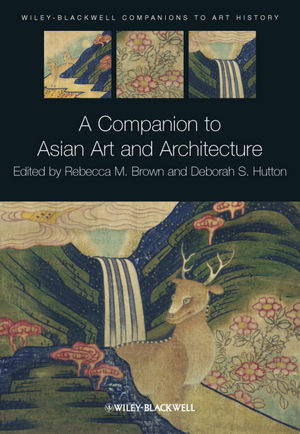
Book announcement: A Companion to Asian Art and Architecture

We are pleased to announce the publication of A Companion to Asian Art and Architecture, a collection of 26 original essays from a group of scholars across disciplines and representing a wide range of emerging research in this field. The introductory chapter and table of contents are available for pdf download from Wiley’s site.

http://www.wiley.com/WileyCDA/WileyTitle/productCd-1405185376,descCd-description.html

or

http://tinyurl.com/BCAA2011

A Companion to Asian Art and Architecture

Rebecca M. Brown (Editor), Deborah S. Hutton (Editor)
ISBN: 978-1-4051-8537-0
Hardcover
688 pages
May 2011, Wiley-Blackwell

A Companion to Asian Art and Architecture presents a collection of 26 original essays from top scholars in the field that explore and critically examine various aspects of Asian art and architectural history.

* Brings together top international scholars of Asian art and architecture

* Represents the current state of the field while highlighting the wide range of scholarly approaches to Asian Art

* Features work on Korea and Southeast Asia, two regions often overlooked in a field that is often defined as India-China-Japan

* Explores the influences on Asian art of global and colonial interactions and of the diasporic communities in the US and UK

* Showcases a wide range of topics including imperial commissions, ancient tombs, gardens, monastic spaces, performances, and pilgrimages.

Table of Contents:

Part I Introduction.
Part II Objects in Use.
Part III Space.
Part IV Artists.
Part V Challenging the Canon.
Part VI Shifting Meanings.
Part VII Elusive, Mobile Objects.

Rebecca M. Brown is visiting Associate Professor in the History of Art and Political Science at Johns Hopkins University, USA. Her publications include Gandhi’s Spinning Wheel and the Making of India (2010), and Art for a Modern India, 1947-1980 (2009)

Deborah S. Hutton is Associate Professor of Art History at The College of New Jersey, USA. She is the author of Art of the Court of Bijapur (2006), which received the American Institute of Indian Studies Edward Cameron Dimock Jr. Prize in the Indian Humanities.

Together, Rebecca Brown and Deborah Hutton have also edited Asian Art: An Anthology (Wiley-Blackwell, 2006).

Posted in announcements, culture | Tagged , , , , , , | Leave a comment

Announcement of Student Travel Award

The Early Modern Medieval: Reconstructing Japanese Pasts
October 7-8, 2011
University of Michigan

The organizers of the conference, “The Early Modern Medieval: Reconstructing Japanese Pasts,” are pleased to announce that we have secured funding for graduate students and advanced undergraduate students to travel to Ann Arbor, Michigan and participate in the conference, to be held October 7-8, 2011.

Recipients of this award will be reimbursed up to $1000 for travel and lodging expenses.  Student participants are invited to attend all panels, source workshops, discussions, and receptions.

A full description of the conference can be found below.

To Apply:

Applications will be accepted on a rolling basis beginning August 1. Final application deadline is September 1.

Interested students should send the following application materials to Peter Shapinsky (pshap2@uis.edu )

(1)     1-page CV with full contact information
(2)  250 word statement that explains how the theme of the conference fits in with her/his work
(3)  A short paragraph from her/his advisor that endorses the student’s interest.

Conference Description:

In the early seventeenth century, Japan entered a period of prolonged, relative stability under the dominion of the Tokugawa shoguns and other regional lords.  This sustained period of peace, usually known by scholars as “early modern,” lasted until the mid-nineteenth century, and witnessed revolutions in printing, literacy, consumer culture, and scholarship in countless fields. The artifacts of this whirlwind of production were particularly shaped by their creators’ need to legitimize their present by reviving and revising motifs from earlier eras. Creators drew heavily from the period known to scholars as “medieval Japan” (c.1200-1600). Writers and artists across early modern Japan appropriated medieval terminology and reinterpreted the words and images to fit their own political, artistic, or social-economic agendas. These projects reconstructed the history of medieval men and women of all walks of life–from samurai to outcastes, from pirates to merchants, and from warrior monks to tea masters.

The chronological division between medieval and early modern times in traditional periodization reflects the actual transition of the country from war to peace. But the division between periods has also had the effect of impeding connections in pedagogy, research, and publication across the chronological boundary.  Scholars today on either side of the medieval-early modern divide share only rarely their sources or interpretations with each other.  Japanese academic institutions maintain a discrete section for each of the two periods.  As a result, relationships between the materials produced in each period have often been overlooked. Potentially more dangerous than the shape these particular chronological fields have taken is the impact this split has had on how modernity is understood.  Modern Japan unwittingly and uncritically claims itself to be the heir of an early modern that in fact projected imaginary histories onto its past in order to fit early modern agendas.

This conference features keynote presentations by Professor Kurushima Noriko of the Historiographical Institute, University of Tokyo, and Professor Umezawa Fumiko of Keisen University; and panel presentations by Professors Kevin Carr, David Eason, Suzanne Gay, Thomas Keirstead, Morten Oxenboell, Morgan Pitelka, Eric Rath, Peter Shapinsky, David Spafford, Hitomi Tonomura, Melanie Trede, and Reinhard Zollner. In addition, each speaker will offer a short presentation of one primary source that was used to formulate her/his argument.

Organizers:

Hitomi Tonomura, University of Michigan (tomitono@umich.edu<mailto:tomitono@umich.edu)

Peter Shapinsky, University of Illinois, Springfield (pshap2@uis.edu)

Posted in announcements, conferences, financial assistance | Tagged , , , , , , , , , | Leave a comment

Job opening: Transnational Asian History, Assistant Professor

Institution Type:   University of Wisconsin – Madison, History
Location:   Wisconsin, United States
Position:   Assistant Professor of Transnational Asian History (tenure-track)

The Department of History at the UW-Madison invites applications for a full-time, tenure-track faculty position beginning August 2012 at the rank of Assistant Professor in transnational Asian history since 1500.

Applicants should hold a doctorate or anticipate its completion by the time of the appointment. Candidates should demonstrate evidence of creativity and excellence in research dealing with transnational exchange or interaction among cultures, societies, regions or states within Asia. Possible realms of exchange include, but are not limited to, intellectual, religious, economic, environmental, military, or political relations. The successful applicant will be expected to teach undergraduate and graduate courses in Asian history and to work closely with such allied programs across campus as the university’s Title VI National Resource Centers in South, East, and Southeast Asia.  The position itself forms part of a larger initiative supported by the Mellon Foundation to enhance the study of Asian history and culture at the UW-Madison.

Interested candidates should send hard paper copies of their letter of application, curriculum vitae, and a writing sample of approximately 50 pages, as well as three signed hard paper copies of letters of recommendation to Ms. Nicole Hauge, Transnational Asian History Search Committee, Department of History, University of Wisconsin-Madison, 3211 Mosse Humanities Building, 455 North Park Street, Madison, WI 53706-1405. We also request that you send PDF copies of your letter of application, curriculum vitae, and a writing sample of approximately 50 pages to historysearches@lists.wisc.edu. If the writing sample forms part of a larger book manuscript or dissertation, please include an abstract and table of contents or a statement of how the writing sample fits in with the larger project. Do not send electronic copies of letters of recommendation. For full consideration, complete applications must be received by November 1, 2010.

Preliminary interviews will be conducted at the American Historical Association Annual Meeting in Chicago. The UW-Madison is an equal opportunity employer and is committed to creating a diverse and inclusive community. Unless confidentiality is requested in writing, information regarding applicants must be released upon request. Finalists cannot be guaranteed confidentiality. A criminal background check may be required prior to start of appointment.

Contact:

Ms. Nicole Hauge, Transnational Asian History Search Committee, Department of History, University of Wisconsin-Madison, 3211 Mosse Humanities Building, 455 North Park Street, Madison, WI 53706-1405, historysearches@lists.wisc.edu.

Website: http://www.history.wisc.edu

Posted in announcements, job openings, jobs | Tagged , , , , , , | Leave a comment

Fun Link Friday! Miso, How it’s made!

Have you ever wondered what miso is actually made of? I eat miso almost every day and it occurred to me recently that I have no idea how it is made or what ingredients are in it. Miso is a culinary staple in Japan and it is widely known as a health food. I have heard that miso is good for your skin, it has anti-aging properties and it can lower your cholesterol. Four months ago, a Japanese grandmother swore to me that if I ate the miso she had been fermenting for five years, I would never catch a cold. I happily had a few bowls of the soup and so far so good. We’ll see what happens this winter.

So, what is in miso paste? I have not had the chance to make it myself but I have seen the process in action. Here is a list of the main ingredients from the JETRO (Japan External Trade Organization) website:

  • soybeans
  • rice
  • barley
  • koji: this is a fermentation starter. It is a mold that breaks down the starches in rice.

There are many variations of miso and lots of other ingredients can be added to enhance the flavor. Salt is commonly added as well as other kinds of beans and sometimes corn. According to the JETRO website, there are many types of miso, differing in their main ingredients, length of maturation, salt concentration, and other properties.

Here is a video that I think is a great introduction to how miso paste is made:

Miso paste can also be eaten in many different ways. It is best known for being the main component in miso soup. It can also be brushed on fish and grilled, used to flavor vegetables and pickles, and it is commonly used to make my favorite ramen, miso ramen. I encourage everyone to try this delicious and healthly Japanese staple in as many ways as possible! You won’t be disappointed!

—

Check out japingu’s J-Festa (blogging festival) for more great articles. This post was submitted as a part of the August “Food in Japan” theme!

Posted in culture, fun links | Tagged , , , , , , , , , | 3 Comments

Transcultural Asia: Pedagogies of Borrowing and Trading in Undergraduate Education

Location: Beloit College, Beloit, Wisconsin,United States
Symposium Date: September 23-24, 2011

Registration is now open for an Asian Studies Teaching Colloquium on Transcultural Asia: Pedagogies of Borrowing and Trading in Undergraduate Education. Both the colloquium schedule and the registration form can be accessed on the colloquium webpage. Proposals for poster sessions are still being accepted. These should be submitted to asintern@beloit.edu no later than August 31. The registration deadline for the colloquium is September 2. There is no fee for participation, nor for the two meals associated with the colloquium.

Elizabeth Brewer
Office of International Education
Beloit College
700 College Street
(608)363-2269
(608)363-2689
Email: brewere@beloit.edu

Visit the website at http://www.beloit.edu/oie/international_education/special_initiatives/asian_studies/

Posted in announcements, conferences | Tagged , , , , , , , | Leave a comment

IUC Series: IUC-sponsored housing: Toriumi Haimu

In our final article on housing, guest David C. writes about his experiences at Toriumi Haimu, one of the popular options for apartment rental through the Inter-University Center for Japanese Language Studies. If you have any questions, feel free to leave a comment or contact us at shinpai.deshou@gmail.com Enjoy!

—

Finding housing in Japan is a guaranteed adventure.  I have moved three times in my two years here and if I have learned anything, it is that the moving process can be long, frustrating and, above all, expensive.  Even for someone who is fairly well versed in Japanese, navigating the realty scene to find a place which has a good location, quality and price is no small task.  Thankfully, the Inter-University Center (IUC), understands this point and does its best to help students live in pre-furnished housing on short leases without any of the usual administrative “bull-poo”.  One such apartment complex is the Toriumi Haimu.  Toriumi is the last name of the owner and Haimu…well…that remains a mystery to this day. As a Haimu veteran, please allow me to introduce you to the wonderful, wubbulous world of, as the students affectionately call it, “The Haim”.

Administrative Matters

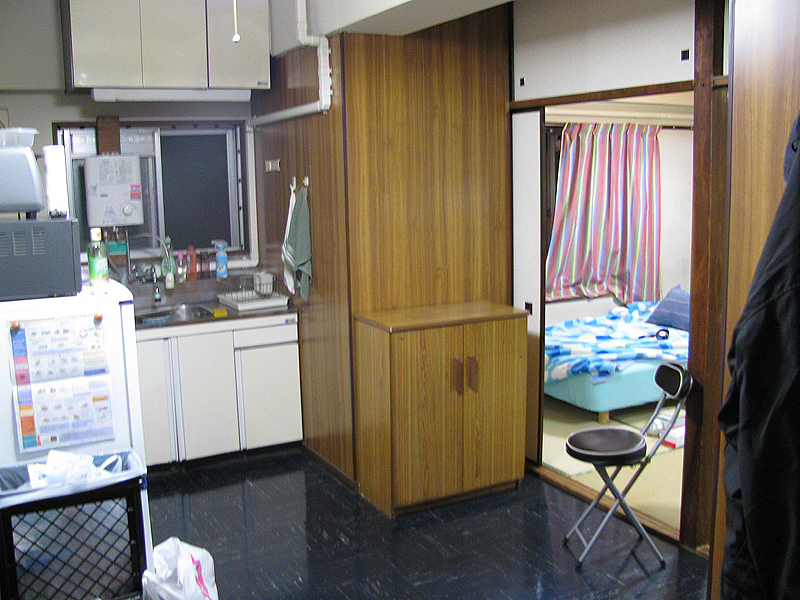
Very little to worry yourself about here. The rent, at least in 2009-2010, was 70,000JPY a month.  There is also a 2,000JPY furnishing fee. Due to generations of IUC students living in the rooms there is some discrepancy in what items are legacied into the different rooms.  For instance, some nice things I got were a bed, a large table and a very effective gas heater for those cold winter nights.  Other rooms got things like kotatsu, desk, desk chair, nice tv, etc. There is no such thing as a free lunch so you are expected to pay a bit for whatever furnishing your room happens to have.

One of the reason moving can be so expensive in Japan is that there are a variety of upfront fees. You can usually expect to pay your first month’s rent and then a security deposit, gift money, real estate agent fee and, if you contract to an outside agency to act as your guarantor, payment to them. These fees are normally 1 month’s rent, but sometimes they are two. Thanks to the IUC all you have to pay upfront is your first month of rent and gift money (1 month’s rent). Please note that this will have to be paid in cash.

After the initial payment you can expect to pay Ms. Toriumi through bank deposit. Ms. Toriumi does not live on-site, but her representative, Ms. Tamura does. Though I did not have much interaction with Ms. Tamura, other residents looked upon her as kind, somewhat benign, presence.  Any issues you may have should first be directed to Ms. Tamura and then, if necessary, it may be elevated to Ms. Toriumi. While most of the students living in the Haim had no quibbles with Ms. Tamura or Ms. Toriumi, one married couple were quite dissatisfied with the pair.  They had experienced a couple of gas leaks and felt that the ownership did not take the situation seriously enough. They eventually moved out and, although I am not aware of every detail of the situation, from what I understand, they seemed to be justified in their frustration. Utilities (gas, water, electric) were paid separately and, depending on your usage tended to be anywhere between 7,000 and 10,000 a month. I shared an internet bill with a few other residents so it only cost about 2,500.

Quality

The Haim is not a deluxe apartment in the sky. It is rather close the ground, rising only 5 stories, and is located on the very edge of one of Japan’s most notorious slums, Kotobukicho.  Before conjuring up images of Compton and people getting capped left and right, please remember that 1) Japan is one of the safest countries in the world and 2) the Haim is located on the border itself.  If you take a left out of the apartment you will hit a fancy bridal store in about 10 feet.  There are a number of homeless, basically harmless old men living in the area but it is almost a sure thing that you will have little to no contact with them or the occasional yakuza patrolling the area. Basically, living in the Haim is one of the easiest ways to get street cred without actually doing anything illegal, painful or otherwise foolhardy.

The building itself is fairly run-down. Built over 30 years ago, it shows its age. As with most cheaper Japanese accommodations (and even some not so cheap ones), it has no central A/C or heat, the water heat is gas powered (figuring out how to make the shower work is a rite of passage for all Haimu residents), the kitchen has a two burner gas range but no oven, insulation is poor, the kitchen is tiled, the living rooms are tatami and, yes, you may be visited by cockroaches and other endearing critters.

However, considering you will be getting a 2DK all to yourself (pairs are allowed if you are married or if you get the lone 3DK) and many of the other housing issues outlined above are moot, the inconveniences of age are perhaps worth it.  Generally speaking, the higher off the ground you are, the less chance you have of encountering bugs. I was on the 3rd Floor and I kept my apartment relatively clean. For the entire year I only spotted a few bugs. However, one of the other students on the 3rd Floor did have to wage a battle to reclaim his turf.

2DK is really a nice amount of space. In fact, several students would pool their resources to throw parties in the Haimu for the entire IUC and would, more or less, comfortably fit about 30-35 people in the room. The room was even able to handle 41 guests for a Thanksgiving dinner party so space, at least, should not be one of your concerns.

Utilities were generally less than 10,000JPY a month. I shared internet service with some of the other students so that helped to defray an otherwise costly item.

Location

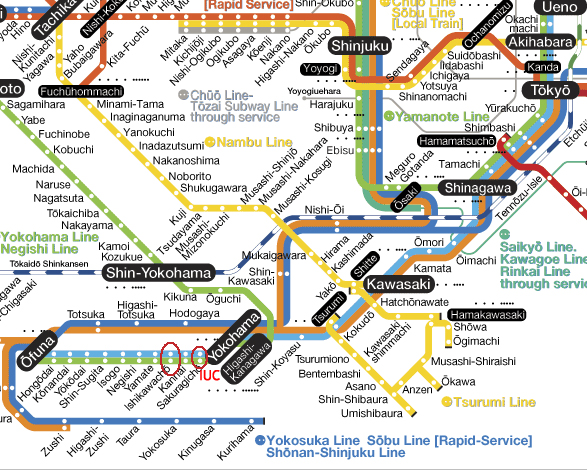
The nearest station is Ishikawacho (石川町) on the Keihin-Tohoku Line (京浜東北線). The KTL is the only line that goes through the station. To get the Yokohama subway line, you need to go to Kannai Station (10 min away), to get to the terminus of the Minato-Mirai/Tokyu-Toyoko line, you need to go to Motomachi Station (20 min away), to get the Yokohama rail line, you need to go to Sakuragi-cho (20 min walk, 4 min train) and to get to Yokohama Station with its bountiful line transfers you need to take the KTL for about 7 minutes.

It is about 45 minutes from Shibuya or Shinjuku in Tokyo, more like an hour to Ueno or Akihabara in Tokyo. While is Tokyo is certainly a good time, Yokohama is nothing to overlook. Ishikawacho is within 10 minutes of the following:

  • The largest Chinatown in Japan
  • Yokohama stadium, home of the Yokohama BayStars baseball team
  • Motomachi, a ritzy shopping district
  • Kannai, a fun area with tons of restaurants, bars and the like
  • Isezakicho, a more reasonably price shopping district, also with lots of restaurants
  • Sakuragi-cho/Minato-Mirai, a recently developed area with a variety of malls, movie theaters, shopping, restaurants and is known for hosting events ranging from Oktoberfest to Jazz Festivals to the recent APEC summit.

In terms of going out, Tokyo is always an option but Yokohama is no slouch when it comes to having a good time.

Intangibles

Living in the Haim is a little like living in a dormitory complex. There were 9 rooms for 12 people my year and it was nice being able to stop by and shoot the breeze between study sessions. We would also sometimes have dinner or even Sunday brunch together. If you are new to Japan, having a support network in close proximity can go a long way to easing into your new adventure.

At the same time, if you know the Japan-game and/or if you are a little bit more independent-minded, you may want to consider arranging your own housing and tailor it to your needs and tastes. Of course if you choose that route, you’ll want to come extra early to get everything set up before school starts. For experienced Japan-ites I would give the Haim a 77/100 grade but, for newbies, probably an 86/100.

Posted in housing, living abroad, main posts, program review, study abroad | Tagged , , , , , , , | 19 Comments