Fun Link Friday: Snow Monkey Relaxation

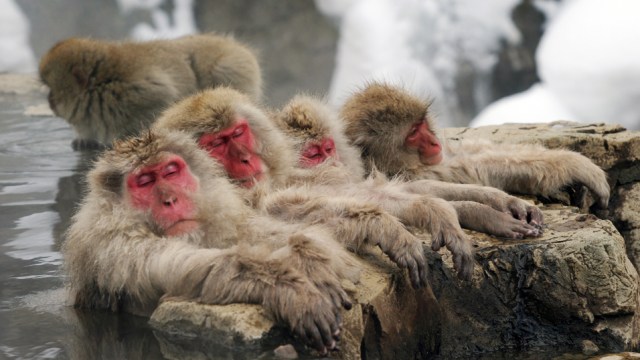
Are you feeling the weight of winter? Wishing there was a way to relax a bit and just hang? While many of us can’t travel to Japan right now, we can still appreciate those who are coping better with winter from afar. In particular, through May it’s snow monkey bathing season, and I always find it a delight to see these little guys letting all the stress of being a monkey melt away in a good bath.

There are a number of places throughout Japan where you can check out these onsen monkeys, like the Yunokawa hot spring in  Hokkaido or the Nagano Snow Monkey Resort.

But if you’re not satisfied with just watching reports on them or looking at cute photos (seriously, click the Nagano one!), there are also a couple places out there that livestream their monkey hot springs. Maybe you’ll catch a glimpse? Or at least you can take a cue on self-care from these little buddies and have yourself a nice bath to unwind this weekend! ♨️

Posted in culture, fun links | Tagged , , , , , | Leave a comment

Funding: KCC Japan Education Exchange Graduate Fellowships Program

Kobe College Corporation – Japan Education Exchange

GRADUATE FELLOWSHIPS FOR PHD RESEARCH IN JAPAN

The KCC Japan Education Exchange Graduate Fellowships Program was established in 1996 to support qualified PhD graduate students for research or study in Japan. The purpose of the fellowship is to support future American educators who will teach more effectively about Japan. One fellowship of $30,000 will be awarded. Applicants may affiliate with Kobe College (Kobe Jogakuin) for award year, if selected.

Completed applications and all supporting materials must be submitted to the KCC Japan Education Exchange email address: programs@kccjee.org no later than March 15, 2021.

For more information: https://www.kccjee.org/graduate-fellow-application-materials

Posted in announcements, financial assistance, funding, graduate school, study abroad | Tagged , , , , , | Leave a comment

Book Announcement: A Proximate Remove: Queering Intimacy and Loss in the Tale of Genji

A Proximate Remove: Queering Intimacy and Loss in the Tale of Genji
by Reginald Jackson (Author)

Open Access: June 2021

How might queer theory transform our interpretations of medieval Japanese literature and how might this literature reorient the assumptions, priorities, and critical practices of queer theory? Through close readings of The Tale of Genji, an eleventh century text that depicts the lifestyles of aristocrats during the Heian period, A Proximate Remove explores this question by mapping the destabilizing aesthetic, affective, and phenomenological dimensions of experiencing intimacy and loss. The spatiotemporal fissures Reginald Jackson calls “proximate removes” suspend belief in prevailing structures. Beyond issues of sexuality, A Proximate Remove contends that Genji queers in its reluctance to romanticize or reproduce a flawed social order. This hesitation enhances how we engage premodern texts and question contemporary disciplinary stances.

For more information: https://www.ucpress.edu/book/9780520382541/a-proximate-remove

Posted in announcements, culture | Tagged , , , , , , , , | Leave a comment

Fun Link Friday: Contemporary Ukiyo-e in Airbrush

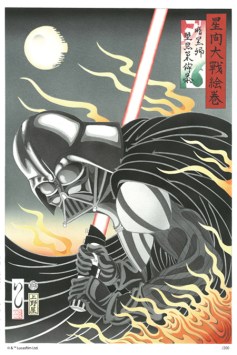
Here at Shinpai Deshou we’re no stranger to fun ukiyo-e-related news, whether it’s the chance to make your own mish-mashed print or see prints as animated gifs. Today’s fun link is to the works of a contemporary ukiyo-e artist, Ishikawa Masumi, who puts a modern spin woodblock traditions with airbrush art that mimics the ukiyo-e style.

We previously featured his tributes to David Bowie, but he popped up on our radar again in an article in the Japan Times from last year showcased his Star Wars chops, including this excellent Darth Vader (which to my mind kind of invokes Hokusai’s Ghost of Kohada Koheiji?). So who could resist highlighting this fun work again.

Expectedly, I rather enjoy his cat series, but that might be because as I type this I’m being gnawed on by kitten. I find the print to the left VERY relatable. What better way to end the week, I suppose!

You can check out Ishikawa’s works on his site or follow him on various social media to see what his latest works are like.

Happy Friday!

Posted in culture, fun links | Tagged , , , , , , , , | Leave a comment

Resource: Japan Biographical Database

Today’s resource is the Japan Biographical Database. This bilingual, interactive database is a network studies project run by a research unit of the Institute of Comparative Culture, Sophia University, Tokyo.

Focusing on early modern Japan, the participants have spent years cataloging information on individuals in historical sources, including their names, occupations, status, family or social relationships, events in which they participated, and more. Aiming to consider the larger networks of relations between individuals or groups in society, the project offers network analysis and geographic visualization tools to which that data can be selectively applied.

Digging into the database, it’s fairly straightforward to seek out a historical figure by their name (in kanji or in romaji), location, or birth/death, with simple data tables and a search function. You can also switch between perusing persons, events, or the sources from which information originated.
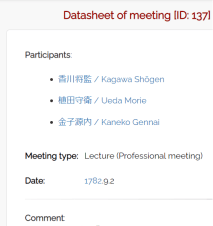
Clicking on an individual entry, you’ll find a breakdown of basic information from the database. The example to the left shows an entry for a lecture that took place in 1782.

For ease of use, each of the participants listed appears by both kanji and romaji versions of their names, and are linked directly to their individual “persons” entry so that it’s convenient to jump between connected people and their sites of interaction.

In the visualization suite section of the site you can play with different parameters to generate your own network analysis or map. There are a wide variety of options for your visualization, including person (by name, source, status, or occupation), the type of relationship to show (events, kinship, non-kinship), whether meeting or exchange will determine the connections, and what attribute (gender, status, occupation, place of birth or residence) should be used to highlight specific groups. In the example below, you can see that I randomly selected everyone with the surname Nakagawa to visualize.
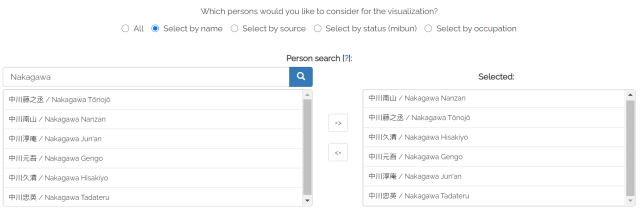
And after fooling around with some settings at random for the sake of getting a graph, I ended up with a large set of people with social connections!
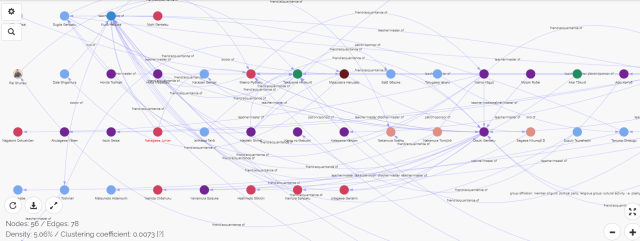
It will probably take some experimentation and reading on the site to fully master specific results that you make want, but the database itself is fairly easy to use and may just as well be interesting to poke around in.

At the bottom of the main page there is also a list of presentations, workshops, and associated publications about the project that can provide much more detailed information about the cool things that have been done with it and the construction of the overall site and its foundations. Anyone interested in digital humanities, network analysis, visualizations, and early modern Japanese history will find a lot of fascinating things here. Happy browsing!
Posted in graduate school, main posts, study tools, undergraduate, useful links | Tagged , , , , , , , , , | Leave a comment

Book Announcement: Exporting Japanese Aesthetics: Evolution from Tradition to Cool Japan

Exporting Japanese Aesthetics:
Evolution from Tradition to Cool Japan

EDITED BY TETS KIMURA & JENNIFER ANNE HARRIS

Exporting Japanese Aesthetics brings together historical and contemporary case studies addressing the evolution of international impacts and influences of Japanese culture and aesthetics. The volume draws on a wide range of examples from a multidisciplinary team of scholars exploring transnational, regional and global contexts. Studies include the impact of traditional Japanese theatre and art through to the global popularity of contemporary anime and manga. Under the banner of “soft power” or “Cool Japan”, cultural commodities that originate in Japan have manifested new meanings outside Japan. By (re)mapping meanings of selected Japanese cultural forms, this volume offers an in-depth examination of how various aspects of Japanese aesthetics have evolved as exportable commodities, the motivations behind this diffusion, and the extent to which the process of diffusion has been the result of strategic planning.

Each chapter presents a case study that explores perspectives that situate Japanese aesthetics within a wide-ranging field of inquiry including performance, tourism, and visual arts, as well as providing historical contexts. The importance of interrogating the export of Japanese aesthetics is validated at the highest levels of government, which formed the Office of Cool Japan in 2010, and which perhaps originated in the 19th Century at governmentally endorsed cultural “courts” at world’s fairs. Increased international consumption of contemporary Japanese culture provides a much needed boost to Japan’s weakening economy.

The case studies are timely and topical. As host of the 2020 Tokyo Olympic Games and the 2025 Osaka Expo, “Cool Japan” will be under special scrutiny.

For more information: http://www.sussex-academic.com/sa/titles/SS_Asian/kimuraharris.htm

 
Posted in announcements, culture | Tagged , , , , , , , | Leave a comment

Fun Link Friday: Food-inspired inks 🍜

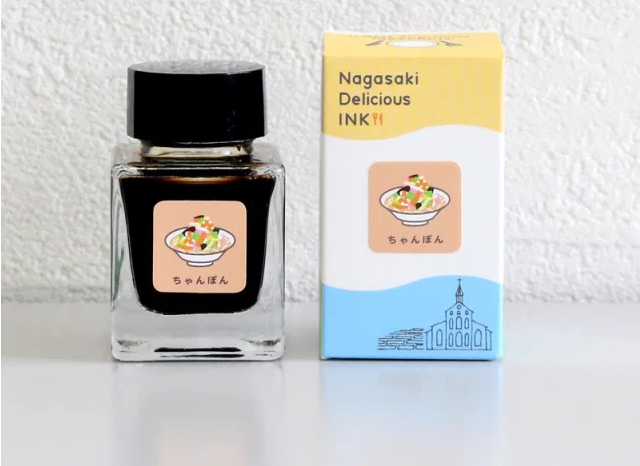
Just a quickie Fun Link Friday today, folks. In keeping with the love of food-inspired crafts from Japan, I was fascinated to come across SoraNews24’s recent exploration of stationery based on local foods of Nagasaki.

The one that particularly caught my eye was ink based on Nagasaki champon noodles, which I imagine makes it very tempting to lick the tip of your pen. Want to send a friend a homemade, savory-smelling postcard? Now is your chance! There are some great images on the site talking about the depth and color of the ink, in addition to its garlicky scent. Is the sweet, brown sugary castella ink just as good? Maybe it’s worth exploring the company’s main site to indulge your cravings! Happy Friday!

Posted in culture, fun links | Tagged , , , , , , , | Leave a comment

Book Announcement: Licentious Fictions: Ninjō and the Nineteenth-Century Japanese Novel

Licentious Fictions:
Ninjō and the Nineteenth-Century Japanese Novel
Daniel Poch

Nineteenth-century Japanese literary discourse and narrative developed a striking preoccupation with ninjō—literally “human emotion,” but often used in reference to amorous feeling and erotic desire. For many writers and critics, fiction’s capacity to foster both licentiousness and didactic values stood out as a crucial source of ambivalence. Simultaneously capable of inspiring exemplary behavior and a dangerous force transgressing social norms, ninjō became a focal point for debates about the role of the novel and a key motor propelling narrative plots.

In Licentious Fictions, Daniel Poch investigates the significance of ninjō in defining the literary modernity of nineteenth-century Japan. He explores how cultural anxieties about the power of literature in mediating emotions and desire shaped Japanese narrative from the late Edo through the Meiji period. Poch argues that the Meiji novel, instead of superseding earlier discourses and narrative practices surrounding ninjō, complicated them by integrating them into new cultural and literary concepts. He offers close readings of a broad array of late Edo- and Meiji-period narrative and critical sources, examining how they shed light on the great intensification of the concern surrounding ninjō. In addition to proposing a new theoretical outlook on emotion, Licentious Fictions challenges the divide between early modern and modern Japanese literary studies by conceptualizing the nineteenth century as a continuous literary-historical space.

For more information:

https://cup.columbia.edu/book/licentious-fictions/9780231193702

Posted in announcements, culture | Tagged , , , , , , , , , | Leave a comment

Fun Link Friday: Original Kanji Contest

Everyone knows that there’s nothing fun about the pandemic and it’s certainly been on all of our minds for months and months now. This past year Grape brought to our attention that there has been a contest for ten years+ to create original kanji reflecting our current times, and what times they are. The contest, titled 創作漢字コンテスト (Original Kanji Contest) is sponsored by Sankei Shimbun newspaper and The Shirakawa Shizuka Institute of East Asian Characters and Culture at Ritsumeikan University.

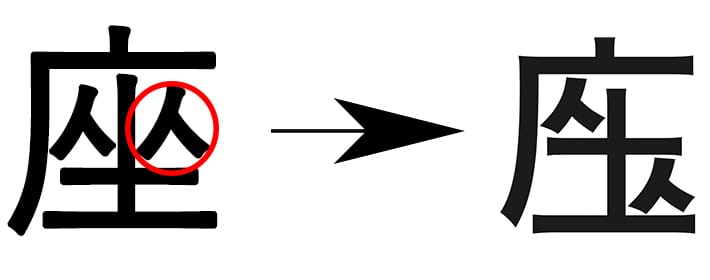
For 2020, undoubtedly one of the biggest topics in and outside of Japan was coronavirus and how it has affected our daily lives. And, appropriately, the winning entry of the original kanji contest was a modified version of 座:

As Grape writers described:

This new kanji still has the on’yomi za, but the kun’yomi has changed to: はなれてすわる(ソーシャルディスタンス)hanarete suwaru (sōsharu disutansu), meaning “to sit at a distance (social distance)”

Wen you consider that the etymology of the kanji 座 is “two people facing each other inside a house.” The genius of this new kanji is that the two people, each represented by the kanji for person 人, are no longer side by side. One of them has moved down beneath the line, which now functions as a partition. Simple, elegant, and very appropriate for 2020.

That said, there are many more kanji that are just as clever, and the contest website has a cool archive of past submissions and winners that you can check out! Any kanji lover will find a nice rabbit hole here to dive into. Happy Friday!

Posted in culture, fun links | Tagged , , , , | Leave a comment

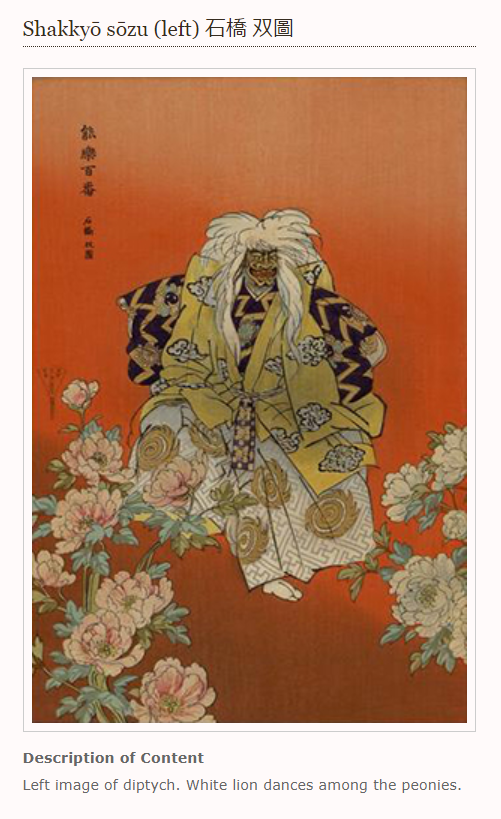
Resource: Tsukioka Kōgyo, 月岡耕漁 The Art of Noh, 1869-1927

When we think of woodblock prints, typically what comes to mind is early modern Japan, with its wealth of colorful kabuki prints and personalities. However, woodblock printing continued to be a rich and fascinating artistic practice long after, and kabuki theater was not the only performance at to be depicted throughout the centuries.

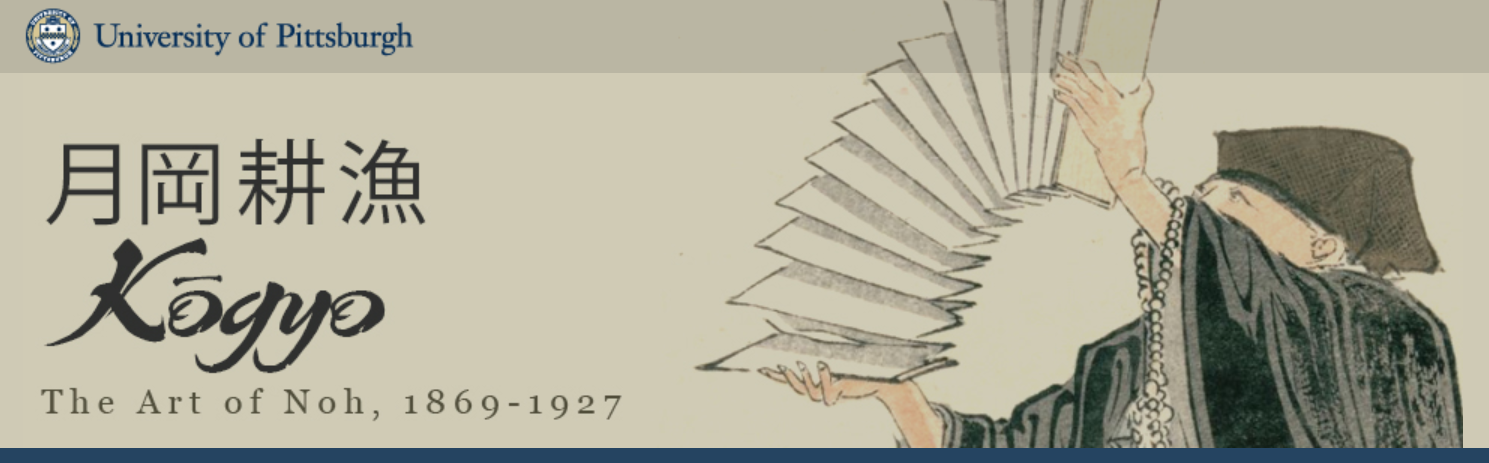
Outside of Japan, University of Pittsburgh holds the largest collection of Japanese color woodblock prints depicting noh theatre created by the artist Tsukioka Kōgyo (1869-1927). These works have been researched, digitized, and displayed on their own website, Kōgyo: The Art of Noh. This archive comprises four sets of print publications, Nōgaku zue (Pictures of Noh), Nōga taikan (A Great Collection of Prints of Noh Plays), Nōgaku hyakuban (Prints of One Hundred Noh Plays), and Kyōgen gojūban (Fifty Kyōgen Plays), which were all published between 1897 and 1930.

The site contains contextual essays for each published work as well as a general biography essay on the artist and even a translation of an essay that Kōgyo wrote himself, published in 1914. One of the strengths of the site, in addition to its abundance of digitized sources that adorn each page, is that there are also sections on the physical appearance of the publications such as the style of the books, measurements of paper, or methods of binding. There’s even information on where one can find other editions of some of the prints in other museum collections, which is useful for scholars hoping to do comparative work. The contextualizing essays also include more general information on noh theatre (such as the categories of plays), so non-specialists will enjoy browsing through the collection as much as those on a mission.

This project is the product of years of collaborative work, and will be useful to students, researchers, and enthusiasts for learning more about the history of performance, art, and printing in the early twentieth century. I highly recommend giving it a look!

Posted in culture, main posts, useful links | Tagged , , , , , , , , , , | Leave a comment