Volunteer Opportunity: Kyoto guest house and volunteer manager

via Idealist.org and Deep Kyoto.

The Japan Cat Network is “seeking responsible manager for our new Kyoto volunteer program, which functions in support of our animal welfare group. Position includes free shared housing in a lovely old Kyoto machiya, along with a small food stipend. This in exchange for coordination and scheduling of volunteers working in the Kyoto program; Managment of guest house check-ins and problem-solving; filling in for emergency gaps in volunteer schedule; help with coordination/support regarding local animal rescue cases; various admin tasks; and potentially teaching several children’s weekly English classes. Happiness required!”

To apply, contact Susan, via susan@japancatnetwork.org.

Photo from original Idealist.org posting.

Posted in announcements, job openings, jobs | Tagged , , , , , | Leave a comment

Book Announcement: Islands of Protest: Japanese Literature from Okinawa

Islands of Protest: Japanese Literature from Okinawa

Editors: Steve Rabson and Davinder Bhowmik

336pp. March 2016
Cloth – Price: $65.00
ISBN: 978-0-8248-3979-6

Paper – Price: $28.00
ISBN: 978-0-8248-3980-2

Via University of Hawai’i Press:

Literature is an important vehicle to further knowledge of other cultures, and English translations of Okinawan literary works have had a major impact on the field of Okinawan studies. Yet the riches of Okinawa’s literature have yet to be adequately mined. Islands of Protest attempts to address this lacuna with this new selection of critically acclaimed modern and contemporary works in English.

The anthology includes poetry, fiction, and drama, drawing on Okinawa’s distinct culture and subtropical natural environment to convey the emotions and tensions present in everyday life. Tōma Hiroko’s poem “Backbone” juxtaposes the natural environment of aquamarine beaches and subtropical flora and fauna with the built environment of America’s military bases. Stories by two of Okinawa’s most dynamic contemporary authors display wide breadth, from the preservation of island dances and burial practices in Sakiyama Tami’s “Island Confinement” and “Come Swaying, Come Swinging” to the bold, disquieting themes of violence and comfort women in Medoruma Shun’s “Hope,” “Taiwan Woman,” and “Tree of Butterflies.” The crown jewel of the anthology, Chinen Seishin’s play The Human Pavilion, is based on an infamous historical incident in which Okinawans were put on display during a 1903 industrial exhibition in Osaka. In his 1978 masterpiece, Chinen depicts the relentless pressure on Okinawans to become more Japanese.

Given the controversial presence of U.S. military forces in Okinawa, this book is particularly timely. Disputes between the United States and Japanese governments over construction of a new marine airbase at Henoko have led to the resignation of Japan’s prime minister, the election of an anti-base governor, and repeated protests. Islands of Protest offers a compelling entrée into a complex culture, one marked by wartime decimation, relentless discrimination, and fierce resistance, yet often overshadowed by the clichéd notion of a gentle Okinawa so ceaselessly depicted in Japan’s mass media.

Posted in announcements, culture | Tagged , , , , , | Leave a comment

Fun Link Friday: A See-Through Home

If you’ve studied Japanese architecture or watched Japanese period dramas (jidai geki 時代劇)you’ve probably noticed how sliding doors in manors could be opened to reveal an atrium to allow the occupants to be close to nature. The “Hiroshima Hut” modernizes that concept by creating what is essentially a glass house, where the world outside is your garden:

Hiroshima-Hut-Shade

[Image: a view of the Hiroshima Hut showing the door and another building viewed through the hut]

Photo © Toshiyuki Yano via ArchDaily

Suppose Design Office’s transparent house uses transparent acrylic for the walls. The blog for realestate.co.jp notes,

The wide eaves of the Hiroshima Hut are meant to encourage the residents to use the spaces inside and outside of the building in different ways according to the seasons and the hour of the day, blending their lifestyles into nature. The roof also has tapered edges. When viewed from a distance the roof appears to be paper thin.

Even better? The acrylic insulates the home, and in a country where insulating homes is not common, a major bonus.

Check out more about the home on realestate.co.jp and Arch Daily.


Posted in culture, fun links | Tagged , , | Leave a comment

Resource: Hachiman digital handscrolls

hachiman

Today we introduce a recently launched online resource, the Hachiman Digital Handscrolls site produced by scholars of Heidelberg University. This is a wonderful research tool for art historians, historians, literature specialists, and any other number of scholars. As stated on the website, the aim of this project is:

to enhance the digital presentation of long horizontal pictorial and textual formats, and render them available to a large audience. This objective was developed on the basis of the project leader’s research regarding the Karmic Origins of the Great Hachiman Bodhisattva. Seven Japanese illuminated handscrolls, created between 1389 and the nineteenth century, narrate the religiously, aesthetically and politically highly influential text and paintings.

The Karmic Origins of the Great Hachiman Bodhisattva includes narratives of the legendary invasion and subjugation of the Korean peninsula in the third century AD, led by the pregnant Empress Jingu, and the later manifestation of the deity Hachiman after her success. Numerous versions of this tale have been produced in handscroll format, which are presented in careful comparison here.

There are a great deal of fantastic elements to this website. Among them is the concise background on the scrolls and their history, provided in several sections in the right-hand navigation pane. This provides an uninformed reader with a great entrance into the Hachiman scrolls, complete with extensively cited resources for further reading, and an informed reader access to the present scholarship on the subject.

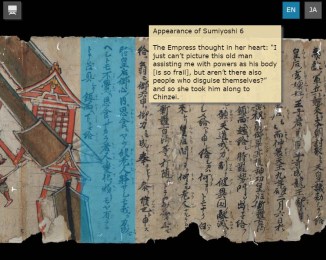
Next is the accessibility of high resolution images of these amazing handscrolls, which the viewer can easily navigate via the sizing and location tools at the top of the screen or the extended viewing bar at the bottom of the site, where you can move quickly through the full length of the image. The overhead navigation bar includes tagging features to switch to particular areas of interest, such as calligraphy, animals, architecture, etc., and quick-jump options between other handscrolls that contain the same scenes, making this an incredibly valuable tool for cross-comparison of different scrolls over the centuries.

hachiman2

Similarly, if you wish to search for a particular figure or key term, the search bar on the top right allows you to click freely between layers of the images relevant to your search.

hachiman3The convenient sidebar also offers the option to jump to annotations, which appear in a text bubble that pops up when the viewers mouse hovers over a particular section of the scroll. This makes the site also a useful tool for studying the calligraphic forms of the text itself if you are looking to brush up on your kuzushiji. Furthermore, it is possible to toggle between English-language translations and the original classical Japanese text included in the scrolls.

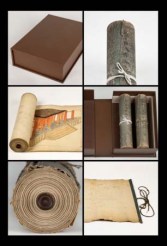
hachiman4Another great and usually underrated feature is that the option to see an exterior view of the scroll, meaning the viewer can observe the more material aspects of each item, such as the box, wrapping, frontispieces, etc. The location of and information on the collections in which each scroll is housed is also available, which is helpful for those who may wish to visit the piece in person where possible.

This site has a number of other wonderful elements that are too numerous to list here. The sheer volume of information, both textual and visual, is stunning, and it is very easy to lose yourself in this resource for a couple hours or more. Check out the original site for more and happy exploring!

Posted in blogs, graduate school, main posts, study tools, undergraduate, useful links | Tagged , , , , , , , | Leave a comment

Resource: Naha City Museum of History website

This is the first in a series of posts highlighting resources related to Okinawa. Building on a post from last year about the Okinawa Compact Encyclopedia, this series will touch upon online resources for learning more about Okinawan history, historical sites to visit, and Okinawan language, and resources for navigating life in Okinawa.

To begin, the Naha City Museum of History is a pretty incredible place. Its gallery space is quite small, and is tucked away on the 4th floor of the Palette Kumoji shopping center at Kenchômae in the Okinawan capital. But, don’t let the “city museum” name and appearance deceive you. The Museum is home to a massive collection of objects and documents, as well as a huge research library, and as I’ll touch upon a bit more below, the catalog of its holdings is easily accessible on the sleek website.

The highlights of the collection, from a museum visitor’s point of view, are the Historical Documents of the Shô Family Kings of Ryûkyû (Ryûkyû kokuô shô ke kankei shiryô 琉球国王尚家関係資料), a large group of documents, records, textiles, lacquerwares, swords, and the only surviving royal investiture crown, all of which together constitute a single “group” National Treasure. These objects are regularly rotated in and out of display in one gallery, while the museum uses the larger, neighboring space for exhibits on Okinawan history unlike anything I’d expect to see anywhere outside of Okinawa. I believe the last time I was there, the temporary exhibit was on prewar tourism and in particular the development of cruise lines, but other exhibits have covered topics ranging from the history of Naha City in poetry, to local festivals, the overthrow of the kingdom, post-war developments in tourism, and on and on. Though the exhibit catalogs are often quite thin, 15-20 page pamphlets, still, many of these are the best sources of information one can find on, for example, Naha’s bridges, or Naha’s scholar-aristocratic class, without turning to hefty & expensive academic tomes.

But the museum’s website goes even further, and does so much more. Firstly, many sections are available not only in Japanese, but also in English, Chinese, Korean, and Spanish. As one might expect, the site lists basic information about the museum (location, hours, upcoming exhibits), as well as lists of the museum’s publications. But it also includes a rather extensive “digital museum,” through which one can explore not only the museum’s collections of art objects, but also its archives of original historical documents, and library of some 33,000 secondary sources on Okinawa. I have yet to investigate accessing these archives or library in person, i.e. as a researcher, but even just searching online, I have found the Naha City Museum’s listings quite useful at times, right alongside those of CiNii, WorldCat, WebCat, and so forth, when trying to confirm that a book exists, to find out its author, year of publication, or the like. The listing for a book very often includes chapter titles, as well, which many other databases don’t, and which can be a lifesaver, when you’re trying to find essays in edited volumes, or just trying to figure out which topics a given book covers.

Returning to the other sets of archives, the collections include nearly 1,000 genealogies (kafu 家譜) of Ryukyuan scholar-aristocrat families, almost 20,000 historical photographs, and just under 1,500 other historical documents (komonjo 古文書), and I believe that’s not even counting those listed under several other collections, including the Shô Family Royal Materials already mentioned, and the Kabira Chôsei and Ie Udun collections.

As with the library listings, the vast majority of these archival pages are merely listings of basic collection information. Some actually provide a lot less information than I would have expected. For example, the record for one of the museum’s copies of the Ôshima hikki gives the “document code” and other collection information (so you can request the item from the archive, as a researcher visiting in person), the year and publisher of this modern reprinting, the number of pages, and some indication of the size and style of binding. It, surprisingly, says nothing of the original date or author (1762, Tobe Yoshihiro), or of the character or content of the item (the Ôshima hikki is a text by a Tosa samurai, recounting his encounters with a group of Ryukyuan officials who became shipwrecked or castaway in Tosa). Still, the sheer extent of the collections is incredible; I look forward to tackling the task of wading through them when I go to Okinawa to do my archival work for my PhD dissertation research next year.

There are also some number of objects for which images are available, and rather high-definition images, with a sleek, easy-to-use interface for zooming in and scrolling through them.

But, the museum’s website goes beyond its own collection, to include two more valuable resources – and despite the great extensiveness of the collection, it is for this reason that this website came to mind, in particular, to share here. First, there are a whole series of pages on the “History of the City, and of the Royal Court Culture” (王朝文化と都市の歴史). These include a lengthy chronology (年表) of significant events in Okinawan history; brief bios of every king of Okinawa/Ryukyu from the unification of the island under Shunten in 1187 to the overthrow of the kingdom during the reign of Shô Tai; and brief summaries of the history of the kingdom, the cities of Naha & Shuri within it, and the establishment of Okinawa prefecture (following the overthrow).

Lastly, and probably the bit I find the most exciting, the museum website includes an extensive list of officially recognized historical sites in the city, along with an embedded, interactive Google Map of all of them. If there’s an explanatory plaque at the site like the one below, placed there by the city (and in many cases, even if there isn’t a plaque), then the site is on this list. Many of the plaques are reproduced on the website, and some have additional information as well. You can browse through the list of sites by category (history, folk culture, historical figures, war sites, arts), or by location according to the former village/town/city, as Shuri, Mawashi, and Oroku were separate from Naha up until the modern period. This set of historical sites is a great resource in itself, without even visiting Okinawa in-person, as it includes so much information about the sites just on the webpage. I found this incredible useful, though, too, for planning out my touristy exploration of the city, as it lists out the modern street addresses of each of the sites, and often includes photos, making finding each site much easier.

A plaque on the former site of the home of Higaonna Kanjun, one of the first pioneers of the modern field of Okinawa Studies.
Posted in main posts, study tools, useful links | Tagged , , , , , , | Leave a comment

Book Announcement: The Orphan Tsunami of 1700: Japanese Clues to a Parent Earthquake in North America

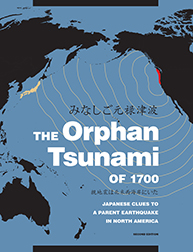
OrphanTsunami-Atwater-coverVia University of Washington Press.

The Orphan Tsunami of 1700: Japanese Clues to a Parent Earthquake in North America
BRIAN F. ATWATER, SATOKO MUSUMI-ROKKAKU, KENJI SATAKE, YOSHINOBU TSUJI, KAZUE UEDA, AND DAVID K. YAMAGUCHI
$30.00S PAPERBACK (9780295998084)
$90.00X HARDCOVER (9780295998091)
PUBLISHED: January 2016
SUBJECT LISTING: Science and Technology Studies
BIBLIOGRAPHIC INFORMATION: 144 pp., 8.5 x 11 in.
PUBLISHED WITH: US Geological Survey, Department of the Interior
CONTENTS

A puzzling tsunami entered Japanese history in January 1700. Samurai, merchants, and villagers wrote of minor flooding and damage. Some noted having felt no earthquake; they wondered what had set off the waves but had no way of knowing that the tsunami was spawned during an earthquake along the coast of northwestern North America. This orphan tsunami would not be linked to its parent earthquake until the mid-twentieth century, through an extraordinary series of discoveries in both North America and Japan.

The Orphan Tsunami of 1700, now in its second edition, tells this scientific detective story through its North American and Japanese clues. The story underpins many of today’s precautions against earthquake and tsunami hazards in the Cascadia region of northwestern North America. The Japanese tsunami of March 2011 called attention to these hazards as a mirror image of the transpacific waves of January 1700.
Brian F. Atwater, Musumi-Rokkaku Satoko, Satake Kenji, Tsuji Yoshinobu, Ueda Kazue, and David K. Yamaguchi pooled their backgrounds in geology, geophysics, forestry, history, and language.
REVIEWS

“The relevance of this history to our present-day situation is underscored. This book about the ‘big one’ of long ago should be of special interest to all of us right now.”-History Link
“A meticulous and comprehensive piece of scholarship that both draws on the authors’ groundbreaking research and pulls together hundreds of references on the topic. . . . The text is highly readable and requires no special expertise, only a scientific curiosity and a willingness to participate in the assembly of discovery.”-Oregon Historical Quarterly

“Paddling around the salt marshes and tidal flats of Washington State, Atwater discovered evidence of earthquakes and giant waves of a magnitude that seemed, to many, inconceivable-until late last year, when a tsunami of similar power tore across the Indian Ocean killing more than 200,000.”-Time Magazine, naming Brian Atwater one of the world’s 100 most influential people of 2005

Posted in announcements, culture | Tagged , , , , , , | Leave a comment

Workshop: Reading Kuzushiji and Hentaigana

call for papers [150-2]University of Pennsylvania

The Penn Faculty Working Group for Reading Asian Manuscripts will hold a three-day workshop on reading Edo-period hentaigana and kuzushiji August 17-19, 2016, and invites applications from faculty and graduate students from all fields of Japanese studies to participate.

The workshop will be led by Dr. Laura Moretti, Emmanuel College, University of Cambridge, and will meet each day from 9 a.m. to 5 p.m.  A key feature of this intensive workshop is hands-on experience with actual texts, graded by the instructor so that participants can achieve a working knowledge in reading Edo-period manuscript forms.  Please note that the materials used in this workshop will not duplicate those used in the Graduate Summer School taught by Dr. Moretti at Cambridge.

The workshop will be limited to 20 participants and will require a nominal fee of $100 from each participant; travel, accommodation and related costs are also the responsibility of the participants.

Applications should include a two-page curriculum vitae and a brief paragraph describing how the workshop will be of assistance to your research; graduate students should also include the name of their advisor as a reference.  All applications are due May 15, 2016, by 5 p.m., and participants will be informed by May 30 of acceptance; we will also keep a waiting list and notify additional participants on a rolling basis.  For more information, please contact Prof. Julie Davis (jndavis@sas.upenn.edu) or Prof. Linda Chance (lchance@sas.upenn.edu).

Posted in announcements, graduate school, study tools, summer program | Tagged , , , , , , , | Leave a comment

Fun Link Friday: Anatomical illustrations of Japanese Folk Monsters

Japan loves its ghost stories, and it especially loves the huge variety of supernatural creatures that feature in them. From handscrolls to ukiyo-e prints, artists have been bringing the spooky to life for centuries. This week’s Fun Link Friday is a series of illustrations posted on dangerousminds.net of anatomical depictions of monsters from Japanese folklore. Created by the famous manga artist Shigeru Mizuki in 1960, this series of illustrations brings to life these legendary creatures along with descriptions of their body parts and how they function.

makuraFor example, the “pillow-mover,” or makura gaeshi, seen on the right is described as having an organ in its body for storing the souls of children.

Dangerous Minds stated:

Mizuki’s monsters first appeared in a Japanese magazine as a part of a series of manga comics called GeGeGe no Kitarō but was deemed “too scary” for kids. [They were] adapted from traditional Kamishibai tales (the art of storytelling using paper scrolls) from the early 1930s…

These illustrations can be found in full in the book Yokai Daizukai, but you can go to the original article on dangerousminds.net for some more great illustration scans.

Happy Friday!

Posted in culture, fun links | Tagged , , , , , , , , | Leave a comment

Job Opening: Japan-in-Asia Cultural Studies, Nagoya University

job opening - 5Institution:       Nagoya University, Graduate School of Letters
Location:          Japan
Position:          Associate Professor or Full Professor, Japan-in-Asia Cultural Studies

Faculty Position Announcement

The Graduate School of Letters of Nagoya University in Japan is inviting applications for a position in “Japan-in-Asia” cultural studies. As a full-time faculty member, the person hired will be expected to perform duties associated with administration and teaching as well as research activities. We would appreciate it if you could circulate this announcement widely to the relevant individuals in your institution.

  1. Position title:
    Associate Professor or Full Professor (permanent contract)2.     Number of Positions:
    One position

    3.     Starting Date:
    October 1, 2016(negotiable)

    4.     Duties and Responsibilities:
    (1)    Teaching courses on cinema, literature and/or popular culture in “Japan-in-Asia” in Japanese.
    (2)    Teaching liberal arts courses in Japanese, or courses in the Japan-in-Asia Cultural Studies Program offered to international students and returnee Japanese students in English.
    (3)    Contributing to projects and operations of the Graduate School of Letters.
    (4)    Other administrative duties.

  2. Qualifications:
    (1)    Scholars who both involve research on the relationship between Japan and East Asian countries (especially Korea) AND can also teach courses on Film Theory, Literary Theory and/or Cultural Theory are particularly encouraged to apply.
    (2)    Applicants must hold a Ph.D. or have verifiable documentation of an outstanding academic career equivalent to or exceeding said scholarly achievement.
  3.  Salary and Benefits
    Salary and Benefits will be determined in accordance with the Nagoya University Employee Work Rules.
    Seehttp://www.nagoya-u.ac.jp/extra/kisoku/act/frame/frame110000115.htmfor details.
    (English translation: http://nutriad.provost.nagoya-u.ac.jp/docs/detail/?re=01&id=1489)
  4. Application Documents:
    (1)    Curriculum vitae (including email address and a list of academic achievements).
    (2)    Copies of three key publications. (Offprints and photocopies are acceptable. Mark these publications in the list of academic achievements.) Enclose 300-word (maximum) abstract of each paper and 800-word (maximum) abstract of each book or a Ph.D. dissertation.
    (3)    Statement of research and teaching interests (up to two pages).
  5. Deadline for Applications:
    Applications must arrive byApril 28, 2016.
  6. Send Applications to:
    Prof. Jun’ichi Sakuma
    Dean, the Graduate School of Letters, Nagoya University
    Furō-cho, Chikusa-ku, Nagoya, 464-8601, Japan
    (Application documents must be sent in an envelope marked in red with “Application Documents for Japanese Cultural Studies.”)
  7.  Selection Procedure:
    (1)  First screening: Short-listing through application documents
    (2)  Second screening: Interview with successful applicants of first screening. A short demonstration lecture in Japanese may also be requested. Applicants who live in Japan will be interviewed at Nagoya University. (Please note that the Graduate School of Letters will not bear the travel costs for interviews.) Applicants who live overseas will be interviewed via Skype.
  8.  Please Note:
    (1)  Applicants may be asked to provide additional information regarding their achievements during the selection process.
    (2)  Application documents and any personal information submitted will be used for the purpose of this screening only. In the case that a published book is submitted, it will be returned to the applicant.
    (3)  For further information and inquiries, please contact:
    Prof. Hideaki FUJIKI
    Graduate School of Letters, Nagoya University
    Furō-cho, Chikusa-ku, Nagoya, 464-8601, Japan
    Email:hfuji@lit.nagoya-u.ac.jp
  9. Other:
    Nagoya University promotes diversity in its faculty, and is currently engaging in the “Positive Action for Increasing Female Faculty Numbers (http://www.nagoya-u.ac.jp/about-nu/declaration/positive)”. We welcome and strongly encourage applications from female and international scholars.

Contact:

Prof. Hideaki FUJIKI
Graduate School of Letters, Nagoya University
Furō-cho, Chikusa-ku, Nagoya, 464-8601, Japan
Phone/Fax: (+81)52-789-2666
Email: hfuji@lit.nagoya-u.ac.jp

http://www.lit.nagoya-u.ac.jp/english/e-jobs/

Posted in announcements, job openings, jobs | Tagged , , , , , , | Leave a comment

Job Opening: Faculty Fellow in Japanese Religions

job opening - 5Institution:  University of California – Santa Barbara
Location:    California, United States
Position:     Faculty Fellow in Japanese Religions

The Department of East Asian Languages and Cultural Studies and the Department of Religious Studies at the University of California, Santa Barbara, seek to appoint a Faculty Fellow in Japanese religions, beginning on July 1, 2016. The fellowship has a term of one year, with the possibility of a one-year extension. It offers recent Ph.D. recipients (awarded between January 1, 2013, and June 30, 2016) a unique opportunity to develop their research and teaching interests within the Department of East Asian Languages and Cultural Studies and the Department of Religious Studies. The Faculty Fellow position is designed for a recent Ph.D. who has not held the rank of assistant professor. The Fellow will teach three courses during the academic year (normally one course per quarter, but different arrangements are also possible), including at least one lower-division, large enrollment course. The field of research is open, but we are especially interested in candidates working on premodern topics (medieval and/or Tokugawa periods). Candidates are expected to be familiar with premodern sources (in classical Japanese and kanbun), in addition to secondary sources in modern Japanese and other languages.

This is a temporary appointment. Fellowship award provides an annual salary of $50,000. The award also includes health, vision, and dental benefits, and up to $2000 for research-related and travel expenses. The selection committee will begin reviewing the applications on May 15, 2016. Applications, including a letter of interest, CV, syllabi of proposed courses, and two letters of recommendation, should be sent to the UCSB Shinto Studies Chair via UCRecruitathttps://recruit.ap.ucsb.edu/apply/JPF00697. Questions may be addressed to Professor Fabio Rambelli, at rambelli@eastasian.ucsb.edu. The Department of East Asian Languages and Cultural Studies and the Department of Religious Studies are particularly interested in candidates who can contribute to the diversity and excellence of the academic community through research, teaching, and service.

The University of California is an Equal Opportunity/Affirmative Action Employer and all qualified applicants will receive consideration for employment without regard to race, color, religion, sex, sexual orientation, gender identity, national origin, disability status, protected veteran status, or any other characteristic protected by law.

Contact:

Kelly Mellon

Department of East Asian Languages & Cultural Studies
Humanities Administrative Support Center – 4001 HSSB
University of California, Santa Barbara
Santa Barbara, California 93106-9670
P: (805) 893-3731 |  F: (805) 893-7671
kmellon@hfa.ucsb.edu | https://recruit.ap.ucsb.edu/apply/JPF00697

Posted in announcements, job openings, jobs | Tagged , , , , , , | Leave a comment