Book Announcement: Accounts and Images of Six Kannon in Japan

Via University of Hawai’i Press.

9780824856229Accounts and Images of Six Kannon in Japan
Author: Fowler, Sherry D.;

384pp. November 2016
Cloth – Price: $70.00
ISBN: 978-0-8248-5622-9

Buddhists around the world celebrate the benefits of worshipping Kannon (Avalokiteśvara), a compassionate savior who is one of the most beloved in the Buddhist pantheon. When Kannon appears in multiple manifestations, the deity’s powers are believed to increase to even greater heights. This concept generated several cults throughout history: among the most significant is the cult of the Six Kannon, which began in Japan in the tenth century and remained prominent through the sixteenth century. In this ambitious work, Sherry Fowler examines the development of the Japanese Six Kannon cult, its sculptures and paintings, and its transition to the Thirty-three Kannon cult, which remains active to this day.

An exemplar of Six Kannon imagery is the complete set of life-size wooden sculptures made in 1224 and housed at the Kyoto temple Daihōonji. This set, along with others, is analyzed to demonstrate how Six Kannon worship impacted Buddhist practice. Employing a diachronic approach, Fowler presents case studies beginning in the eleventh century to reinstate a context for sets of Six Kannon, the majority of which have been lost or scattered, and thus illuminates the vibrancy, magnitude, and distribution of the cult and enhances our knowledge of religious image-making in Japan.

Kannon’s role in assisting beings trapped in the six paths of transmigration is a well-documented catalyst for the selection of the number six, but there are other significant themes at work. Six Kannon worship includes significant foci on worldly concerns such as childbirth and animal husbandry, ties between text and image, and numerous correlations with Shinto kami groups of six. While making groups of Kannon visible, Fowler explores the fluidity of numerical deity categorizations and the attempts to quantify the invisible. Moreover, her investigation reveals Kyushu as an especially active site in the history of the Six Kannon cult. Much as Kannon images once functioned to attract worshippers, their presentation in this book will entice contemporary readers to revisit their assumptions about East Asia’s most popular Buddhist deity.

27 color, 136 b&w illustrations

Posted in announcements, culture | Tagged , , , , | Leave a comment

Fun Link Friday: Roman Coins Found in Ryukyu Castle

For our archeology and history enthusiasts: Okinawa was a historical trade hub, and recently ten ancient coins, including several from the Roman and Ottoman empires, were excavated in Katsuren Castle, Uruma, Okinawa.

gettyimages-610818620_wide-2a747df9223ce242c7891c836fc0319b603e977e-s1500-c85

Image of a 4th century coin with an outline of a portrait. Jiji Press/AFP/Getty Images

“We don’t think that there is a direct link between the Roman empire and Katsuren castle, but the discovery confirms how this region had trade relations with the rest of Asia,” Yokou, told CNN.

Read more on CNN (the most detailed), NPR, and The Japan Times.

Posted in culture, fun links | Tagged , , , , | 1 Comment

Resource: A-to-Z Dictionary of Japanese Buddhist Statuary and Religious Art

azChances are that if you have tried to google something about Buddhist deities, particularly some of the rarer ones, you’ve come across the A-to-Z Dictionary of Japanese Buddhist Statuary and Religious Art. Run by Mark Schumacher, an independent researcher with a passion for Buddhist statues, symbolism, and history in general, this site offers some of the most comprehensive information on Buddhist (and to a lesser extent Shintō) figures in Japanese tradition. Schumacher was challenged by the inability to find concrete information on the background and meaning of deities and their representations, so he began photographing and investigating them on his own, leading to a truly expansive repository of information.

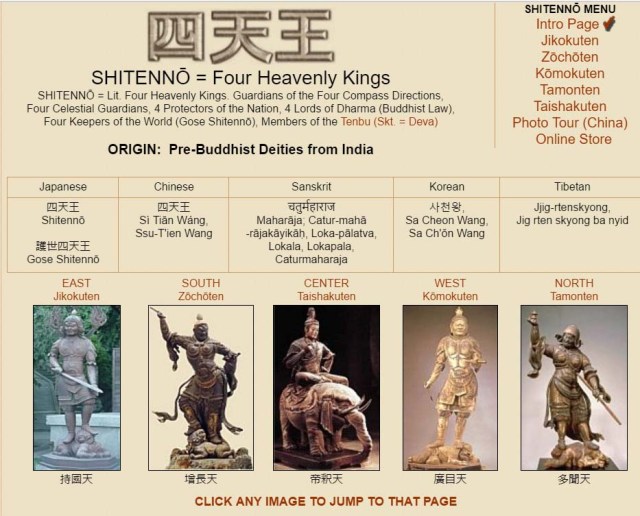
az2His website includes both basic introductory information as well as more complex backgrounds on these deities, including a quickstart guide for Buddhist Teachings and their history and chronological development, a guide to the basics of Buddhism aimed at students and teachers, deity guides (with photographs) to help you understand who’s who and how Buddhist deities are classified, and even guides to broader topics that have an impact on Buddhist practices such as celestial worship and information as it occurred in China and Japan.

The actual A-to-Z index of deities (found on the bottom left-hand side of the page) lists a great variety of figures, and in addition to providing useful summary explanations of each one, there are also diverse images from different types of media (statues, paintings, etc.) to help you recognize these figures in actual art. Schumacher also includes explanations of the deities gleaned from other authoritative sources around the internet, such as JAANUS, and compiles them into one convenient place for the reader’s comparison. There are helpful lists included with each entry, such as alternate names for deities and their kanji, which allows visitors to see what different areas with Buddhist call the same figure.

az3

In all, there are hundreds of deities included, over 4,000 images, and over 1,000 pages of information, making this an invaluable source for amateur or professional interests alike. The extensive combination of textual and visual sources is especially helpful, and though there is an overwhelming amount of materials to navigate, there is also an embedded search bar to get at more specific information. It is easy to get lost in the maze of deities, so be sure to block off some time to tackle it!

Posted in culture, graduate school, study tools, undergraduate, useful links | Tagged , , , , , , , | Leave a comment

Job Opening: Staff Assistant II, East Asian Languages and Civilizations, Harvard University

job opening - 5Institution: Harvard University
Department: East Asian Languages and Civilizations
Location: Cambridge, MA
Posted: 11/14/2016
Type: Full Time
Education: BA preferred
Auto req ID: 41013BR

Duties & Responsibilities:
The EALC Program Assistant supports the administrative operations and communication initiatives in three offices of the Department of East Asian Languages and Civilizations (EALC): the language program (EALP), the undergraduate program (EAS), and the main EALC office. Operational support duties vary by location but may include answering in-person, emailed, and telephone inquiries; distributing mail; photocopying; maintaining office files; managing printers and supplies; assisting with AV/media needs and triaging computer issues; data entry; preparation of mailings; addressing building and classroom issues; and supporting program event planning and logistics.

Working as part of a team and under the supervision of the initiating office, the Program Assistant also assists with preparation and dissemination of departmental content via program newsletters, social media, and program websites; and proofreading or editing occasional correspondence or reports. The position provides the opportunity to develop skills in the production of short videos promoting the program. Additional tasks as required.

Basic Qualifications:
College background, one to two years’ office work experience, and proficiency with MS Office (MS Word, Excel, and PowerPoint), Twitter, and Facebook (pages and groups) required.

Additional Qualifications:
Bachelor’s degree preferred. The successful candidate must be proactive, detail-oriented, and highly organized, with the ability to prioritize work in order to manage a variety of time-sensitive activities simultaneously. The position requires working both independently and as part of a team, and thus flexibility, accountability, and follow-through are all essential. Strong interpersonal skills are important, as the candidate must be able to communicate effectively and professionally with faculty, students, and department visitors. Excellent written and verbal communication skills. Knowledge of advanced MS Office skills and PhotoShop and/or graphic design applications strongly preferred. Background and/or an interest in East Asian languages and civilizations, and experience in or willingness to learn video production (shooting and editing) are plusses.

Additional Information:
This is a full-time academic-year (10-month) position, running from mid-August to mid-June.
The position schedule is Monday – Friday, 8:30AM to 4:30PM but the candidate must be able to work early/late hours on occasion as required by the EALC schedules and other events.

Full listing on HigherEdJobs.com.

Posted in announcements, job openings, jobs | Tagged , , , | Leave a comment

Book Announcement: Return Migration Decisions: A Study on Highly Skilled Chinese in Japan

returnmigrationReturn Migration Decisions: A Study on Highly Skilled Chinese in Japan
by Ruth Achenbach
Wiesbaden: Springer VS.
http://www.springer.com/de/book/9783658160265

Ruth Achenbach develops a model of individual return migration decision making, which examines both the process and the decisive factors in return migration decision making of Chinese highly skilled workers and students in Japan. She proposes to answer a question yet insufficiently explained by migration research: why do migrants deviate from their migration intentions and return sooner or later than planned, or not at all? Her study integrates factors from the spheres of career, family and lifestyle, and redefines stages in long-term decision-making processes, thereby contributing to decision and migration theory. She analyzes migrants’ shifting priorities over the course of migration, including a perspective on life course and on the impact of the triple catastrophe of March 11, 2011.

Ruth Achenbach is Academic Coordinator at the Interdisciplinary Centre for East Asian Studies (IZO) at Goethe University Frankfurt. Her research focuses on migration in East Asia with a focus on Japan.

Posted in announcements, culture | Tagged , , , , , , , , | Leave a comment

Job Opening: Manager, Asia Campus Master of Public Health Program, University of Utah

job opening - 5Institution: University of Utah
Location: Salt Lake City, UT
Posted: 11/14/2016
Type: Full Time
Requisition Number: PRN12881B

Job Summary:
This individual will be responsible for managing projects in relation to the educational programs for the MPH programs at University of Utah Asia (UA) including leading recruitment efforts, marketing and advising for the Division of Public Health (MPH). The program manager will provide internal and external customer service to potential and current students, staff, faculty and other visitors.
This position may require regular travel between Utah and Korea.

Responsibilities:
Recruit

  • Devise a sustainable recruitment and marketing plan that outlines financial support required for success.
  • Meet and advise potential students who drop-in inquiring about degree offerings (advise on degree requirements, expectations, registration requirements, deadlines, and the Division and University of Utah policies and regulations).
  • Address inquiries regarding admissions in person and via email; general information about the Program, Division/University requirements and deadlines, programs of study, and career opportunities.
  • Attend appropriate local and national professional meetings; assist in all aspects of the exhibit booths; coordinate recruiting and marketing materials for these meetings.

Marketing/External communications

  • Assist with maintaining information on Division website, newsletters, brochures, and other related marketing materials requested by Academic Manager.
  • Assist with social media and presence at the UA.

Advising

  • Meet and advise, counsel and track current University of Utah Asia Campus Master of Public Health (MPH) students Provide current information on degree requirements, expectations, registration requirements, deadlines, schedules, and the Division and University of Utah policies and regulations).May possibly advise potential joint degree students and certificate students as well.
  • Continually review, monitor, evaluate and maintain current student records/files to determine status for completion of degree program requirements.
  • Provide students with current and upcoming schedules; registration advising, and distribution of permission codes.

Practicum

  • Track paperwork and progress. Assist students with questions and coordinate with practicum coordinator in Utah.
  • Assist in developing new practicum sites.
  • Promote and publicize opportunities.

Career

  • Provide information and services related to career advising. Search and disseminate local, national and international job opportunities.
  • Coordinate career center services and communicate student and career job opportunities.
  • Coordinate meetings with local businesses interested in hiring graduates.

Administrative

  • Coordinate the “New Student Orientation” with feedback from Academic Manager prepare handouts, docket, and assigned advisors for appropriate programs.
  • Assist with providing potential Division/Program graduate information to the Academic Manager; assist in preparing student’s graduation forms.
  • Answer the University of Asia Public Health mainline, greet and assist customers, and unlocking and locking up the Division of Public Health area, and other assigned areas during.
  • Act as supporting liaison between campuses.
  • Support administrative functions such as planning and attending meetings, taking meeting minutes, as well as support faculty course support.

Minimum Qualifications:

  • Bachelor’s degree in a related field plus two years of related experience or equivalency. Demonstrated human relations and effective communication skills also required.

Full description on HigherEdJobs.com.

Posted in announcements, job openings, jobs | Tagged , , | Leave a comment

Fun Link Friday: Videos of Japan’s Traditional Artisans

Maybe it’s because of my research, maybe because I love art, or maybe because making things with your hands is so dang cool, but I am totally obsessed with a YouTube playlist recently highlighted by Open Culture on production processes of Japan’s artisans.

On the “手技TEWAZAシリーズ” (Tezawa Series) playlist, tezawa roughly translating to “hand technique” or “hand craft,” twenty videos are linked that showcase the amazing skills of Japan’s traditional artisans. The subjects range from fine pattern dyeing of the Edo period to techniques for making carving knives originating in the sixteenth century. Each video, about three to five minutes long, is totally mesmerizing and has wonderful production value, so I suggest you block out some time in your internet rabbit hole schedule to enjoy these. If you need convincing, just check out the Kanazawa gold leaf video below! The full list can be found here.

Posted in culture, fun links | Tagged , , , , , , , | Leave a comment

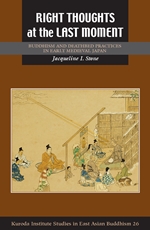
Book Announcement: Right Thoughts at the Last Moment: Buddhism and Deathbed Practices in Early Medieval Japan

9780824856434 Via the University of Hawai’i Press.

Right Thoughts at the Last Moment: Buddhism and Deathbed Practices in Early Medieval Japan
JACQUELINE I. STONE

616pp. November 2016
Cloth – Price: $68.00
ISBN: 978-0-8248-5643-4

Buddhists across Asia have often aspired to die with a clear and focused mind, as the historical Buddha himself is said to have done. This book explores how the ideal of dying with right mindfulness was appropriated, disseminated, and transformed in premodern Japan, focusing on the late tenth through early fourteenth centuries. By concentrating one’s thoughts on the Buddha in one’s last moments, it was said even an ignorant and sinful person could escape the cycle of deluded rebirth and achieve birth in a buddha’s pure land, where liberation would be assured. Conversely, the slightest mental distraction at that final juncture could send even a devout practitioner tumbling down into the hells or other miserable rebirth realms. The ideal of mindful death thus generated both hope and anxiety and created a demand for ritual specialists who could act as religious guides at the deathbed. Buddhist death management in Japan has been studied chiefly from the standpoint of funerals and mortuary rites. Right Thoughts at the Last Moment investigates a largely untold side of that story: how early medieval Japanese prepared for death, and how desire for ritual assistance in one’s last hours contributed to Buddhist preeminence in death-related matters. It represents the first book-length study in a Western language to examine how the Buddhist ideal of mindful death was appropriated in a specific historical context.
Practice for one’s last hours occupied the intersections of multiple, often disparate approaches that Buddhism offered for coping with death. Because they crossed sectarian lines and eventually permeated all social levels, deathbed practices afford insights into broader issues in medieval Japanese religion, including intellectual developments, devotional practices, pollution concerns, ritual performance, and divisions of labor among religious professionals. They also allow us to see beyond the categories of “old” versus “new” Buddhism, or establishment Buddhism versus marginal heterodoxies, which have characterized much scholarship to date. Enlivened by cogent examples, this study draws on a wealth of sources including ritual instructions, hagiographies, doctrinal writings, didactic tales, courtier diaries, historical records, letters, and relevant art historical material to explore the interplay of doctrinal ideals and on-the-ground practice.

11 color, 1 b&w illustrations

Studies in East Asian Buddhism Series
Published in association with the Kuroda Institute

Posted in announcements, culture | Tagged , , , , , , | 1 Comment

Fun Link Friday: Rocks with Faces

Sorry for the lag in Fun Link Fridays lately, everybody! Last weekend I was traveling to Chicago to present at a workshop on The Impact of the Digital on Japanese Studies (more to come on Japanese Studies and digital humanities soon!).

Is an Elvis rock a really good pun or a bad one?

Is an Elvis rock a really good pun or a bad one?

This week is also a bit hectic, so here’s a quickie fun link– a museum in Japan dedicated entirely to rocks that look like they have faces. Yes. This is a thing. Colossal recently posted an article  on the Chinsekikan (literally “hall of unusual rocks”) in Chichibu, Japan, where Yoshiko Hayama and her late husband have gathered over 1,700 rocks that look like they’ve got faces. They even name them! Think you might have a good name for one? They sometimes let visitors name the rocks, so you’d better get out there to stare into the rock void– it stares back.

Posted in culture, fun links | Tagged , , , , | Leave a comment

Resource: Okinawa Hai!

Okinawa Hai! is one of a series of websites aimed, primarily, at helping US military families settle in, find their way around, and otherwise make the most of life in Okinawa, Germany, Korea, or Turkey, with the tagline “Helping you go from ‘Overseas? Yikes!’ to ‘Overseas? Yes!’.” That said, a great many of the posts can apply to the rest of us as well.

Those I have personally found most helpful are guides to local restaurants & other establishments, and to historical sites and other tourist sites, as well as monthly guides to local events. As I write this, some of the most recent posts include a guide to July 2016 local events, one on Aeon Shopping Mall, and one on visiting Cape Hedo. Again, many of these are written from the viewpoint of assuming that one is living not in Naha, but in some other part of the island, with driving directions often beginning at the gates of one of the bases.

Similarly, looking through their posts about looking for housing, I was a bit surprised and disappointed to find no blog posts for Naha at all; of course, most of these posts are going to be aimed at whole families on a military income, and not for the single grad student on a limited budget looking for a small apartment, but even so, if you’re an ethnographer coming to Okinawa with your whole family, you may find their “off-base housing” posts for Okinawa City, Gushikawa and Uruma, Yomitan, Chatan, etc. helpful. There is also a nice, lengthy post for getting started, which links to other posts on moving, finding housing, setting up phone and internet, renting a car, getting an international or Japanese driver’s license, finding a place of worship, finding things to do with the kids, and so on and so forth.
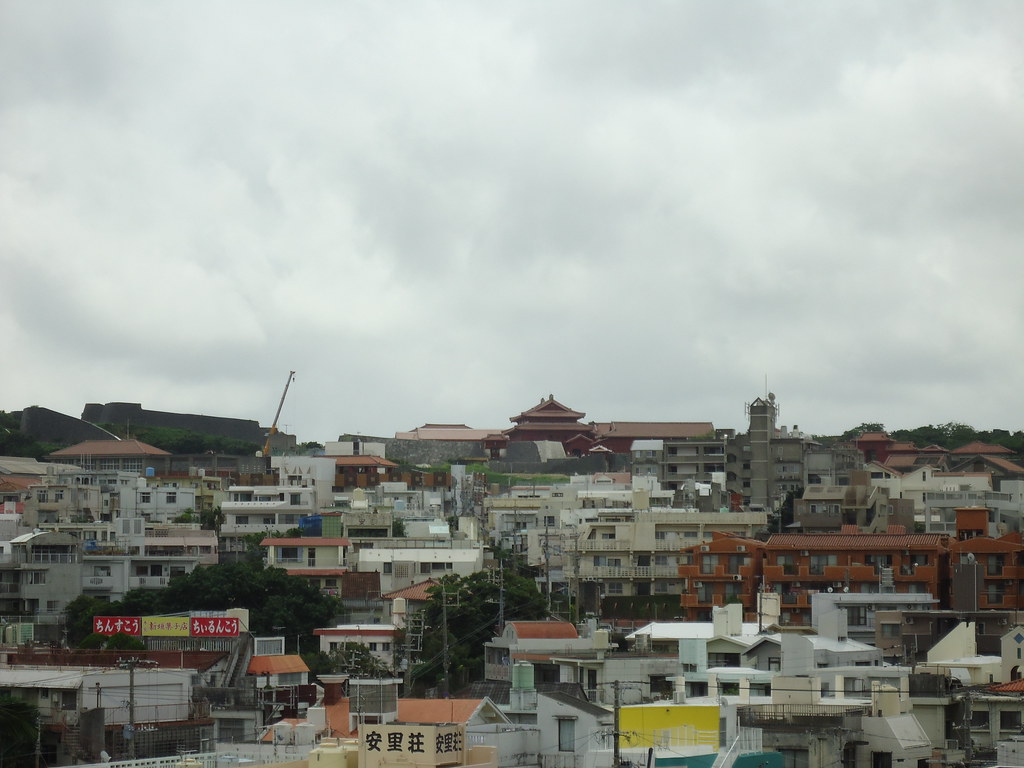
The Shuri skyline.

There are also a number of related posts on the basic logistics of living in Japan which I think may be of more general relevance for our Shinpai Deshou readers, including posts on paying bills in Japan, moving on-island within Okinawa Island, how to clean your Japanese air conditioner, how to know which kind of milk you’re buying, a comment thread on gluten free resources, and a whole category of posts on mobiles, landline phone, and internet services.

Along similar lines, Okinawa Hai! has countless helpful posts about everyday life-on-the-island sort of things, from information on preschools and childcare and kids’ activities, to reviews/listings of dental, vision, and other healthcare clinics, to stuff about buying/renting a car, car repair, highways & toll roads, etc..

There’s also a very brief blog post on attending university in Okinawa, which simply lists a few of the international universities available. But, I found this post quite useful as it keyed me in to the fact that LeoPalace21, the Japan-wide chain of apartment buildings, has an English website, and month-to-month contracts with no guarantor. I’m not sure about key money or other concerns, but it definitely seems a good place to start.

Asato Hachimangû, one of the Ryûkyû Eight Shrines, tucked away back in a Naha residential neighborhood, but just a few blocks walk from the Prefectural Museum. Given that it’s in Naha, I’m somehow not too surprised that Okinawa Hai! doesn’t have a review of it (yet). Maybe I’ll write and submit one.

Next, let me come back around to the reviews of historical sites, tourist destinations, restaurants, and so forth. Much of what’s listed here is very basic tourist stuff, and family-friendly; but there’s a lot, too, that’s more keyed in to the history and culture, and I’ve found Okinawa Hai! posts quite helpful in terms of telling me how to get to Futenma Shrine and what to expect to see there; and similarly for many other temples, shrines, gusuku, and other historical sites. These not only provide photos and basic narratives of what to see and do at each site, but are also quite good on the basic information: entry fee, street address, embedded Google Map of the location, hours, etc. They also have more than 500 listings of restaurants, cafés, and the like; more than just listings, these are often full narratives of individuals’ experiences with the restaurant, including photos, and I definitely plan to make use of these reviews to help me find cool places while I’m on-island.

And finally, there are a whole bunch of blog posts about hotels & visiting the outer islands, including tips on budget airlines, cheap hostels, and so forth. I’m definitely hoping to visit some of the nearer islands (Izena, Iheya) while I’m in Okinawa, and also hopefully some of the more distant ones (e.g. Taketomi, Yonaguni), so I’m sure these posts will come in helpful towards managing my budget, finding a place to stay, knowing where to go and what to see…

Iejima, visible in the distance from Churaumi Aquarium at Motobu.

All photos my own. Thanks to Okinawa Hai! for permission to use their header banner.

Posted in blogs, culture, housing, living abroad, military service, useful links | Tagged , , , , | Leave a comment