Exhibition: Imaging Others: Cultural Intersections in the Colonial Period

If you’re anywhere near Iowa, this sounds like a fascinating exhibit featuring Japanese, Chinese, and African art of the 19th and 20th centuries!

—

Imaging Others: Cultural Intersections in the Colonial Period

An Exhibition Examining Cultural Representation
in Japanese, Chinese And African Works

Opening at the Anderson Gallery, Drake University, Des Moines, Iowa


We often hear the term “diversity.” But who decides what constitutes diversity? Differentiating one group of people from another is a process a process of “othering” that highlights characteristics that distinguish one group from another. These categories are fluid: at times, groups highlight their differences from one another, at other times the same groups overlook differences and, viewing similarities, unify.

More than 50 works from Japanese, Chinese and African artists of the late 19th century and early 20th century will be brought together in “Imaging Others: Cultural Intersections in the Colonial Period,” a landmark exhibition opening this November at Drake University’s Anderson Gallery. The exhibition looks at the process of “othering,” displaying the wide assortment of other ways nations viewed each other during the turbulent nineteenth century.

“Imaging Others” illuminates the distinctive interaction between art and commerce, demonstrating how artists of this era interpreted the transformations that occurred between cultures.

The exhibit incorporates Japanese 19th century prints depicting the first Japanese impressions of Westerners, at the time when the West persuaded Japan to open its ports to Western trade. The exhibit also features African sculptures portraying white people, or incorporating items from European countries into culturally significant objects. In addition, stereographs and photo-postcards show Chinese people in the United States, and Westerners in China.

“In each culture, some objects emphasize the foreignness of another group, while other objects from that same culture reveal the incorporation of once foreign people and their works,” says Lenore Metrick-Chen, curator and professor of art history. “Through the process of othering, not only is the other group defined, but often inadvertently, we reveal characteristics of our own.”

The exhibition is organized into several groupings that closely examine thematic intersections such as utility, spirituality, and power, while also examining ways in which Africans, Japanese and Chinese artists viewed the West and western practices and dress. A prominent theme throughout the exhibition is the idea of market exchange and commodification.

The exhibition will open with a public reception on Friday, Nov. 19 from 5 to 7 p.m. in the Anderson Gallery and will run through Friday, Dec. 17.

Additional Related Events and Programs

The Anderson Gallery will present a selection of related public programs to coincide with “Imaging Others.” All events are free and open to the public.

  • Saturday, Nov. 20, 2 p.m. “Imaging Others through Woodblock Prints,” a gallery walk led by Lenore Metrick-Chen and Michael Chiang, professor of East Asian History. This event is held in conjunction with the monthly meeting of the Japan-American Society of Iowa (JASI).
  • Saturday, Dec. 4, 2 p.m. Roundtable Discussion to be held at the Anderson Gallery with: Lenore Metrick-Chen, curator of “Imaging Others” and professor of Art History at Drake University; Michael Chiang, professor of East Asian History at Drake University; John Monroe, professor of History at Iowa State University and former curator of the Stanley Collection of African Art at the University of Iowa Museum of Art; and Glenn McKnight, professor of History at Drake University.

Contact: Lenore Metrick-Chen, lenore.metrick-chen@drake.edu , 515-271- 3801 For additional information, visit http://www.drake.edu/andersongallery or contact the director, Heather Skeens, at 515-271-1994.

—

Lenore Metrick-Chen
Assistant Professor
Department of Art & Design
Drake University

—

Image from Anderson Gallery website

Posted in announcements, culture | Tagged , , , , , , , | Leave a comment

Call for papers: Asian Studies on the Pacific Coast and Western Conference of the Association for Asian Studies – Joint conference

This is a call for papers, but the conference itself is a joint one and a great opportunity to attend if you’re in the California area. Check out the links below for more information.

—

Location: Pacific Basin Institute at Pomona College in Claremont, CA (in the Los Angeles area)

Date: June 17-19, 2011

The two regional conferences of the AAS in western North America are holding a single annual conference this coming year, set around the usual meeting time of the ASPAC conference. The venue’s location near major airports ought to mean that transport costs would be more reasonable for participants

CALL FOR PAPERS

Annual Meeting of Asian Studies on the Pacific Coast (ASPAC) and the Western Conference of the Association for Asian Studies (WCAAS)

The conference theme is Asia Rising and the Rise of Asian America. This conference will provide a low-key venue to share your latest research with peers on any topic in Asian Studies. We welcome advanced graduate students and foreign participants.

Presentations on Asia’s rising prominence and the growing Asian presence in America are especially welcome. Proposals for panels, individual papers, workshops, and discussion roundtables will be accepted until May 15, 2011. Authors will be notified of proposal acceptance within two weeks of submission.

To submit proposals, register for the conference, and make other arrangements visit: http://www.pomona.edu/pbi/aspac.shtml

_________________

Program Chairs: Hung Cam Thai and David Arase
Email contact: pbi@pomona.edu

_________________

A special joint annual meeting of Asian Studies on the Pacific Coast (ASPAC) &

Western Conference of the Association of Asian Studies (WCAAS)

Conference Theme

Asia’s Rise

Asian societies and cultures are experiencing unprecedented change and are having a palpable impact on the direction of global affairs. Asia is the most populous geographic region, with 56 percent of the worlds population. The Asian economy today encompasses 33 percent of real world GDPsurpassing the size of either Europe or North America. Asias political influence is also on the rise. Of the Group of Twenty (G-20) nations currently managing the global economy, there are five Asian members (China, Japan, South Korea, India, and Indonesia), a substantial increase of Asian representation at the global level over the old G-8, which had Japan as the only Asian representative. And one cannot overlook how the rapid rise of China and India is unavoidably changing the international security order.

With successful development comes environmental cost. In a world with limited oil reserves, three of the top four oil importing countries are in Asia. Chinas growth now makes it the world’s largest contributor to climate change. Asia also confronts harsh natural resource constraints. The demand for fresh water is already unmet in many places and will exceed supply by at least 20 percent across the entire region by 2025. However, Asia may be in a position to address these problems. It leads in many areas of innovation and problem solving: three of the top four patent-filing countries are Asian; the US is number two on the list. Finally, Asia also makes leading contributions to world culture. Asian cuisine is changing the worlds taste for fine food, Asian corporations set the standard in consumer products, and Asian fashion designers and film makers attract international attention and awards. Other leading cultural contributions come in music, religion, literature, architecture, and the fine arts, redefining how human civilization regards itself.

Rising Asian America

Globalization ensures that the impact of Asia’s rise is not limited to Asia. In a very real sense it is changing America at home. In Southern California and other parts of the country, an increasing number of Asians and those of Asian heritage establish their lives and form communities, raising issues of changing identity, power relations, and hybridity in culture. Yet the impact of Asians and those of Asian heritage born here in America has received relatively little attention. Therefore, we include Asian America in our scope of interest and invite proposals from those who can expand our knowledge in this area as well.

—

Proposals

Individual paper proposals are welcome. Those accepted will be grouped according to general topic and organized in a panel format (see next). Multiple paper panel proposals should address a single theme and have three or four paper presenters, a chair, and a discussant. The chair may serve as a discussant.

A roundtable proposal should organize 3-6 participants who will engage in informed discussion on a particular theme of wider interest. The organizer should designate a chair or moderator. Written papers are not required.

Proposals will be reviewed and a response will be sent within two weeks of submission. To submit a proposal, click the link below and fill out the form. Send the proposal at the earliest convenience to facilitate conference planning.

The deadline for submission is May 15, 2011.

For Proposal Form link to URL:
http://www.pomona.edu/pbi/aspac/proposal.shtml

For Tentative Program Schedule link to URL:
http://www.pomona.edu/pbi/aspac/program.shtml

Registration

Conference Registration EARLY RATES General registration will be $110 for participants and attendees. Student registration will be $55.

The deadline for early registration is March 15, 2011.

Late registration begins March 16, 2011. After that date, general registration will be $160 and student registration will be $70. On-site registration will also be considered late registration.

You may also select housing and meal options during registration.

ASPAC-WCAAS Registration online event registration by Regonline

< http://www.regonline.com/Register/Checkin.aspx?EventID=895371 >

For questions or concerns regarding your registration contact Kayo Yoshikawa at 1-909-607-8035 or email Kayo.Yoshikawa@pomona.edu .

Housing

A number of Pomona College student dormitory rooms (singles) will be available to attendees at a rate of $40 per night (June 16, 17 & 18). You may select to reserve a dormitory room on the Additional Events page of the conference registration form.

Room blocks have been reserved at two local hotels in Claremont (follow links on the ASPAC-WCAAS Registration site). *Be sure to mention you are part of ASPAC to receive discounted rates.

Meals

You may prepay $14 to have lunch on Friday, June 17 and Saturday, June 18 at a dining hall conveniently located on the Pomona College campus. You may select this option on the Additional Events page of the conference registration form.

A banquet dinner will be held on Saturday, June 18 from 6:30 to 8:30 pm in Smith 201.

You may select to attend this event on the Additional Events page of the conference registration form.

Posted in announcements, conferences, graduate school, social networking | Tagged , , , , , , , | Leave a comment

Fun Link Friday: Hanafuda!

Hanafuda, or “flower cards,” are a traditional set of Japanese playing cards. The deck consists of 48 cards that have nature inspired designs and are associated with the months of the year. There are four cards for each month and each set of four has a similar theme. For example, the October set of four all have maple leaves on them. For a more detailed history of Hanafuda please see http://www.hanafuda.com/history.

Hanafuda and Yakuza

Hanafuda is the name of the set of cards but there are many different games that can be played with them. One game called Oicho-kabu is the source of the modern term Yakuza which has come to mean Japanese gangster. In this game, the players score is determined by the added point values of several cards. The lowest digit of the added score is the amount of points the player is rewarded. The word Yakuza comes from the worst hand you can get which is 8+9+3. It equals 20 meaning your score is zero. 8 (ya or yattsu), 9 (ku) and 3(za, san) becomes Yakuza and it meant “no points” or “useless gambler.” Today the term is synonomous with Japanese gangster.

Another fun history note!

In 1889, Fusajiro Yamauchi founded a company that produced handmade Hanafuda cards. His company, which he called Nintendo, has since branched out, but they still make Hanafuda cards today. Nintendo has never forgotten its roots and the company has made a special Hanafuda deck that features Mario characters. Nintendo also included a Hanafuda game called Koi Koi in a videogame for Nintendo DS, Clubhouse Games.

Let’s Koi Koi!

Koi Koi is one of the most popular Hanafuda games. Here is a link to a flash site where you can enjoy it yourself:

http://www.gamedesign.jp/flash/hanafuda/hanafuda_e.html

You can start playing right away but it may take a few minutes of study before you understand what is actually going on in the game. Some of you trial by fire types may be saying to yourselves, psssshh study? who needs more of that? and to you I say GO FOR IT!

If you want to know more about the game, here is some basic information.

The first thing you need to do is become familiar with the 12 suits of hanafuda which consist of four cards for each month.

(For a full list of the kanji and translations of each suit with pictures and point values, see the Wikipedia article on hanafuda for a convenient chart!)

The goal of Koi Koi is to get the “yaku” or “scoring combination” of cards that has the highest point value. Each player begins with 8 cards lined up face down in front of them. There are 8 cards in the middle that are face-up (this will be immediately clear in the flash game). You play by matching up one of your cards at a time with one of the face-up cards in the middle that is in the same set (pine goes with pine, maple goes with maple etc.). You want to get the cards that have higher point values so that you can create a better yaku than your opponent. Go to this site or this site to see a detailed description of game play, yaku, and point values.

There are four basic types of cards.

Kasu (カス): These are plain cards and they have the lowest point value.

Tanzaku (短冊): These cards have a ribbon on them and are worth more than kasu.

Tane (タネ): These cards usually have an animal on them. The exceptions are May (The dock with an Iris), September (the sake cup), and January (the crane) which is a higher class of card. If you haven’t guessed by now, tane cards are the second most valuable cards.

Hikari (光)*: These cards are known as bright cards and they have the highest value. They are easily identifiable because they are usually the most detailed cards. Most sets have either a Tane or a Hikari card. The exceptions are August and November, which have both.

*Special note on pronunciaton of 光. When this kanji is paired with a number, the pronunciation becomes “kou.” For example, 五光, should be pronounced gokou. If you see sankou, shikou, or gokou on the explanation website, it means three brights, four brights, or five brights.

The point values change depending on the game you are playing. In Koi Koi, the yaku that have the better cards are generally worth more than the yaku that have only Kasu or Tanzaku cards. There are special pairings like the moon card and the sake cup card which are worth a lot of points because it is difficult to get that combination.

The point of the game is to get the best yaku and score the most points. There are cases in which you complete a yaku but it isn’t that great. In this case, you can say koi koi to keep playing for a better yaku. I recommend only going for koi koi after careful examination of what cards you have and consideration of what cards remain in play. This could be dangerous because you have to complete your second yaku before the other player gets one. You can continue to say koi koi until you have the yaku that you want but do so at your own risk. The advantage is that your score goes up with a better yaku and the risk is that you lose all points if your opponent gets a yaku. If you tie, the dealer gets the points.

I hope you enjoy this fun and challenging game! It is easy to learn as you go and the hardest part is getting used to the sets of cards. If you would like an actual hanafuda set, they are easily obtainable from specialized websites. If you are in Japan, you can find them at almost any toy store.

Now start playing!!

-Rachel

—

Image 1 from the article “Nintendo the birth of a giant”
Image 2 from the Nintendo Wiki (check out images of the Mario cards!)
Image 3 from the article “Hanafuda in Anime”
Image 4 from here

Posted in culture, fun links | Tagged , , , , , , , | 1 Comment

Site review: GaijinPot

Living in a foreign country can be one of the most frustrating experiences a person goes through, especially if they aren’t equipped with a full grasp of the language and culture, or a solid set of people and material resources to explain the ropes. One site that aspires to do it all is GaijinPot, an online community site for all manner of advertising, information, and personal exchange related to Japan for people (both foreign and native) living there.

The site divides its services into four main sections (as the header of the site states): Jobs, Apartments, Classifieds, and In Japan, although it has many subsections for these in the left-hand sidebar.

–

Jobs:

GaijinPot has a great search engine for its job listings. Predictably, most of them are English teaching positions, but even amongst those there are a variety of types, such as part time teachers for young adults and adults, business language teachers, and even pre-school level for 1-3 year olds. However, you’ll also find advertisements for technical jobs, human resource work, business consulting, and more. The level of English and Japanese proficiency required is specified, and the listings are from all over Japan, so there’s a good chance you can find something near you. The basic info about salaries and whatnot is included, so it’s great to glance through and see what interests you in the pay range you’re looking for as well.

There’s also a special area where you can sign up as a Job Seeker and upload resumes and send in applications, so if you’re seriously looking for work in Japan, I highly suggest you at least give this site a look to broaden your options.

Apartments:

One very daunting challenge for foreigners planning to live in Japan is apartment hunting. It is true that the failing economy in Japan is opening new doors to foreign tenants. But even so, many Japanese landlords don’t want to rent to someone who has no Japanese guarantor to vouch for his or her character, and who is not accustomed to the way renting apartments is handled in Japan. Therefore, a resource like GaijinPot that lists foreigner-friendly apartments can be a huge relief to those searching.

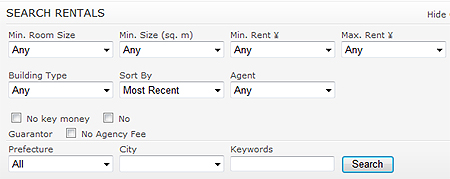
You’re able to search under “Rentals,” “Guest Houses,” and “Serviced Apartments,” or look up agencies directly that advertise through GaijinPot. Large companies or individuals can advertise here, so there’s quite a bit of variety. Each listing also has all of the related expenses and details of the apartment listed, often including maps and photos. Listings for key money (a onetime non-refundable ‘gift’ fee to the landlord) and agency fees are especially important, as a lot of foreigners don’t expect these if they’ve never rented in Japan. Search by area, price, building type, or any number of options and keywords.

Classifieds:

The classifieds section was one of the most important sections to me while I was in Japan. Why? Because some of the most annoying things to do when establishing or leaving life in Japan can be:

1)      acquiring furniture cheaply that you’re not afraid to toss out
2)      throwing away said furniture

Having lived in Yokohama, which has some of the most strict trash restrictions ever, being able to sell my things online easily (and not feeling it was a waste to buy them) without figuring out the trash system was a godsend. A lot of people leaving put up their belongings on these classifieds boards for cheap under the term “Sayonara Sale,” which pretty much speaks for itself. A lot of people just put up things for free, too. As long as you can pick it up, it’s yours!

There’s also some unique sections like “Lessons” for educational services, and a “Friends” section which is GaijinPot user personals for friendship or more. A couple steps up from Craig’s List, at least, if you looking for a buddy to drink with or a date for Saturday night. 🙂

In Japan:

The In Japan section is a collection of articles on various topics related to everyday living situations. If you’re looking for simple things like resources on learning Japanese or where to find a good restaurant in your area, or complicated ones like starting businesses or figuring out how to do your banking and investing, there’s bound to be something useful. For first timers, this section is great to help you know what to expect when it comes to things like getting a credit card or cell phone. There are also links throughout this section and on the main page that lead you to a variety of articles on current news, keeping you up to date with Japanese current affairs.

–

Also helpful, GaijinPot runs a forum for people to exchange information informally. If you have a question you can’t find the answer to elsewhere on the site, or want a different type of advice, you can ask forum members (though at your own risk, of course).

Because GaijinPot is such a massive site, obviously we can’t cover all of its features in depth here. But I highly suggest that you cruise the pages and keep its services in mind if you’re planning on getting a job in or moving to Japan. There’s tons of helpful and informative materials that we’re sure to link back to in the future on this blog.

Posted in culture, housing, jobs, living abroad, social networking, study tools, useful links | Tagged , , , , , | Leave a comment

The Story of the Stone and The Tale of Genji in Modern China and Japan: Issues in Media, Gender, and Cultural Identity

Students and researchers in the New York area may be interested in the following symposium on The Story of the Stone and The Tale of Genji , which will take place this Friday and Saturday at Columbia University. See below for a schedule. Registration is not required.

—

The Story of the Stone and The Tale of Genji in Modern China and Japan: Issues in Media, Gender, and Cultural Identity

November 19-20, 2010

403 Kent Hall, Columbia University

This symposium explores the remarkable histories of the reception of the Stone and the Genji in the early modern and modern world. By exploring the parallels between the Stone and the Genji phenomena in China and Japan, particularly with regard to media, gender, and cultural identity, this symposium will bring together specialists of various fields and aims to generate interdisciplinary and comparative research that crosses temporal, cultural, and national boundaries.

Friday, November 19

9:30 am – 11am  Issues in Reception and Adaptation

Haruo Shirane, Columbia University
The Tale of Genji Reception in Comparative Perspective

Shang Wei, Columbia University
The Stone Phenomenon and its Transformation

Chair and Discussant: Joshua Mostow, University of British Columbia

11:15 am – 12:45 pm  Global Reception

Tomi Suzuki, Columbia University
The Tale of Genji in relationship to Chinese vernacular fiction and the Western novel

Michael Emmerich, University of California, Santa Barbara
Genji Goes Global: History, Materiality, Mass Media

Chair and Discussant: Patrick Caddeau, Princeton University

12:45 pm – 2 pm: Lunch

1:15 pm – 1:45 pm: Lunch Talk

Charo D’Etcheverry, University of Wisconsin – Madison
Stone-Genji Syllabi

2 pm – 3:30 pm: Gender, Cultural Identity and Education I

Satoko Naito, University of Maryland
The Tale of Genji as retsujoden (biographies of exemplary women): Images of Murasaki Shikibu in 18th Century Instructional Texts for Women

Ellen Widmer, Wellesley College
How Well Did Lin Daiyu Know Honglou meng?–Some Perspectives From Japan

Chair and Discussant: Lewis Cook, Queens College

4 pm – 5:30 pm:  Gender, Cultural Identity and Education II

Christina Laffin, University of British Columbia
Prequels, Sequels, and Self-Narratives: The Tale of Genji in Women’s Memoirs

Keith McMahon, University of Kansas
Two Jia Baoyus and Perversion

Chair and Discussant: Lydia Liu, Columbia University

—

Saturday, November 20

9:30 am-11am:  From Theater to Film I

Satoko Shimazaki, University of Colorado, Boulder
Strange Encounters: Performing Genji on the Kabuki Stage

Ling Hon Lam, Vanderbilt University
Stone’s New Clothes: Re-visioning the Origins in Modern-Costume “Red Chamber” Films and Photoplay Novels

Chair and Discussant: Martin Woesler, Harvard University

11:15 am – 12:45 pm:  From Theater to Film II

Judith Zeitlin, University of Chicago
The Death of Lin Daiyu in Opera, Spoken Drama, and Film from Late Qing to the Cultural Revolution

Sophie Volpp, University of California, Berkeley
Mind Wandering: Honglou meng’s Dramatic Sequels

Chair and Discussant: Weihong Bao, Columbia University

12:45 pm -2 pm: Lunch

2 pm – 3:30 pm: Visual Culture: Pre-modern to Modern I

Kimberly Besio, Colby College
Baochai Chasing Butterflies: Reception of Honglou meng in Visual Culture

Sarah Thompson, Museum of Fine Arts, Boston
Poetry, Incense, Card Games, and Pictorial Narrative Coding in Early Modern Genji Pictures

Chair and Discussant: Joshua Mostow, University of British Columbia

4 pm – 5:30 pm:  Visual Culture: Pre-modern to Modern II

Melissa McCormick, Harvard University
Reading Pictures: Genji Pictures in the Age of Illustrated Fiction

I-Hsien Wu, The City College of New York
Portraits of a Lady: Lin Daiyu’s Makeover in Honglou meng Pictures

Chair and Discussant: Jonathan Hay, New York University

Posted in announcements, conferences, graduate school, social networking | Tagged , , , , , , , , , , , | Leave a comment

The Next Generation Leadership in Asian Affairs Fellowship

For those of you interested in Japan and government policy that have just finished your Master’s degree, the National Bureau of Asian Research offers a one year research fellowship for 2 to 4 research individuals. The competition is now open, and the deadline is January 15, 2011.

—

The National Bureau of Asian Research is offering a fellowship to students who desire knowledge about foreign policy decisions between Asia and the United States. The Next Generation Leadership in Asian Affairs Fellowship is year-long program, based in Seattle, focuses on bridging the gap between scholarship and policymaking. Fellows support NBR research projects and collaborate with leading scholars to conduct independent research and share research findings with the policymaking community in Washington, D.C. This one-year fellowship is designed to further the professional development of Asia specialists in the year just after the completion of their master’s degree. Successful fellows will gain further knowledge of Asia and an understanding of the U.S. foreign policymaking process by: conducting independent research under the guidance of the NBR Editor; collaborating with senior scholars on academic publications; and traveling to Washington, D.C., to participate in the briefing of research findings to relevant constituents within the policy community.

Fellowship Description

The Next Generation Fellowship Program will grant a one-year award to two to four fellows annually. The four major components of the Next Generation Fellowship are:

• Publication.

A signature element of the program is the completion by the fellow of at least one journal-quality article that could be published by either NBR or an outside scholarly journal.

• Bridging the gap between research and policy.

Because NBR believes that writing alone is not adequate to inform policy, the fellow will also participate in NBR’s active outreach toward the policy community in Washington, D.C., through participation in conferences, briefings, and private meetings.

• Gaining in-depth knowledge of U.S. foreign policymaking.

Fellows will engage the policymaking community through association with current and former U.S. government officials on the program’s advisory board, the program orientation, the Leadership Forum, and briefings to policymakers.

• Guidance and mentoring.

The Next Generation fellows will be incorporated directly into NBR’s substantive policy research projects. Responsible to and guided by the relevant project director, the fellows will be embedded in the workings of an organization that expresses in daily practice the high ideals of the fellowship’s goals.

As part of the fellowship, each new class of fellows will participate in an orientation in Washington, D.C., which includes meetings with government officials, members of Congress and their staffs, and senior academics who have themselves successfully bridged the scholarship policy gap. Each fellow will be placed on projects that best match his/her qualifications and research interests. NBR organizes its research around three broad topics:

• Politics and Security: The Political and Security Affairs (PSA) group advances NBR’s mission of informing and strengthening policy by engaging in innovative, forward-looking policy research on political and security issues in Asia of critical importance to U.S. interests. The group’s research focuses on three broad areas: Asian Security, Politics in Asia, and Muslim Asia.

• Economics and Trade: The Economic and Trade Affairs (ETA) group leads NBR’s efforts to conduct policy research on the rising economic importance of Asia to the United States. The group’s research initiatives focus on Energy and the Environment and Trade, Investment, and Economic Engagement Issues.

• Health and Society: The mission of the Center for Health and Aging (CHA) is to facilitate dialogue between science, industry, and policy for a healthier world. Toward this end, CHA coordinates innovative research and dialogue on the demographic, economic, social, political, and medical trends related to health and aging across the globe.

Application

Applicants are required to submit the following:

• Curriculum vitae/resume
• 750-word essay stating their qualifications for and interest in applying for the fellowship, particular topical and regional research area, and how their research within that area would contribute to NBR’s research agenda.
• Three written references (one professional and two academic) highlighting the applicant’s strengths and weaknesses, leadership potential, and other relevant information, emailed directly
• Application Form

Please email the above materials to nextgen@nbr.org.

Fellowship Eligibility
U.S. citizenship or permanent residence status is required. The applicant must have completed a master’s degree by the time the fellowship begins. Individuals who have received their master’s degree diplomas up to twelve months prior to the application deadline may apply to the program; exceptions may be permitted on a case-by-case basis. No deferrals are permitted.

Each fellow will receive a $32,500 fellowship award (with benefits), as well as a reimbursement for some relocation expenses.

Applications due at nextgen@nbr.org:  January 15, 2011


For more information, visit the Next Generation Fellowship page (http://www.nbr.org/about/nextgenfellowship.aspx) or contact:

Kailani Chin-Hidano
Director, Human Resources
nextgen@nbr.org

—

Photo by o palsson

Posted in financial assistance, funding, graduate school, social networking | Tagged , , , , , , , | Leave a comment

Is JET for you?: Why I didn’t do JET.

Hey, everyone. I’m a Gettysburg College 2009 graduate with a B.A. in Japanese Studies. I studied abroad at Kansai Gaidai during the spring of my junior year and I was also the 200-level Japanese tutor my senior year. I’m currently teaching English to elementary school students in Osan, South Korea.

That being said, I’m sure you’re wondering why I’m in Korea instead of Japan. Well, folks, that is exactly what this blog post is about: why I didn’t do JET. This blog post is just going to tell how things panned out for me. I was hoping it would show you all that things might not always turn out the way you had initially planned after graduation, but that’s not necessarily a bad thing. JET is a great first job out of school, but it might not be for everyone.

First, you should know that I did apply to JET my senior year at Gettysburg. Initially JET was my ideal job out of school: it was a way for me to get some “real job” experience, make money and start paying off my school loans, as well as improve my Japanese. My Japanese is nowhere what I would consider fluent so I thought the best thing would be to return to Japan right after graduation to maintain and improve my skills. I went through the entire application process and I got an interview at the Japanese Embassy, but I failed to receive a position or even get put on the waiting list for positions that opened up from people that dropped out.

There are a number of reasons why I think I got rejected, but none of which I can confirm or prove (especially since JET gives you no information on the matter). For one, I was poor at the time and I didn’t wear a suit to my interview. I didn’t look like a deadbeat, but I felt slightly underdressed for my interview. My interview was also kind of a mess in hindsight. I was extremely nervous and fumbled with my words as well as missed certain opportunities to display my love for Japan. For example, I mentioned in my jikoshoukai (self introduction) that one of my hobbies was watching movies. So an interviewer asked what sorts of movies I liked. Rather than starting to name all of the Japanese films I enjoy, I for some reason said I liked fantasy movies, like Harry Potter. Yeah. Another reason I think I got rejected is because I applied to JET with my boyfriend. He got an interview as well, but it apparently didn’t go well either seeing as he’s now teaching in Korea as well. I said I was willing to be far away from him (which was the truth) but I don’t think they quite believed me.  Lastly, this is a rather sensitive issue, but I have a sneaking suspicion that I got rejected because I’m Korean. That’s not at all to say JET doesn’t hire Asian people, but I think the truth of the matter is that the vast majority of English schools in both Japan and Korea would prefer a Caucasian or typical “white” English teacher. I have definitely experienced such discrimination in Korea too, so I’m definitely not singling JET out.

So the next question you would likely have for me is why I didn’t just reapply the next year. That is also a rather personal issue, but it had to do with my debt. My school loan debt is… well, a rather sizable amount and unfortunately my parents aren’t in a position to help (otherwise I’m sure I wouldn’t have taken out loans to begin with) so waiting another year to apply for a job which I may or may not get was pretty much out of the question. At the time, I couldn’t even secure a part-time job to hold me over so I was pretty desperate to find something immediately. Not only that, but even applying to JET was eating up money since I had to mail that giant stack of papers i.e. the application and travel to the Embassy and back for the interview (I lived in Northeast PA and had to travel to DC). Korea was the better option because I could apply at all times of the year, whereas JET has a really strict timeline for applications. I also didn’t have to travel for interviews for positions in Korea because they’re usually done over the phone. Lastly, this is really trivial, but the JET application itself is also a pain in the butt to fill out and I sure as heck didn’t want to fill it out again if I could possibly avoid it.


Another question you may have is why I didn’t work for an eikaiwa (English conversation) school in Japan. I did apply to a handful of eikaiwas after JET but either heard no response or was rejected. After my interview with AEON I decided that an eikaiwa work environment was not suited for me because I felt the emphasis was more on bringing money into the school rather than the students’ educations. My viewpoints and morals didn’t quite line up with how an eikaiwa runs. I understand that’s just business, but that’s why I decided not to pursue eikaiwas any further. One other detail was the fact that eikaiwas don’t pay your airfare to Japan if you’re hired. That’s all on the teacher. As you know, plane tickets are not cheap and that was an expense I would have rather avoided. On the other hand, it’s quite common for both private and public schools to pay your airfare to Korea (well, in my case reimbursement).

The last reason I decided to come to Korea is because, well, I’m Korean. I love Japan, but I have an interest in Korea as well and it was an opportunity for me to learn more about my native heritage. Obviously this has nothing to do with the work situation, but it is one of the large reasons I decided to come here.

My current job is likened to JET, but as Rachel explained in her post, the E in JET stands for “Exchange” and your job involves teaching but does not revolve around that. In JET you are meant to represent your country, and cultural exchange with your students is stressed.

I am in the GEPIK program, which stands for Gyeonggi English Program in Korea. Gyeonggi is the province I teach and live in. There are separate programs for Seoul (SMOE – Seoul Metropolitan Office of Education) and the rest of Korea that isn’t Gyeonggi (EPIK – English Program in Korea). All of these programs are for public schools only. Like in JET, I teach with a co-teacher, but also unlike JET, this is for sure a teaching-based job. It’s good to be able to teach the students a little about your culture,  but it’s definitely not the main focus and it’s more about helping the kids learn English. I’m an elementary school teacher and I feel that my job is to make English-learning fun for them; my job is to engender a love for English in the kids.

To sum up, my reasons for not doing JET I’d say were largely financial. The other factors were time constraints and personal interests. For me, JET just ended up being a not-right-now situation. I could absolutely end up doing it later on, but for the time being Korea seemed the better option. The only bad thing is that I’m not improving my Japanese right now like I wanted to, but I suppose I can always work on my Japanese later. I just don’t like not keeping up with it; when you don’t use it, you forget it.

So there you have it. If you’re thinking about JET, great, go for it. Just know that if you don’t get in there are other options and it isn’t the end of the world. And unlike me, you can choose to reapply. Weigh all the options before deciding what you want to do. If you’re interested in ESL jobs, know that there are plenty of other countries to teach in besides Japan and also know that not all schools or programs work in the same manner. In the end I’m sure you’ll be able to find a path that works for you.

Posted in JET, jobs, living abroad, main posts | Tagged , , , , , , , , , , , , , , | 2 Comments

Fun Link Friday: Online games for Japanese study

It was my hope to do Fun Link Friday with some online Japanese learning games, but to my disappointment, most of the games out there are aimed at beginners learning hiragana, katakana, and kanji. Once you hit a decently advanced level, most of what’s out there is just JLPT flash cards! Well, I’ll save that for another post focusing just on advanced vocabulary and kanji materials. For now, maybe you’ll find it fun to cruise through some of these games and remember the good old days when studying for a quiz meant the hardest kanji you’d have to write was 勉強. 😉 Some of the kanji games at the bottom do touch on more difficult material, though, so be sure to take a look.

—

  • Ultimate Kana Challenge: This is for the basics of learning the proper chart order of hiragana and katakana. I gave it a spin and was surprised to find out 1) I actually still get mixed up on the chart, seven years later 2) just how hard is it to concentrate on finding a character that’s floating around in a sea of characters!
  • Java game of hiragana and katakana: I don’t know about you, but katakana still trips me up sometimes. This game is very simple, but you might surprise yourself. It’s neat that it’s timed and you can see the best score to try to beat it, too.
  • Concentration games: Here you’ll find flash games for the Yookoso textbooks for vocabulary (meaning) and kanji (reading and meaning) through 2nd year Japanese.
  • Transitive and intransitive pairs: I spent a lot of time during my second year agonizing over getting these right. Complete with little moving pictures and contextual sentences, this site has seven levels of 自動詞 and 他動詞 words for a total of 70 practice sets.
  • Kanji Game: This site might actually be helpful even to advanced learners. There are sets of individual kanji and compounds, the former of which has 67 levels of difficulty, and the latter 30. So despite the old school comic sans font and bright blue background, there’s still a lot of value to studying the meaning of kanji and compound sets using this site from MSU.
  • Kanji Invader: Unfortunately for Mac only, this game mimics Space Invaders for kanji from the Nakama 1 & 2 textbooks. I’d tell you more about it, but I’m a PC!
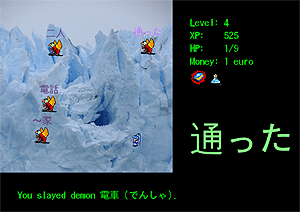
  • JRPG: This kanji learning game (Windows) is styled after classic SNES RPG games. I haven’t played it myself yet, but the description says that some of the kanji demons reach the difficulty of JLTP Level 2, so it might be worth taking a look at!

—

These are just a handful of the games I was able to scrounge up. I also found some games for very advanced learners on some Japanese sites, but I’ll save those for next time as well. If you have a particular game you like or find useful, please leave a comment or email us at shinpai.deshou@gmail.com so we can include it in a future post!

Next week look forward to a special FLF games post on Hanafuda by Rachel! Happy clicking!

Posted in fun links, study tools, useful links | Tagged , , , , , , , , | Leave a comment

Call for Papers: ECO-CITIES IN PAN-ASIA International Conference

Here’s a very interesting announcement for an international conference headed by the International Eco-Cities Initiative, a multi-national research network coordinated by scholars at the University of Westminster.

—

ECO-CITIES IN PAN-ASIA – International Conference
Date: June 17-18, 2011
Location: Johns Hopkins University, Baltimore, MD
Call for Papers Due Date: January 14, 2011

The participation of early career researchers and practitioners is particularly welcome and will be supported through a competitive travel bursary scheme.

Deadline for submitting abstracts (250 words): 14 January 2011.
Please send the abstracts to: d.tomozeiu@westminster.ac.uk

Proposals are invited for papers to be presented at the 5th International Conference hosted by the International Eco-Cities Initiative in collaboration with Johns Hopkins University, the Smithsonian Institution and the University of Westminster. The conference will bring together academics, planners and policy experts with the aim of analyzing and comparing a variety of eco-city developments in China, India, Japan, South Korea and other Asian countries. The focus will be on discussing diverse eco-city initiatives within their specific local and national contexts, as well as comparing relevant governance and innovation perspectives across national and cultural boundaries.

We welcome papers discussing (i) individual eco-city case studies; (ii) cross-national comparative analyses; and/or (iii) theoretical perspectives relating to eco-city innovation in various Asian contexts.

For more details please visit: http://www.westminster.ac.uk/ecocities
(see International Conferences link)

Daniel Tomozeiu
University of Westminster
309 Regent St
W1B 2UW, London, UK
Email: d.tomozeiu@westminster.ac.uk
Visit the website at http://www.westminster.ac.uk/ecocities

Posted in announcements, conferences | Tagged , , , , , | Leave a comment

CIA Open Source Center

If you’re interested in government work with foreign languages, you may want to check out what the Open Source Center has to offer. I encountered this resource via an email on an information session happening at Ohio State, but the only info besides the website that I have is below.

Sure enough, there is nothing that I can find on the site which leads you to information about becoming a part of OSC. Only government employees have access to the information as well. But then again, this is the CIA- secrecy is everything, right? If you think government intelligence is for you, it might be worth taking a closer look and trying to find out how to join through some of their contact info. You can find a brief PDF of OSC’s history here.

—

The Open Source Center (OSC) is the US Government’s premier provider of foreign open source intelligence. OpenSource.gov provides information on foreign political, military, economic, and technical issues beyond the usual media from an ever expanding universe of open sources. Our website contains sources from more than 160 countries in more than 80 languages and hosts content from several commercial providers, as well as content from OSC partners.

If you are not eligible for an account because you do not have an official U.S. Government purpose, you may subscribe to OSC information through World News Connection (WNC), an on-line news service. Please contact WNC at http://wnc.dialog.com or at 1-800-3-DIALOG.

~

OPEN SOURCE OFFICERS (OSOs), the Intelligence Community’s experts in collecting and analyzing publicly available information in the foreign arena in support of national security.  OSOs use foreign language and area knowledge to review and assess publicly available information (radio, TV, press, etc), Internet sites, and specialized publications to deliver high-impact products to the US foreign policymakers. OSOs develop and apply in-depth knowledge of a broad range of publicly available information to identify trends, patterns, and often subtle relationships that provide unique insights into national security issues.

OSOs may specialize in an area of the world (country or region) or a specific topic (i.e., targeting, military, economics, emerging media technologies, terrorism, weapons proliferation, science & technology, etc).  Additionally, OSOs may manage the collection and analysis of open sources by foreign national staff and contractors throughout the United States and overseas.

Foreign Languages Sought:

Chinese, Turkish, Kurdish, Japanese, Dari/Pashto, Farsi/Persian, Indonesian, Korean, Urdu, Arabic, Russian and Central Asian dialects, East European languages, two or more West European languages, regional dialects, etc.

Posted in jobs, useful links | Tagged , , , , , , , , , | Leave a comment