FLF: Nothing like human sacrifice to top off a good castle!

For most, talk of human sacrifice brings to mind the Pre-Columbian Americas, such as Aztec sacrifices to the sun god of war, Huitzilopochtli, but this tradition has taken many forms all over the world. Earlier last year Pink Tentacle featured an article on a Japanese tradition of human sacrifice, the hitobashira 人柱, or human pillar, and it’s consistently one of the most fun legends I come across in my medieval castle research.
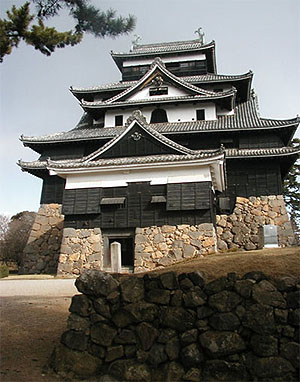
Photo by Japanese Castle Explorer

The idea of hitobashira is a simple one: in order to placate spirits of the earth (upset by construction processes), one makes a human sacrifice inside the hole in which a building’s pillar is to be set, and this will ensure the safe completion of a building. Numerous locations across Japan have legends about hitobashira, and Pink Tentacle describes one of the most famous at Matsue Castle (Shimane prefecture):

According to local legend, the stone wall of the central tower collapsed on multiple occasions during construction. Convinced that a human pillar would stabilize the structure, the builders decided to look for a suitable person at the local Bon festival. From the crowd, they selected a beautiful young maiden who demonstrated superb Bon dancing skills. After whisking her away from the festival and sealing her in the wall, the builders were able to complete the castle without incident.

However, the maiden’s restless spirit came to haunt the castle after it was completed. According to folklorist Lafcadio Hearn, who described the castle’s curse in his 1894 work “Glimpses of Unfamiliar Japan,” the entire structure would shake anytime a girl danced in the streets of Matsue, so a law had to be passed to prohibit public dancing.

Lots of castles, especially, have these types of stories. According to historian Owada Tetsuo in his book Sengoku no shiro (Sengoku Castles), human pillar legends can typically be divided into two patterns:

1)      A castle’s stone walls or a building was destroyed, and an onmyouji (a type of diviner or occultist) would divine that a curse from the gods of the land was present, and therefore it was necessary to erect a human pillar.

2)      From the beginning of construction a human pillar was erected in order to pray for safe completion of the structure.

Photo by Japan Photo

Some samurai legends also recount either in response to a supernatural event or as a show of loyalty to one’s lord (who was building a residence), a samurai would commit seppuku, slitting his belly and then jumping into the hole to protect his lord even in death.

Sadly for those of us that love when creepy ghost stories are close to reality, substantial evidence of hitobashira is few and far between, although at Kiyosu Castle in Aichi prefecture the remains of severed dog legs have been found. It’s also possible that in lieu of actual people, dolls were thrown into the holes instead of real human sacrifices. Don’t be too disappointed, though, the PT article mentions a few notable examples of bridges and tunnels where bodies have been found and the human sacrifice rumors are still circulating.

If you’re interested in looking up some other locations, PT has listed these notable spots with hitobashira legends:

– Gujo-Hachiman castle (Gifu prefecture)
– Nagahama castle (Shiga prefecture)
– Maruoka castle (Fukui prefecture)
– Ozu castle (Ehime prefecture)
– Komine castle (Fukushima prefecture)
– Itsukushima shrine (Hiroshima prefecture)
– Fukushima bridge (Tokushima prefecture)
– Kintaikyou bridge (Yamaguchi prefecture)
– Hattori-Oike reservoir (Hiroshima prefecture)
– Imogawa irrigation channel (Nagano prefecture)
– Karigane embankment (Shizuoka prefecture)
– Manda levee (Osaka prefecture)

I recommend checking out basic information and photos of the castles here at Japanese Castle Explorer.

And if you’re interested in Owada Tetsuo’s history blog, you can find it (in Japanese only) here.


Posted in culture, fun links | Tagged , , , , , , , , , | 3 Comments

Not going on to graduate school for Japanese Studies

Are you trying to make a decision about attending grad school for Japanese Studies, but are you wondering if it’s really right for you just after undergrad? Don’t worry, there are plenty of good reasons to take an extended side trip and do something different! I’m here to write about my personal experience with my decision not to pursue graduate studies for a few years.

I graduated from Gettysburg College in 2008 and went to Fukushima on the JET Programme for 2 years. I’m now an administrative assistant at a high school study abroad program.

blurry thoughts about grad school

“What are your goals?”

In the fall of my senior year at Gettysburg, I started to consider my post-undergraduate path. I had passed the JLPT 2-kyuu exam in the previous year and was preparing for 1-kyuu (which I did end up passing, just barely). I knew I had more than the minimum Japanese level to apply for a Coordinator of International Relations (CIR) position with the JET Programme. JET was my first choice, but I did consider grad school.

I believe at the time I had a brochure with a title like, “Knowing if Grad School is Right for You!” I can’t recall where I picked it up, but it might have been at Gettysburg’s Center for Career Development. Usually this type of brochure begins by asking you to answer three to five questions to help you figure it all out. It isn’t a magic formula you can trust completely, so it’s worth having a discussion with your advisor about your grad school potential. In any case, I couldn’t answer the questions to my satisfaction.

The first question was something like, “Why are you considering a graduate degree? Do you have a clear understanding of what your career goals are?”

Well, to make this story short, I didn’t know.

I thought about it seriously for several days (looking back on it, I didn’t agonize over my decision for too long). I was interested in several fields of study (history, linguistics, social science), but I had no concept of how those things would translate into “Future Career A” or “Future Career B.” I couldn’t successfully narrow down my interests. In my junior year, I began focusing on anthropology and those courses broadened my area of interest beyond Japanese Studies, but I wasn’t prepared to commit to Anthropology.

I received good advice that your plan for grad school can change over time (despite how focused and detailed those application statements of purpose appear!). However, if I wasn’t convinced I had a plan, then it would be best for me to put off grad school and save the money. I was also burnt out from being a student and the prospect of working was exciting. My idealistic thought was, why force the grad school decision when there are so many things I haven’t done yet?

Turning life experiences into a career

For the time being, I decided to go back to Japan with the JET Programme. I was unsure of my future career for most of the 2 years I spent in the mountains of Fukushima. I had chosen a good path that would eventually lead me to a solution, but it took some time. I was attempting new activities, which started to satisfy my desire to gain more experience and confidence beyond my comfort zone.

Ironically, the new brought me back in touch with the past. Working in a Japanese school environment, I remembered my first study abroad year in Japan during my junior year of high school. I suddenly realized that I had passion for study abroad and I wanted to work in that field.

Eight months after that turning point, I’m looking back and wondering why I didn’t realize it before. My positive experiences studying abroad with Rotary International and Kansai Gaidai make me a good candidate for administering such programs and building cultural experiences for a new batch of study abroad hopefuls.

Right now might be an especially good time to start working in study abroad because of the Global 30 Project. Japanese universities are developing more internationalized programs that will appeal to foreign students. International faculty and administration can make a huge contribution to Japanese institutions. While the numbers of Japanese university students studying abroad continues to decline yearly, the numbers of foreign students are always growing. In addition to academic programs, they will also need assistance and support in their daily lives.

Getting into the field


As a JET, there were some opportunities for information about how to search for a job on your own in Japan. But, those were only guideposts and encouragements. The truth is that many jobs are never advertised, so you have to be proactive about the job search. It helped that I was already in Japan on a working visa, but of course no one was going to just knock on my door and offer me a job. You really have to be willing to put yourself out there and ideally show potential employers specific reasons why you are the best person for the job.

I polished my resume (in English and Japanese), practiced “walking through” my resume in front of the mirror, registered for online job search engines (such as CareerCross), and kept my eye on the hiring pages of major universities. I also signed up for JAFSA`s (Japan Network for International Education) mailing list. In addition to announcements about conferences, universities also post job announcements from time to time. Mailing lists are one good way to find opportunities, but it also helps to go to networking events and meet professionals.

Through my research, I started to learn about the state of study abroad, what professionals are doing to strengthen their programs, and where the jobs could be found. Most university positions start in the spring, while I was looking for a job starting in August. I kept my job search area wide; I would have relocated to almost anywhere. Luckily, in my final month on JET, I was hired for an entry-level position with a high school study abroad program in central Japan. It started the day after my JET contract ended.

Years after graduation, I’m looking at a similar “Deciding if Grad School is Right for You” questionnaire and that first question about goals is much easier to answer. My goals are much clearer to me after time away from studying. Many of the programs I’ve looked at require work experience, so I feel that I’m on the right track. After getting at least two years of experience at my current job, I hope to start applying to grad schools in the US. I’m very thankful to be using some marketable skills (translation, business manner, office management) that I can further develop in grad school and hopefully have luck in the employment field.

It’s amazing what a difference work experience can make in terms of confidence and maturity, so if you are unsure, it might be beneficial to take your time before rushing into the grad school decision.

-Nyssa

===

Nyssa Shannon received a B.A. in Japanese Studies with a minor in Anthropology from Gettysburg College.  She is a former JET Programme participant and served as a Coordinator of International Relations in Nishiaizu-machi, Fukushima (2008-2010). After returning to the US in 2011, she earned an MA in Intercultural Relations from Lesley University (’13). Nyssa then worked in administration as a cultural interpreter for a Japanese manufacturer in the Midwest.

Posted in graduate school, JET, jobs, living abroad, main posts, study abroad | Tagged , , , , , , , , | 4 Comments

SOAS Summer Programme in London: Empires in World History

The School of Oriental and African Studies at the University of London announces its summer program “Empires in World History”

—

Empires in World History: Merchant Capital, Colonialism and World Trade


Website: www.soas.ac.uk/ifcels/summer/empires/
Minimum Entry Requirements: 3.0 GPA (US) or equivalent
Length of programme: July 18 to August 5, 2011
Application Deadline: May 16, 2011
Duration: Three weeks
Mode of Attendance: Full Time
Fees: £1,600 – Includes: tuition, student hall accommodation with breakfast, London excursions, and overnight Paris excursion. Airfare not included.

—

This three week summer course examines how people, political regimes and capital created the modern world economy. Starting with the status of EurAsia circa 1500, students will chronologically examine the vectors of change, resistance and transformation in Africa, Asia and the Near and Middle East. Through daily lectures, punctuated by excursions across the historical and contemporary cityscapes of London and Paris, students will be invited to identify broad patterns of change in world historical perspective by engaging a series of case studies drawn from the histories of individual societies in transition. This course is designed specifically for students desiring credits transferable to their home institution.

Based in the historic Bloomsbury district of London, just a few minutes’ walk from the British Museum and the British Library, the School of Oriental and African Studies (SOAS) is a college of the University of London and the only Higher Education institution in the UK specializing in the study of Asia, Africa and the Near and Middle East. SOAS offers a unique convergence of languages, disciplinary expertise and regional focus, and offers the largest concentration in Europe of faculty concerned with the study of Africa, Asia and the Near and Middle East.

Contact:

World History Summer Programme IFCELS
School of Oriental and African Studies
University of London
Thornhaugh Street, Russell Square
London WC1H 0XG, UK
Email: ifcels@soas.ac.uk
Phone: +44(0)20 7898 4800

—

Image from Empires in World History

Posted in announcements, graduate school, study abroad, summer program, undergraduate | Tagged , , , , , , , , , , | Leave a comment

Stanford University Library Travel Grants

Here’s another competition for travel grants for students and scholars of East Asian Studies to use Stanford University’s East Asian Library collection.

—

The Stanford University Center for East Asian Studies is now accepting applications for its 2010-11 travel grants for scholars of East Asia to use the Stanford East Asia Library collection.  Funded by the Department of Education Title VI program, the Center will award up to six grants on a competitive basis to help defray the cost of travel and lodging for scholars of East Asia at other institutions who wish to utilize the collection at the Stanford East Asia Library. The grants will be paid as reimbursements of expenses in compliance with University travel guidelines. Candidates must secure approval prior to travel.  The Stanford East Asia Library collection includes roughly 700,000 volumes in Chinese, Japanese, Korean, and western languages.

Further information about the library collections is available at http://lib.stanford.edu/eal or by contacting the relevant area librarian.

Eligibility

Scholars (faculty and advanced graduate students) of East Asia at

other institutions who wish to utilize the collection at the Stanford

East Asia Library between February 1 and August 14, 2011.

Amount

Up to $500 per trip.

Application Procedures

Applicants must submit the following by email to  jgroschwitz@stanford.edu

*  A current curriculum vita
*  A brief statement (not to exceed 250 words) describing their research, the need to use the East Asia Library collection, and proposed travel dates
*  A list of resources they would like to access (applicants must check availability of these resources in the Library’s online catalog or by contacting the relevant area librarian prior to submitting applications)
*  An estimated budget

Deadline

Applications are due February 1, 2011

Contact

John Groschwitz
Associate Director
Center for East Asian Studies
Phone: 650.736.1759
Email: jgroschwitz@stanford.edu

Posted in announcements, financial assistance, funding | Tagged , , , , , , | Leave a comment

Job Opening: Associate Professor at Tokyo Gakugei University (TGU)

Tokyo Gakugei University (TGU) is looking for a full-time Associate Professor or Lecturer in International Exchange.

Job Description:
Responsibilities and duties include:
(1) Planning and Management of International Academic and Educational Exchange, and Raising Competitive Funds
(2) Research on Quality Assurance in University-based Teacher Education in East Asia
(3) Coordinating Exchange with Partner Universities

Qualifications and Experience:
(1) M.A. or equivalent research achievements
(2) Experience of engaging in international service at one or more educational institution
(3) Ability to conduct duties and communicate in Japanese and English (A good command of Chinese or Korean would be advantage.)

Application Process:
To apply, applicants must submit:
(1) A full resume/CV (academic background starting from high school), with a photo, plus contact address, phone number and e-mail address (A4 sheet)
(2) A proof of the final stage of education
(3) A complete list of previous research and educational achievements (Free-form):
ⅰ Books published
ⅱ Articles and research papers published*
ⅲ Other research and educational achievements
*All peer-reviewed/refereed articles and papers must be so identified.
(4) Copies (one each) of three major publications (Offprints and duplicates are acceptable.)
(5) A complete list of previous achievements in the field of international exchange (starting from the oldest one)
(6) Essay on applicant’s ambition for international exchange at university (A4 paper,
approx. 2,000 characters in Japanese.)

Applications must be received by February 10 , 2011.

Position Appointment Date: April 1, 2011.

Submit materials to:*International Planning Unit, International Division, Tokyo Gakugei University 4-1-1 Nukuikita-machi, Koganei City, Tokyo 184-8501, Japan * In red ink, print “Faculty Position Application” on the envelope. The envelope must be sent by registered mail.

TGU is an Equal Opportunity Employer. TGU is committed to a policy of equal opportunity in employment without discrimination,including that based on nationality and/or disability, and also in compliance with the Basic Law for a Gender-equal Society of 1999.

For a complete description of the application/selection process see TGU`s website:

http://www.u-gakugei.ac.jp/~jinjika/shokuin-bosyu/index.html

Posted in announcements, job openings, living abroad | Tagged , , , , | 1 Comment

Funding Opportunities for International MBA Students at the Doshisha Business School

This information is from Dr. Andrew Staples via Great Lakes JETAA. Although this information it is targeted at former JETs, the funding opportunities are for international students in general. -Leah

Additionally, there is an open day at Doshisha Business School for JETs on 12 Feb. 2011 (scroll down in the News section linked here for details). Please contact Dr. Staples at the email address below for more information.

My name is Dr. Andy Staples and I am a visiting professor at Doshisha Business School, Kyoto, Japan. I am writing to you as a JET alumnus (Fukuoka, 1996-1999) and AJET Group Associate Member to pass on details of significant funding opportunities that may be of interest to any of your [JETAA] members considering enrolling on an MBA program in Japan (please see below). I am keen to develop opportunities for JET alumni….

Dr. Andy Staples PhD
Associate Professor
Doshisha Business School
astaples [AT] mail [DOT] doshisha [DOT] ac [DOT] jp

The University and MBA

Based in the heart of Kyoto, Doshisha University is Japan’s second oldest private university with a long tradition of international exchange reinforced by institutional agreements with top-ranked institutions around the world including the University of Cambridge in the UK, Stanford in the USA and Peking University in China. The university was designated as a ‘Global 30’ institution by the Japanese Ministry of Education in 2009 in recognition of its proactive internationalization strategy which includes the launch of a number of new undergraduate and postgraduate program delivered in English.

As part of this process the Graduate School of Business (Doshisha Business School, established 2004) launched the Global MBA in 2009. This is a two-year, full-time program delivered entirely in English by an international and research active faculty. 40 students representing 20 different nationalities are currently enrolled on the program reflecting the international, diverse and cosmopolitan nature of the degree. The average Global MBA candidate is around 27 and has approximately 3 years of work experience. Many of our students have had previous experience of studying or working in Japan and some are seeking to develop a Japan based degree although all have joined the program for its content, structure and global outlook. Our mission is to educate young managers/executives willing to take the initiative in business and society as proactive leaders capable of seeking out business opportunities while at the same time making a contribution to the well-being of our society.

Applications

We currently have one former JET enrolled and believe that the program offers an excellent next step for JETs interested in developing an internationally focused career while remaining based in (or returning to) Japan. Significant funding opportunities exist for 2011 entry including scholarships, monthly stipends and fee waivers for outstanding international students and full details can be found on our web page (http://gmba.doshisha.ac.jp/). Applications are open now and early submissions are advised, particularly for those seeking funding. Potential applicants are encouraged to submit a CV/resume and personal statement outlining interest in the Global MBA and career ambition on a no-fee/consultative basis. Please also feel free to get in touch if you would like to informally correspond with a former JET enrolled on the program.

Posted in announcements, financial assistance, funding, graduate school, JET | Tagged , , , , , , | Leave a comment

NEAC grants available

The Association for Asian Studies (AAS) Northeast Asia Council (NEAC) has a number of Japan grants available thanks to the generous funding of the Japan-U.S. Friendship Commission, but the grant deadline is fast approaching.

Grants are available in a number of categories including: United States or Japan research travel; Japan conference/seminar/workshop funding; Japan Instructional materials; etc.

The grant deadline for receiving applications in our Ann Arbor office is Tuesday, February 1, 2011. Award notification will be made by the end of April and submitted projects must begin after May 1, 2011 to be considered.

Please note:

*Individual applicants must be U.S. citizens or permanent residents, and seminars/workshops/conferences must be held in the United States. Institutional applicants must be located within the USA.

*For the United States and Japan research travel categories only, applicants must be current AAS members at the time of application.

Please see the AAS website for further details and application forms:

http://www.asian-studies.org/grants/main.htm#NEAC-JAPAN

Posted in announcements, financial assistance, funding, graduate school, living abroad | Tagged , , , , | Leave a comment

Fun Link Friday: Losing Time to Books Ngram Viewer

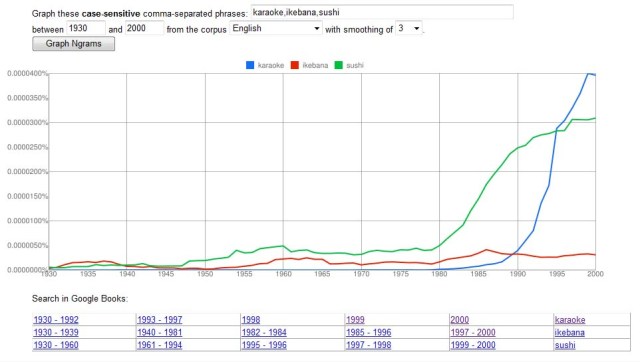
Google Labs introduced a new feature a little while back called the Books Ngram Viewer, which has a lot of interesting potential for a variety of uses (including just plain for fun!). Since I’m no expert in statistics, it’s mostly the fun we’re going to talk about here. The premise of the Viewer is that you enter a word or phrase, and then it displays a graph showing how those phrases have occurred in a corpus of books. You can enter your own parameters for time, too (the standard setting on the homepage provided is 1800-2000). I haven’t had a lot of time to get to know functions intimately, but I’ll briefly outline the process below.

Say you want to get a look at how often the words “sushi,” “ikebana,” and “karaoke” appear. Enter them, separated by commas, and be sure to put in the span of years. I used 1930-2000.

And there you go! It looks like the occurrence of these three words was pretty steady (except karaoke, which didn’t exist yet) until 1980, when suddenly everyone REALLY wanted to talk about sushi. Yum. Then 1990 hit, and the population was ready to talk karaoke. But apparently, no one is going to be getting intense about traditional flower arrangement any time soon.

If you click on the dated options below “Search in Google Books,” you’ll find cited references from which these results came for each of your words. Which is actually pretty darn neat! If you click on 1999 for karaoke, you can find all the books, articles, and magazines Google has recorded with that keyword.

One scholar on the PMJS mailing list playing with this tool brought up how these citations can illustrate certain cultural trends, pointing out that the graph for “netsuke” (Japanese miniature sculptures from the 17th century on) illustrates the great number of museum and art catalogues that published works on them during the “netsuke boom” of the early 20th century.

Although the Books Ngram Viewer is case sensitive, which make skew some results, and I can’t speak to the corpus of books Google is using, this is a really fascinating and fun way to look at trends in published work, whether you’re using everyday words or those that come to us from foreign cultures.

I was pretty excited to put in “shinpai,” but glancing through the citations, “shinpai” also appears to mean a type of license/credentials. I guess everyone wasn’t all “worry” between 1985 and 1992. 🙂 Nevertheless, I’ve lost a lot of time to playing with this new tool, and it’s definitely been fun.

Have fun and happy searching!

—

Netsuke image from Wikipedia.

Posted in culture, fun links | Tagged , , , , | 1 Comment

Blog Review: Observing Japan

We live in an increasingly globalized society in which it is becoming more and more important to familiarize ourselves with other cultures and political environments. Many of us have our hands full keeping up-to-date with our own government’s policies but as responsible citizens of the world we want to look beyond our borders to obtain a more comprehensive view of world events. For those of you looking to expand your political horizons, Observing Japan is the blog for you.

Observing Japan was created by Tobias Harris, a Japanese politics specialist who worked for a Democratic Party of Japan member of the upper house of the Diet from 2006 to 2007. He is now a Ph.D. Candidate in political science at MIT. He has been published in the Wall Street Journal Asia and the Far Eastern Economic Review, and has provided commentary for CNBC Asia, Bloomberg, BBC, and NPR. Mr. Harris is respected throughout the Japanese political science community.

The blog is directed toward a well-informed audience looking for analysis and insight on current events related to the Japanese government. There is an extensive list of resources on the sidebar as well as links to relevant blogs, media and think tanks. The blog archives, also located on the side, are organized by date allowing the reader to search for specific political events such as the pivotal August 2009 elections in which the underdog party, the DPJ, came into power after fifty solid years of LDP control. Further down the page is a Labels section which enables the reader to search by subject. It is an excellent place to turn to if you are looking for an opinion on the broader political implications of specific events, such as the recent exchange of fire between the North and South Korean militaries.

Observing Japan is an excellent resource for readers who want to expand their knowledge of current Japanese politics. Tobias Harris provides a unique perspective into the recent rise of the DPJ and other hot topics of the day such as whaling, the controversial US base located on Okinawa, and Japan-China relations. The Political atmosphere of Japan has been in flux ever since Junichiro Koizumi left office with five different Prime Ministers in the past five years. Observing Japan provides an expert English language opinion on these recent events and many more. We highly recommend it.

Posted in blogs, culture, living abroad, study tools, useful links | Tagged , , , , , | Leave a comment

Job opening: Instructor for Manga and Animation

The IES Abroad Tokyo Center seeks a qualified instructor for Anthropology 343 “Japanese Manga & Animation,” for the spring (April through July) semester, 2011.  The course meets one afternoon per week for three hours; instruction to be conducted in English.

IES Abroad is a U.S.-based educational organization overseen by a consortium of universities and colleges, and instructs over 4,500 undergraduate students abroad each year in programs located throughout Europe, Asia, Australia, New Zealand and Latin America.

Located in the Chiba, Makuhari area, the IES Abroad Tokyo Center offers a rigorous academic program to students from institutions all over the U.S., through partnerships with Kanda University of International Studies and Meikai University.  IES Tokyo programs are established on the educational belief that students learn the best and most through participation in and interaction with the local culture within which they are living and studying.

Qualifications & Compensation

Qualified candidates must hold a graduate degree in an appropriate field (PhD or ABD preferred); teaching experience, and familiarity with American higher education system is a plus.  Compensation will be commensurate with qualifications and experience and will include reimbursement for transportation expenses.  Continuing faculty are also eligible to apply for small grants offered to assist with travel to professional conferences or other research-related expenses.This is contract position and open to renewal in subsequent semesters.  For further information contact Karl Friday, Center Director at kfriday@iesabroad.org .

How to Apply

All applicants should submit a letter of interest, CV, and names and contact information for three letters of recommendation to:

IES Abroad Tokyo Center
Attn: Manga/Anime Search
1-7-1 Nakase, SCEC Bldg. 3rd Fl
Mihama-ku, Chiba-shi
Chiba-ken 261-0023.

Review of applications will begin on Feb. 1 and continue until position is filled. IES is an equal opportunity employer and encourages applications from all qualified candidates.

Posted in announcements, job openings, jobs, living abroad | Tagged , , , , , , , , | Leave a comment