Bento have hit the states! Ready to make your own?

Here’s a brief history of and some great resources for getting started on bento-making, whether it’s in Japan or here in America.

Bento is the Japanese version of a packed lunch, typically taken to work and school by adults and children as a convenient and nutritious meal. Traditionally, the meal is divided into two parts: one half of the box is filled with rice, while the other half will be filled with a variety of accompanying foods, such a vegetables, fish, eggs, or meat.

It’s not uncommon for the person who prepares the bento to make it while they are preparing a larger main meal, perhaps dinner, and choose foods that will stay fresh the longest and will be good to eat the next day. I know what you’re thinking: leftovers. However, what makes a Japanese bento stand out from the American packed lunch is the presentation of the food in an aesthetically pleasing manner. The Japanese truly know that people eat with their eyes first. Here are a few examples of rock star bentos:



The word “bento” (bentou 弁当) is said to have originated from the 16th Century military commander, Oda Nobunaga (1534-1582) who fed the large numbers of people that inhabited his castle by handing out simple meals to each individual. The word was created to describe the small convenient meal. Nobunaga did not begin the trend; he merely solidified it as part of Japanese culture. Bento can be traced as far back into Japanese history as the 5th Century, when people spent all day working away from the home needed something they could prepare quickly to take with them as they traveled.

In Japanese literature, Ise Monogatari’s Tales of the Ise contains illustrations of people eating dried rice during trips.  The meals they took were generally based around a staple diet of rice. However, these meals would vary based on the foods that were available and the region that they lived in. Nihon Shoki’s historical record Chronicles of Japan mentions how falconers would use feed sacks to carry their lunch when they went hawking.

During the Edo period (1603-1868), people took bento as a meal during outdoor excursions or to the theatre.  Makunouchi bento (bento served during a specific interval in the play featuring rice balls sprinkled with sesame seeds and assorted side dishes) first appeared during this period. In this era, bento was served less as a necessity and more as a part of leisure. After that, bento served on special occasions evolved into a specialized, sophisticated art form.

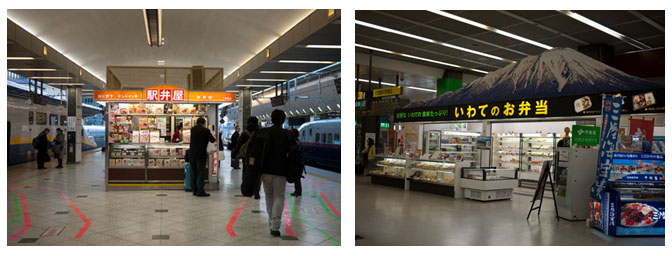
The Meiji period (1868-1912) was a period of immense modernization and industrialization for Japan. With the Japanese railway, Ekiben (bento sold at train stations) first appeared around 1885. Commuting to employment became an important part of many people’s lives. Ekiben consisted of rice balls with pickled plum inside (umeboshi).  Ekiben can still be found at train stations to this day.
Today, bento is as popular as ever. Ready-made bento can be found in grocery stores, convenience markets, and department stores. Restaurants and shops regularly offer bento as a take-out option.  Different ethnic varieties of bento can be found as well featuring Western, Korean, and Chinese dishes.

In the United States, bento has hit the main stream. Thanks to a New York Times post, interest in bento has taken off.  It’s no surprise that the number one and three Japanese cookbooks on Amazon.com is bento related. The Times reports that there are a number of reasons why bento is now big in the States.  For some parents, it’s the belief that if their child’s food looks like something they recognize, they’ll eat it. For dieters, it allows them ability to better control their portions. The preparation of food allows some people a pleasant artistic distraction, to make their lunch look pretty, and to indulge in their love of Japanese culture. For students, it lets them to consume a balanced diet while on a budget.

Bento blogs are also extremely popular.  Many blogs that I look at regularly for inspiration are:

Want to get started making your own bento?  JustBento.com finds that there should be ten rules to get started on bento:

  1. Bento should be reasonable healthy and balanced.
  2. Keep it simple.
  3. Make sure the bento is tasty.
  4. Make the bento, fun, colorful and attractive, but don’t fuss too much.
  5. Use seasonal, locally grown, natural ingredients whenever possible.
  6. Pay attention to safety and hygiene.
  7. Plan ahead.
  8. Stock up on homemade and store-bought staples.
  9. Keep costs down.
  10. Don’t try to replicate Japanese bento made in Japan, at least not all the time.

Check out Maki’s Top Ten Rules for Bento on JustBento.com for details.

The most important thing for me about Bento? Have fun. It translates well into the food.

– Tony

For more information on bento, please check out the following links:

Bento Basics. Retrieved from http://justbento.com/handbook/bento-basics.

Japanese box lunches. Retrieved from http://web-japan.org/kidsweb/virtual/bento/index.html.

Lucks, Eva (2001). Eating our way through Japanese history: A brief study of the obento. Retrieved from http://artsci.wustl.edu/~copeland/obento.html.

(Check out the bibliography for even more resources.)

Storey, Samantha (2009). Bento boxes win lunch fans. New York Times. Retrieved from http://www.nytimes.com/2009/09/09/dining/09bento.html.

—

All images from http://justbento.com/

Posted in culture, fun links, living abroad, main posts, useful links | Tagged , , , , , , | 3 Comments

Lecture: Japanese Technical Translation: Freelancing as a Career

Information from jetwit.com via PNW JETAA.

Japanese Technical Translation: Freelancing as a Career

When: Tuesday, Feb. 1 from 3:30-5:00pm

Where: UW Campus, Denny Hall 216

Learn about technical translation as a career. Mr. Barrett will help us understand what technical translation is and how it differs from interpretation and from non-technical translation. Aspects of this introductory discussion include: qualifications for entering the field, where to find work, translation issues, state of the industry, pay ranges, types of work, professional organizations, starting out, and what to expect from clients. He will also discuss machine translation and its potential impact on the future of the industry.

http://jsis.washington.edu/japan/events.shtml

Posted in announcements, jobs, social networking | Tagged , , | Leave a comment

Funding from the Aurora Foundation

We previously featured the Aurora Challenge Grant for funding possibilities, but there is also a Japanese Language Scholarship they offer. Unfortunately the deadline has passed for this year, but it might be worth bookmarking for next year! Also, the Challenge Grant is still open for applications until the end of May.

—

1. Aurora Japanese Language Scholarship
2. Aurora Challenge Grant

Japanese Language Scholarship Foundation, aka Aurora Foundation, is currently accepting applications for the year 2011 scholarship and Aurora Challenge Grant. The application forms can be downloaded at www.jlsf-aurora.org.

1. AURORA JAPANESE LANGUAGE SCHOLARSHIP

JLSF was established in 1998 to encourage teachers of the Japanese language as well as to generate international cultural exchange. These awards will enable the awardees to carry out a project of their choice in Japan. Each awardee will receive a $3,000 scholarship and roundtrip air tickets from the USA to Japan (coach class). The project can be anything that would enhance the quality of the awardee’s teaching. Applicants are encouraged to propose any projects they would like to carry out but are currently unable to because of the lack of funding. Types of projects awardees may choose are unlimited! For example, projects may include:

  • Studying Japanese at a pre-existing program, such as the Japan Foundation Japanese-Language Institute, or the Hokkaido International Foundation
  • Traveling around the country to gather authentic materials for teaching purposes, including taking photographs and making films
  • Visiting a school(s) in Japan to learn more about their education system
  • Volunteering at Japanese non-profit organizations to learn differences and similarities in how different cultures operate in a working environment
  • Experiencing Japanese New Year’s with a host family and write up the experience on a web page
  • After their Japan trip, scholarship awardees will be required to submit reports to the JLSF about their experiences in Japan. Each awardee will also have the (optional) opportunity to attend the annual ATJ Conference to address the conference about their scholarship experience in Japan.

    Qualifications:

  • Non-native Japanese speaker/ non-heritage Japanese speaker
  • AND

  • In-Service Japanese language teacher in any school level OR
  • Pre-service Japanese language teacher currently studying to obtain a teaching credential for teaching Japanese.
  • Must be available for an oral interview in person or by phone.
    Must be able to attend the award ceremony to be held in the Autumn of 2011 in Los Angeles (date to be announced). (Limited travel expenses and accomodations may be covered by JLSF as needed.)

    Required Applications Documents:

  • Completed application form
  • Current resume/biography
  • Official college transcript sent directly from the college to the JLSF
  • Photograph of applicant (optional)
  • Two letters of reference.
  • A typed letter no longer than 3 pages on 8-1/2″ X 11″ (double-spaced, font size 10pt or 12pt) that describes the potential scholarship recipient and proposed project. The letter should include the applicant’s background, goals, current activities, commitment to Japanese language education, a detaile description of their proposed activity in Japan, and a proposed budget (excluding airfare between the U.S. and Japan).

    Deadline and Submission
    All applications must be mailed on or before January 21, 2011 to:
    JLSF Scholarship Application Submission
    3127 Nichols Canyon Road
    Los Angeles, CA 90046

    Judging Criteria:

  • Long term commitment to Japanese language education
  • Teaching experience and training background, i.e. methodology courses, workshops, seminars, and conference participation
  • Usefulness and appropriateness of the project
  • Design and feasibility of the project within the budget
  • Applicability of the project results to teaching
  • Up to two winners will be selected, depending on application volume and quality of applications, from anywhere in the USA. Selection will be announced by February 28, 2011
    Entries, including photographs, will not be critiqued or returned. From the time of submission, all entries are the property of the JLSF.

    2. AURORA CHALLENGE GRANT

    The grant will be awarded to a citizen of the USA who resides in California and has a unique dream, in any field or endeavor, which is related to Japanese culture and which it would never be possible to realize without traveling to Japan between fall 2011 and summer 2012. There is no age limit and no GPA/Scholastic achievement requirement. The award will go to an individual with a creative dream or challenge that, if fulfilled, would contribute to global goodwill and intercultural appreciation.

    The winner will receive a $3000 scholarship and roundtrip air tickets from the USA to Japan (economy class). The recipient can travel anytime (for any duration) between fall 2011 and summer 2012. By awarding this grant, the Aurora Foundation hopes to help the winner enhance the pursuit of her or his truest, most heartfelt dream by providing the opportunity for a once in a lifetime experience.

    All applicants must be citizens of the USA. Selection criteria will include the commitment of the applicants to their dream projects, necessity of Aurora’s support, and positive future potential. After the Japan trip, the grant awardee will be required to submit a report to the Aurora Foundation about the experience in Japan and progress of the project.

    Aurora Challenge Grant Qualifications:

  • Applicant must be a citizen of the USA residing in California
  • Must have a unique and voluntary dream or challenge which requires travel to Japan between fall 2011 and summer 2012
  • Must be available for an interview in person or by phone
  • Must be able to attend the award ceremony to be held in Los Angeles in Fall 2011 (date TBD). (Travel expenses and accomodations will be covered by JLSF as needed.)
  • Aurora Challege Grant Required Application Documents:

  • Completed application form
  • Current resume/biography
  • Materials supporting the applicant’s project or concept, if applicable (such as photographs, video, visual aids, etc.)
  • Photograph of the applicant (optional)
  • Two letters of reference.
  • A typed letter no longer than 3 pages on 8″ X 11″ (double spaced, font size 12pt) that describes the potential scholarship recipient and the project. The letter should include the applicant’s background, goals, current activities, and a detailed description of the proposed activity in Japan and a proposed budget (excluding airfare between the USA and Japan).

    Deadline and Submission:
    All applications for the Aurora Challenge Grant must be submitted by May 31, 2011 to
    Aurora Challenge Grant Application
    3127 Nichols Canyon Road
    Los Angeles, CA 90046

    One winner will be from California and selection will be announced by June 20, 2011.
    Entries, including photographs, will not be critiqued or returned. From the time of submission, all entries are the property of the JLSf.

    Judging Criteria:

  • Firm commitment to his/her dream project and to some facet of Japanese culture.
  • Necessity of Aurora Foundation’s support.
  • Experience and background pertinent to the applicant’s dream project.
  • Future potential to enhance
  • Posted in announcements, applications, culture, financial assistance, funding | Tagged , , , , , , , | Leave a comment

    One year Assistant Professor, East Asian History

    Institution Type:   College / University
    Location:   Colorado College, United States
    Position:   Assistant Professor

    The History Department of Colorado College invites applications for a one year position at the assistant professor level beginning in September 2011. Teaching responsibilities will be in East Asian History, specifically: ancient and modern China, modern Japan, and comparative or world history. The department seeks a gifted teacher who can both encourage historical interest in students majoring in other disciplines and engage potential historians in research problems. For more information, consult: the web page at http://www.coloradocollege.edu/Dept/HY/ . The ideal candidate will have completed all requirements for the Ph.D. by August 2011.

    Send letter of application, c.v., copy of graduate transcript, sample syllabus, and three letters of reference to:

    John Williams
    Department of History
    Colorado College
    14 E. Cache La Poudre
    Colorado Springs, CO 80903

    The college is committed to increasing the diversity of its community and particularly encourages applications from individuals who can identify strengths or experiences in this area that might contribute to that goal.

    Applications will be considered beginning February 15, 2011, until the position is filled.

    Posted in announcements, job openings, jobs | Tagged , , , , , , | Leave a comment

    DISCO International Boston Career Forum for Law Students

    For those looking into doing law using their Japanese language skills, JETs with J.D.s has posted a great introduction to the DISCO International Boston Career Forum. See the following link for more details:

    http://jetswithjds.wordpress.com/2011/01/22/discos-career-forum-for-jets-with-j-d-s/

    Posted in blogs, jobs, social networking, useful links | Tagged , , , , | Leave a comment

    Blog Review: Surviving in Japan (Without Much Japanese)

    Anyone who has been to Japan before mastering the language has had to learn the very valuable art of surviving in Japan without much Japanese. Whether it’s an important word like “トイレ” (toilet) or simple self-introduction, a little bit can go a long way. Which is why it’s so great to see a site out there like Surviving In Japan Without Much Japanese, which addresses this exact necessity and more.

    The author of the blog, Ashley, is a 20-something former JET currently doing part time teaching and freelance work in Japan. The goal of her blog is not to give a definitive explanation on how to survive or teach all the nuances of Japan living etiquette, but to provide helpful tips, resources, and some guidance from her own experiences in “surviving” to help out others going through life under the rising sun as well.

    In her “how-to index,” you’ll find an archive of articles arranged by key words on various topics. For example, you can skip ahead to Travel or Health, or just scroll down and look up each article individually beneath its heading, such as how to do a bank transfer (under Daily Life), how to find bus routes/schedules online (Travel), or words to know when ordering online (Food).

    All of the articles are extremely practical without being too technical. Glancing through these, there are a bunch I wish I had had when I first studied abroad, such as how to find a good deodorant in Japan (Oh, the curse of being a foreigner in the land of spray deodorant! Alternatives do, in fact, exist!) or 7 words to know when you have a cold. And for the ladies who didn’t stock up before they left, there are helpful guides to things like finding Japanese tampons and pads.

    Another great thing is that Ashley does Q&A posts as well, so you can send in your burning questions if you find yourself stumped. Almost all the articles have images and photographs to help you out where it’s relevant, and in addition to the posts themselves, Ashley has also compiled some basic internet resources that are useful to people struggling to get by without a lot of Japanese under their belts. The site has a simple, clean layout and is easy to navigate, so you’ll have no trouble finding what you’re looking for. There’s also a twitter account for the site, updated daily with additional neat and helpful things.

    I highly suggest you peruse Surviving In Japan Without Much Japanese yourself and recommend it to friends you know taking their first (or second, or third!) leap across the Pacific.

    Posted in blogs, culture, living abroad, useful links | Tagged , , , , , , | 3 Comments

    Position Available: Executive Director, Japan-U.S. Friendship Commission

    The Japan-United States Friendship Commission (JUSFC) seeks to recruit an Executive Director. The JUSFC, a US Government agency located in Washington, DC, makes grants to non-profit organizations, especially in higher education, for research and exchange with Japan. Applications may be submitted only online. Recruitment will be made through usajobs.gov from February 1 through February 28, 2011.

    During this time period please refer to www.usajobs.gov.

    Job announcement number: CK406842.

    For further information, please contact:
    Ms. Amanda Custer at Amanda.Custer@opm.gov


    Posted in announcements, job openings, jobs | Tagged , , , , | Leave a comment

    Fresh Ink: Ten Takes on Chinese Tradition (via 茶有の者 – A Man with Tea)

    For the Asian Studies and art historians/artists who read this blog, this is an excellent article on a current exhibit on Chinese art at the Museum of Fine Arts in Boston. A Man with Tea is a excellent Asian art/media blog by an MA candidate who specializes in Okinawa and holds another MA in art history.

    Fresh Ink: Ten Takes on Chinese Tradition I am still way behind on posting about exhibits I saw on the East Coast over winter break. Trying to catch up… but I realize I’ve lost my notes that I took of my impressions and thoughts while visiting this exhibit, which is only going to make the whole process that much more difficult, as I try to reconstruct those impressions from the photographs, and from memory. Fresh Ink: Ten Takes on Chinese Tradition at the Museum of Fine Arts, Boston, i … Read More

    via 茶有の者 – A Man with Tea

    Posted in blogs, culture, fun links | Tagged , , , | 1 Comment

    Princeton Graduate Workshop on Edo Calendars

    On April 8-9, 2011, the Princeton University East Asian Program and Princeton Institute for International and Regional Studies will be holding a graduate student workshop focusing on Edo period calendars and related calculations. The goal of the workshop is to gain some practical knowledge of and first-hand experience in the reading and compilation of an Edo-period-style calendar.

    If you are interested in participating in the workshop or have additional questions about its format or content, please contact Yulia Frumer (yfrumer@princeton.edu) by Tuesday, January the 25th. In your email please include your affiliation and a short description of your research. All are welcome to apply to participate, but financial support from the workshop itself is limited to graduate students. Princeton will provide participating graduate students with meals and accommodation during the workshop. In addition, some funds are available for travel reimbursement.

    Best regards,

    Yulia Frumer
    PhD Candidate
    History of Science Program
    Princeton University
    129 Dickinson Hall
    yfrumer@princeton.edu

    Posted in announcements, graduate school, social networking, study tools | Tagged , , , , , , , , , | 1 Comment

    University of Michigan Ross Business School 21st Asia Business Conference: “Asia: Navigating the Global Stage”

    Venue: Ross School of Business, University of Michigan
    Date: January 28-29, 2011

    There will be a Keynote Speech on January 28 (Friday) and Panels on January 29 (Saturday), 2011.

    This year’s conference will feature Singapore’s Ambassador to the US during our Keynote Speech, and executives from Japan, Korea, India and ASEAN, representing diverse companies such as Deloitte, Pfizer, Acer and more! There will be panels on China, Japan, Korea, ASEAN, India, Finance, Technology, Healthcare and Energy/Environment.

    Registration is open! You must register at our website in order to attend.

    For more information about our panelists and registration, please visit www.rossabc.com.

    You can also follow us on Twitter:
    https://twitter.com/umrossabc

    And join us on Facebook:
    http://www.facebook.com/home.php?sk=group_166644006687778

    Please share this invitation with any of your colleagues, classmates, and club members who may be interested, and we look forward to seeing you at the conference.


    Posted in announcements, conferences, graduate school | Tagged , , | Leave a comment