FLF: Winter Festivals in Northern Japan

As a JET in Akita Prefecture, I can attest to the fact that the cold, long and dark winter can lead to cabin fever and possible frostbite from below average indoor temperatures. One of the saving graces for those of us who live in Northern Tohoku aside from kotatsu, is Winter Festivals! Even if you do not live in Japan, it is possible to enjoy these festivals from afar by looking at the amazing pictures of snow sculptures galore or reading about the unique histories of traditional winter events. I would like to take a minute to highlight some of Northern Japan’s most amazing and bizarre winter festivals.

The Sapporo Snow Festival

Dates: February 7th to February 13th.
City: Sapporo City, Hokkaido Japan

I have been dying to see this festival for years. It is one of Japan’s largest winter events and about two million people come to Sapporo every year to see the gorgeous snow statues and ice sculptures that line the streets around Odori Park, the Community Dome at Tsudome and the main street in Susukino. This week long event features some of the most amazing snow creations on the planet, from the mind-blowingly gigantic to the spectacularly detailed. As the website for the festival says, Sapporo is turned into a “winter dreamland of crystal-like ice and white snow.” I finally have the opportunity to go to the Sapporo Snow Festival this year and I can’t wait! If you have a free minute to check out photo galleries of the festival, I definitely recommend it.

Kamakura Snow Festival

Dates:February 15th-16th
Place:Doro Koen Park in front of Yokote City Hall
City: Yokote City, Akita Prefecture

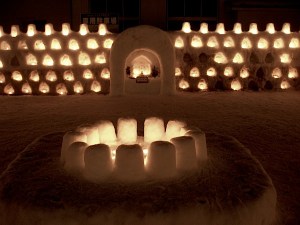
Kamakura are essentially small igloos made entirely of packed snow instead of blocks of ice. They consist of one small room that an adult would have to duck down into because of the height of the door. Often, benches are carved from snow on the inside of the kamakura and a small shrine lit by candles is constructed. This 400 year old traditional festival takes place in Yokote in southern Akita. During the festival, children sit in the kamakura and call out in Akita dialect to passers-by, inviting them in to have some sake, rice cakes, and sweets! It is definitely on my list of festivals to attend.

The Namahage Festival

(Designated a National Important Intangible Folk Cultural Property)

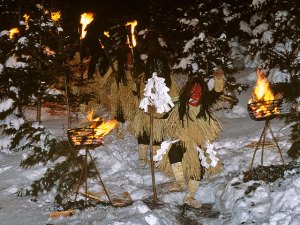
When I first heard about this tradition, I thought someone was trying to pull one over on me. The Namahage festival takes place in Oga on the Oga peninsula in Akita prefecture around New Years. Young men dress up in demonic blue and red masks as well as traditional straw garments. They go through the village and burst into the houses of new community members often carrying large knives with them. In low terrifying voices, they say in Akita dialect, “Are there any bad children here?” and they search the house for young kids. They inevitably scare the children half to death. They are supposed to embody the demons that take bad children away and the only way they can be placated is by giving them sake to drink. As the night goes on the “demons” get increasingly more intoxicated and rowdy. Even though the festival is only at New Years, the Namahage can be seen performing traditional Japanese drumming known as Taiko in Oga throughout the winter months.

Kandekko-Age of Nakazato

On the more bizarre side of winter festivities, is the Kandekko-Age Festival of Nakazato. In this fertility festival which is held every year on January 15th,  a small plow made of magnolia wood, aka. a Kandekko, is tied to a wooden penis made of walnut wood and attached to a sacred straw festoon. This creation is then thrown at the sacred Japanese Judas tree while people wish for a good harvest, a successful marriage and household welfare. According to the Semboku City Sightseeing website, “The wish is said to be granted if the Kandekko is thrown right, and the successful Kandekkos, when taken off and hung on fruit trees such as chestnuts and persimmons, will make the tree give plenty of fruits.” I have yet to witness this spectacle but for an account from someone who has experienced it first hand I highly recommend this guide which has been posted on the Akita JET official webpage.

Here ends my highlights of the festivals of Northern Japan but there are many MANY more that have not introduced. Again, I encourage you to read this entertaining guide to get an idea of the variety and sheer amount of winter festivals that take place in the glorious Akita Prefecture. Some things to look forward to from the guide are hadaka matsuri aka naked matsuri in which men strip down and throw water on themselves outdoors wearing only a funkoshi or loin cloth. Another great festival is one in which one side of a town faces off against another and they battle with very long bamboo poles. There are a wealth of fascinating traditions and I hope you have happy hunting learning about the winter fun that Japan has to offer!

—

This post has been submitted to the February Japan Blog Matsuri! It happens every month, so check it out!


Posted in culture, fun links, living abroad | Tagged , , , , , , , , | 3 Comments

William and Alice Hosokawa Fellowship Program for Coloradoans

This comes to us from Japan America Society of Colorado mailing list and web page.

Founded under the auspices of the Japan America Society of Colorado, the William and Alice Hosokawa Fellowship Program provides grants annually to create a better understanding of Japan by educating people in Colorado about Japanese history, culture and arts. Grants cover the two categories listed below:

  • Individual: Educational expenses, other than undergraduate tuition, which might include graduate tuition, travel expenses, books, and other materials.
  • Institutional: Funds for public programs, which might include conferences, symposia, performances, exhibitions, community events, and cultural exchange (other than staff salaries).

General Guidelines:
Grants are intended to assist Colorado-based individuals and nonprofit 501(c)(3) organizations with projects that promote goodwill and understanding through educational and cultural activities. Fellowships totaling up to $10,000 annually are meant to provide special opportunities for individuals and organizations to promote an understanding of Japan in Colorado. A project which receives a grant for 2011 must be commenced by April 15, 2012.

Application:
Applications can be downloaded here. Additionally, printed applications can be obtained from the Japan America Society of Colorado at 303-592-5364; Fax: (303) 592-5367; email:jascolorado@att.net. Applications must be postmarked on or before Friday, May 13, 2011. Submit seven (7) copies of the application and supporting materials by postal delivery.

Announcement of grant recipient(s) will be made in June 2011.

Best of luck to all applicants for the 2011 cycle!

Dilek Eccles

Executive Director, Japan America Society of Colorado

Posted in applications, financial assistance, funding, graduate school | Tagged , , , | Leave a comment

ESL Job Application Differences: Japan and Korea

Greetings, everyone! Amanda here. If you read my last post, you will remember I talked about why I didn’t do JET. This time I am back to tell you about application processes for different ESL jobs. Jen C. has already talked about the JET application process in more detail in another post; I will mention it briefly for comparison purposes, but will go into more detail with eikaiwa (English conversation/teaching) jobs and jobs in Korea. I can’t speak for other countries, since I only applied in Japan and Korea, but from what I can tell from recruiting sites, many countries seem to be similar to Korea.

Photo by Robert S. Donovan

As I’m sure you may know by now, JET has a very strict application timeline and one may only apply once a year. The application process begins in October, the interviews are administered in February, and new JETs arrive in Japan in August. Eikaiwa and Korean schools are very different in that you can often apply more than once a year. I applied to AEON, and they have interviews monthly. If I remember correctly, if you get rejected in an interview, you have to wait six months before applying again. For Korea, they hire at all times of the year because contracts begin and end at all different times, but their major hiring times I imagine are before the new semesters start. The beginning of the semesters are in the beginning March and the end of August, so they probably start hiring a few months before then. But you can contact recruiters at any time.

The other major difference between JET and eikaiwa and Korean jobs is that for JET and eikaiwas you apply directly to them, i.e. you submit your application directly to the people you intend to work for, or at least people who work directly for the company/school your intend to work at. For Korean jobs (and I think many jobs in other countries) it is extremely common to use a recruiter. You submit your resume and application to a recruiter who would then look for a job for you.  I will go into more detail about recruiters after fleshing out my AEON experience a bit.

My Experience with AEON:

After you submit your application to AEON, they will notify you of a group interview that you are to attend. The interview process for overseas applicants is usually a series of interviews that spans two days in a major city, like New York or Chicago. I attended my interview in New York City. For AEON, you have a sort of group interview/evaluation and if they like you, you get called back the next day for an individual interview.

The group interview is kind of weird. I’ve never been to anything like that before. In my group interview, there were five other people, but I imagine that group numbers vary depending on how many applicants they get that month. The interviewers will tell you all about AEON as a company, what the job entails, and other relevant information. The most nerve-wracking part of the group interview is having to prepare a 30 minute sample lesson plan and present five minutes of it. You have to hand a copy of the 30 minute lesson plan to the interviewer, and he/she will observe you as the other group members act as your “students.” They broke the group up into two groups (we had two interviewers) so there were three people in my lesson group. At that time, I had no teaching experience, so I had no idea what I was doing or what to expect, so you can imagine how terrifying that was. I had prepared a basic lesson on foods, complete with picture cards and a key expression: “I have [food] for [meal].”

After the group interview, they hand each person an envelope that they kindly ask you to open after leaving. The envelope contains the results of the group interview. If you are liked, you are asked to return for an individual interview the next day. I was able to get an individual interview, and that was a whole other experience. The interviewer from the day before met with me one on one. He first told me about the job in more detail, like how a day of classes for you is set up. Then he handed me a sample page from their textbook. He left the room and I was given 15-20 minutes or so to look it over and prepare a way to teach it to him (he would act as a Japanese student upon returning). Again, I still had no teaching experience then, so I was pretty lost and really winged it. When he came back, he actually role-played as a student, complete with low English ability and blank stares when “confused.” It was really weird. After I was finished “teaching,” we switched roles and he showed me how an AEON teacher would’ve presented the lesson. Following that, he asked about what I could have improved in my lesson. The last thing he talked about with me before I left was a typical weekly schedule and what to do with time before and after work and in between classes. I left after he told me he’d be in touch.

Obviously, I wasn’t hired by AEON, so about a month later I got a rejection letter in the mail. I imagine if your are hired, they’d probably tell you in a more timely manner and perhaps even call to tell you the news, but then again maybe not. Please ask someone who was hired by them. ^_^;;

My Experience with Korean Recruiters:

First thing’s first: you should never have to pay recruiters. Their salary is provided either by the government or the schools they recruit for. If you’re asked to pay, you’re being swindled.

Basically, a recruiter is a middle man between you and your potential employer. With a recruiter, you never have to contact your employer during the application process, unless you choose to for whatever reason. (I had a very short, informal phone interview with my current co-teachers upon their request.) Many people never meet or talk to someone from their school until they arrive in Korea.

Photo by blmurch

When you want to apply to a recruiting agency, you should find a recruiter online, send them your resume and fill out their online application form, and then they will supposedly contact you about jobs. The online application form is just about your preferences in teaching and placement; it is NOT your actual job application. That comes later. When a recruiter contacts you, they usually set up a phone interview. This is really informal and they just ask very simple questions, like if you’ve ever been to Korea, if you have teaching experience, and if you have a criminal background. It’s kind of like part two of the online application. I think it’s mostly to make sure you’re not crazy and to hear you speak in English. Once they deem you a worthy applicant, they start looking for schools for you based on your preferences. You’ll start filling in the real job application and gathering necessary documents for the visa process (some of them take a REALLY long time to get). If it is a good recruiter, they will stay in touch frequently and check in about potential schools, your progress on gathering needed documents, and answer questions promptly and thoroughly. If they find a school interested in you, they will send you a contract and the visa process will begin.

One thing you should know about Korean recruiters is that you are in no way required to use just one, but that only applies if you’re looking for a hagwon*, or English academy, position. If you’re applying for a public school position, the government will void your application if it’s received from more than on recruiter, so please be careful. You can contact as many recruiters as you want and can handle. That being said, not all of them are upright, helpful people.

There are recruiters that recruit for just public schools, just hagwons, and sometimes both (though I think these are rare). At the time I was applying, I didn’t care where I got a job (even though I think public school positions in general are much better), so I contacted multiple recruiters. My first recruiter was for public schools. He was wishy-washy, didn’t seem very organized, and would often only half-answer or ignore questions in emails. I applied to a well-known recruiter called Footprints Recruiting, and I got an email to call a number to set up an interview, but every time I called the phone just rang. No answer, no machine, nothing.

My friend got a position at a hagwon before I got hired, so I contacted some recruiters she used. They hired only for hagwons, I think. One called me for a preliminary interview on the phone, and then I never heard from them again aside from mass emails about job positions that they sent to everyone that had contacted them. The other one I also talked to on the phone, but she pretty much flat out told me she wouldn’t search for a job for me because I am ethnically Korean and hagwons wouldn’t want to hire me since they prefer stereotypical Caucasian Westerners. Yeah, talk about discrimination, not to mention the fact that’s total bull crap. I’m not saying finding an English teaching job as an Asian in an Asian country isn’t hard, because it is. I’m pretty sure because I’m ethically Korean it took me longer to find my job, but it’s not impossible. Far from impossible. I’ve met a lot of other Asian English teachers here. It just takes longer to find an accepting employer.

I’m not sure when I contacted my successful recruiter in the mix, but she was seriously LOADS better than all the others. The recruiter I worked with was named Juno from Korvia Consulting. Sadly, Juno no longer works there (she resigned and went to India to study yoga – random!), but I heard similarly good things about the other recruiters there. They were friendly, professional, and honestly the only agency I thought actually cared about me as a person as opposed to just one more job to fill. My boyfriend and I had the same recruiter, and we actually became friends and had dinner with her and hung out… before she went to India, that is. She was really helpful for the whole process and even after I arrived in Korea. I was happy she was my recruiter, and I’m even happier I can call her a friend.

Don’t get me wrong; I’m not here to bash most recruiting agencies. I just want everyone to be aware of the discrepancies in service and that you should do some shopping to find a recruiter that suits your needs.

—

As you can see, the application processes are all very different depending on the position you are looking to obtain. All of them are very tedious in their own ways though. For all positions, my advice is to APPLY EARLY. It’s always best to get things in quickly. It’s also good to be on top of things, like getting visa documents and letters of recommendation, and check your email frequently to stay updated on news and questions.

Job-hunting can be really stressful, but you just need to be well-prepared and persistent, especially with the current job situation. I started contacting recruiters in August of 2009 and didn’t get hired until maybe March or April of 2010, so these things take time. It’s easy to get discouraged when you don’t hear back, but try to remember that many people are in the same boat as you. So good luck to those of you job-hunting!

-Amanda

*Hagwons are schools that students attend after public school that their parents pay to attend. They are pretty much like eikaiwa in Japan.

Posted in applications, JET, jobs, living abroad, main posts | Tagged , , , , | Leave a comment

Job Opening: Teaching Fellow, East Asian Cinema and Media Studies

The Japan Studies Committee of the Center for East Asian Studies at the University of Chicago announces a teaching fellowship in East Asian Cinema and Media Studies with a focus in Japanese film. This two-year, non-renewable appointment provides a salary of $40,000 plus health benefits and includes a $5,000 annual research budget. The fellow will be expected to teach a minimum of two classes per year and take an active interest in the East Asia-related workshops on campus as appropriate. Successful candidates will have a Ph.D. in hand by September, 2011. Candidates from both the humanities and the social sciences will be considered. Screening of applications will begin March 1, 2011 and continue until the position is filled.

Send a letter of application, describing both research and teaching interests and experience, syllabi of two proposed courses, curriculum vitae, and three letters of reference to:

Chair, Japan Film Teaching Fellow Search
Center for East Asian Studies
5835 S. Kimbark Ave. Judd 302
Chicago, IL. 60637

Inquiries and electronic application materials can be emailed to Sarah Arehart at sarehart@uchicago.edu .

The University is an Equal Opportunity/Affirmative Action Employer.

Posted in announcements, job openings, jobs | Tagged , , , , , , , , , | Leave a comment

Blog Review: 世論 What Japan Thinks

As a student of Japanese Studies, have you ever found yourself thinking, “What on earth do Japanese people think about (insert your topic here)?” or “How many Japanese people actually do (insert social habit here)?”

If you haven’t discovered the long-running blog, 世論 What Japan Thinks yet, you’re in for some enlightenment that could help flesh out your own observations about Japan.

Since 2005, 世論 What Japan Thinks has been regularly filling its’ archives with a wide breath of surveys and polls. Ken Y-N, the Scottish blogger behind WJT, tracks and translates recent opinion polls and surveys into English from a pool of Japanese sources including Dimsdrive and Goo ranking. It`s easy to lose a few hours browsing the archives.

Looking at WJT is an exercise in interpreting survey data, but with a touch of personal humor and entertainment. Every entry begins with a breakdown of the survey or ranking’s demographic. In addition to his English translation, Ken also supplements the data with tables and charts, helping the viewer visualize the percentages better. The layout of the blog is straightforward and there is a search bar.

There is a little bit of everything so even the casual viewer will find an interesting entry. Since the surveys are often internet-based, there tend to be many surveys related to how Japanese users view mobile phones, internet technology, online social networking, and blogging; for examples see surveys about Twitter and mixi.

For me, browsing the “Lifestyles” tag has led to a few interesting discoveries. The surveys pertaining to marriage and views on family life are notably fascinating.

There are a strange, silly, and trivial surveys, such as opinions about the color pink on men, what you cannot show your boyfriend or girlfriend, and cellphone strap habits.

If you look, you might also find a survey related to questions that have arisen in your own everyday experiences in Japan. For example, during the influenza scare of 2009, for almost 5 months the students in my English class wore a mouth-obscuring mask everyday. This was kind of frustrating for encouraging clear English pronunciation and I actually started to forget what their faces looked like. So, I was quite intrigued to see this survey about influenza prevention habits, mostly among adults. Masks aren’t necessarily a part of everyone’s habits, it seems.

I highly suggest visiting 世論 What Japan Thinks, subscribing to an RSS feed, or liking the facebook page. It`s an excellent resource for entertainment, information, and going beyond the generalizations about Japan, as shown in current market research.

Posted in blogs, culture, living abroad, useful links | Tagged , , , , , , , | 1 Comment

Call for Papers: Urban Culture: Literature and the City in Early Modern Asia

Venue: Modern Language Association: Seattle, Jan 5-8, 2012
Panel Title: Urban Culture: Literature and the City in Early Modern Asia

Now inviting proposals for papers exploring new forms of urban cultural expression in literature and popular media in premodern East Asia (pre-1900).

Please send abstracts of 500 words to Charlotte Eubanks cde13@psu.edu by March 1st.

Charlotte Eubanks
Assistant Professor of Comparative Literature and Japanese
The Pennsylvania State University

Posted in announcements, conferences, social networking | Tagged , , , , , , | Leave a comment

Four Job Openings: Faculty of Liberal Arts, Lecturer on Anthropology/Japan Studies; Political Science; Philosophy/History; Economics

Institution Type:   College / University
Location:   Japan
Position:   Lecturer
Website: http://www.laureate.net

Laureate International Universities (www.laureate.net), an international network of more than 50 universities in 24 countries, offering more than 130 undergraduate degree, graduate degree, and certificate programs in fields including law, medicine, business, architecture, design, and health science to more than 600,000 students worldwide, seeks to hire up to 45 faculty in various disciplines to staff the launch of its first four-year, undergraduate university in Japan. The university is located in the Kansai region, which includes Osaka, Kobe and Kyoto and is one of the most culturally rich and international communities in Japan. The campus is 10 minutes away by train from downtown Osaka.

The successful candidate will join the Faculty of Liberal Arts. Major responsibilities include teaching a set of core liberal arts courses and seminars in the Comparative Culture Program. Members of the faculty are expected to engage also in academic advising, community contribution, and scholarly research.

Minimum qualifications:

General:

  • Outstanding teaching skills.
  • Near native English skills. Japanese language skills desirable. Preference will be given to broadly trained candidates with experience working in interdisciplinary contexts or having intellectual interests that indicate an ability to teach and work in an interdisciplinary, highly collaborative atmosphere.

Anthropology/Japan Studies:

  • Ph.D. in Anthropology or Japan Studies from an internationally acclaimed institution at the time of appointment; ABDs near completion of the degree will be considered.
  • Specialization in comparative cultural studies, with focus on Japanese culture.

Political Science:

  • Ph.D. in Political Science from an internationally acclaimed institution at the time of appointment; ABDs near completion of the degree will be considered.
  • Ability to teach introduction to political science, social policy, Japanese politics, international organizations, comparative political systems, and comparative political thought.

Philosophy/History:

  • Ph.D. in Philosophy or History from an internationally acclaimed institution at the time of appointment; ABDs near completion of the degree will be considered.
  • Ability to teach Asian and Western philosophy and World History.

Economics/Development/Japan economy

  • Ph.D. in Economics from an internationally acclaimed institution at the time of appointment; ABDs near completion of the degree will be considered.
  • Ability to teach microeconomics, macroeconomics, international economics, economics of globalization, Japanese economy, and comparative economic systems.

The University is a four-year undergraduate institution based on a hybrid curriculum designed for ambitious, career-focused students, combining liberal arts education with specialized training for a fast changing world. The interdisciplinary curriculum is based on the concept of career pathways that begin with the development of fluency in English, followed by liberal arts courses designed to develop in students the capacity to think in critical, creative, independent, and global dimensions. At the final stage, students develop specialized professional skills leading to exciting careers. All students have opportunities to study abroad. The campus is international. A high percent of the faculty and student body is non-Japanese. Faculty will have opportunities to interact with their counterparts at other Laureate universities around the world.

Salary and benefits commensurate with experience and academic background and competitive in the field.

Contact:

Anthropology/Japan Studies:

Applications should include a letter of interest, curriculum vitae, evidence of teaching effectiveness, two syllabi: one for a basic Anthropology course and another for a Japan Studies course, such as Comparative Theatre Studies or Comparative Pop Culture Studies, a research statement, two article-length samples of research writing, and names and contact details for three references. Review of applications will continue until the position is filled. Send applications to: faculty.search.japan@laureate.net .

Political Science:

Applications should include a letter of interest, curriculum vitae, evidence of teaching effectiveness, two syllabi for the courses Comparative Political Systems and Comparative Political Thought, a research statement, two article-length samples of research writing, and

names and contact details for three references. Review of applications will continue until the position is filled. Send applications to: faculty.search.japan@laureate.net.

Philosophy/History:

Applications should include a letter of interest, curriculum vitae, evidence of teaching effectiveness (e.g., course evaluations), two syllabi for the courses Comparative Philosophical Studies and Comparative Ethical Studies, a research statement, two article-length samples of research writing, and names and contact details for three references. Review of applications will continue until the position is filled. Send applications to: faculty.search.japan@laureate.net .

Economics/Development/Japan economy

Applications should include a letter of interest, curriculum vitae, evidence of teaching effectiveness (e.g., course evaluations), one syllabus for the course Comparative Economic Systems, a research statement, two article-length samples of research writing, and names and contact details for three references. Review of applications will continue until the position is filled. Send applications to: faculty.search.japan@laureate.net
.

Posted in announcements, job openings, jobs, living abroad | Tagged , , , , , , , , , | 1 Comment

Fun Link Friday: Do you know your prefectures?

Back to some fun game links, this week we’re featuring two prefectural guessing games to see if you know your Japan geography! They’re simple, but very addictive.

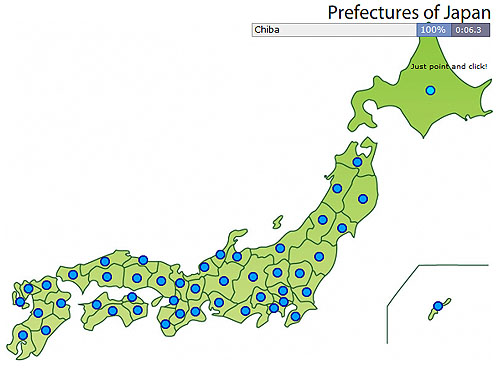
The first, from http://www.purposegames.com/ is Prefectures of Japan. Each prefecture has a little blue dot, and text appears at random telling you which one to locate on the map. You get a timer as well as a percentage correct, so it’s fun to keep track of your best time and score each play.

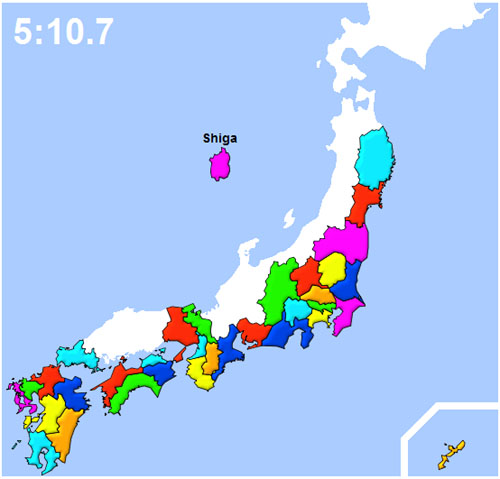
The second, from http://www.mapmsg.com/ is Statetris-Japan. Based off of the classic Tetris, of course, the prefectures fall as individual shapes for you to situate properly on the map. Since you’re confined to the dropping process (meaning the south-eastern prefectures come down first), it seems like it might be easy, but there’s three levels of difficulty to the game (Easy, Medium, and Hard).

In Easy mode, the prefectures appear stationary (not able to be turned like in Tetris) with the names attached, which is helpful if you’ve never studied the locations before. With Medium mode, the names are still included, but the prefectures appear randomly on their sides. You must maneuver them into the right orientation for them to fall properly. Finally, Hard mode has nameless, mobile pieces for you to shift around. A timer is included with this game, too, and both have hints appear if you get answers wrong a lot.

There you go! Challenge yourself and improve your Japan geography knowledge. Each site also features geography games for other countries around the world if you want to beef up you world map.

Know any others Japan geography games online? Email us at shinpai.deshou@gmail.com and we’ll feature them in a future post!

So what’s your best time? 🙂

Posted in fun links, study tools, useful links | Tagged , , , , | 2 Comments

Society of East Asian Anthropology Annual Prizes

For those of you interested in the anthropology field, the Society for East Asian Anthropology has three potential prizes now open for competition.

—

The Society for East Asian Anthropology (SEAA) announces the return of its annual prizes for outstanding graduate paper, English-language published book, and best multimedia work on the topic of East Asian studies.

The submission deadline for each prize is May 1, 2011.

For full details, please see our website:

http://aaanet.org/sections/seaa/prizes.html

~~~~~~~~~~~~~~~~~~~~~~~~~~

Bestor Prize for Outstanding Graduate Paper

The Society for East Asian Anthropology invites submissions for the 2011 Theodore C. Bestor Prize for Outstanding Graduate Student Paper in honor of Ted Bestor, the first president of SEAA. The prize of $250 is awarded annually for the best graduate student paper on any aspect of East Asian anthropology and/or East Asian anthropology’s contribution to the broader field.

Papers must deal with the anthropological study of East Asian societies and cultures, or other societies/cultures and diasporic and transnational communities with historical or contemporary ties to East Asia.  Papers will be read by a committee of the Society for East Asian Anthropology and judged on original empirical research and contribution to the field; organization, quality, clarity of writing, and cogency of argument. The author of the paper judged to be of the highest quality will receive the prize.

Manuscripts should be sent to Jennifer Robertson (jennyrob@umich.edu) as MS Word file, double-spaced, author’s name removed. Please put “Bestor Prize” in the subject line of your email message.

General eligibility criteria:

1. Students must be in a degree-granting program (including MA or PhD) at the time of their submission.
2. Paper must be the original work of the student and previously unpublished.
3. Limit one submission per student.

~~~~~~~~~~~~~~~~~~~~~~~~~~

Hsu Prize for English-language Book

The Society for East Asian Anthropology invites submissions for the 2011 Francis L.K. Hsu Book Prize. The prize of $250 is given to the English-language book published in the previous calendar year (2010) judged to have made the most significant contribution to the field. The prize is named for the late Francis L.K. Hsu (1909-2000), renowned cross-cultural anthropologist and former President (1977-78) of the American Anthropological Association.

Nominations for the prize may be made by authors, publishers, or interested third parties (with the consent of the author). Reference works, translations, textbooks, edited works, and anthologies are not eligible. Both members and non-members of SEAA are eligible.

Please send three non-returnable copies of the book to:

Francis L.K. Hsu Prize Committee
c/o Professor Jennifer Robertson
Department of Anthropology, University of Michigan
101 West Hall
1085 S. University Ave
Ann Arbor, MI 48109-1107
email: jennyrob@umich.edu

~~~~~~~~~~~~~~~~~~~~~~~~~~

Plath Media Prize

The Society for East Asian Anthropology invites submissions for the David Plath Media Award for the best work (film, video, audio, and multimedia) on any aspect of East Asian anthropology and/or East Asian anthropology’s contribution to the broader field. The 2011 prize will be awarded for material produced in 2009 or 2010.

The prize of $250 is named for David Plath, renowned Japan-scholar and producer of award-winning documentary films. Evaluators of the work will seek to determine the scholarly significance of submissions which contribute to the anthropology of East Asia, and which take the form of research footage and documentation that adds to the historical and/or ethnographic record, or is used for further analysis (such as linguistics, dance, and art); ethnographic media that contributes to theoretical debate and development; media designed to enhance teaching; and media produced for television broadcasting and other forms of mass communication.

Nominations for the prize may be made by producers/authors, distributors, or interested third parties.

Please send three non-returnable copies of the media to:

David Plath Prize Committee
c/o Professor Jennifer Robertson
Department of Anthropology, University of Michigan
101 West Hall
1085 S. University Ave
Ann Arbor, MI 48109-1107
email: jennyrob@umich.edu

Posted in announcements, culture, financial assistance, funding, graduate school | Tagged , , , , , , , | Leave a comment

Job Opening: Lecturer Position at Musashi University

Musashi University is looking for someone (3rd year PhD candidate or beyond, or roughly equivalent experience) to teach a course in English on Japanese history 1920-1955, to (chiefly) English-speaking exchange students, Fall 2011 only. This information comes to us from Travis Seifman, the author of A Man With Tea, a blog about art, art history, Japan, and media.

Lecturer Position at Musashi University (Nerima Ward, Tokyo)

Course:  Modern Japanese History

Course structure:  The course should provide a general survey of Japanese history from 1850-1955.  We welcome a lecturer who will take an active and innovative approach to using Tokyo as a study site and to supplement text based lectures with field experiences.   We envision the class to highlight learning both inside the classroom as well as considering Tokyo itself as a location for learning; in short, the ideal class would connect in-class lessons with appropriate excursions within Tokyo.

Students will be international students from Musashi’s partner institutions in the Australia, US, UK, France, and Germany. There may be some Musashi students (Japanese students), but such participants will be quite limited.  We expect the course to be conducted at a high academic English level for undergraduates.

Time considerations

The Fall Semester runs from September 16, 2011-January 28, 2012

*Winter break from December 23-January 9 (classes resume January 10).

The course must meet twice a week at 90-minutes per session.

The course cannot be offered at the same time as either Japanese language courses or another EAS English content course.

For Fall 2011, the following days and times are currently available

Monday:  3rd period (13:00-14:30) and 5th period (16:20-17:50)

Tuesday:  4th period (14:40-16:10)

Wednesday: 3rd, 4th and 5th

Thursday: 4th

Friday: 3rd, 4th, and 5th.

Minimum qualifications

1)  MA degree obtained by December 2007

2)  More than three years of academic/research experiences after MA, such as enrollment in a Ph.D. program or as a researcher

3) A record of publication in academic journals and experiences of oral presentations at academic conferences or workshops.

Salary will be paid from October-March. Contract will run the Fall 2011 term only. Renewal is at the discretion of Musashi University.

Please send your CV, a brief sample course syllabus, and a brief self-introduction to Brian J, Masshardt, Director, East Asian Studies Program:  bjmass[AT]musashi[DOT]jp

To find out more about Musashi University and the East Asian Studies Program go to:

http://web.me.com/bjmasshardt/East_Asian_Studies_Program/Welcome.html

The Musashi University campus is located approximately 15 minutes from Ikebukuro, 25 minutes from Shinjuku, and 30 minutes from Shibuya.  Stations in the area include: Shin Sakuradai, Shin Egota and Ekoda.  All are within 7 minutes walk of the Musashi Campus.

Applications will be accepted until the position is filled.

Posted in announcements, job openings, jobs | Tagged , , | Leave a comment