Job Opening: Curatorial Assistant in Asian Art

Information from HigherEd Jobs, which is a great resource for finding faculty and staff positions in higher education.

Iris & B. Gerald Cantor Center For Visual Arts at Stanford University

Curatorial Assistant, Asian Art, 75% to FTE

The curatorial assistant reports to the Patrick J.J. Maveety Curator of Asian Art, and is responsible for assisting the curator in all aspects of the Asian collection, particularly its management, research, exhibitions, education, and development. The curatorial assistant will provide support for the organization of original and loan exhibitions; the maintenance of the permanent collection, including record keeping and new acquisitions; and the management of departmental activities including research, programs, education, public affairs, and development.

The curatorial assistant’s responsibilities include:

1. Exhibition Planning
a. Works with Asian art curator in locating and selecting objects
b. Communicates with lenders and participants in loan shows
c. Collaborates with the CAC’s public relations and education staff
d. Participating in the gallery renovation at the CAC

2. Collection Management
a. Answers public and scholarly inquiries
b. Arranges student and visitor access to collection
c. Works with registrars to maintain accurate records in database
d. Catalogues permanent collection and new acquisitions
e. Assists in planning rotations in galleries

3. Publications
a. Prepares press releases, educational materials
b. Carries out scholarly research on collection and exhibitions
c. Secures photographs and transparencies for the Center collection and exhibition projects
d. Collaborates with rights and reproductions manager and other CAC staff to obtain proper permissions
for reproductions

4. Education
a. Prepares labels for permanent collection galleries and loan exhibitions
b. Supports all educational efforts including writing of brochures, presentation of lectures, symposia, and films
c. Assists in the training of docents

5. General Curatorial And Clerical Support
a. Answers routine correspondence, fax, telephone, email
b. Conducts library research as directed
c. Other duties as requested

QUALIFICATIONS:

Background in art history and archaeology. M.A., Ph.D in process, or equivalent museum experience. Expertise in the arts of Asia with a strong interest in Chinese and/or Japanese arts a must. Established fieldwork, research, publications, and curatorial experience in Asian art related areas, with a knowledge in both traditional and contemporary Asian arts desirable. Fluency in Macintosh computer, Microsoft Word, Microsoft Excel, Microsoft Power Point, Adobe Photoshop, and FileMaker Pro. Command of English and very good writing skills, with excellent grammar, punctuation, and proofreading. Able to read, word-process, and conduct research in Chinese and/or Japanese. Curatorial assistant must be self-motivated, flexible, have a desire to learn, and be willing to manage multiple tasks in an active and evolving department. Candidate should be reliable, punctual, and possess good interpersonal skills.

Application Information
Contact: School of Humanities and Sciences
Stanford University
Online App. Form

Original posting at Higher Ed Jobs.

Posted in announcements, job openings, jobs | Tagged , , , , | Leave a comment

Call for Manuscripts: US, Asia, and the World, 1620-1914

EAA Fall 2011

(Economic History Topics Encouraged)

Education About Asia (EAA) is the peer-reviewed teaching journal of the Association for Asian Studies. Our readers include undergraduate instructors as well as high school and middle school teachers. Our articles are intended to provide educators, who are often not specialists, with basic understanding of Asia-related content. Qualified referees evaluate all manuscripts submitted for consideration. A large number of our readers teach some form of world history, but some of our secondary school teachers are also responsible for US History.

We are in the process of developing a special section entitled “US, Asia, and the World, 1620-1914” for the fall 2011 issue of EAA. In this special section, we invite authors to submit manuscripts that encompass a wide range of US-Asia topics that focus upon interactions and significant events, drawing from diverse areas of study including the arts, diplomacy and politics, economics, military history, and society and culture. We are looking for manuscripts concerning all areas of Asia. We seek manuscripts both from historians of Asia and scholars and teachers with expertise on the US and other parts of the world. We are especially interested in manuscripts where authors address US-Asia interactions that proved to have global impact.

Prospective authors should be aware that approximately fifty percent of our readers are secondary or middle school teachers and the remainder of our subscribers teach at the college or university levels. We are most interested in manuscripts that are useful for introductory survey-level courses at both the secondary and undergraduate levels. Please consult the EAA guidelines, available on the website under my signature, before submitting a manuscript for this special section. Pay particular attention to feature and teaching resources manuscript word-count ranges. The length of an EAA manuscript is 2,500 to 3,500 words (ten to fourteen double-spaced pages). Prospective authors are also encouraged to share possible manuscript ideas with me via email. The deadline for initial submission of manuscripts is May 10, 2011.

Cordially,

Lucien Ellington
Editor, Education About Asia
302 Pfeiffer Stagmaier Hall
University of Tennessee at Chattanooga
Chattanooga, TN 37403
Phone (423) 425-2118, Fax (423) 425-5441
Email: l-ellington@comcast.net
Website: http://www.asian-studies.org/

Posted in announcements | Tagged , , , , , , | Leave a comment

The Japan Sociological Society Travel Grant for Starting Scholars from Overseas

The International Liaison Committee of the Japan Sociological Society (JSS) is pleased to announce its fifth annual travel grant competition for starting scholars. The objective of this grant is to support up to 6 sociologists who will present papers and participate in the JSS annual meeting at Waseda University, Tokyo this fall. Each scholar selected will be awarded 80,000 yen to support accommodation and travel expenses. To be eligible for support, the applicant must:

(1) be currently living and working outside of Japan

(2) hold a masters degree or higher obtained within the past ten years

(3) hold a membership in their country’s national (or equivalent) sociological association.

Deadline: April 20, 2011.

For more information, visit

http://www.gakkai.ne.jp/jss/2011/04/20135921.php Email:

jss@wwwsoc.nii.ac.jp

The Japan Sociological Society (JSS)
c/o Galileo,Ink. Tokyo Office
3-21-10-3F Kitaotsuka
Toshima-ku, Tokyo 170-0004 JAPAN
Phone: +81-3-5907-3750
Fax: +81-3-5907-6364
Email: jss@wwwsoc.nii.ac.jp

Visit the website at http://www.gakkai.ne.jp/jss/2011/04/20135921.php

Posted in announcements, financial assistance, funding, living abroad, study abroad, study tools | Tagged , , , | Leave a comment

Fun Link Friday: Japanese Kit Kats

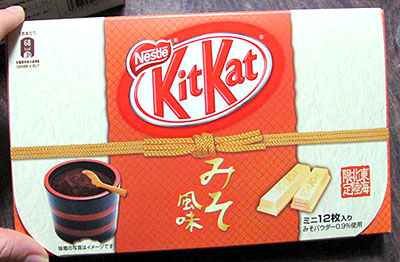
I went to Nagano over the National Foundation Day weekend. Nagano is great because it’s full of local specialties: apples, soba, and shichimi (seven-spice). Nagano, like many culinary hot spots in Japan, has its own regional Kit Kat flavors, so I picked up a box of shichimi Kit Kats and a box of apple Kit Kats while I was there.

The Kit Kats of Japan are well known among those in Japanese Studies. Today’s fun link is My KitKats. Run by Alison Musket, a JET in Hamamatsu, this site features Kit Kats from all over Japan and from around the world, plus some cultural commentary.

It’s refreshing to have someone blogging about Kit Kats who genuinely enjoys collecting and trying them. Most English-language articles on Kit Kats tend toward “oh, those wacky Japanese!” It’s true that Japan loves regional and seasonal foods and that there is a spirit of “gotta catch ‘em all!” here, whether that’s climbing sacred mountains, making pilgrimages to temples, or obtaining Hello Kitty charms. However, this is a brilliant marketing tactic, and I can’t claim to not be excited for “collecting” my third Daibutsu or the annual coming of the Starbucks sakura latte. Ms. Musket’s blog completely avoids the “wacky” bent, going instead for photo documentation and some translations and explanations of the flavor text (har) on the boxes.

If you’d like to read more about the specifications and flavors of Japanese Kit Kat’s, check out Jen Ken’s Kit Kat Blog. Jen is an ex-JET who has not only managed to get Japanese Kit Kats in the US but has also sampled all of the regional flavors! おめでとう!

Take a break! Enjoy a Fun Link!

-Leah

Further Reading About Kit Kats

Official Japanese Kit Kat website: http://www.breaktown.com/

Chappell, Bill. “Kit Kat Kaleidoscope: Far-Out Flavors from Japan.” NPR
http://www.npr.org/templates/story/story.php?storyId=126515207. 10 May 2010.

Cummings, Tucker S. “Japan’s Strangest Kit Kat Flavors.” Weird Asia News.
http://www.weirdasianews.com/2010/03/18/japans-strangest-kit-kat-flavors/. 18 Mar. 2010.

“Kit Kat Takes on Japanese Tastes.” The Independent.
http://www.independent.co.uk/life-style/food-and-drink/kit-kat-takes-on-japanese-tastes-1901867.html. 17 Feb. 2010.

Madison, Jillian. “18 Kit Kat Flavors You’ve Probably Never Tried.” Food Network Humor.
http://foodnetworkhumor.com/2009/06/kit-kat-flavors-from-around-the-world/ 15 June 2009.

Posted in culture, fun links | Tagged , , | Leave a comment

Call for Papers: Conference – Asia at Work and Play

New York Conference on Asian Studies – NYCAS 2011

The University at Buffalo, State University of New York
September 16-17, 2011
Conference theme: Asia at Work and Play

Plan now to participate in NYCAS 2011!

EARLY submission of panels and papers is encouraged!
The deadline for submitting proposals is May 2, 2011.

The University at Buffalo, State University of New York, will host the 47th annual meeting of the New York Conference on Asian Studies (NYCAS), September 16-17, 2011.

The NYCAS 2011 program committee invites proposals for panels, roundtables, and individual papers on all aspects of Asian and Asian-American history, culture, and contemporary life, representing disciplines in the humanities, social sciences, and professional schools. Interdisciplinary proposals are also welcome.

We encourage scholars from New York State, neighboring states and provinces, and beyond to share their research at the conference.

In formulating proposals, participants are encouraged to consider the NYCAS 2011 theme —ASIA AT WORK AND PLAY— which calls attention to the ways in which the labor and creativity of people in and from Asia have transformed the world. The conference will feature an address by Dr. Gail Hershatter, noted historian of Chinese gender and labor and president of the Association for Asian Studies, as well as a wide range of presentations and performances.

Panels and roundtables will be held at the Ramada Hotel and Conference Center, adjacent to the university’s North Campus, at 2402 North Forest Road in Amherst, New York. A block of rooms has been reserved at the Ramada for conference participants.

On Friday evening, September 16, NYCAS attendees will enjoy a plenary speech by Melissa Chiu, Vice President for Global Art Programs at the Asia Society, and an exhibition opening of work by students from the Central Academy of Fine Arts in Beijing. The Friday evening events will be held at the Center for the Arts, University at Buffalo North Campus, and cosponsored by the Confucius Institute at the University at Buffalo. A Saturday morning teacher workshop on “The Arts in Asia” is also planned.

SUBMISSION GUIDELINES

All panel, roundtable, and paper proposals must include the name and full contact information of all participants, and should be submitted online by visiting

http://www.asianstudies.buffalo.edu/conferences/nycas2011.shtml and clicking the link at the top that says “Propose a panel, roundtable, or paper.”

INDIVIDUAL PAPER proposals should include the full title and a brief abstract of 200 words or less. Individual papers will be assigned by the NYCAS 2011 program committee to a panel according to topic and should be short enough to present in 15-20 minutes. Word-for-word reading of papers is discouraged.

A PANEL consists of 3 or 4 papers organized around a common topic or theme, and a chair (who may also be one of the panelists). All panel proposals should include a title and brief abstract of the panel (200 words or less), and a title and brief abstract of each paper. Panels will run for 90 minutes, and paper presentations should be short enough to allow for questions and discussion. Creative panel formats that encourage discussion and exchange are especially welcomed.

ROUNDTABLE format may vary, but could include introductory remarks by each roundtable participant, followed by comments and discussion among participants and the audience. All roundtable proposals should include a title, content summary, and description of the anticipated contributions of each roundtable participant.

NYCAS 2011 website:

http://www.asianstudies.buffalo.edu/conferences/nycas2011.shtml

Please address all inquiries to nycas2011@buffalo.edu .

Ron Knapp
Executive Secretary
New York Conference on Asian Studies–NYCAS
http://www.asianstudies.buffalo.edu/nycas/index.shtml

Posted in announcements, conferences, graduate school | Tagged , , , | Leave a comment

Specialty Dictionaries Online: Art History and History

There’s an enormous amount of online J/E and E/J dictionaries, add-ons, and web readers out there, some aimed at the casual learner and others for more advanced students. But let’s face it- when you’re in the Japanese field as a student or researcher, sometimes you find yourself searching for words that the typical dictionary just can’t explain.

Being in a medieval history/art history field, this is a problem I’ve often encountered over the years. Some words are simply specialist vocabulary, and if your Japanese isn’t quite where it should be (or even if it is) or if you don’t have a familiarity already with what you’re working on, hunting down some words is more difficult than others. To showcase a source for art and history study, today I’m introducing two resources: the JAANUS (Japanese Architecture and Art Net Users System) online database and the Tokyo University’s Historiographical Institute’s online glossary of historical terms. Navigating these can sometimes be tricky, so we’ll take it step by step.
To start, let’s look at JAANUS. This database is a compilation of art and architecture terminology from a number of publications and scholarly sources, containing approximately 8,000 terms related to traditional Japanese architecture and gardens, painting, sculpture and art historical iconography from the 1st century A.D. to the end of the Edo period (1868). It’s truly unique and useful for all types of interdisciplinary work.

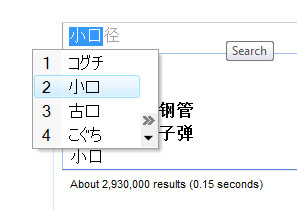
Let’s use JAANUS while indulging my recent study of castles. 🙂 Say, as a castle newbie, I come across the word 虎口(koguchi) in an article. Having first fumbled to figure out the reading if it wasn’t provided, my first instinct is to pop it into my trusty Canon Wordtank in hiragana from the 和英 option, but the closest thing I get is 小口(also read koguchi, but not the characters or the meaning I want). Even trying to pull up こぐち to type it into google, the reading 虎口, being unusual, doesn’t even appear.

Now, if I put this in my 和和 Super Daijirin dictionary, I do manage to pull up 虎口, but if I’m not armed with other castle vocabulary like 城郭or 陣営 to read the definition or if I’m a beginner to the concepts of castles, I might be at a loss (truth be told, the definition is pretty easy to guess from the Japanese, but for example’s sake I’m sticking to the worst case scenario!).

Enter JAANUS! Enter a kanji or a romaji rendering into the left sidebar’s search option and click “GO.” A number of related definitions immediately pop up, and right away you can see one of them is labeled “JAANUS / koguchi 虎口” Convenient! Now we find that it means:

Lit. tiger mouth. A castle entrance. An early modern term likening the castle gateway to the tooth and fang of a tiger, alluding to the difficulty needed to penetrate the armed garrison on guard. Probably originally written 小口, lit. little mouth. Because the entrance and egress were vital to the defense of a castle, the design and placement of the koguchi entailed crucial strategic considerations. Certainly the smaller it was the better it could be defended. Castles, however, were not only used for withdrawal and security *in-no-koguchi 陰の虎口, but had an offensive role as well *you-no-koguchi 陽の虎口. As warfare evolved, the koguchi became larger and included various contingent strategic installations.

We get great historical background and even a little etymology as to why the heck we’re using “tiger” and “mouth” for the technical term for a castle entrance. Also to be found below is a number of reference links to related vocabulary in the database, which is immensely useful for some of the tougher words and getting familiar with what other vocab might pop up in your reading. Similarly, as seen in the above definition, embedded cross-references make jumping to other related articles simple!

Some entries are more complex and detailed (even including photos) than others, so it can be quite hit or miss depending on what you’re looking up. The entire site is a work in progress and can be expected to continue to be updated over time, but since its launch in 2003 it’s become an incredibly valuable resources for researchers and the casually curious who want to discover more about the field.

—

Moving along, we have another important online resource that’s more than a simple dictionary for historians. Not limited to just definitions, as we will see, Tokyo University’s Historiographical Institute is making good in the historiography area by not just including the meaning of words, but creating a glossary which quotes (and cites) works in which the word appears.

Logging in can be a bit of a hassle, but here’s a simple run down.

  • Go to the site.
  • Scroll down to the link at the bottom where it says “Access the database” and click.
  • On the next page, click “データベース選択画面” (Database selection screen).
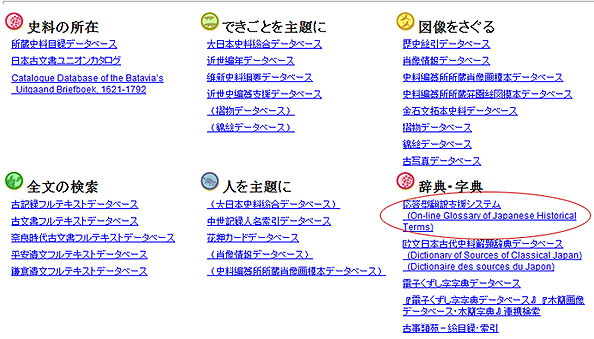
  • On the far right in both Japanese and English you’ll find the link to the glossary. Click “応答型翻訳支援システム  (On-line Glossary of Japanese Historical Terms)”.

A pop up will appear, and at the bottom check the box marked “上記の内容に同意します。” and click “同意します”to agree.

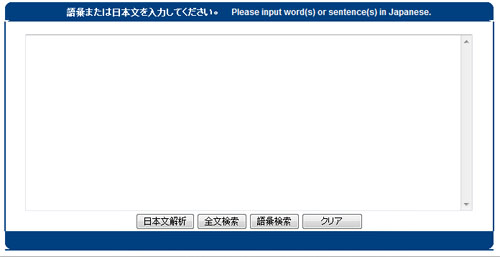
And up pops this window:

There are directions below the Japanese search buttons to explain them. You can enter things in kanji, hiragana, OR romanized text. So say I come across the word “kenmon” (権門) in my history textbook, but it’s not translated (which happens quite a bit in your average text!).

Pop it into a search and you get this for the 全文検索 (all text search):
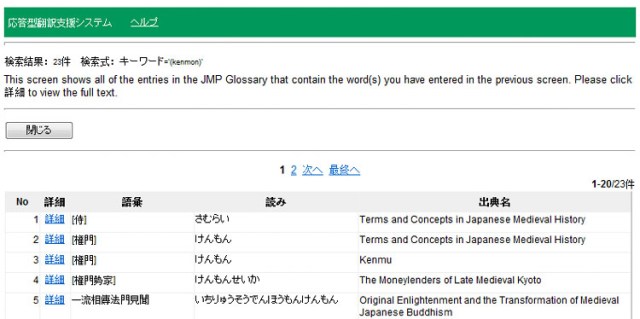
And this for the 語彙検索 (vocabulary search):
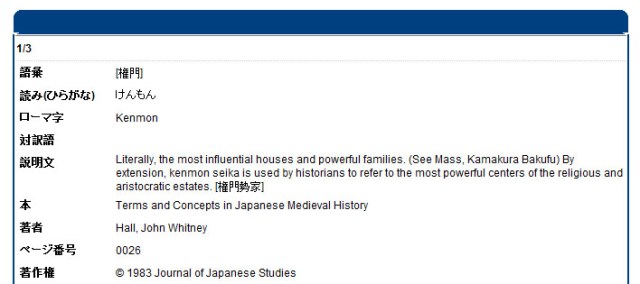
Both are useful and get you what you want, though obviously you’ll get slightly different searches since the vocab option is more specific. But as you can see in this entry, you’ll find the word, the kanji, the definition as an author has rendered it, similar or related vocabulary, and even all of the citation information (page number, publication year) and everything! How amazingly useful is that? What’s also great is that you’ll find definitions from foreign language materials too. For example, working on craftspeople research, I’ve had a lot of overlap with German publications which are the only source for some glossary terms (I then copy paste into Google translate and make my best guesstimate… ;))

—

Both of these sources can be hit or miss, but when you hit, they’re fantastic resources for some of the more obscure or difficult to understand words you’ll stumble across. Also, don’t forget that when looking up vocab you have the romanization for, Google Books can also be really helpful, since many publications about Japan are now online as well.

If you have any specialist dictionaries you personally use, feel free to email us at shinpai.deshou@gmail.com and we’ll feature it in a future post!

Happy searching!

– Paula

Posted in graduate school, main posts, study tools, undergraduate, useful links | Tagged , , , , , , , , , | 9 Comments

Job opening: Visiting Professor, History and Culture of East Asia

Institution:   Eckerd College
Location:   Florida, United States
Position:   Visiting Assistant Professor

Eckerd College, a nationally-ranked liberal arts college in St. Petersburg, Florida, seeks a visiting position with faculty rank of Assistant Professor specializing in the history and culture of East Asia. The position has a full benefit package and requires teaching five courses: the first half of the World History survey; at least one course in modern East Asian history; and three other courses in East Asian history and culture that accord with the candidates specialization. Candidates should have Ph.D. or ABD in history or other appropriate discipline and college-level teaching experience. Please send cover letter, curriculum vitae, undergraduate and graduate school transcripts, evidence of effective teaching (e.g. course evaluations), and three letters of recommendation by March 18th, 2011 to:

Andrew Chittick
Professor of East Asian Humanities
Eckerd College
4200 54th Avenue South
St. Petersburg FL 33711. EOE.

Candidates must be currently authorized to work in the United States. Please indicate whether you will be available at AAS in Honolulu, March 31st-April 3rd, for an interview.

Contact:

Andrew Chittick
Professor of East Asian Humanities
Eckerd College
4200 54th Avenue South
St. Petersburg FL 33711.

Website: www.eckerd.edu

Posted in announcements, job openings, jobs | Tagged , , , , | Leave a comment

Job openings: Two Positions in Contemporary Japanese Studies

Institution:   National University of Singapore, Japanese Studies
Location:   Singapore
Position:   Assistant Professor, Associate Professor, Full Professor

The Department of Japanese Studies, National University of Singapore invites applications for two (2) open-rank positions in contemporary Japanese studies.  Candidates from all disciplines working on contemporary Japan are encouraged to apply (excluding Japanese language which is taught in a separate University unit).  We are particularly interested in filling one of the positions with a candidate competent to teach/research in aspects of contemporary Japanese popular culture.  Candidates should be willing to contribute to the Departments team-taught, interdisciplinary modules.  Fluency in English and Japanese is required.  An attractive salary and benefits package will be determined according to experience/seniority.

To apply, please submit a full CV, contact details of three referees, writing samples, past teaching evaluations (if  applicable), and a statement indicating research and teaching interest to:

Mr. Tan Kay Hoe by e-mail (jpssec@nus.edu.sg as a single, clearly labeled .pdf file) or post (Dept. of Japanese Studies, FASS, NUS, AS4, 9 Arts Link, Singapore 117570).  The National University of Singapore is consistently ranked as one of the worlds best universities, and has emerged as a leading force in all fields of Asian studies. We welcome applicants of all backgrounds. Further information on the Department of Japanese Studies is available at http://www.fas.nus.edu.sg/jps/ .  Applicants attending the AAS/ICAS conference in Hawaii (Mar.31~Apr.3, 2011) are encouraged to contact the Department ahead of time to arrange an informal meeting at the conference.  Application closes on March 21, 2011. Only shortlisted candidates will be notified.

Contact: Mr. Tan Kay Hoe    jpssec@nus.edu.sg

Website: http://www.fas.nus.edu.sg/jps/

Posted in announcements, job openings, jobs | Tagged , , | Leave a comment

Cleaning up a bit

Pardon some hiccups in the site’s layout while we do a little clean-up with the presentation. Not a WordPress expert here, but we’re trying to improve navigation. 🙂

Edit: We’ve combined some of our menus into dropdown menu features, and also added a “Posts” section on the far right to provide direct access to our main writing features. Hope this helps navigation go more smoothly! Feel free to email us with comments or suggestions.

Posted in site maintenance | Leave a comment

Freeman-Asia Award for Study in Asia

If you are an American undergraduate student and the only thing holding you back from studying abroad in Asia is lack of finances, here is an opportunity for you! Freeman-Asia provides scholarships for U.S. undergraduate students with demonstrated financial need to study abroad in East or Southeast Asia. The program’s goal is to increase the number of Americans with first-hand exposure to and understanding of Asia and its peoples and cultures.

The application deadline varies by intended study abroad term. Here is a basic chart:

Study Abroad Term (Application Deadline)

  • Summer (February 15)
  • Fall /Academic Year (April 15)
  • Spring / Early Academic Year (October 12)

**For more on application deadlines, please see the website.**

Eligibility Requirements Outline:

  • U.S Student or Permanent Resident
  • Undergraduate in good standing at a U.S. institution
  • Must have at least one term of enrollment remaining upon return from studying abroad
  • Must currently receive need-based financial aid or demonstrate a verifiable need for financial assistance to study abroad
  • Must have applied to or been accepted to an approved undergraduate, credit-eligible study abroad program
  • Program must be at least eight weeks for a summer term, ten weeks for a quarter term and 12 weeks for a semester term
  • Must have little or no previous experience in the proposed country of study
  • Participants must agree to fulfill a service project to promote study abroad in Asia upon return from studying abroad.

Possible Destinations in Asia are: Cambodia, China, Hong Kong, Indonesia, Japan, Korea, Laos, Macao, Malaysia, Mongolia, Philippines, Singapore, Taiwan, Thailand and Vietnam.

Award amounts vary from up to $3,000 for a summer term, up to $5,000 for a semester quarter term, and up to $7,000 for an academic year term.

While this award may not cover all of your expenses, it will certainly go a long way in helping out. If you are interested in the Freeman-Asia Award, please go to this website in order to get more detailed information.

Good Luck!

Contact Info:

Freeman-ASIA
U.S. Student Programs
Institute of International Education
809 United Nations Plaza
New York, NY 10017-3580
Tel: +1 212.984.5542
Fax: +1 212.984.5325
Email:Freeman-ASIA@iie.org

—

Many thanks to Playing with Hire for the link! Check out the PWH website for more Asia-related opportunities!

Posted in announcements, financial assistance, funding, study abroad, undergraduate | Tagged , , , , , , | Leave a comment