
Resource: Networking with Japan Societies

As our previous article on maintaining relationships in Japanese Studies emphasized, networking and getting to know the field is very important. Whether you decide to go on to an academic career or stick with other types of employment, like any other area of the job market, meeting people and being involved is an important aspect of moving up and furthering your goals. Becoming a member of Japan societies in your area offers an excellent avenue to do this without any flaming hoops to jump through.

Local “The Japan Society” or the “Japan-America Society” groups offer a great and easy way to network as well as be informed about what others working in the Japan field are doing. Not only that, but they constantly have esteemed guests and special events open the public that are meant to foster ties between you and the Japanese community. In case you’re wondering where in your area you can find a local Japan society, I’ve compiled a list of these organizations, organized alphabetically by state. Most states have these organizations (though some may not have a web presence) so I encourage you to take a look and see what opportunities are about in your area. If you know of a site I’ve missed, please let me know and I’ll add it! Happy browsing!

[Edit]

Thanks to Shannon  for pointing out that these associations are often independent of each other, though the consortium NAJAS (http://www.us-japan.org/resources/ussocieties.html) comprises of about 40 Japan-America Societies across the U.S.! Other comments or corrections are always welcome!

Japan America Society of Alabama
Japan America Society of Alabama [2]
Japan America Society of Alaska [no site]
Japan America Society of Tucson [Arizona]
Japan-America Society of Arkansas
Japan Foundation of Los Angeles
Japan Society of Northern California [California]
Japan America Society of Southern California [California]
The Japan America Society of San Antonio [California]
Japan Society of San Diego and Tijuana [California]
The Japan America Society of Colorado
Japan America Society of Southern Colorado [Colorado]
Japan-America Society of Connecticut
Japan-America Society of Delaware [no site]
Japan-America Society of Northwest Florida [Florida]
Southeast US / Japan Association [Florida]
The Japan-America Society of Georgia
Japan America Society of Hawaii
Idaho Japanese Association
Japan America Society of Chicago [Illinois]
Japan-America Society of Indiana
Japan America Society of Iowa
Heart of America Japan-America Society [Kansas and Missouri]
Japan/America Society of Kentucky
The Japan Society of New Orleans [Louisiana]
Japan America Society of Maine
Baltimore Area Japanese Meetup [Maryland – no formal society]
The Japan Society of Boston [Massachusetts]
Japan America Society of Greater Detroit [Michigan and Windsor]
Japan America Society of Western Michigan [Michigan]
Japan America Society of Minnesota
The Japan-America Society of Mississippi
Japan America Society of St. Louis [Missouri]
[Montana – no site]
Japanese Association at Kearney
Japan America Society of Nevada
Japan Society of New Hampshire [no site]
Japan-America Society of New Hampshire [no site]
Japanese-American Society of New Jersey
[New Mexico – no site]
Japan Society of New York
Japan Foundation of New York
North Carolina Japan Center
[North Dakota – no site]
The Japan-America Society of Central Ohio
Japan America Society of Greater Cincinnati
Japan-America Society of Oklahoma
Japan-America Society of Oregon
Japan-America Society of Pennsylvania
Japan America Society of Greater Philadelphia [Pennsylvania]
The Japan Association of Greater Pittsburgh [Pennsylvania]
Rhode Island Japan Society
[South Carolina – no site]
[South Dakota – no site]
Japan-America Society of Tennessee
Japan-America Society of Greater Austin [Texas]
Japan-America Society of Dallas/Fort Worth [Texas]
The Japan America Society of Houston [Texas]
[Utah – no site]
Japan America Society of Vermont
Japan-Virginia Society
Japan America Society of the State of Washington
[West Virginia – no site]
Japan America Society of Wisconsin [no site]
Japan-America Society of Washington D.C.
The Japan-America Society of Wyoming

Posted in social networking, study tools, useful links | Tagged , , , , , , | 5 Comments

Call For Papers: Architectures of Mobility: Structures, Circuits, Deformations”: Third Annual Transnational Asia Graduate Student Conference

Call for Papers
3rd Annual Transnational Asia Graduate Student Conference
February 10-11, 2012
Rice University Chao Center for Asian Studies

Architectures of Mobility: Structures, Circuits, Deformations

Keynote: Dr. Nayan Shah, Department of History, UC San Diego

Deadline: Please send abstracts of 250-300 words to transnationalasia@gmail.com* by November 28, 2011

Contemporary figurations of the transnational often invoke a language of flows and frictions to describe the increasingly ambiguous role of nation-states and their boundaries in the movement of goods, persons, and ideas. Without abandoning this view altogether, this conference invites participants to move beyond it in order to investigate the dynamics which have led to its promulgation–both as dominant metaphor in the thought of many scholars studying Asia and as lived analytic for individuals making sense of their vertiginous contemporaries and their legacies.

We aim to look at the structures which animate and render possible or hinder experiences of mobility, from those of subjectivity to the economy; the circuits that enable those mobilities, from local bus routes to the trajectories of migrant workers; and the deformations of these established systems that can generate both psychic violence and practices of agency alike. In short, this year’s Transnational Asia Graduate Student Conference envisions a cross-disciplinary approach to exploring the processes and effects of “transnationalism,” as well as the conditions supporting its conceptual coherence, in both the historical past and the emerging present. We invite interventions situated at all levels of analysis, from the micro-social to the geopolitical, utilizing a range of methodological approaches.

The above description of the themes of this conference ought to be taken as a heuristic for our discussion about transnationalism in Asia, rather than as a strict or exclusionary rule for the content of papers. Potential areas of focus include, but are not limited to:

-Media and technology
-Health and the body
-Scientific collaboration
-Language and linguistic practice
-Activism and social movements
-Theoretical approaches to transnationalism
-The built environment and transportation
-Environmental practices and the natural world
-Religion and spiritual practices
-Affect and emotional life
-Political economy
-Consumption practices

This conference is explicitly interdisciplinary in nature, and we invite participation from graduate students in ALL disciplines across the humanities, social sciences, architecture, planning, business, and natural sciences. Similarly, we strive to include research which represents the regional and national diversity of Asia. Presentations on work in progress or research utilizing experimental approaches are strongly encouraged. In addition to a stimulating theoretical discussion, this conference is intended to function in part as a workshop space, to allow graduate students to receive feedback from mentors and peers at any stage of their projects.

Please circulate freely.

Rice University
Chao Center for Asian Studies
6100 Main Street
Houston, Texas
http://asia.rice.edu

chaoctr@rice.edu <transnationalasia@gmail.com>

Please send abstracts by November 28, 2011 to: transnationalasia@gmail.com

Posted in Uncategorized | Tagged , , , , , , | Leave a comment

Resource: Japanese Historical Text Initiative

Studying Japanese history? Check out the Japanese Historical Text Initiative (JHTI)through the University of California-Berkeley (UCB)!

Background

The Japanese Historical Text Initiative is the brainchild of Delmer Brown, Professor Emeritus of History at UCB, whose interests in religio-political dimensions of early Japanese history led him towards the development of a database containing key ancient texts and their translations. After receiving grant funds from the Grand Tsubaki Shrine of America, UCB, International Shinto Shrine of Tokyo, and the Japanese Ministry of Education, the JHTI met its fruition.

Since 2005, the JHTI is sponsored and owned by The Center for Japanese Studies at UCB. Its mirror site is owned by Osaka International University (OIU) in Japan. Both the Center and OIU co-manage the JHTI website.

Contents

The JHTI is a growing database with historical texts dating back over 1200 years. Each resource includes the original version of every paragraph in every text and is cross-tagged with English translations. This allows the researcher the opportunity to see both the original and English translation of every JHTI text.

Text contents include ancient texts, ancient gazetters, ancient religio-civil code, Medieval chronicles and tales, Medieval and early-modern interpretive histories, religion and polity in the modern state.

As the site grows and evolves, the JHTI plans to include content of Japanese texts in translation of public domain historical documents found over the internet.

Current texts available on the JHTI include: Kojiki, Nihon Shoki, Izumo Fudoki, Harima Fudoki, Bungo Fudoki, Hizen Fudoki, Hitachi Fudoki, Shoku Nihongi, Kogo Shui, Engi Shiki, Yamato Monogatari, Okagami, Eiga Monogatari, Gukansho, Azuma Kagami, Jinno Shotoki, Taiheki, Tokushi Yoron, Meiji Horei, Kokutai no Hongi, Kyuhanjo, Kinji Seironko, and Shinto wa Saiten no Kozoku Kaidai.

Due to copyright, several texts require a username and password to access the resource in its entirety. By e-mailing the JHTI, users typically receive access within a week. (UPDATE: I received my username and password within a week after requesting one. I’m not affiliated with the UC school system and used my OSU account to receive access.)

Search and Navigation

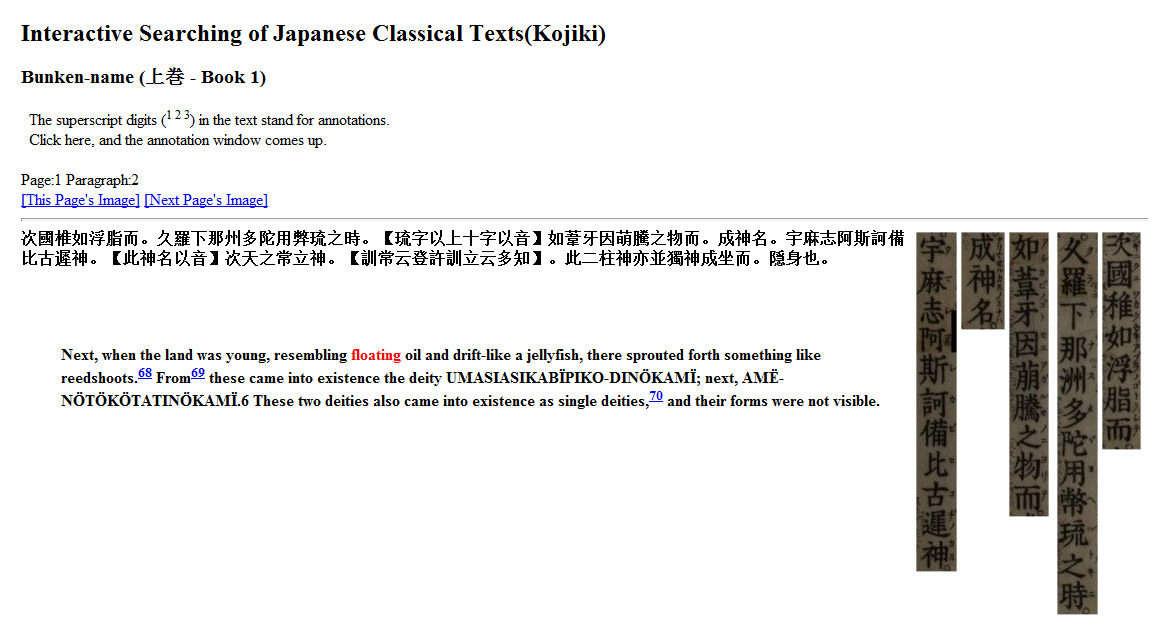
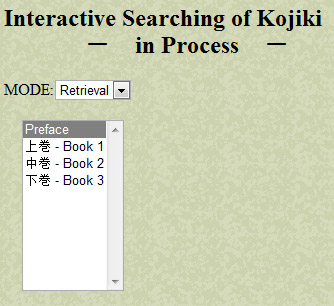
The JHTI offers two modes to access content: “Retrieval” and “Browse”. For “Retrieval”, select either Japanese or English, and then type in the character or string of characters, or the word or string of words, you wish to find and study.  For “Browse”, the user simply explores the content from the selected text in its entirety in both Japanese and English. (Because there is only an English version available to the Preface of the Kojiki, the user is unable to search or browse the Japanese original.)

When the user selects a text, they will be able to learn where the original Japanese resource came from as well as the English translation that is utilzied. A description of the cross-tagging is provided as well. Users will click on the option to search within the text. While this may be helpful in searching within a text, it also limits the user by forcing them to search within one particular document at a time.

As I perused the Kogoshui, I saw that the search interface allowed the user to search either in Japanese or English a word or phrase found within the document. Additionally, a search section is available for users to find non-standard Kanji characters.

An example of a search and the resulting text.

Search Observations

The results in “Browse” mode are a little awkward in my opinion. As I browsed through the Kogoshui, I would of preferred a vertical split screen option in which I could read one side completely in Japanese and the other side showing the direct English translation. Instead, what you have is a horizontally “stacked” presentation of results in which the Japanese text of one sentence is followed by the direct English translation. While this may be effective in showing the direct translation of each line for the user, it may prove to be too distracting for the user, especially the person that browses the entire document.

While doing a search for a particular word or phrase, I noticed the importance of selecting “complete word” as a search result will try to find the letters or characters within the document in its entirety. This may cause a lag time for results to appear as well as a poor precision of retrieved items.

General Observations

For some reason, not all of the Japanese characters appeared on my desktop as I examined the results. It is likely due to the Kanji being in its original form as opposed to the modernized Japanese that I typically utilize. Needless to say, that warrants further investigation on my end personally.

While I appreciate and like the idea behind the JHTI, I do feel that it is still in its early phases in terms of content, navigation, and presentation. Personally, I have to compare this site to the University of Virginia’s Japanese Text Initiative which has a higher yield of content, better presentation of the resources, and somewhat easier navigation and search function. (Check it out, I dare you.) While I can appreciate the UCB’s JHTI’s desire to not duplicate the content found on UVa’s site, UCB should certainly consider some of the takeaways such as a browse feature by Title, Author, and time period or the option to look at the resource in its original Japanese, modern Japanese, English translation, or all three in a parallel form. (As done with the Genji Monogatari.) It is certainly something that UCB could have investigated to see how best to present resources for the benefit of the end-user.

Check out the Japanese Historical Text Initiative through the University of California – Berkeley. Overtime, I am certain that this resource will benefit many scholars as they investigate Japanese history.

Posted in culture, graduate school, study tools, useful links | Tagged , , , , , , | 2 Comments

Book Announcement: Dealing With Disaster in Japan: Responses to the Flight JL123 Crash

Just as the sinking of the Titanic is embedded in the public consciousness in the English-speaking world, so the crash of JAL flight JL123 is part of the Japanese collective memory. The 1985 crash involved the largest loss of life for any single air crash in the world. 520 people, many of whom had been returning to their ancestral home for the Obon religious festival, were killed; there were only four survivors. This book tells the story of the crash, discusses the many controversial issues surrounding it, and considers why it has come to have such importance for many Japanese. It shows how the Japanese responded to the disaster: trying to comprehend how a faulty repair may have caused the crash, and the fact that rescue services took such a long time to reach the remote crash site; how the bereaved dealt with their loss; how the media in Japan and in the wider world reported the disaster; and how the disaster is remembered and commemorated. The book highlights the media coverage of anniversary events and the Japanese books and films about the crash; the very particular memorialization process in Japan, alongside Japanese attitudes to death and religion; it points out in what ways this crash both reflects typical Japanese behaviour and in what ways the crash is unique.

This book is likely to provide a useful framework for students and others
writing dissertations, essays and other work on the Great East Japan
Earthquake.

For further details see
http://www.hood-online.co.uk/JL123/Book1/contents.php

Posted in announcements, culture | Tagged , , , | Leave a comment

Call for Papers: Kentucky Foreign Language Conference

April 19-21, 2012
University of Kentucky
Lexington, Kentucky

CALL FOR PAPERS

East Asian (Chinese, Japanese, and Korean) Studies

Deadline for submission of abstracts: November 15

The 65th annual Kentucky Foreign Language Conference (KFLC) will feature sessions devoted to the presentations of scholarly research in the field of East Asian (Chinese, Japanese, and Korean) Studies, broadly defined. The theme of this year’s conference is “Place and Space.”  Abstracts are invited in all areas and aspects of this topic.

Each presentation is 20 minutes followed by a 10 minute questions & answers period.  In view of the multi-lingual audience, the language of presentation is English.

We will consider 1) individually submitted paper abstracts and 2) proposals
for a panel of three-to-five papers.

1) An individually submitted abstract should be 250 words or less in length, and should include the author’s name, affiliation, and contact information. Once accepted, paper abstracts will be grouped into the panels according to the common themes.

2) A panel proposal should be 500 words or less in length, and should include the theme of the panel, the organizer’s name and contact information, and the names and affiliations of the panel participants.

Abstracts of the papers to be presented in the panel should be assembled by the panel organizer and submitted with the panel proposal.

The KFLC has a tradition of attracting scholars from a broad range of languages and specializations. This year’s conference will have sessions in Arabic Studies, East Asian Studies, French and Francophone Studies, German-Austrian-Swiss, Hispanic Studies, Italian Studies, Language Technology, Luso-Afro-Brazilian, Russian Studies, and Second Language Acquisition.  This year’s KFLC will feature Mary Sheriff of the University of North Carolina at Chapel Hill as keynote speaker.

Deadline for submission of abstracts and panel proposals is November 15.

To submit a paper abstract or a panel proposal, please visit the following website for more information:
http://www.kflcabstracts.uky.edu/index.php/kflcabstractsite/kflc2012

Acceptance of a paper or a panel implies a commitment on the part of the participant/s to register and attend the conference. All presenters must pay the appropriate registration fee by February 15th  to be included in the program.

For more information on the conference, please visit http://web.as.uky.edu/kflc/index.htm. For specific questions regarding the East Asian sessions, please contact the leader Masamichi (“Marro”) Inoue (msinoue@uky.edu).

Posted in announcements, conferences | Tagged , , , , , , , , | Leave a comment

Call for papers: 51st Southeast Conference of the Association for Asian Studies

Call for Papers, SEC-AAS

Location: Furman University, South Carolina, United States
Deadline: October 31, 2011
SEC/AAS Conference Jan. 13-15, 2012

The 51st annual meeting of the Southeast Conference of the Association for Asian Studies (SEC/AAS) will be hosted by Furman University, to be held in Hyatt Regency Hotel in downtown Greenville, South Carolina. This years conference will feature a keynote by AAS president and historian, GAIL HERSHATTER, University of California, Santa Cruz.

Proposals for panels on specific Asia-related topics are expressly solicited; panels devoted to teaching Asian subjects at the secondary or college level are also requested. Individual paper proposals are also welcome. Only one paper per participant will be accepted. For detailed guidelines and requirements regarding proposal submission for individual papers, panels, roundtables, and outreach sessions, visit http://www.uky.edu/Centers/Asia/SECAAS/callpapers.html

Dr. Krista Van Fleit Hang, hangk@mailbox.sc.edu, Department of Languages, Literatures, and Cultures, Welsh Humanities Office Bldg. 813, University of South Carolina, 1620 College St., Columbia, SC 29208.
Email: harry.kuoshu@furman.edu
Visit the website at http://www.uky.edu/Centers/Asia/SECAAS/callpapers.html

Posted in announcements, conferences | Tagged , , , , | Leave a comment

No Fun Link Friday today

Sadly, there are no fun links today, as I’m currently occupied at the University of Michigan’s conference The Early Modern “Medieval”: Reconstructing Japanese Pasts (http://japanesepasts.lsa.umich.edu/).

Regular posts will resume tomorrow, though! Have a great weekend!

Posted in announcements, site maintenance | Leave a comment

Job Opening: Japanese and East Asian History, Assistant Professor

Institution: McGill University, History and Classical Studies
Location:   Quebec, Canada
Position:   Japanese and East Asian History, Assistant Professor,Tenure Track Faculty

McGill University invites applications for a tenure-track position at the rank of Assistant Professor in Japanese History, a joint appointment in the Department of History and Classical Studies and the Department of East Asian Studies, commencing August 1, 2012. The candidate will have an active and innovative research program, and will be expected to teach courses in both departments at the undergraduate, masters and doctoral levels.  This includes introductory courses in East Asian history and in modern Japanese history, and courses within the candidate’s area of specialization. Ph.D. expected at time of appointment; teaching experience preferred. McGill University is an English language institution, but knowledge of French would be considered an asset.

Please complete the online application form available at http://www.mcgill.ca/history/academic-job-opportunities/.  A letter of introduction, curriculum vitae, one-page statement of teaching philosophy and three confidential letters of reference should be sent electronically to jobsearch.history@mcgill.ca.

Applicants are asked to include the words “Japanese History Appointment” in the subject line.  Referees are asked to include the words “Japanese History Reference” in the subject line. Hard copies of reference letters might be requested at a later stage.  Review of applications will begin on November 15, 2011, and will continue until the position is filled.

Although letters should be addressed to the Chair of the Japanese
History Search Committee, McGill University, Lea 608, 855 Sherbrooke
St. W., Montreal, Quebec, Canada, H3A 2T7, supporting documents as
well as all enquiries concerning the search are to be sent to
jobsearch.history@mcgill.ca.

All qualified candidates are encouraged to apply; however, Canadians and permanent residents of Canada will be given priority.  McGill University is committed to equity in employment and diversity.  It welcomes applications from indigenous peoples, visible minorities, ethnic minorities, persons with disabilities, women, persons of minority sexual orientations and gender identities and others who may contribute to further diversification.  We draw your attention to the self-identification equity form, available on our application website, which we invite you to complete and return with your supporting documents, if you so wish.

Contact: jobsearch.history@mcgill.ca
Website: http://www.mcgill.ca/history/

Posted in announcements, job openings, jobs, Uncategorized | Tagged , , , , , , , , , , | Leave a comment

Job Opening: Japanese Linguistics, Applied Linguistics or L2 Japanese Language Acquisition

Institution: University of Iowa, Department of Asian and Slavic Languages and Literatures
Location:   Iowa, United States
Position:   Assistant Professor, Japanese Linguistics (tenure-track)

The Department of Asian and Slavic Languages and Literatures in the Division of World Languages, Literatures and Cultures at The University of Iowa invites applications for a tenure-track Assistant Professor of Japanese Linguistics, Applied Linguistics, or L2 Japanese Language Acquisition position beginning August 2012. A Ph.D. is required in Japanese linguistics, applied linguistics, second Language Acquisition or related areas. Native or near-native fluency in Japanese and in English and teaching experience at the college level are required. Proficiency in North American models of language and content area pedagogy is preferred. Duties include 1) serving as the Coordinator of Japanese Language Program (with 200+ students), supervising and coordinating all levels of language courses, and guiding curriculum development and outcomes assessment; 2) teaching language courses and content area courses (i.e. Japanese linguistics, applied linguistics, Japanese language pedagogy to graduate and undergraduate students. Optional additional teaching duties would include general second language acquisition and applied linguistic courses for the FLARE Ph.D. program in second-language acquisition. Accepted candidate will teach 2 courses (or equivalent) per semester. Application review will begin on November 15, 2011.

The Department, the Division, and the College of Liberal Arts and Sciences are strongly committed to gender and ethnic diversity; the strategic plans of the University, the College, the Division, and the Department reflect this commitment. Women and minorities are encouraged to apply. The University is an Affirmative Action/Equal Opportunity Employer.

Contact: The salary for this position is commensurate with experience and qualifications. Interested candidates must submit an application letter and complete curriculum vitae to the Search Committee via online application at http://jobs.uiowa.edu and arrange to have three letters of recommendation submitted online to the same link. Refer to requisition number 60066. Paper applications will not be accepted.

Website: http://clas.uiowa.edu/dwllc/asll

Posted in announcements, job openings, jobs | Tagged , , , , , , , , | Leave a comment

Foreign Area Officer (aka Getting Paid to be an Expert)

Hello cyberspace!  Katie here, coming at you with a little bit more incentive to go military, or even just military related.  A lot of agencies and services have realized the importance of having individuals specialized in certain areas of the world.  It makes sense.  This carries the potential to save the government money and time in the long run, and you avoid messy and confusing turnovers.  Let’s face it:  going from South America to Asia is a bit of a leap.  It helps if you’ve got staff already well versed and experienced.

Foreign Area Officer (FAO) is all the rage these days with government agencies and services.  They tend to be selected for one specific area, Northeast Asia for example, and rarely will leave that geographic region.  They typically act as liaisons due to their acute understanding of a culture, but that doesn’t mean they get pigeon-holed into any particular line of work.  FAOs can come from a variety of backgrounds within each agency or service, which means a wide range of capability.  To say a FAO just does (insert job description here) would be selling the profession short.

I won’t lie to you, this is not a “straight out of college” deal.  Most agencies and departments require that you spend a few years getting used to regular business, but already having that East Asian-related degree definitely makes you more appealing than your average liberal arts major.

The Navy’s policy towards going FAO is a bit loose:  the day you can submit your package is not specified but is dependent upon your designation (ie. Supply, Surface Warfare, etc) and whether your prior commitments are satisfied.  Depending on when you switch, you might be enticed with packages for a bonus or a higher degree and you can almost always expect some additional and more intensive language training.  The Navy, for example, takes puts its FAOs through the Defense Language Institute (DLI) and the Navy Postgraduate School (NPS) before allowing them to deploy to their respective regions.

Since FAO is so new, you can expect changes to occur in the various programs as everyone overcomes the growing pains.  Eventually there might evolve a set timeline, but in the meantime things are very open.  As with everything else, positions are dependent upon demand.  A lot of focus is being placed on the Middle East so you can expect employers being more anxious with FAOs in that region than others.  Forewarning you all, it is common belief that if you are proficient in one area, you can just as easily become proficient in another.  Don’t be surprised if someone tries to get you to learn a new language/culture/region because you’ve already excelled at something different.

If going FAO sounds enticing to you, then your best bet is to a pick a few agencies and services that you are interested in and start applying for entry-level positions.  Always pick those that you want to be a part of separately from your desire to be a FAO.   Once hired, ask about their policy about going FAO and, when the time comes, apply.  But always bear in mind that good things come to those who wait!

Some helpful links to my favorite service and agency (naturally they are both maritime-related!):

http://www.faoa.org/ (Foreign Area Officers Association)
http://www.navy.mil/search/display.asp?story_id=24182 (Article with a good background for the Navy program)
http://www.ncis.navy.mil/Careers/Pages/ … ogram.aspx (Description for NCIS)


===

Katie McDaniel graduated from Gettysburg College with a BA in Japanese Studies and a minor in Political Science (2009).  After working a year with ESE elementary students, she was commissioned an officer in the Navy through Navy Officer Candidate School (OCS).

Posted in jobs, main posts, military service, useful links | Tagged , , , , | 4 Comments