Studying Japanese history? Check out the Japanese Historical Text Initiative (JHTI)through the University of California-Berkeley (UCB)!

Background
The Japanese Historical Text Initiative is the brainchild of Delmer Brown, Professor Emeritus of History at UCB, whose interests in religio-political dimensions of early Japanese history led him towards the development of a database containing key ancient texts and their translations. After receiving grant funds from the Grand Tsubaki Shrine of America, UCB, International Shinto Shrine of Tokyo, and the Japanese Ministry of Education, the JHTI met its fruition.
Since 2005, the JHTI is sponsored and owned by The Center for Japanese Studies at UCB. Its mirror site is owned by Osaka International University (OIU) in Japan. Both the Center and OIU co-manage the JHTI website.
Contents
The JHTI is a growing database with historical texts dating back over 1200 years. Each resource includes the original version of every paragraph in every text and is cross-tagged with English translations. This allows the researcher the opportunity to see both the original and English translation of every JHTI text.
Text contents include ancient texts, ancient gazetters, ancient religio-civil code, Medieval chronicles and tales, Medieval and early-modern interpretive histories, religion and polity in the modern state.
As the site grows and evolves, the JHTI plans to include content of Japanese texts in translation of public domain historical documents found over the internet.
Current texts available on the JHTI include: Kojiki, Nihon Shoki, Izumo Fudoki, Harima Fudoki, Bungo Fudoki, Hizen Fudoki, Hitachi Fudoki, Shoku Nihongi, Kogo Shui, Engi Shiki, Yamato Monogatari, Okagami, Eiga Monogatari, Gukansho, Azuma Kagami, Jinno Shotoki, Taiheki, Tokushi Yoron, Meiji Horei, Kokutai no Hongi, Kyuhanjo, Kinji Seironko, and Shinto wa Saiten no Kozoku Kaidai.
Due to copyright, several texts require a username and password to access the resource in its entirety. By e-mailing the JHTI, users typically receive access within a week. (UPDATE: I received my username and password within a week after requesting one. I’m not affiliated with the UC school system and used my OSU account to receive access.)
 Search and Navigation
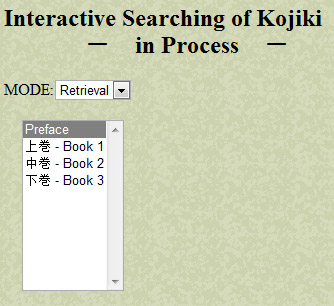
The JHTI offers two modes to access content: “Retrieval” and “Browse”. For “Retrieval”, select either Japanese or English, and then type in the character or string of characters, or the word or string of words, you wish to find and study. For “Browse”, the user simply explores the content from the selected text in its entirety in both Japanese and English. (Because there is only an English version available to the Preface of the Kojiki, the user is unable to search or browse the Japanese original.)
When the user selects a text, they will be able to learn where the original Japanese resource came from as well as the English translation that is utilzied. A description of the cross-tagging is provided as well. Users will click on the option to search within the text. While this may be helpful in searching within a text, it also limits the user by forcing them to search within one particular document at a time.
As I perused the Kogoshui, I saw that the search interface allowed the user to search either in Japanese or English a word or phrase found within the document. Additionally, a search section is available for users to find non-standard Kanji characters.
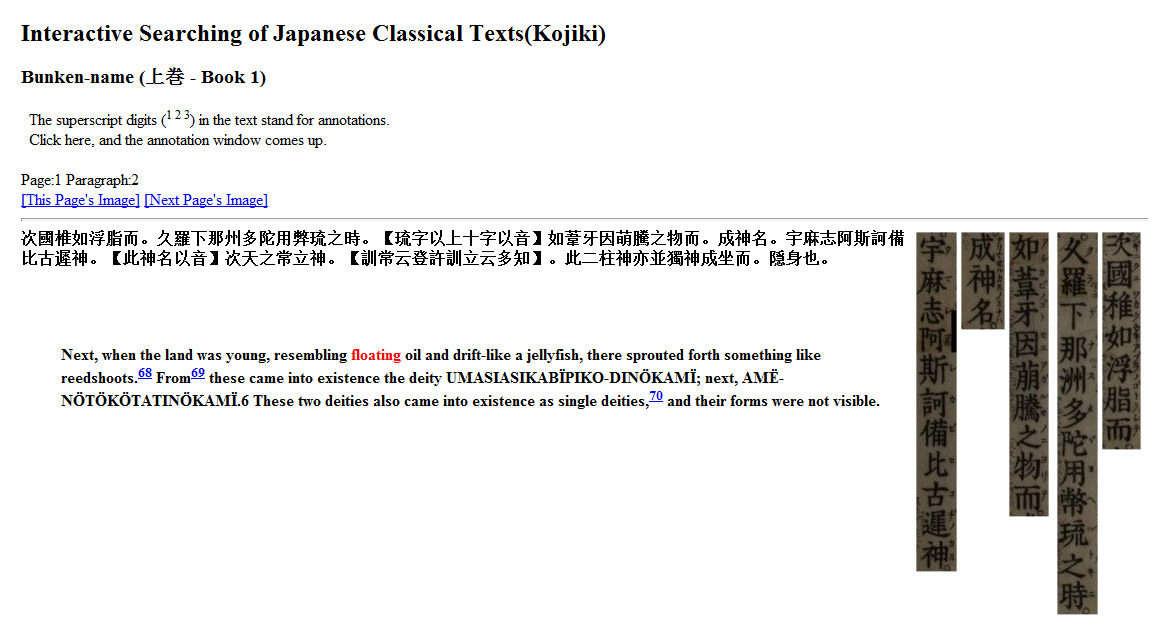
An example of a search and the resulting text.
Search Observations
The results in “Browse” mode are a little awkward in my opinion. As I browsed through the Kogoshui, I would of preferred a vertical split screen option in which I could read one side completely in Japanese and the other side showing the direct English translation. Instead, what you have is a horizontally “stacked” presentation of results in which the Japanese text of one sentence is followed by the direct English translation. While this may be effective in showing the direct translation of each line for the user, it may prove to be too distracting for the user, especially the person that browses the entire document.
While doing a search for a particular word or phrase, I noticed the importance of selecting “complete word” as a search result will try to find the letters or characters within the document in its entirety. This may cause a lag time for results to appear as well as a poor precision of retrieved items.
General Observations
For some reason, not all of the Japanese characters appeared on my desktop as I examined the results. It is likely due to the Kanji being in its original form as opposed to the modernized Japanese that I typically utilize. Needless to say, that warrants further investigation on my end personally.
While I appreciate and like the idea behind the JHTI, I do feel that it is still in its early phases in terms of content, navigation, and presentation. Personally, I have to compare this site to the University of Virginia’s Japanese Text Initiative which has a higher yield of content, better presentation of the resources, and somewhat easier navigation and search function. (Check it out, I dare you.) While I can appreciate the UCB’s JHTI’s desire to not duplicate the content found on UVa’s site, UCB should certainly consider some of the takeaways such as a browse feature by Title, Author, and time period or the option to look at the resource in its original Japanese, modern Japanese, English translation, or all three in a parallel form. (As done with the Genji Monogatari.) It is certainly something that UCB could have investigated to see how best to present resources for the benefit of the end-user.
Check out the Japanese Historical Text Initiative through the University of California – Berkeley. Overtime, I am certain that this resource will benefit many scholars as they investigate Japanese history.


Pingback: Resource: Japanese Historical Text Initiative | What can I do with a … - - worldhistory.vno.bz
Pingback: Call for Writers: Articles, Resource Review, Fun Links | What can I do with a B.A. in Japanese Studies?