Fun Link Friday: War Kimono

Cranes, carp, cherry blossoms…Zero fighters? I guarantee you haven’t seen kimono motifs like these before!

Wolfgang Ruf of Lake Lucerne, Switzerland, collects rare wartime kimono from roughly 1894-1942 with soliders, weapons, and military vehicles.

Image va swissinfo

Image va swissinfo

Today’s fun link, “Kimonos reveal Japanese wartime history,” takes a look at Ruf’s collection of 200 rare kimonos and offers insights into who may have worn them.

“The ancient clothes are beautiful but they also tell us about the social, cultural, economic and political contexts in which they were worn,” added Ruf. “It’s a real encyclopaedia of Japanese weaponry.”

Posted in culture, fun links | Tagged , , , , , , , , , , , , | Leave a comment

Job Opening: Developer, UNU Publications Repository [Tokyo]

job opening - 5

For those with experience and education in computer science:

Institution: UNU Publications Repository
Job posted by: United Nations University Office of the Rector (Tokyo)
Location: Tokyo, Japan (local applicants only)
Posted on: July 3, 2013
Start date: August 5, 2013
Application deadline: July 26, 2013
Education requirements: 4-year degree, Computer, Computer Science

The United Nations University Office of the Rector, the Library, and the Office of Communications are developing an online digital repository for UNU publication output. A platform and application (Fedora Commons, Fez) have been selected and are in the process of being deployed. The project team is currently investigating ways to improve the user experience for administrative users, improving the workflows and streamlining the user interface.

The successful applicant will be tasked with assisting the project team in the development and implementation of the publications repository, focusing on the improvement of the administrative user interface. Primary tasks will be:

  • Working with the project team to develop improved form workflows;
  • Implementing the new workflows;
  • Updating/adjusting existing administrative form layouts and workflows;
  • Updating existing PHP controllers and Smarty templates to modify the workflows;
  • Updating/adjusting existing CSS to be more in line with the unu.edu style;
  • Developing additional styles where necessary;
  • Data import and maintenance;
  • System testing and troubleshooting;
  • Other duties requested by the project team.

Required qualifications and experience

  • A bachelor’s degree in computer science or related fields;
  • At least three (3) years of work experience in web development, preferably in the areas outlined below;
  • Proficiency in PHP/CSS/JS;
  • Experience in user interface design;
  • Experience or familiarity with the frameworks/toolkits used in the project is beneficial (Zurb Foundation, Jquery, Dojo, Smarty);
  • Knowledge of digital repository management systems (Fedora Commons, dSpace) is beneficial;
  • Familiarity with XML and XML document types is beneficial;
  • Excellent time management skills and the ability to work within tight deadlines;
  • Results-oriented and a demonstrated ability to deliver on projects;
  • Excellent communication skills with fluency in both oral and written English. Knowledge of another UN official language is an asset;
  • A good team player with strong interpersonal skills, demonstrated by the ability to work in a multi-cultural, multi-ethnic environment with sensitivity and respect for diversity.

Full application details on Idealist.org.

Posted in announcements, job openings, jobs | Tagged , , , , , , , | Leave a comment

Job Opening: Program Manager, TOMODACHI Initiative [temp]

job opening - 5

Institution: The Washington Center for Internships and Academic Seminars
Location: Washington, D.C.
Start: August 1, 2013
Application deadline: August 1, 2013
Education requirements: Master’s degree
Level of language proficiency: Proficiency in Japanese required.
Employment type: Full time & Temporary (see below)

Position Description:

The Program Manager, TOMODACHI Initiative, is a key role for delivering “Building the TOMODACHI Generation Program” which is a two-week leadership-based program engaging globally oriented U.S. and Japanese college students in social problem-solving. In this role, the Program Manager, TOMODACHI Initiative, is responsible for planning and executing the two-week program including but not limited to arranging logistics, activities, and speakers for the program as well as promoting, assessing, and reporting on the program.

The position will be hourly part-time from August through December 2013, and hourly full-time from Jan 1 through Feb 28, 2014, and part-time again in March 2014.

JOB FUNCTION

Program Planning

  • Develop a leadership-based curriculum for 14 Japanese students and 10 U.S. students that enhances students’ understanding of the principles, challenges and potential of civil society.
  • Identify preferred criteria for selection of U.S. students participating in the program and manage the selection process.
  • Develop learning outcomes for the program.
  • Plan all program logistics including but not limited to airport pick-up and drop-off, ground transportation, food, etc.
  • Recommend faculty directors and arrange for speakers based on the program curriculum.
  • Plan all program activities based on the curriculum including orientation, commencement, networking events, off-site team-building, civic engagement project (for U.S. students), etc.
  • Communicate with the U.S. Japan Research Institute regularly to coordinate the program schedule.
  • Regularly communicate with students selected for the program prior to arrival to address any questions/concerns.
  • Create program syllabus outlining program components for students.
  • Develop program survey and assessment templates.

Program Execution

  • Serve as an advisor to students during the program, not only answering questions, but also providing individualized counseling for them throughout the program.
  • Serve as a liaison between students and their campus liaisons for challenges that may occur during the program.
  • Confirm all aspects of the program and execute as planned with Program Assistant’s help during the two week program (from airport pick-up to program delivery, then to commencement and airport drop-off).
  • Conduct program assessment and compile the results.
  • Serve as an ongoing social media and PR liaison for Communications team.
  • Collect and compile students’ testimonials for the program report.

Administrative

  • Track all expenses for the program and manage sub-contractors and vendors.
  • Provide monthly updates on the program development.
  • Write a program report based on the program content as well as survey results.
  • Communicate to universities regarding students’ projects and performance.
  • Support other related areas as needed.

Education and Experience

An equivalent combination of education, training, and experience will be considered:

  • Master’s degree in fields relevant to the TOMODACHI initiative.
  • Proficiency in Japanese required.
  • One to three years of experience in working with college students in advising, mentoring, or supervision capacities within specific area desired.
  • Proven ability in planning and executing programs/seminars/workshops.

Knowledge, Skills, and Abilities which are critical to the successful performance of the job. These may be representative but not all inclusive of those commonly associated with the position:

  • Track record of planning and organizing trainings or conferences
  • Ability to manage multiple projects and work collaboratively
  • Demonstrated understanding of diversity issues within a higher education and professional environment and actively addresses situations to ensure cultural and global competency
  • Proven ability to articulate organizational objectives and development goals
  • Independent judgment and initiative
  • Familiarity with Japanese culture.

Full application details on Idealist.org.

Posted in announcements, job openings, jobs | Tagged , , , , , , , , , , , | Leave a comment

Conference: Religious Performance, City and Country in East Asia

call for papers [150-2]The University of Illinois will host an international symposium, “Religious Performance, City and Country in East Asia,” October 9-10, 2013, at Levis Center of the Urbana-Champaign Campus.  For details concerning the event, including registration and schedule, see below.

University of Illinois

This conference brings together leading scholars in the field from North America and Japan for a two-day symposium, October 9-10, 2013 (Levis Center), to examine the relationship between metropole and rural religious performance by drawing a set of clear lines of liturgical practice in the East Asia case, with special reference to Japan.  The keynote speakers will be Professors Matsuo Kōichi, National Museum of Japanese History, and Haruo Shirane, Columbia University.  First, we pay attention to the position of medieval Japanese religious performance vis-à-vis continental East Asia.  What were the ritual and cultural flows that informed the development of medieval Japanese Buddhist and other religious performance (Kami worship, Shugendō [mountain asceticism])?  Second, we consider the character and movement of a series of religious performances in the Japanese isles.  What were the producers and audiences of these performances?  How, moreover, were these performative modes translated between groups in the metrapole and countryside?  Third, how did performance genres such as divine dance (kagura), visual didactic performance (etoki), and biwa lute playing influence religious performance and reception through their mixture of multiple media?  Finally, how did the mobility of performers and media influence the development of religious performance?  That is, how did the travel of the monk Ennin to China influence his production of shōmyō chanting in Japan?  What does archeological study tell us about the movement of Pure Land Buddhist performative practices?  How did performances of Kumano believers and Shugendō practitioners transmit or otherwise transform their practices in currents between metropole and mountainside?  Furthermore, how were textual-performative practices related to temple arts and ritual transmission in the city and country?
Registration is free but required (contact ruppertshogyo@gmail.com) since there is limited seating.  Booklets with the full lectures by participants, including translations into Japanese and English, will be provided to all registrants at the event; discussants, with the exception of Professor Matsuo, will comment in English, and discussion will be in both English and Japanese.  Japanese participants will present in Japanese.
Religious Performance, City and Country in East Asia

Continue reading

Posted in announcements, conferences, graduate school | Tagged , , , , , , , , | Leave a comment

Resource: Tools for Banking, Finance, and Law

Lately we’ve been fortunate to have a number of guest writers contributing articles related to translation and non-academic careers that use Japanese (and we have more to come in the near future!), but we’ve been a bit lax on updating our resources. As I was going through my massive “save this, people could use it!” folder, I came across a fairly old link that a lot of people looking for information on business and banking with Japanese companies will find interesting.

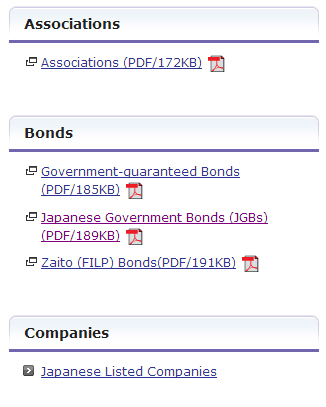
The Mizuho Securities company, a Japanese investment and banking firm, has a plethora of informational resources for English-speakers. If you go from their homepage to Corporate and Institutional Clients, then click on Research & Links (or, you know, just click the hyperlinks I gave you), you’ll find a large list of English-language subheadings full of internet resources and learning tools.

Mizuho

For example, if you want to check out more about Japan’s government organs, you can click on Government Ministries & Agencies, where you’ll find a list of the English language websites for each organization like the Ministry of Economy, Trade, and Industry or the Ministry of Justice. There’s also links to specific agencies of interest, like the Japanese Mint or Patent Office, or financial and economic councils.

Their section on Translating Tools is noteworthy for economically-minded learners of Japanese, people entering finance/banking positions, or people working on translation related to this field. Here you’ll find a long list of PDF files that include direct translations of commonly used business and banking terms. So if for some strange reason you ever found yourself needing to know the word “discount of bills with government bonds as collateral,” you’d discover it in “Japanese Government Bonds” vocabulary file, and know that it’s 国債担保手形割引 (kokusai tanpo tegata waribiki)! A lot of these are very specialized vocabulary sets—I really have no idea what a “yield curve analysis” is, nor to I expect to ever need to consult a huge list of terms related to it—but some of the PDFs are more basic, everyday things like words related to taxation and pensions, which I imagine would also be useful to people who plan on spending a significant amount of time living in Japan.

Also, for those of you interested in the legal system, there is also a section on Japanese Law that provides links to English translations of finance related legislation and English translations of other legislation, both of which list specific laws and tap into J/E texts within the Japanese Law Translation Database system. So this is a great resource for people with overlapping interests in finance and the law, too.

Know of any other, similar resources? What do you guys use? Let us know via email or in the comments!

Posted in graduate school, living abroad, study tools, undergraduate, useful links | Tagged , , , , , , , , , | Leave a comment

Workshop: Reading Late Edo Period Media and Society

Reading Late Edo Period Media and Society: Kawaraban and Handwritten Manuscripts from the Kano Bunko Collection of Tohoku University

September 16th – 20th, 2013

ORGANISERS

Heidelberg University   ハイデルベルグ大学
Institute of Japanese Studies   日本学科
Akademiestrase 4-8
69115 Heidelberg

Tohoku University   東北大学
Center for Northeast Asia Studies   東北アジア研究センター
Uehiro Historical Materials Research Department   上廣歴史資料学研究部門
http://uehiro-tohoku.net/guide.html

The instructor will be Prof. Ken‘ichiro Aratake, Associate Professor at Tohoku University. The language of instruction will be Japanese only!

CONDITIONS

The workshop will be limited to 20 participants. No tuition fees apply but registered participants will be asked to contribute €50 toward the cost of course materials. We cannot provide accommodation for the duration of the workshop, but we are happy to help the successful applicants locate accessible
venues in Heidelberg.

APPLICATION INFORMATION

Applicants should send a short CV and a brief paragraph explaining how the workshop will contribute to their research. The deadline for applications is August 18th. We will keep a waiting list and notify additional participants on a rolling basis.

For further details and the week schedule please see the announcement:
http://www.zo.uni-heidelberg.de/japanologie/

For more information and to send your application please contact:
Dominik Wallner (senseito@gmx.de) or Doreen Mueller (dm29@soas.ac.uk).

Posted in announcements, conferences, graduate school | Tagged , , , , , , , | Leave a comment

Job Opening: Asian History, Assistant Professor (tenure-track)

job opening - 5Institution:   Elon University, Department of History and Geography
Location:   North Carolina, United States
Position:   Assistant Professor of Asian History, tenure-track

Elon University seeks applicants for a tenure-track position in Asian History at the assistant professor level beginning in mid-August 2014. Applicants must demonstrate both excellence in teaching at the
undergraduate level as well as strong scholarly potential. Areas of specialization to be considered include: Inner, South, Southeast, or East Asia. PhD in History is required as are strong language skills
commensurate with the successful scholarly potential of any such candidate. Responsibilities include teaching lower division survey courses in regional history and upper division courses in his/her area
of specialization. Applicants must also be willing to teach courses in the interdisciplinary general studies program. Elon is a dynamic private, co-educational, comprehensive institution that is a national
model for actively engaging faculty and students in teaching and learning. To learn more about Elon, please visit us at www.elon.edu. Complete applications must be received by September 23, 2013. To
apply, please send a letter of application, curriculum vitae, graduate and undergraduate transcripts, three letters of recommendation, teaching evaluations, and a writing sample. All materials should be sent electronically to: Michael Matthews, Chair, Asian History Search Committee, Department of History and Geography, historysearch@elon.edu. Elon University is an equal opportunity employer committed to a diverse faculty, staff and student body and welcomes all applicants.

Contact:
All materials should be sent electronically to: Michael Matthews,
Chair, Asian History Search Committee, Department of History and
Geography, historysearch@elon.edu.

Website:
http://www.elon.edu/e-web/academics/elon_college/history_geography/default.xhtml

Posted in announcements, job openings, jobs | Tagged , , , , , , | Leave a comment

Funding: Diversity Abroad Scholarship

money [150-2]Although the deadline for 2013 has already passed, DiversityAbroad.com offers annual scholarship for study abroad to undergraduate students. See the 2013 information below.

Program Background


Diversity Abroad, in cooperation with the AIFS Foundation, will offer $500 scholarships for summer 2013 and fall 2013 study abroad. Five scholarships are available for the summer, and five are available for the fall. Economically disadvantaged students, first-generation, students with disabilities and ethnic and racial diverse students are strongly encouraged to apply.

Application deadlines are as follows: March 1st, 2013 Summer, and May 3rd, 2013 for fall 2013 


Eligibility


Applicants must be full-time undergraduates at a university or community college based in the Australia, Canada, the United Kingdom or the United States. Economically disadvantaged students, African-American/Black, Asian, Hispanic/Latino, Multiracial/ethnic or Indigenous/Native-American, students with disabilities and first generation college undergraduate students are strongly encouraged to apply.

Applicants must meet the following criteria: 


  • Applicants must be full-time undergraduates at a university or community college based in the United States. Students must participate in a study abroad program offered by a DiversityAbroad.com partner organization.
  • Economically disadvantaged students, African-American, Asian-American, Hispanic/Latino, Multiracial/ethnic or Native-American undergraduate students as well as student who study in non traditional locations (Outside western Europe & Australia ) are strongly encouraged to apply.
  • Applicants must meet the following criteria:
  • Have a minimum cumulative 2.75 GPA at an accredited U.S. university or college
  • Be accepted to a study abroadintern abroadlanguage immersion abroad or volunteer abroad program offered through a DiversityAbroad.com Partner Organization
  • Be a U.S. citizen or legal permanent resident
  • Must be willing to share their experiences abroad with the DiversityAbroad.com community via blogs, picture and videos (at least twice a week), participation in DiversityAbroad.com travel abroad forum and do a study abroad testimonial at the end of their time abroad

See application details at:

http://www.diversityabroad.com/scholarships/diversity-abroad

Posted in announcements, financial assistance, funding, graduate school, living abroad, study abroad, summer program, undergraduate | Tagged , , , , , | Leave a comment

Book Announcement: Wondrous Brutal Fictions: Eight Buddhist Tales from the Early Japanese Puppet Theater

Wondrous Beautiful FictionsWondrous Brutal Fictions:  Eight Buddhist Tales from the Early Japanese Puppet Theater.  

Wondrous Brutal Fictions presents eight seminal works from the seventeenth-century Japanese sekkyō and ko-jōruri puppet theaters, many translated into English for the first time. Both poignant and disturbing, these whimsical narratives contain stories of cruelty and brutality, as well as love, charity, and outstanding filial devotion, representing the best of early Edo literary and performance traditions and acting as important precursors to the Bunraku and Kabuki styles of theater.

As works of Buddhist fiction, these texts relate the histories and miracles of particular buddhas, bodhisattvas, and local deities. Many of their protagonists have become recognizable cultural icons through their representation in later works of Japanese drama, fiction, and film. The collection includes such sekkyō “sermon-ballad” classics as Sanshō DayūKarukaya, and Oguri, as well as the “old jōruri” plays Goō-no-hime and Amida’s Riven Breast. R. Keller Kimbrough provides a critical introduction to each vibrant performance genre, emphasizing the role of seventeenth-century publishing in their spread. He also details six major sekkyō chanters and their playbooks, filling a crucial scholarly gap in early Edo-period theater. More than fifty reproductions of mostly seventeenth-century woodblock illustrations offer rich, visual foundations for the critical introduction and translated tales. Ideal for students and scholars of medieval and early modern Japanese literature, theater, and Buddhism, this collection provides an unprecedented encounter with popular Buddhist drama and its far-reaching impact on literature and culture. The book is now available for purchase at the CUP website, at:  

http://cup.columbia.edu/book/978-0-231-14658-6/wondrous-brutal-fictions

Posted in announcements, culture | Tagged , , , , , , , , , , , | Leave a comment

Call for Papers: Kinema Club XIII – Three Times +X. Transitional Moments in Film and Media History in Japan

call for papers [150-2]*Dates: January 17, 2014*
*Reischauer Institute, Harvard University*
*Deadline for submissions: August 20, 2013*

We welcome submissions for the 13th Kinema Club Conference on Film and Moving Images from Japan!

This Kinema Club will focus on three transitional moments in the history of film and media in Japan, centered around the years 1927, 1962, and 1995. Additionally, to celebrate the 40th anniversary of the Reischauer Institute, we will include the year 1973.

Panel proposals on additional years are also possible (though not individual papers), as are panels on questions of historiography in relation to research on film and moving images from Japan.

The concept is therefore somewhat different from previous Kinema Clubs. By focusing respective sessions on specific years, we will be able to recognize heterogeneous constellations. These can be what Harry Harootunian has (in reference to Ernst Bloch) called “noncontemporaneous contemporaneity“, or due to other factors of industry or audience segmentation. These constellations can include relations across different genres, distribution networks, or media platforms at a given historical moment. It will allow recognizing what we might call contradictory coherences of aesthetic, social, and political history.

For this we have selected three years that are often regarded, for different reasons, as transitional:

– 1927 is the year that Komatsu Hiroshi sees as foundational for modernism in the cinema of Japan, strongly influenced by the 1923 earthquake in Kantô.

– 1962/3 is the time of the appearance of Pink Film and Ninkyô Yakuza film, and the production of the first anime, Tetsuwan Atomu / Astro Boy (even if the first broadcast took place on January 1, 1963). It the year after a large part of Shin Toho’s archives were sold to television, making Japanese films produced for the cinema available on TV for the first time.

– 1995 is often discussed as a year of crisis and rupture, deeply leaving its mark on moving image culture. After the burst of the bubble and the re-organization of the film industry, it is the year in which Neon Genesis Evangelion is broadcast. It is the time when Japanese film is re-”discovered” at international film festivals.

and as a bonus option and due to the 40th anniversary, we include the year1973, the year of the founding of the Reischauer Institute.

*Panel submissions of at least three presenters that focus on additional years are also welcome!*
*Dates*:

The conference will be held on *January 16 *at the Reischauer Institute at Harvard University.

*Submissions:*

Please send abstracts of up to 200 words or any questions to:
kinemaclub13@gmail.com

Deadline for submissions is August 20, 2013.

Posted in announcements, conferences, graduate school | Tagged , , , , , , , | Leave a comment