
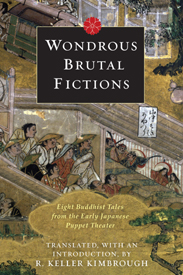
 Wondrous Brutal Fictions: Eight Buddhist Tales from the Early Japanese Puppet Theater.
Wondrous Brutal Fictions presents eight seminal works from the seventeenth-century Japanese sekkyō and ko-jōruri puppet theaters, many translated into English for the first time. Both poignant and disturbing, these whimsical narratives contain stories of cruelty and brutality, as well as love, charity, and outstanding filial devotion, representing the best of early Edo literary and performance traditions and acting as important precursors to the Bunraku and Kabuki styles of theater.
As works of Buddhist fiction, these texts relate the histories and miracles of particular buddhas, bodhisattvas, and local deities. Many of their protagonists have become recognizable cultural icons through their representation in later works of Japanese drama, fiction, and film. The collection includes such sekkyō “sermon-ballad” classics as Sanshō Dayū, Karukaya, and Oguri, as well as the “old jōruri” plays Goō-no-hime and Amida’s Riven Breast. R. Keller Kimbrough provides a critical introduction to each vibrant performance genre, emphasizing the role of seventeenth-century publishing in their spread. He also details six major sekkyō chanters and their playbooks, filling a crucial scholarly gap in early Edo-period theater. More than fifty reproductions of mostly seventeenth-century woodblock illustrations offer rich, visual foundations for the critical introduction and translated tales. Ideal for students and scholars of medieval and early modern Japanese literature, theater, and Buddhism, this collection provides an unprecedented encounter with popular Buddhist drama and its far-reaching impact on literature and culture. The book is now available for purchase at the CUP website, at:
http://cup.columbia.edu/book/978-0-231-14658-6/wondrous-brutal-fictions


