Today we will be featuring a guest article by Joel Challender, a professional translator and interpreter who will discuss a bit about his career path and the process from the BA onward in the professional field.
—
Although Japanese language remains highly popular and attracts keen learners year after year, how viable is it to pursue a career based on an undergraduate degree in Japanese?
What can a BA in Japanese Studies do for you? My name is Joel Challender, and I currently occupy a number of positions, including translating books on disaster prevention for Kyoto University (and CeMI (http://www.npo-cemi.com/). I also translate documents into English for various corporations and organizations, provide interpreting (both simultaneous and consecutive) at conferences and business meetings in Japan and abroad, and occasionally conduct walking tours in the Japanese countryside for people here on holiday. Since graduating with a BA in 2002 from the School of Oriental and African Studies (University of London), I have held a number of positions hinging on interpreting and translation, encompassing media production, tourism, corporate communications, NGO-related work, and education. I imagine that my story will strike a familiar note with many readers who have trodden a similar path, but I hope that it can still offer some new perspective.
Given the economic slowdown and the fact that more and more Japanese people speak English, those contemplating a BA in Japanese may legitimately worry as to whether their degree will translate into a viable career path. At the very least, it should surely be combined with another subject such as economics or politics, no? Or Mandarin? Can a BA in Japanese alone provide the tools to carve out a niche in a “post-Lehman” world where many language and humanities graduates have been flung onto the proverbial scrap heap? I hope to show that diligently studying the language while actively networking and looking for opportunities can result in a very rewarding career. The bottom line is that I firmly believe Japan will become a net exporter of cutting-edge knowledge and technology suited to tackling an ageing population and for generating power with reduced environmental impact. This will spawn a not insignificant amount of international cooperation in which competent Japanese linguists will have an important role to play.
What your background is related to Japanese and the education you pursued?
I first got interested in Japanese when I was about sixteen. My mother, a teacher, had a Japanese boy in her class at school and was taking an evening course on Japanese in the UK. Seeing her study materials around the house, I thought that it would be great to get to grips with a really foreign language. When it came to selecting a major at University, I decided to give Japanese a go because I had some aptitude for languages, having studied French, Latin and Spanish. I felt that Japanese would be a great challenge and would also open up doors in future although I did not plan out a particular career or job category. My parents and teachers at school were hesitant at first but came round the idea eventually. I entered SOAS in 1998, spent a year in London, and then a year at the Hokkaido University of Education in Sapporo (followed by two more years in London). My major was advanced practical Japanese and the translation of modern Japanese literature into English. During my third and fourth years I was reading Japanese literature on a daily basis and trying to learn the process of how to reproduce it in English. The teachers were inspirational. This was complemented by courses on linguistics where we had to compare and contrast the syntactic structures of English and Japanese. The course was rigorous and challenging, and in our final year we were set timed essays on any given topic to be written out by hand, in pencil. I still study on a daily basis to keep up with the ever-evolving lexicon and to learn new expressions and words. Apart from my BA, though, I have had no further formal education in Japanese I have lived in Japan since 2003.
Taking opportunities as they come
A BA in Japanese has opened many doors for me, and I feel like I have only just gotten started. While I always dreamed of becoming an interpreter, my basic approach was to get my Japanese as proficient as possible in all aspects (speaking, reading, writing) while networking as broadly as I could. I should mention that throughout my degree course in London I already had a wonderful job teaching English to Japanese people at a very good school called One to One English. I was teaching several nights a week, as a visiting teacher to private homes, and even ran the school when the manager went away on holiday. Before starting my degree in Japanese I taught in Fiji for 6 months as a volunteer teacher and after that at an English school in my hometown. During my second year in Sapporo, I had over 20 private students and so as far as I was concerned, teaching was my vocation. Besides, it helped me learn a lot of vocabulary and to gain insight into difficulties faced by Japanese learners of English. With five years of teaching already under my belt, I decided to head to Japan to teach English and gain some experience.
Most of the opportunities I have had have been unexpected and not strategically planned, although I have always been proactive in networking and trying to bring work my way. It is certainly not an approach that suits everyone. This was evident from an early stage at University, as many people with a more strategic bent were doing joint degrees in Japanese and Economics/Business Studies with internships lined up. I remember meeting one student in his final year who already had a job lined up in a Swiss Bank before he even had time to throw his mortarboard in the air.
Once you graduated, what was the process like for thinking about/searching for jobs? Did you have a particular type of job in mind?
As mentioned above, while I was at University, I worked several days a week as an English teacher to Japanese people living and working in that city, ranging from bankers to chefs, housewives, their young children, and students. I decided to go straight to Japan to seek work in June 2002 when I finished my studies, having been invited to spend the summer with a family in Shizuoka Prefecture who were residents in London and wanted to ensure that their children did not lose their English ability while on holiday. Luckily for me, this opportunity presented itself out of the blue, but in reflection it was partly due to the fact that I had put a lot of effort into teaching their children over the years in London. I stayed with them and taught their friends English, played tennis, went to the beach, and explored the Kanto region. I picked up the Japan Times, which at that time was full of classified ads and applied to a few schools. I lined up a job in a small town near Mt.Fuji, but at the same time received an email from a fellow SOAS graduate about a position working in a bilingual TV production company in the UK where he had interned, and decided to go back to London to interview with them.
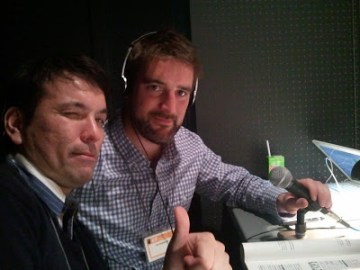
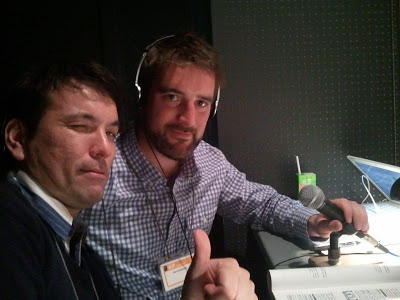
Booth interpreting at Japan Renewable Energy Conference, Yokohama
I worked freelance for this company as a researcher, interpreter, translator and production assistant while carrying on some English teaching and found the work really rewarding. The company serviced Japanese broadcasters filming in the UK, who often needed footage licensing or filming permission. It was a steep learning curve and I started at the bottom rung. I observed how to write polite emails to customers, how to discuss their requirements on the phones, and how to plan and coordinate shoots in London. I got involved in the shoots, assisting the Japanese crew with casting for actors, securing interviewees as well as providing logistical support as part of a small team. Eventually I was able to do more interpreting and production related work. The owner of the company was a charismatic producer who also graduated from London with a BA in Japanese. He was an astute businessman and for the most part very patient with junior staff so it was a very positive experience with lots of important lessons learned. I started to notice I had an aptitude for interpretation when I accompanied two Japanese senior producers from NHK to interview victims of serious crime in London for a documentary on CCTV. This fermented my belief that I was most suited to interpretation as a career.
In 2003, I discovered by chance that the international NGO Peace Boat were recruiting volunteer interpreters and was given a telephone interview. The test involved interpreting into both languages over the phone and I remember feeling the pressure of being put on the spot. I got the job and spent the next three years working for Peace Boat, first as a volunteer interpreter and then the coordinator of the interpreting team. I did 4 global voyages and had many wonderful experiences, but perhaps most significantly discovered I had an aptitude for simultaneous interpretation from Japanese into English. The learning curve was steep and I was constantly studying. There were career interpreters on my team who trained me and gave me lots of pointers for which I was very grateful. This included, learning how to prepare properly for lectures and seminars, how to build up the memory muscle to hold down long chunks of text, how to take notes, how to work in a booth and support other interpreters,how to interpret in a way that the listener appreciates and not just a monotonous drawl of words, how to anticipate where the sentence is going but still leave yourself enough room to maneuver out of it if you have incorrectly anticipated the direction the speaker is taking, and how to boost vocabulary and knowledge of subject matter. The topics ranged from international politics to Japanese domestic issues, history, music, art, plus the current state of all the countries visited. I learned that successful interpreting is 80% preparation and familiarization with the subject matter, creating glossaries, speaking with the speaker beforehand, and so on.
Having clocked up several hundred hours of interpreting, I left Peace Boat and worked in Tokyo for 5 years in various roles, including translating in-house (at Mizuho Corporate Bank and Link Communications), interpreting and translating on a freelance basis, while occasionally reverting to my role as a media coordinator for film crews coming into Japan from abroad.
I translated investor and research reports, presentations, currency analysis, internal rules and policies, marketing materials, articles and books. I still have a box full of flashcards I made on financial terms that I used to study on the train in the morning on the way to work. One key duty in both of the teams where I worked was crosschecking each other’s work. I was extremely lucky to work with veteran translators who were generous in meting out constructive criticism.
In 2010, I started leading walking tours for foreign tourists in the Japanese countryside to get away from a desk-based environment and all the squinting, neck ache and coffee that this can involve. Ergonomic chairs, CAT tools and flexible working hours make translation easier, but are a small consolation for staring at computer screens for hours on end, racing deadlines and triple-checking your work before it goes to the printers. I won’t go into the vagaries of translation here and will save that for a more veteran translator to divulge, but will mention a few brief points. The industry is crowded, with new entrants from other job categories and an increasing number of Japanese who have totally mastered English. Companies are opting to translate in-house and then outsource the proofreading to cut costs. There are a plethora of translation tools to streamline work processes for increased cost efficiency. Despite the industry undergoing various changes, in terms of earning a good wage, personal experience tells me that technical translators both in-house and freelance can definitely make 6 figure salaries. Patent translation is one area to consider if you are thinking of going into translation and want to strategically position yourself in the market.
One other major impact on my career path is the fact that we are attempting to raise our children bilingually and to his end return to the UK for at least a month every year. This has of course had a major bearing on my career path. I have parted company with various employers despite offers of sei-sha-in (permanent employee with benefits) positions, as the main priority has been to give my children exposure to English and their roots in England. The only way to get a month’s holiday is to change jobs frequently and so this has necessitated a fair amount of career hopping. However, because Japanese interpreting and translation are relatively portable skills, this has not posed any major problems, except perhaps the awkwardness of re-explaining your job situation to curious friends and family every Christmas
What kinds of resources did you use to seek out the jobs you wanted?
There were resources available for career guidance at University such as information on career forums, but as I mentioned previously, I was already on a teaching trajectory by this stage. Later on, between jobs I registered in person with all the major Japanese-related recruitment agencies in the UK (of which there are several servicing a fairly quiet job market) and they offered me a few positions that involved Japanese language. For example, I was asked to go along to an interview at a Japanese opticians in London and it was only then that it dawned on me that it was futile to simply look for a job with the sole criterion of using Japanese language.
Many translation and interpreting jobs have come through personal contacts. I might venture that there is no substitute for networking with people in the real world rather than only online. Of course it is important to have an online presence and SEO if you wish to aggressively increase your business, but there is a lot to be said for making the personal connection and gaining access to other people’s networks. Translation bodies and associations often have formal and informal gatherings and representatives of translation companies who are looking for new translators to cope with new demand sometimes attend these.
The Big 3 Interpreting Companies

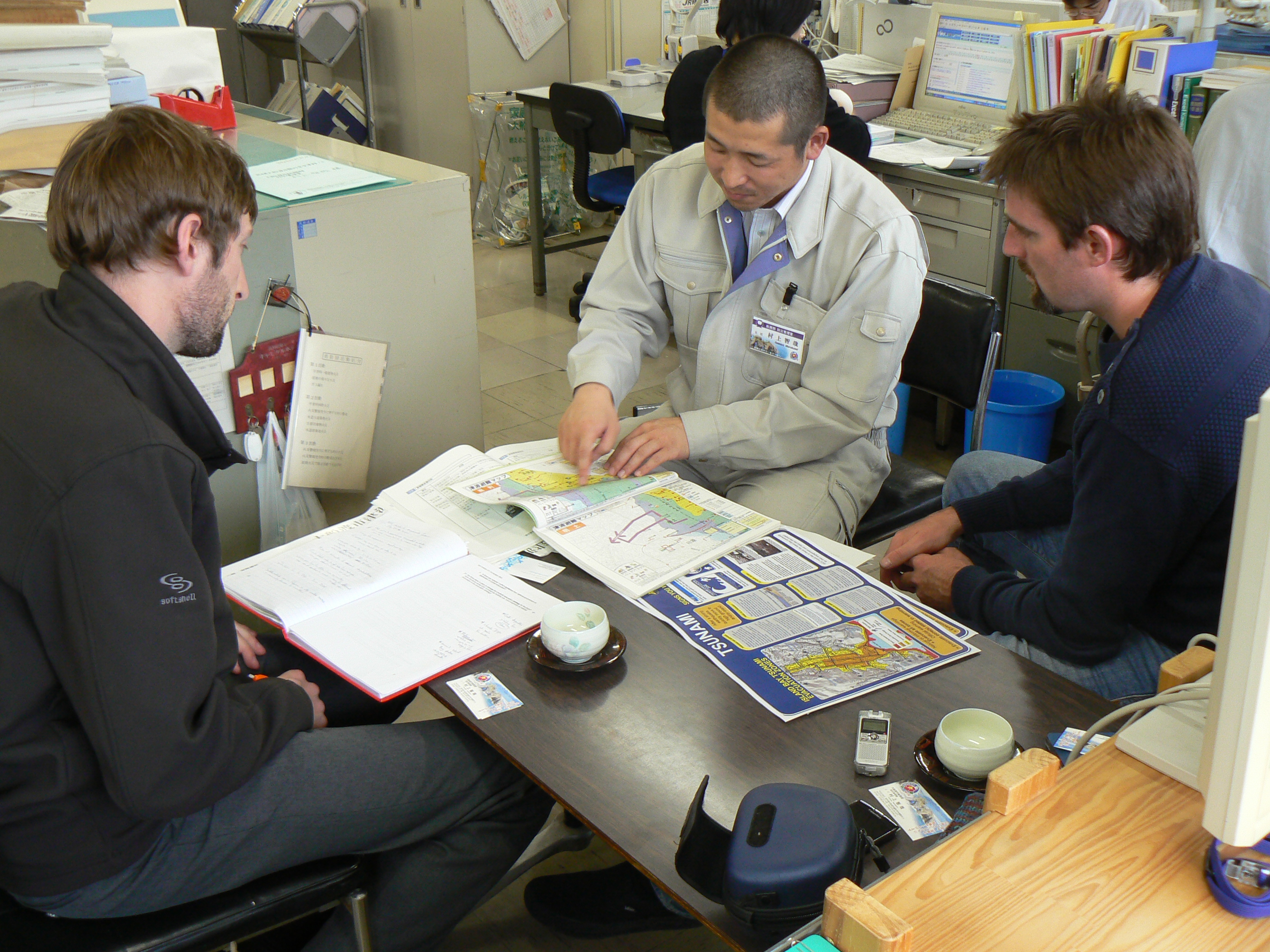
Interpreting for The New Zealand Geological Survey in Ishinomaki
A few large well-known interpreting companies in Tokyo hold a lot of the jobs, and require investment on your part in their training programs before you get to work as a dispatch interpreter at a multi-national, often on an hourly wage. While this route takes more time and money than going it alone, it has a high probability of yielding steady work in the future. To share one anecdote, I received a personal introduction to the head of interpreting at one of these “Big 3” companies from a colleague, and attempted to register with them. I explained that I could interpret in certain areas and certain subjects and offered a recording of my interpreting to complement the personal recommendation I had been given, but he was adamant that anyone who wanted to work for them had to first of all go through their training program, a part of which involved taking English lessons from a native English instructor. This further kindled my desire to try and cultivate jobs through my own means, and I secured interpreting jobs in-house and for business meetings, negotiations, lectures and seminars. Would I have had more interpreting work if I had pursued the agency route? This question remains.
What were the most difficult challenges you encountered when you finally landed that first job?
My first job was in a bilingual television production company in London, servicing Japanese broadcasters such as NHK and Fuji TV. The biggest challenge was learning how to effectively communicate with the clients in Japan. I learned that email can lead to obfuscation rather than clarification and that is often much quicker to make a phone call. I thought that my spoken and written Japanese was good but I soon realized I had a lot to learn, mainly related to the industry itself which had its own lingo (mainly concerned with filming and footage licensing) that took a while to get my head around. The other challenges were practical; as I was employed on a freelance basis I had to file my own taxes and this was a lot more of a headache than I had anticipated. My employer also talked about “spinning plates”, meaning the act of juggling all sorts of different tasks at once when leading up to a shoot. I learned a lot in that job that stood me in good stead for other jobs later on. Funnily enough, but said in all seriousness one of the biggest challenges of working in London at that time was the transport – buses and trains were constantly late or delayed making it hard to be anywhere on time! With regards to working in translation, often one has to do trial tests or bid for large jobs, pitted against many other translators. I win a fair amount of bids and trials and lose some too. Coping with this is of course one downside but serves as motivation to always try and better one’s efforts.
A bright future for Japanese-English linguists?
This year, jobs have included proofreading, editing, translating, proposal writing, interpreting, media coordination, live television interpreting, business negotiations, shipping negotiations, CEO reception speeches, facilitating for sports coaches, cultural exchange programs, ambassador speeches, international conferences and one three-week trip to the USA to survey the aftermath of Hurricane Sandy with some twenty government officials, interpreting at meetings with US government agencies. It has been the most varied year in terms of work so far and I hope that it continues.
Someone recently asked me if I had any regrets with regard to my career path to which I replied in the negative with the caveat that on reflection, interpreting and translation qualifications and certificates are very important. In the short term I aim to become a member of a couple of professional bodies if my experience and references suffice. Ultimately my aim is to work as a bridge between Japan and other countries in various capacities but also to continue studying Japanese and exploring its depths, because a life dedicated to language learning for its own sake is worth it in my opinion. Translation on its own is an art and science that takes a lifetime to master and I can only claim to have scratched the surface of professional interpreting.
A recently convened interpreting event addressed the tough climate facing interpreters. There is no shortage of Japanese MBA graduates fluent in English and other languages who can’t find that much-coveted in-house translator and interpreter job. This may mean that even qualified and experienced linguists need to diversify and have a portfolio of services to offer, unless they intend to specialize in one particular technical area; there are some fields in which only a handful of people are proficient and so Japanese and English combined with genuine expertise in any of the technical fields that underpin the modern economy is a very sound approach to adopt.
My advice to people considering a BA in Japanese would be to do so in good faith provided they feel that there is a future in working as broker between Japan and the rest of the world as new technologies are pioneered and diffused globally. Japan will confront several major issues in the coming years, finding solutions to problems posed by demographic and environmental factors. Interpreting and translating will play a major part in exporting and localizing these new technologies around the world. However, jobs will be closely guarded and over-subscribed, so a diverse set of skills with a broad network certainly would not do any harm. Other reasons for optimism for budding interpreters and intercultural consultants include the decision to host the 2020 Olympics in Tokyo, the goal of attracting millions more in-bound tourists by then, and the Japanese government’s decision to increase the number of foreign English assistant teachers in Japan. There are many niches still waiting to be carved. For future articles, I would be prepared to contribute more of my limited knowledge about what makes a good translator and interpreter and how to generate work as a freelancer if there is sufficient interest.
—
Joel Challender is an interpreter, translator and researcher living and working in Japan since 2003. Since graduating from SOAS (London) in 2002 with a BA in Japanese he has worked as an in-house and freelance interpreter and translator in various fields. He currently works as a researcher for Kyoto University Disaster Prevention Research Institute and the Crisis & Environment Management Policy Institute (CeMI), while also providing translation, interpreting and coordination services to companies in Japan and overseas, tackling various business, finance and other commercial documents.
websites:
www.japanesenglishtranslations.com
http://jp.linkedin.com/pub/joel-challender/82/726/a2a

 Via University of Hawai’i Press.

![call for papers [150-2]](https://shinpaideshou.com/wp-content/uploads/2012/06/call-for-papers-150-23.jpg)
 What can I do with a B.A. in Japanese Studies?