Japanese Studies: 5-10-20 – Eight Years Out, Where Am I Now?

For the second article in our Japanese Studies: 5-10-20, today we have a unique perspective from Reid Monroe-Sheridan, the CEO and Representative Director of Tokyo Nexus Limited and an Adjunct Lecturer at the University of Tokyo Law School. Anyone interested in taking their skills into law, business, or technology should definitely check it out! You can find our first 5-10-20 article here.

===

Eight Years Out, Where Am I Now?

Photo by Reid Monroe-Sheridan

Earlier this year, I left my job at an American law firm in Tokyo to found a Japan-based internationalization consultancy, Tokyo Nexus Limited (in Japanese: 東京ネクサス株式会社). Since then, I’ve been working with several Japanese Internet and technology companies to help them expand overseas by launching international product offerings, preparing investor relations material, and coordinating and executing business transactions with American companies. I’m also interested in helping foreign companies with market entry in Japan.

I’m still licensed as a lawyer in New York but I’m not practicing law and Tokyo Nexus does not provide legal services. I’m also an adjunct lecturer at the University of Tokyo Law School, where I co-teach teach a seminar course on international capital markets transactions.

How did I end up here? Until earlier this year I was working as a corporate lawyer at a law firm called Simpson Thacher, first for a couple years in the firm’s New York office and then in its Tokyo office. At Simpson I worked on derivatives transactions, mergers and acquisitions, and a large number of securities offerings. In Tokyo specifically, I worked mostly with large Japanese companies that were issuing and selling securities to American institutional investors like banks and pension funds.

Back to the Beginning: Majoring in Japanese and Deciding on Law School

I decided to go to law school when I was a junior in college. I loved studying Japanese and I knew I wanted to build a career involving Japanese, but I wasn’t sure what the best route might be. I knew there were American lawyers who worked in Japan and even though I had no idea what kind of work these lawyers did or how their careers progressed, I decided that this was the most promising route based on my goals and strengths. At the time I also did quite a bit of freelance web development for various clients but I didn’t see a good way to tie that to Japan. So I put web development aside in favor of law school.

For any readers considering law school, I advise you to think long and hard about your motives and what your personal finances will look like after you graduate. Law school is enormously expensive, and unless you can attend for free or law school is a concrete step in a well-defined career path, it’s probably a bad idea. What happens often is that law students take on so much debt to pay for tuition that by the time they graduate, they feel compelled to work at a big law firm to start paying back their loans. Generally speaking, working as an associate at a large law firm is extremely demanding and requires significant personal sacrifices. If you weren’t planning on that route from the beginning (or sometimes even if you were), a few years later you might find yourself very unhappy but effectively unable to leave your job for financial reasons. On the other hand, law school and my experience at a big firm were instrumental in helping me build a career and develop a professional skill set, so I do think law school is a good option in some cases.

Law School (with a Japanese B.A. in Japanese)

Studying Japanese in Law School

Keeping up my Japanese language skills was difficult during the first year of law school. Cross-registration into Japanese language courses is difficult or impossible, and adapting to a different class and schoolwork structure takes a lot of energy during the first term of law school. The second term is more relaxed for most students and the second and third years are a breeze (comparatively).

I cross-registered for Japanese language courses during my second year, took a couple Japanese law courses during my second and third years, and also spent a term studying at a law school in Tokyo. Studying abroad at a Japanese law school was a lot of fun and a great way to improve my legal Japanese. (In case you’re wondering, I was absolutely not held to the same standard as the Japanese law students. If I had been, I’m sure I would have failed all my courses.)

Getting a Japan-Related Job as a Law Student

Because I already knew I wanted to work in Japan, finding the right job was an easier process for me than for many other law students. There isn’t much public interest work for U.S. lawyers to do in Japan, so if you want to work here as a lawyer you’re almost certainly going to be working at an international law firm. I spent a summer at a litigation firm after my first year of law school and it became clear that I was better suited to corporate work over litigation.

So by the time I was a second-year law student I knew that I wanted to do corporate work at an American firm in Japan. With that criteria, there weren’t that many options to consider, and U.S. law firms with strong Japan practices are always in need of native English-speaking U.S. lawyers with business Japanese language abilities. After gathering as much information as I could about the Tokyo market, I settled on Simpson Thacher based on the combined strength of their Japan and U.S. corporate practices. Even after striking out on my own, I continue to recommend Simpson to any law students who want to work in Japan.

Working as a U.S.-licensed Lawyer in the U.S. and Japan

Getting the Right Experience and Working in Japanese

For anyone interested in working in Japan as a lawyer, I strongly recommend that you start your career with at least a year of practice in the U.S. The Japanese deal process is idiosyncratic in some ways and becoming familiar with U.S. market standards for deals in your practice area will be hugely valuable. It will also give you experience working and negotiating “the American way,” which differs from the typical workflow in Japan and will be very useful experience once you move out here.

When you come to Japan, there’s a good chance you’ll be involved in some legal work that requires Japanese language skills. The amount of Japanese you’ll be using varies by practice area, and there are some areas that actually don’t require Japanese language skills at all. Generally speaking, litigation requires the least (or no) Japanese, mergers and acquisitions requires some to a lot of Japanese, depending on the type of transaction, and capital markets work virtually requires business proficiency.

I know the prospect of doing legal work in Japanese can be intimidating. One important thing to keep in mind is that you’re almost certainly never going to be doing any drafting in Japanese. You’ll attend Japanese meetings, work from Japanese legal documents, and potentially participate in Japanese negotiations, but as a U.S. lawyer you won’t be producing Japanese-language documents.

Strangely, doing legal work with a Japanese component is easier than it sounds. The bottom line is that you have to get things right, and when you’re forced to do this in a high-pressure situation you’ll be surprised at just how much you can understand. And as you pick up more and more specialized Japanese legal vocabulary the process gets easier and easier.

Registering as a Foreign Lawyer

This is a bit of a side note, but it’s a very important point for anyone who wants to build a legal career in Japan.

Under Japanese law, foreign lawyers cannot practice law in Japan without registering with the Ministry of Justice. This means that even if you’re licensed to practice U.S. law, you cannot provide services or advice regarding U.S. law to clients in Japan unless you’re also registered in Japan. The definition of legal services is more limited in Japan than in America, but this is still a key point worth noting. At a law firm you will almost certainly be working in a support capacity to a partner, counsel or senior associate who is properly licensed, and that person should be delivering the legal services to your client. The general view is that to be a partner at a law firm in Japan you must be either a Japanese lawyer or a registered foreign lawyer. This wasn’t always the case, but these days I’m not aware of any exceptions at all.

As of this writing, to register as a foreign lawyer you need to have two years of practice experience as a licensed attorney outside of Japan, plus an additional year of practice experience either in or outside Japan. Some long-time Japan residents get stuck by establishing a legal career here without spending enough time overseas, and are ultimately unable to register as a foreign lawyer without leaving the country to fulfill the two-year international practice requirement. This can be disruptive to the lawyer’s career, not to mention family life, so you can potentially save yourself a lot of grief if you plan ahead. There has been talk about eliminating this requirement for many years, but it’s unclear if or when that might happen.

Establishing a Business in Japan

What goes through the mind of a foreigner living in Tokyo who decides to start a business in Japan? My primary motives were:

  • Working on a broader range of client projects, including business-side strategy and execution
  • Working with a wider range of clients, rather than only working with the large companies that can afford a big law firm
  • Getting firsthand business experience by building my own business from the ground up
  • Having control over my workflow
  • Having the freedom to structure and price my engagements to further my professional development in fields of interest

In short, I wanted to branch out and gain a wide variety of professional experience that was unavailable to me as a law firm associate while also having the freedom to focus on my particular fields of interest. And being flexible about engagements has finally allowed me to get back to my web development roots by doing a lot of work with internet and technology companies, a field that I’ve always found exciting and interesting.

Establishing a business in Japan is challenging, in no small part because nearly all of my client interaction is in Japanese and I have to pitch projects, negotiate terms, execute contracts, and do nearly all my corporate administrative work in Japanese. On the flip side, being a native English speaker who can manage this and has professional negotiation, drafting, and transaction management experience puts me at a distinct advantage for many international projects. It also provides an opportunity to work with foreign clients who want to move into the Japanese market and who need a capable English-speaking consultant on the ground in Tokyo.

Combining a Japanese Degree with Professional Skills

I initially focused on law, but there are a number of career opportunities in Tokyo for native English speakers who have business proficiency in Japanese and a little bit of professional training. Despite Japan’s persistent economic woes, there is such an extreme lack of supply of this type of profession that many foreign companies here are eager to snap up any promising recruit with the right language skills.

The fields where this lack of supply is most immediately visible are international internet and technology companies like Google and Facebook, foreign investment banks, and law firms. If you look around at various job postings in Tokyo you’ll see that companies in these areas are nearly always recruiting talented bilingual prospects.

If you don’t have any practical or professional experience, you are unlikely to get hired on the strength of your language skills alone. But a little bit of professional training or experience combined with native English ability and business Japanese will make you competitive for positions that you wouldn’t necessarily be competitive for in the U.S. I’ve observed this plenty of times and I’ve also experienced it firsthand, getting interviews for positions that I almost certainly would not have received in the U.S.

The best part about being a professional in Japan is that you get to combine the usual process of building skills and experience with constantly using and improving your Japanese language abilities. Additionally, if you’re working on international projects, any international experience you bring to the table is likely to be very valuable and appreciated by your team members. Given the very small number of foreign professionals in Tokyo and the continuing overseas expansion of Japanese companies, this remains a great place to establish a truly unique career path.

————–

Reid Monroe-Sheridan is the CEO and Representative Director of Tokyo Nexus Limited and an Adjunct Lecturer at the University of Tokyo Law School. Prior to founding Tokyo Nexus, Reid worked as an associate at Simpson Thacher & Bartlett LLP from 2010 through 2014. Reid has a J.D. from Harvard Law School and a B.A. in Japanese Literature from Carleton College, and is a graduate of Stanford University’s Inter-University Center for Japanese Language Studies. You can contact Reid at reid@tknexus.com.

Tokyo Nexus is a bilingual internationalization consultancy working with Japanese companies to help them expand overseas and with American companies to help them enter the Japanese market. Tokyo Nexus does not provide legal services. More information about Tokyo Nexus is available at www.tknexus.com (English) and www.tknexus.com/content/jp (Japanese).


Posted in culture, graduate school, jobs, living abroad, main posts, social networking | Tagged , , , , , , , , , , , | 2 Comments

Job Opening: Administrative Associate II, Mansfield Center, University of Montana

job opening - 5Institution: The University of Montana
Location: Missoula, MT
Closing Date: Screening begins May 6, 2014; Applications received after 5/5 may be considered
Education: High school required, BA preferred

The Mansfield Center houses programs that embody the core interests and characteristics of Senator Mike Mansfield’s career, striving to increase understanding and cooperation among the peoples and cultures of the United States and East Asia while advancing research and education related to ethics and public affairs worldwide. The Center focuses geographically on East Asia (China, Japan, Korea, and Vietnam) but includes programming involving the Philippines, Cambodia, Laos, Thailand, and Myanmar (Burma).

This position performs routine and less common clerical and administrative functions such as creating or editing correspondence, organizing and maintaining paper and electronic files, reconciling bills, running and formatting reports, and providing more complex information to internal and external customers; updates and maintains website; supports social media activities involving Facebook, Twitter, and blog development and maintenance; supports basic computer needs for Center staff; supports basic financial management of Center including assisting with Procard reconciliation; and supports personnel functions such as maintaining department time and effort reports and working closely with the Office of Research and Sponsored Programs to provide data as instructed.

This position works closely with the Mansfield Center Director, arranging travel requests, travel expense reports, coordinating meetings, conference calls, identifying Procard expenses, and creating the appropriate forms.

This position requires incumbent to develop working knowledge of UM platforms and databases to input material and manipulate reports and ability to work successfully with our audiences from diverse international and cultural backgrounds, including Native American communities in Montana and Asian communities in our target region.

Required Skills

  • Knowledge of Cascade Contemporary Management System software to develop and maintain Center website.
  • Thorough knowledge of Microsoft Office in order to develop Excel spreadsheets, PowerPoint presentations, Publisher booklets, Word documents and other such documents.
  • Ability to learn UM databases such as Banner, GrizMart, etc.
  • Knowledge of utilizing social media platforms to promote organizations.
  • Ability to demonstrate professionalism, initiative, judgment, and independent thought and action.
  • Ability to maintain confidentiality.
  • Ability to understand and utilize non-verbal communication in a range of situations given language or cultural differences.
  • Skills to establish and maintain working relationships and coordinate with UM offices such as office of research and sponsored programs, business services, IT, residential life, and dining services.
  • Demonstrate varied communication skills required to represent the Center in written and verbal exchanges.

Experience Required
High school graduation and two (2) years related work experience or an equivalent combination of education and experience.

Preferred Qualifications

  • Bachelor’s degree in a field related to the mission of the Mansfield Center
  • Significant exposure/study of one Asian language and experience living in Asia
  • Experience engaging with international audiences (foreign students, scholars, government officials, professionals, etc.)
  • Experience with service organizations preferred given Center program emphasis on service and volunteerism
  • Experience designing promotional materials
  • Experience developing and managing physical mail and email information dissemination lists
  • Experience reviewing and compiling proposal materials

Full details on HigherEdJobs.com.

Posted in announcements, job openings, jobs, Uncategorized | Tagged , , , , , , , , , | Leave a comment

Job Opening: Special Collections Assistant II, Princeton University [part time]

job opening - 5Institution: Princeton University
Location: Princeton, NJ
Posted: 04/25/2014
Application Due: Open Until Filled
Type: Part-Time
Education: high school

Position Summary: The position takes care of several daily recurring tasks related to circulation and public services, such as handling outgoing and incoming Annex, ReCAP, Borrow Direct and newly displayed book requests; maintenance of item records (updating, correcting and creating); maintenance of the “hold” shelves; handling patron notices (overdue, recall and fine); tracing missing books; carrel patrol (maintenance of neatness); library supply management; assisting patrons; as well as more seasonal tasks such as handling course reserves (including electronic reserves).

Participation in all other circulation activities and processing is required as needed, especially in times of pressure (circulation desk duties, carrel assignments, special projects, etc.). Books handled are in the Chinese, Japanese, Korean, and Western languages.

The precise time is to be coordinated with other Circulation staff in order to avoid overlapping; it is likely to be daily in the afternoon, but flexibility is required.

Essential Qualifications: Position Requires:

  • Must be very service-oriented and have excellent customer service skills; must work effectively and diplomatically with all users. Demonstrated ability to build good working relationships and work with others in a team environment. Excellent oral communication, judgment, and problem-solving skills in English.
  • Candidate must demonstrate that (s) he will be able to learn quickly computer programs such as Voyager (circulation, cataloging, reserves), E-Reserves, ILLiad, Acrobat and OCLC FirstSearch. Has to present sufficient indications of analytic skills to learn, select and interpret procedures efficiently and accurately, including different book classification schemes.
  • Must also be able to lift and shelve books (using stepladders), and push large book trucks holding approximately 300 volumes. Other physical tasks involve careful dealing with large, heavy and dusty books, possibly in poor condition.
  • Occasional flexibility in work schedule (to ensure full public service coverage in the absence of colleagues) is required.
  • Education Required: High School or Equivalent

Preferred Qualifications: Preferred:

Some previous experience with copy machines, scanners, and scanning software. Some knowledge (script, romanization) of one or more of the East Asian languages covered in the East Asian Library (Chinese, Japanese, Korean). Knowledge of MARC record structure and knowledge of the Voyager circulation and catalog systems in particular. Knowledge of reserves, including E-reserves. Experience using online union catalogs (OCLC). General experience with PC computers, including scanning technology and software, and programs such as Acrobat, Ariel.

NOTE: This is a part-time position – afternoon schedule (52%) duty time. 18.85 hours per week.

Full application details on HigherEdJobs.com.

Posted in announcements, job openings, jobs | Tagged , , , , , , , , | Leave a comment

Job Opening: Visiting Assistant Professor, Asian History

job opening - 5Institution:  University of Central Arkansas, History
Location: Arkansas, United States
Position: Visiting Assistant Professor, History

Asian History. The University of Central Arkansas invites applications for a one-year Visiting Assistant Professorship in Asian history, with preference for a specialty in China.  PhD desirable by time of appointment, August 15, 2014.  Successful candidate will teach world history surveys and upper division courses in area of specialty. Send application materials to Asian History Search, Dept. of History, Irby Hall 105, University of Central Arkansas, Conway, AR  72035.  Review of applications will begin on May 19, and continue until position is filled.  Web page www.uca.edu.  UCA is a university of 11,000 students; the history department has 22 faculty, approximately 200 undergraduate majors, and a masters program.  UCA is an Equal Employment Opportunity/Affirmative Action employer.

Contact: Dr. Ken Barnes, Chair, History Department; kennethb@uca.edu, (501)450-3158

Website: uca.edu/history

Posted in announcements, job openings, jobs | Tagged , , , , , | Leave a comment

Funding: 3 Japanese Government Scholarships, Consulate-General of Japan in Seattle

money-150-2Three scholarships are available through the Consulate-General of Japan in Seattle: Undergraduate Student Scholarship, Research Student Scholarship, Specialized Training College Students Scholarship
Deadline: May 20, 2014

Available to U.S. citizens living in the states of Washington, Montana, Idaho, Oregon and Alaska.

Scholarship benefits include: monthly stipend, airfare to and from Japan, and exemption of school fees for entrance examination, matriculation and tuition.

SCHOLARSHIP BENEFITS:

(Note: Details may be subject to change)

  1. Monthly stipend
    (117,000 yen ~ for Japanese Studies, Specialized Training College and Undergraduate Scholarships)
    (143,000 yen ~ for Research Student Scholarship)
  2. Travel Expenses to and from Japan
  3. Exemption of school fees for entrance examination, matriculation, and tuition

Undergraduate Student Scholarship
Available to high school graduates and above
Four to seven year scholarship is available to high school graduates for attending a Japanese university as an undergraduate student. Includes a one-year Japanese language program at a Japanese language school prior to attending a Japanese university as an undergraduate student. Recipients will receive bachelor’s degree in Japan. Applicants must be between 17 to 21 years of age.

Research Student Scholarship
Available to university graduates
Covers a one-and-a-half year to two-year period of graduate research at Japanese universities. The study area must be in the same field as the applicant studied or is now studying, or a related one. Recipients may enter Master’s or Ph.D. program after passing the entrance examination given by the university concerned. Includes a half-year of Japanese language training for those who need Japanese language training. Applicants need to be less than 35 years of age and must be university graduates.

Specialized Training College Students Scholarship
Available to high school graduates and above
This scholarship covers a three-year period of vocational study program in the following areas: civil engineering, architecture, electrical engineering, electronics, telecommunication, nutrition, infant education, secretarial studies, hotel management, tourism, fashion, dress making, design, photography and other fields of study. Includes a one-year Japanese language program at a Japanese language school prior to attending Professional Training College. Available to high school graduates who are between 17 to 21years of age.

See full application requirements and details on the Seattle Consulate-General website.

Posted in announcements, applications, financial assistance, funding, graduate school, undergraduate | Tagged , , , , , , , , , , , , , , , , | Leave a comment

Funding: Mellon Postdoctoral Fellowship in Humanities, University of Pennsylvania

money [150-2]University of Pennsylvania, Penn Humanities Forum
Andrew W. Mellon Postdoctoral Fellowship in the Humanities, 2015-2016

Five Andrew W. Mellon Postdoctoral Fellowships in the Humanities are available for the 2015-2016 academic year on the general theme of SEX. Open to untenured junior scholars holding a PhD (no more than eight years out of doctorate). Research proposals from all humanistic disciplines and allied areas (e.g., anthropology, history of science) are eligible, except for educational curriculum-building and the performing arts (scholars of performing arts are eligible). Fellows teach one undergraduate course during the year in addition to conducting their research (must be in residence during fellowship year: September 1 – May 31). Stipend: $46,500 plus single-coverage health insurance and a $2,500 research fund.

Applications are accepted via secure online webform only. Do NOT email your application or c.v., or questions about whether proposed topic is viable. Those submissions and questions will NOT be considered. The committee cannot comment on the appropriateness of proposals in advance. A careful reading of the topic description and the application form itself generally answers most questions. Please also note that if you will defend you graduate thesis any time after December 2014, you are NOT eligible to apply, and NO exceptions will be considered.

Full fellowship guidelines, ‘SEX’ topic description, and downloadable application:http://humanities.sas.upenn.edu
Application deadline: October 15, 2014

Contact:            Jennifer Conway, Associate Director

Website:           http://www.humanities.sas.upenn.edu

Posted in announcements, funding, graduate school | Tagged , , , , | Leave a comment

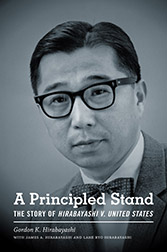
Book Announcement: A Principled Stand: The Story of Hirabayashi v. United States

Via University of Washington Press.
HIRPRIA Principled Stand: The Story of Hirabayashi v. United States
Gordon K. Hirabashi, with James A. Hirabashi and Lane Ryo Hirabashi.
paperback not available
$29.95 HARDCOVER (9780295992709)
PUBLISHED: April 2013
SUBJECT LISTING: Asian American Studies, American Ethnic Studies, World War II
BIBLIOGRAPHIC INFORMATION: 232 pp., 43 illus., map, notes, 6 x 9 in.
TERRITORIAL RIGHTS: World
SERIES: A Capell Family Book / Scott and Laurie Oki Series in Asian American Studies
CONTENTS

“I never look at my case as just my own, or just as a Japanese- American case. It is an American case, with principles that affect the fundamental human rights of all Americans.” – Gordon K. Hirabayashi

In 1942, University of Washington student Gordon Hirabayashi defied the curfew and mass removal of Japanese Americans on the West Coast, and was subsequently convicted and imprisoned as a result. In A Principled Stand, Gordon’s brother James and nephew Lane have brought together his prison diaries and voluminous wartime correspondence to tell the story of Hirabayashi v. United States, the Supreme Court case that in 1943 upheld and on appeal in 1987 vacated his conviction. For the first time, the events of the case are told in Gordon’s own words. The result is a compelling and intimate story that reveals what motivated him, how he endured, and how his ideals deepened as he fought discrimination and defended his beliefs.

A Principled Stand adds valuable context to the body of work by legal scholars and historians on the seminal Hirabayashi case. This engaging memoir combines Gordon’s accounts with family photographs and archival documents as it takes readers through the series of imprisonments and court battles Gordon endured. Details such as Gordon’s profound religious faith, his roots in student movements of the day, his encounters with inmates in jail, and his daily experiences during imprisonment give texture to his storied life.

Gordon K. Hirabayashi (1918-2012) was awarded the Presidential Medal of Freedom in May 2012. He was professor emeritus of sociology at the University of Alberta, in Edmonton. James A. Hirabayashi (1926-2012) was professor emeritus of Asian American Studies at San Francisco State University. Lane Ryo Hirabayashi is professor of Asian American Studies and the George and Sakaye Aratani Professor of the Japanese American Incarceration, Redress, and Community at UCLA.

“A Principled Stand makes an important contribution to understanding both Gordon Hirabayashi’s life and the horrible episode in this country’s history that was the internment.” – Lorraiane Bannai, Fred T. Korematsu Center for Law and Equality, Seattle University School of Law

Posted in announcements | Tagged , , , , , , , , , , , , , | Leave a comment

Competition: Manga in/as Essay: Interpreting Kurama Tengu

Manga in/as Essay competition: Interpreting Kurama Tengu

To demonstrate the expressive potential of manga, Asiascape.org (based at Leiden University), is proud to announce its third competition ‘Interpreting Kurama Tengu.’

For its 3rd manga competition, we invite manga artists, cartoonists, students and scholars to offer graphic interpretations of the classic Japanese Noh play Kurama tengu.

Contributors may interpret this task as creatively, expansively, or parsimoniously as they like: style, genre, and length may all be freely chosen. Contributors are encouraged to give the Kurama tengu a Science Fiction twist but this is not a requirement.

The text (or part of the text) of the original Noh play may be used if desired but is not necessary. Euro 1000 in prizes, plus the best artist will be considered for commission for a follow-up project.

All entries will be used for academic, non-commercial products only.

Deadline: June 1, 2014

Email: info@asiascape.org

Visit the website at http://asiascape.org/competition.html

Posted in announcements, culture | Tagged , , , , , , , , | 1 Comment

Job Opening: Visiting Assistant Professor, History (Africa, Asia, Latin America, Middle East)

job opening - 5Institution: St. Mary’s College
Location: Indiana, United States
Position: Visiting Assistant Professor

The Department of History at Saint Mary’s College invites applications for a one-year, visiting appointment for a teacher/scholar with a Ph.D. (ABD considered) in the history of Africa, Asia, Latin America or the Middle East. Teaching responsibilities include the World Civilizations survey and upper-level courses, preferably including women’s history, in the area of specialty. Applicants must demonstrate excellence in teaching. Review of credentials will begin on May 15.  Send letter of application, c. v., graduate transcripts, at least three letters of reference, and evidence of teaching excellence (e.g. teaching evaluations) to Dr. Bill Svelmoe, Department of History, Saint Mary’s College, Notre Dame, IN 46556.

Saint Mary’s College, the nation’s premier Catholic women’s college, was founded by the Sisters of the Holy Cross in 1844 and is located in Notre Dame, Indiana. Its mission is to educate women in the liberal arts tradition, focusing on intellectual vigor, religious sensibility, aesthetic appreciation, and social responsibility. Saint Mary’s College is an Equal Opportunity Employer. In keeping with the College’s mission, Saint Mary’s is committed to increasing its racial and ethnic diversity at all levels – students, faculty, and staff – and seeks applications from candidates who share this commitment.

Contact:

Bill Svelmoe
Department of History
Saint Mary’s College
Notre Dame, IN 46556

Website:
wsvelmoe@saintmarys.edu
https://www.saintmarys.edu/

Posted in announcements, job openings, jobs | Tagged , , , , , , | 1 Comment

Fun Link Friday: Cat Hanami

Hanami: not just for people. Check out these adorable cats enjoying the sakura over on Neko Memo’s post “Golden Collaboration! A Collection of Beautiful Photos of Cherry Blossoms and Cats” 「黄金のコラボ! 桜と猫の美しすぎる画像集」.

Image via Neko Memo.

Image via Neko Memo.

Via RocketNews24.

Posted in culture, fun links | Tagged , , , , | 1 Comment