Resource: Tobunken-Sainsbury Institute Research Collections Database

The Sainsbury Institute for the Study of Japanese Arts and Cultures (SISJAC) has just made available a new online database adding in English-language publications and media on Japanese arts, compiling books, exhibitions, etc. released/published within the last few years (and moving forward into the future) to a larger database already maintained by Tôbunken (National Research Institute for Cultural Properties, Tokyo).

The URL is: http://sainsbury-institute.org/research-database/

I have only just begun testing out how it works. I typed in “Okinawa” as the search terms, and found five results on fine arts, one on performing arts, and one exhibition catalog; these included two works in Japanese from an “Okinawa Artists Interview Project,” one in Japanese on “Okinawa Design,” one from 1975 on Cultural Assets of Okinawa, one conference proceedings volume from SISJAC itself entitled “Okinawa: The Rise of an Island Kingdom – Archaeological and Cultural perspectives,” and the catalog for Okinawa Prismed, a 2008 exhibition of modern/contemporary Okinawan at at the National Museum of Modern Art, Tokyo.

This seemingly appears to be drawing only on titles, not keywords, so many of the other publications, exhibit catalogs, etc. which have come out in recent years on Okinawan subjects did not come up on this particular search; the search term “Ryukyu” brought out additional, different results. The database also seems to be particularly focused on “art” in a slightly narrow way – though a few books on Okinawan archaeology did come up, exhibit catalogs for history exhibits (that certainly featured plenty of artworks and artifacts) did not. But, this is only a very tentative poke at what the database might include and not include; I imagine it is also continually in the process of being expanded.

The database also includes records from a few very specific sources, such as the Kuroda Seiki Memorial Hall, Kuroda’s diary, and illustrations from Bijutsu Gahô. So I invite you to give it a go yourself and see what it can do for you.

Here is the official announcement from SISJAC, as reposted from the Japan Art History Forum mailing list:

The Sainsbury Institute for the Study of Japanese Arts and Cultures (SISJAC) would like to introduce to you an online Japanese arts related resources database that we have been developing in collaboration with the National Research Institute for Cultural Properties, Tokyo (Tôbunken).

Following the establishment of a collaborative agreement between SISJAC and Tobunken, SISJAC has been collecting information on Japanese arts related English publications, exhibitions and film festivals that have taken place outside of Japan since 2013.

We hope that this database will develop into an indispensable tool for research on Japanese arts in and outside of Japan. For more information on the database and SISJAC’s role in this project, and to search the Tobunken Research Collections, please follow the link below.

Please note that our database is not an English translation of the information collated by Tobunken but it complements the existing databases created by them. Please also note that the publications and exhibitions in English language that predate December 2012 are not included in this database.

Posted in announcements, culture, study tools, useful links | Tagged , , , | Leave a comment

Call for Papers: Verge AAS panel on Operations of Forgetting

Verge: Studies in Global Asias will be proposing a panel about the operations of forgetting in the Asia-Pacific region for AAS (Association for Asian Studies) in Toronto next year (March 16-19, 2017). For this panel, we solicit scholarship about the myriad forgotten wars—whether military exercises deemed “small wars” or obscured conflicts within “great wars”—that have shaped, as well as shifted, the geopolitical contours of the Asia-Pacific region as we know it today. We are especially interested in the ways in which regional and transpacific skirmishes are erased, neglected, or otherwise rendered illegible. We also encourage interdisciplinary theorization of the possibilities and limits of cultural amnesia as a response to atrocity and conflict; critical attention to the dynamics between individual and social forgetting; and sustained engagement with the ethical and moral implications of forgetting in relation to memory and counter-memory.
The issues addressed in this panel are ones that will be further explored in an upcoming special issue of the journal. For more information about Verge: Studies in Global Asias and Issue 5.2 (Forgetting Wars), please see the journal’s website: https://www.upress.umn.edu/journal-division/journals/verge-studies-in-global-asias/editorial-information

250 word paper abstracts and a brief c.v. due by Friday, 7/29/16 to We Jung Yi (wuy3@psu.edu) and Tina Chen (tina.chen@psu.edu).

Posted in announcements, conferences | Tagged , , , , , | Leave a comment

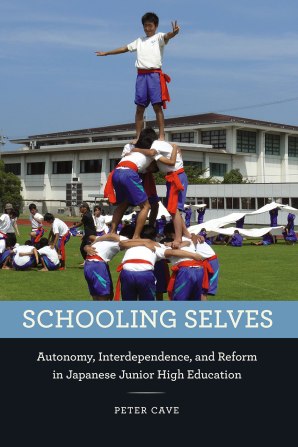
Book Announcement: Schooling Selves: Autonomy, Interdependence, and Reform in Japanese Junior High Education

selfSchooling Selves: Autonomy, Interdependence, and Reform in Japanese Junior High Education

Peter Cave

Balancing the development of autonomy with that of social interdependence is a crucial aim of education in any society, but nowhere has it been more hotly debated than in Japan, where controversial education reforms over the past twenty years have attempted to reconcile the two goals. In this book, Peter Cave explores these reforms as they have played out at the junior high level, the most intense pressure point in the Japanese system, a time when students prepare for the high school entrance exams that will largely determine their educational trajectories and future livelihoods.

Cave examines the implementation of “relaxed education” reforms that attempted to promote individual autonomy and free thinking in Japanese classrooms. As he shows, however, these policies were eventually transformed by educators and school administrators into curricula and approaches that actually promoted social integration over individuality, an effect opposite to the reforms’ intended purpose. With vivid detail, he offers the voices of teachers, students, and parents to show what happens when national education policies run up against long-held beliefs and practices, and what their complex and conflicted interactions say about the production of self and community in education. The result is a fascinating analysis of a turbulent era in Japanese education that offers lessons for educational practitioners in any country.

See: http://press.uchicago.edu/ucp/books/book/chicago/S/bo23467662.html

Posted in announcements, culture | Tagged , , , , , , , | Leave a comment

Fun Link Friday: kayakowithtoshio Instagram

In the tradition of Freddy vs. Jason and Alien vs PredatorSadako vs. Kayako, which debuted on June 18, features Sadako from Ringu and Kayako from Ju-On: The Grudge facing off in a cross-over film.

Regardless of what you think of the film, you may enjoy the Instagram @kayakowithtoshio, the heartwarming Instagram of cursed ghost Kayako and her ghost son Toshio re-enacting scenes from everyday Japanese life:

あ゛あ゛あ゛あ゛あ゛(…成長してる?) #あ゛あ゛あ゛あ゛あ゛ #ニャー #さだかや

A photo posted by 伽椰子と俊雄のほのぼの親子日記 (@kayakowithtoshio) on Apr 20, 2016 at 12:18am PDT

This charming scene is of Kayako measuring Toshio’s height, with the caption “aaaaaaaa (is he growing?) a a a a a #nyaa #sadakaya”

あ゛あ゛あ゛あ゛あ゛(呪…) #将来有望 #小学生男子 #貞子vs伽椰子 #あ゛あ゛あ゛あ゛あ゛ #ニャー #さだかや #sadakovskayako

A photo posted by 伽椰子と俊雄のほのぼの親子日記 (@kayakowithtoshio) on Jul 4, 2016 at 3:09am PDT


In this post, Toshio is practicing writing kanji, specifically 呪 (ju, kashiri; curse). The caption reads, “a a a a a (curse) #futureprospects #elementaryschoolboy #SadakovsKayako #a a a a a #nyaa #sadakaya”

Check it out at @kayakowithtoshio.

Posted in culture, fun links | Tagged , , , | Leave a comment

Call for Papers: Conference of European Association for Asian Art and Archaeology

call for papers [150-2]Conference of European Association for Asian Art and Archaeology
University of Zurich, Switzerland, August 24 – 27, 2017
Deadline: Nov 15, 2016

The Board of the EAAA is pleased to announce the call for paper for the 2nd EAAA conference to be held at University of Zurich, Switzerland,
between 24th and 27th August 2017.

Deadline for submissions: November 15, 2016
Notification of acceptance: February 28, 2017

The conference is jointly organized by the European Association for Asian Art and Archaeology (EAAA) and the Section of East Asian Art History (KGOA) at the University of Zurich.

The University of Zurich is the only institution of higher learning in Switzerland where the subject of East Asian art history can be studied as a full program. Museum research constitutes an important part of the department’s activities and its broader aim is to promote the discipline of East Asian art history, both within Switzerland and within Europe. The KGOA is proud to host the conference as a founding member of the EAAA.

The purposes of the conference are to:
– open dialogues between scholars of Asian art and archaeology and to offer a platform for the presentation and discussion of recent research
– highlight the significance of Asian art and archaeology research
– focus research on the many collections of Asian art in European collections and institutions;
– revise historical approaches that have been prevalent in the study and research of Asian art and archaeology
– elaborate existing art theories and methodology
– form new research approaches and methods in Asian art and archaeology

Conference participation
Scholars of Asian art and archaeology from Europe and beyond are invited to submit their proposals for contributions on art and archaeology of China, Japan, Korea, South and Central Asia, as well as on art theory, methodology and museum research of these areas. Presenters are either established scholars (working at museums, universities, institutes or active as independent scholars) or junior scholars (holding MA or PhD degrees).

For details on submissions, please consult the EAAA homepage:
http://www.ea-aaa.eu/events/events

Further information
For more information on the EAAA and its conference, visit the EAAA website:
http://www.ea-aaa.eu

At a later date, suggestions for accommodations in Zurich and other information will be posted on the website.

For questions related to the conference, please contact:
conference@ea-aaa.eu

For questions related to the EAAA, please contact:
info@ea-aaa.eu

Organizational committee
Hans Bjarne Thomsen (KGOA, University of Zurich & EAAA)
Nataša Vampelj Suhadolnik (EAAA)
Anna Hagdorn (KGOA, University of Zurich)


Posted in announcements, conferences, graduate school | Tagged , , , , , , | Leave a comment

Call For Papers: Individual Agency in Institutional Contexts in East Asia

call for papers [150-2]Call for Papers

GEAS Graduate Conference: Individual Agency in Institutional Contexts in East Asia

December 9-10, 2016, Freie Universität Berlin

How institutions work in real life depends to a considerable extent on how individuals relate to them in their everyday activities. As the structures given by institutions are often manifold, conflicting, and multi-leveled, diverging interpretations and pathways of action can be expected. There are various perspectives to study the relationship between institutions and individuals, among which some recent approaches emphasize the agency of individuals within an institutional setting. How do individuals interact with larger cultural, social, political, and economic contexts? Also, while doing research, how can scholars navigate the gap between concrete persons or situations, and the abstract models of agency?We welcome contributions that focus on formal and/or informal institutions.

The main purpose of this conference is to provide a forum for young researchers for an academic exchange from a multidisciplinary perspective. The conference is aimed at doctoral candidates and recent PhDs in area studies or social science disciplines related to East Asia. There are no specific requirements in respect of a candidate’s disciplinary background. The disciplines that will be considered include, but are not limited to, social and cultural anthropology, law, economics, history, political sciences, and sociology. Each speaker will be asked to deliver a paper in English, followed by a discussion with invited scholars and specialists.

Applicants are to submit the paper title and abstract (no more than 300 words) in English  by 31st July 2016 at

easychair.org/conferences/?conf=geasgradconference2016

The selected participants will be notified by End of August 2016. Final papers (5000-8000 words) should be sent in by 4th November 2016.

Contact Info:

Grad Conference Committee
Graduate School of East Asian Studies
Freie Universität Berlin
Hittorfstr. 18
14195 Berlin

http://www.geas.fu-berlin.de

Contact Email:
grad-conference@geas.fu-berlin.de

URL:
http://geas.fu-berlin.de

Posted in announcements, conferences, graduate school | Tagged , , , , , , | Leave a comment

Book Announcement: Fourteenth-century Voices 1 & 2

414gDMsxZ6L._SX331_BO1,204,203,200_FOURTEENTH-CENTURY VOICES I

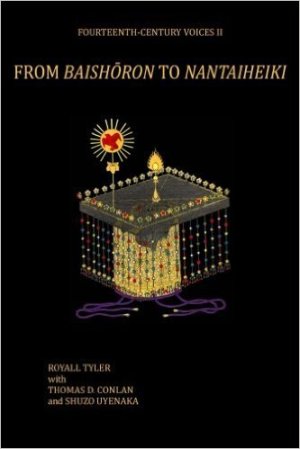
FOURTEENTH-CENTURY VOICES II
Blue-Tongue Books
Charley’s Forest, NSW, Australia

All texts except Baishōron translated, introduced, and annotated by Royall Tyler.

VOICES I

From the Bamboo-View Pavilion: TAKEMUKI-GA-KI

By Hino Nako (1310-1358)

VOICES II

  1. Baishōron(ca. 1350), translated by Shuzo Uyenaka, introduced and annoted by Thomas D. Conlan
  2. The Northern Emperors’ Journey to Anō (1352), from Taiheiki
  3. Ojima no kuchizusami (1354), by Nijō Yoshimoto
  4. The Battle of Tōji (1355), from Gen’ishū
  5. Retired Emperor Kōgon’s Last Years and Death (1364), from Taiheiki
  6. Michiyukiburi(1378), by Imagawa Ryōshun
  7. Nantaiheiki(1402), by Imagawa Ryōshun


Posted in announcements, culture | Tagged , , , , | Leave a comment

Call for Applications: Tomodachi Emerging Leaders Program

Applications Open for the 2016 TOMODACHI Emerging Leaders Program!

Application Deadline: Sunday, July 10, 2016, 11:00 pm Pacific Time

The U.S.-Japan Council and the TOMODACHI Initiative are pleased to announce that the TOMODACHI Emerging Leaders Program (ELP) is now accepting applications!

– Overview –

In 2016, twelve Japanese American young professionals will be selected to attend the U.S.-Japan Council Annual Conference and Members Meeting in Silicon Valley, California. The Conference is a forum for education and networking among the highest levels of leadership in business, public policy, academia, journalism and community organizations. By providing access to senior leaders and education on relevant topics, the program aims to motivate participants to promote strong and positive U.S.-Japan relations in their personal and professional lives.

The TOMODACHI Emerging Leaders Program is currently in its seventh year. Past participants have created a vibrant alumni network deeply engaged with the work of the Council. Continued engagement following the Conference is expected.

Selected 2016 applicants will receive transportation, hotel accommodations, meals and Conference registration. At the Conference they will become U.S.-Japan Council Associates with the first year’s membership dues waived (membership is normally by invitation and nomination).

Click here to download the program flier.

– Eligibility –

Applicants must reside in the United States or Japan, and must be available to travel to Silicon Valley, Japan from November 11 to 16, 2016.

Ideal candidates for the TOMODACHI Emerging Leaders Program should meet the following criteria:

  • Japanese American professionals 24-35 years of age at the time of the Conference
  • Applicants must reside in the United States or Japan, and must be available to travel to Silicon Valley, California from November 11-16, 2016
  • Strong interest in U.S.-Japan relations as demonstrated through professional, academic, extra-curricular or community involvement
  • Demonstrated leadership experience
  • Commitment to remain involved in U.S.-Japan relations by engaging in U.S.-Japan Council programs and initiatives, and other activities

Application deadline: Sunday, July 10, 2016

Please follow the link here to the application.

Posted in announcements, applications, graduate school, social networking, undergraduate | Tagged , , , , , | Leave a comment

Fun Link Friday: Learning Japanese through Instagram Flashcards

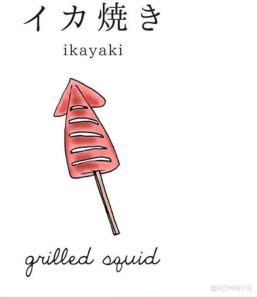
ikayakiUsing flashcards with words on them is one thing, but they don’t always give you the kind of vocabulary you may need when you actually hit the ground in Japan: visual. If you’re looking for a fun new way to get in some daily vocabulary practice, you might check out Nihongo Flashcards, which Spoon & Tamago recently reported on.  Nihongo Flashcards is an Instagram account featuring cute illustrations of various everyday Japanese words. They are followed by Japanese characters and the English pronunciations so that anybody can get a little bit of fun learning in as they cruise their everyday Instagram endeavors. Follow their account to join the party!

Posted in culture, fun links, graduate school, study tools, undergraduate, useful links | Tagged , , , , , , | Leave a comment

Resource: Gender Statistics Database

GSDB

Today we briefly introduce a resource for those interested in gender studies in modern Japan: the Gender Statistics Database. This source is almost entirely presented in a bilingual format. As stated on the site:

The Gender Statistics Database by National Women’s Education Center of Japan (NWEC) provides 551 statistical tables to show the situation of Japanese women and men in their daily living. It lays emphasis on showing the differences and similarities between women and men.

The tables in the database are divided into 11 categories and most of them are originally from statistical data by government ministries and agencies. All the tables are provided in excel format.

These categories include: population, household and family, labor, time use and unpaid work, household budget and property, learning and education, security and welfare, health, security and crime, decision-making, and consciousness surveys.

Users can click on each of these categories to access a variety of statistics collections, which appear to be listed in no particular order. The lists do, however, provide (in both English and Japanese) the source survey title, the ministry or agency that tendered the survey, the titles of the surveys, and the ability to download each survey in an Excel file format for personal use. Although the Excel files themselves occasionally have formatting issues, the data is also typically provided in a bilingual format, and is easy to utilize for your own research or interests.

It is also possible to search not by category of survey subject, but specifically by which ministry or agency conducted the survey, in case you have a specific interest in seeing what types of surveys these organizations focus on.

GSDB2

Furthermore, those without a specific category or ministry in mind can also perform a free keyword search, and those with Japanese skills may find their link for a thesaurus for women-related report terms useful, since this can at times be highly specialized vocabulary.

The site also includes a helpful guide in English and Japanese about how to enter search terms most effectively for the results you want and also includes links to other related websites in Japanese. These statistics will definitely be useful for researchers and those with a casual interest in modern Japan from a number of gender-related perspectives. The major drawback one will find, though, is a limited application of the term “gender” here, including information on only men and women in the biological sense.

Posted in study tools, useful links | Tagged , , , , , , | Leave a comment