Resource: Joseph Berry Keenan Digital Collection

Those researching or just interested in modern Japanese history will find much to explore in Harvard University’s Joseph Berry Keenan Digital Collection. A compilation of manuscript materials and photographs related to the Japanese War Crimes Trial, these works originate from Joseph B. Keenan, an American overseeing the International Prosecution Section (IPS) of the International Defense Panel and a part of SCAP.

The collection consists of two major sections, the Joseph Berry Keenan Papers, 1942-1947 and the Joseph Berry Keenan Visual Materials Collection, which can be accessed through Harvard’s HOLLIS image repository.

As described by the website, the papers section contains:

primarily of correspondence written during Keenan’s work as Chief Counsel in the International Prosecution Section. Most of the correspondence relates directly to the trial. There is a small subsection of letters between Keenan and colleagues from his Washington, D.C. law firm. Additional documents in the collection include: material relating to the court-martial of Major Walter V. Radovich; a three-page transcript of a 1946 interview with Madame Chiang-Kai-Shek; letters from Japanese and American citizens expressing their opinions on the war crime trials and the war itself; as well as some candid notes by Keenan on Japan and his work. The collection also includes newspaper clippings, photographs, business cards and notes.

In addition to the digitized images of these materials, there is also a separate finding aid section that summarizes and lists the materials within the archive, which may be of use for those searching for something specific or who just want to get a sense of the collection at a glance. The image collection consists largely of personal rather than official photographs, though they do include notable military figures, formal events, daily life and scenery, and post-1945 aerial shots of the Japanese landscape.

The collection is rich in content with a huge variety of personal and official materials that would be useful for research or use in the classroom. Be sure to take a look and see what there is to explore from this fascinating moment in history.

Posted in graduate school, main posts, study tools, undergraduate, useful links | Tagged , , , , , , , , , | Leave a comment

Job Openings: Kanagawa University


The Dept of Cross-Cultural Studies, at Kanagawa University, is in the process of expanding and restructuring into a separate faculty, 国際日本学部, to be located in a new high-rise in Yokohama’s central Minatomirai district. We are seeking TWO new Japan scholars for positions in 国際日本学, starting in **April 2020**. I will be teaching in this stream within the restructured 国際文化交流学科.

The application deadline is August 5, 2018. (Documents must arrive by post by then). Details in English are below.

————————

In addition, there are new positions for Japan scholars in the planned department of 日本文化学科 in 国語, 日本語学, 「表象文化論(現代日本文化), 「表象文化論(近世・明治期の日本文化)」, for which preference may be given to native speakers of Japanese.) Finally, there are positions in 観光学(観光文化史) for someone who is a native or near native speaker of English who has sufficient Japanese to conduct courses in Japanese too and in メディア論(特にメディアと言語との関連を研究するもの) in 国際文化交流学科 for someone who is a native or near native speaker of English who has sufficient Japanese to be a full member of the department (e.g., serving on committees).

Deadlines are late July or early August.

Follow this link to 国際日本学部(2020年4月設置構想中)の専任教員公募 for details on all positions: http://www.kanagawa-u.ac.jp/employment/professor/fulltime/

————————

Open-rank positions (2) in Japanese History, Japanese Art History, Japanese Religious Studies and/or Japanese Visual Media Studies

Kanagawa University in Yokohama, Japan, invites applications for two full-time, open-rank faculty positions in the Department of Cross-Cultural Studies, part of a new Faculty of International and Japan Studies that will be established in 2020. Appointments will begin April 1, 2020.

We seek applicants pursuing the following research specializations: 1) Japanese History; 2) Japanese Art History; 3) Japanese Religious Studies; 4) Japanese Visual Media Studies. Native- or near-native-level English ability is required.

Duties will include the teaching of an English-language course in the specialization area, as well as general English courses. Appointees will also be able to offer seminars related to their area of specialization.

Native-level speakers of a European language (other than English, French or German) or an Asian language (other than Japanese) who are able to instruct students in that language will be given priority. Japanese ability sufficient for carrying out administrative duties is required of all applicants.

Applicants must have completed the PhD by time of appointment, or be able to show evidence of equivalent research accomplishments.

For a detailed list of materials to be submitted when applying, the address to which applications should be sent, and further information regarding the positions, please view the Japanese-language announcement at http://www.kanagawa-u.ac.jp/employment/professor/fulltime/pdf/063.pdf.

Materials must arrive by August 5, 2018.

Salary is competitive; precise salary level, which is linked to appointee experience, will be determined according to university guidelines.

In accordance with common practice at Japanese institutions, all ranks of these open-rank positions can be understood as tenured.

For more information, please contact Christian Ratcliff (ratcliff@kanagawa-u.ac.jp)

Posted in announcements, job openings, jobs | Tagged , , , , , , , , , | Leave a comment

Book Announcement: The Monstrous-Feminine in Contemporary Japanese Popular Culture

The Monstrous-Feminine in Contemporary Japanese Popular Culture
Dumas, Raechel

This book explores the monstrous-feminine in Japanese popular culture produced from the late years of the 1980s through to the new millennium. Raechel Dumas examines the role of female monsters in selected works of fiction, manga, film, and video games, offering a trans-genre, trans-media analysis of this enduring trope. The book focuses on several iterations of the monstrous-feminine in contemporary Japan: the self-replicating shōjo in horror, monstrous mothers in science fiction, female ghosts and suburban hauntings in cinema, female monsters and public violence in survival horror games, and the rebellious female body in mytho-fiction. Situating the titles examined here amid discourses of crisis that have materialized in contemporary Japan, Dumas illuminates the ambivalent pleasure of the monstrous-feminine as a trope that both articulates anxieties centered on shifting configurations of subjectivity and nationhood, and elaborates novel possibilities for identity negotiation and social formation in a period marked by dramatic change.

The TOC is available at the publisher’s site: https://www.palgrave.com/us/book/9783319924649

Posted in announcements, culture | Tagged , , , , , , , , , | Leave a comment

Call for Papers: 23rd Annual Japan Studies Graduate Conference at UCLA

We are pleased to announce a call for papers for the 23rd Annual Japan Studies Graduate Conference to be held in historic Royce Hall at UCLA, October 29th, 2018. The conference is titled:

“Bent out of Shape: Remolding Conceptions of Materiality and the Body in Japan”

We are also delighted to have Dr. Reginald Jackson, Assistant Professor of Premodern Japanese Literature at University of Michigan, as our keynote speaker. Dr. Jackson will offer a workshop seminar, tied to the conference theme, during the following day.

An abstract (250 words) and CV are due by July 23, 2018. All submissions and inquiries may be sent to: uclajapanesegradconference@humnet.ucla.edu

Please visit the conference site for the full CFP and for more information.

CFP: https://uclajstudiesgradcon.weebly.com/call-for-papers.html

This conference is co-sponsored by the Center for Japanese Studies and the Terasaki Center. Flight and accomodations for presenters and discussants will be provided.

Posted in announcements, conferences, graduate school | Tagged , , , , , , , | Leave a comment

Call for Papers: Sound Culture Studies and Modernity in Asia

Call for papers for the Sound Culture Studies and Modernity in Asia Conference
Organised by the Asian Sound Cultures and Modernity Project at Tokyo University of Foreign Studies

Date: 14- 15 September 2018
Tokyo University of Foreign Studies

In Asia, as elsewhere, the political, social, cultural and technological changes wrought by modernity gave rise to an onslaught to the senses that is most often explained through reference to visual, material culture. Emotional, ephemeral and subjective, rather than concrete, empirical and scientific, the role of sound is constantly undermined by the primacy attributed to the visual as objective, rational and, ultimately, modern. The aim of this interdisciplinary conference is to examine sound in the process of modernity in Asia as an essential aspect of global cultural, social, political and technological change.
The recent turn toward the history of the senses has encouraged scholars to examine the historical transformation of sound, and the usefulness of this aural approach to social and cultural history has been forcefully examined from varying perspectives. As archives begin to digitize everything that has ever been published, noted, photographed, carved, stamped or painted, the problem of sound as a historical resource is finally beginning to be addressed. Yet, the study of sound in the process of modernity remains very much restricted to comparisons between Western countries. To the extent that it has assumed a transnational or global perspective it is within the universalism of a western discourse of modernity.
How does attention to modern sound in Asia help us as academics understand the region within a global perspective? What can sound tell us about the ambiguous nature of the experience of modernity in Asia? The conference also seeks to address the wider interdisciplinary theoretical questions of sources, methodologies and approaches in the study of sound cultures. It will also question the ways in which ‘modern sound’ transformed individual, communal, social and national subjectivities, made clear political and social cleavages and brought new forms of social, cultural and political control. This conference, therefore, is an invitation to rethink and re-examine the ways in which processes of modernity in Asia were experienced through sound.

Some questions that could be addressed, but the conference is not limited to:

  • How do we ‘read’ sound as academics?
  • What is modern sound?
  • How did the process of modernity alter the soundscapes of  Asia?
  • Along what social or cultural lines do cracks appear in any consensus over the nature of modern sound?
  • In what ways did sound structure urban space?
  • How is sound recorded in literature and other media?
  • How does sound affect relations of class, gender, and ethnicity?

Please send a title and an abstract of ca 300 words to: asiansoundcultures@gmail.com
By: 16 July 2018

Conference organizers;
Dr Martyn Smith, SOAS, (visiting researcher at TUFS)
Dr Iris Haukamp, TUFS


Posted in announcements, conferences, graduate school | Tagged , , , , , , , | 1 Comment

Funding: Abe Fellowship Competition 2018

Overview

The Social Science Research Council (SSRC) and the Japan Foundation Center for Global Partnership (CGP) announce the annual Abe Fellowship Program competition. Funding for the Abe Fellowship Program is provided by CGP.

The Purpose of the Fellowship

The Abe Fellowship is designed to encourage international multidisciplinary research on topics of pressing global concern. The program seeks to foster the development of a new generation of researchers who are interested in policy-relevant topics of long-range importance and who are willing to become key members of a bilateral and global research network built around such topics. It strives especially to promote a new level of intellectual cooperation between the Japanese and American academic and professional communities committed to and trained for advancing global understanding and problem solving.

Research support to individuals is at the core of the Abe Fellowship Program. Applications are welcome from scholars and nonacademic research professionals. The objectives of the program are to foster high quality research in the social sciences and related disciplines, to build new collaborative networks of researchers around the four thematic foci of the program, to bring new data and new data resources to the attention of those researchers, and to obtain from them a commitment to a comparative or transnational line of inquiry.

Successful applicants will be those individuals whose work and interests match these program goals. Abe Fellows are expected to demonstrate a long-term commitment to these goals by participating in program activities over the course of their careers.

The Abe Fellowship Research Agenda

Applicants are invited to submit proposals for research in the social sciences and related disciplines relevant to any one or any combination of the four themes below. The themes are:

1) Threats to Personal, Societal, and International Security
Especially welcome topics include food, water, and energy insecurity; pandemics; climate change; disaster preparedness, prevention, and recovery; and conflict, terrorism, and cyber security.

2) Growth and Sustainable Development
Especially welcome topics include global financial stability, trade imbalances and agreements, adjustment to globalization, climate change and adaptation, and poverty and inequality.

3) Social, Scientific, and Cultural Trends and Transformations
Especially welcome topics include aging and other demographic change, benefits and dangers of reproductive genetics, gender and social exclusion, expansion of STEM education among women and under-represented populations, migration, rural depopulation and urbanization, impacts of automation on jobs, poverty and inequality, and community resilience.

4) Governance, Empowerment, and Participation
Especially welcome topics include challenges to democratic institutions, participatory governance, human rights, the changing role of NGO/NPOs, the rise of new media, and government roles in fostering innovation.

Across the program’s four dominant themes, projects should demonstrate important contributions to intellectual and/or policy debates and break new theoretical or empirical ground. Within this framework, priority is given to research projects that help formulate solutions that promote a more peaceful, stable, and equitable global society or ameliorate the challenges faced by communities worldwide. Applicants are expected to show how the proposed project goes beyond previous work on the topic and builds on prior skills to move into new intellectual terrain.

Please note that the purpose of this Fellowship is to support research activities. Therefore, projects whose sole aim is travel, cultural exchange, and/or language training will not be considered. However, funds for language tutoring or refresher courses in the service of research goals will be included in the award if the proposal includes explicit justification for such activities.

Policy-Relevant, Contemporary, and Comparative or Transnational Research

Rather than seeking to promote greater understanding of a single country—Japan or the United States—the Abe Fellowship Program encourages research with a comparative or global perspective. The program promotes deeply contextualized cross-cultural research.

The Abe Fellowship Program Committee seeks applications for research explicitly focused on policy-relevant and contemporary issues with a comparative or transnational perspective that draw the study of the United States and Japan into wider disciplinary or theoretical debates.

Policy Relevance

The program defines policy-relevant research as the study of existing public policies for the purpose of (a) deepening understanding of those policies and their consequences and (b) formulating more effective policies. Policy relevance can also be found in research questions that are pertinent to understanding public dialogue on contemporary issues of concern to various sectors of society. All proposals are expected to directly address policy relevance in theme, project description, and project structure.

Contemporary Focus

The program is concerned with present day issues and debates. Thus, proposals in history or with a historical component must demonstrate how the research is specifically intended to inform contemporary concerns.

Comparative or Transnational Perspectives

The Abe Fellowship Program does not support research on a single country. Priority is accorded to comparisons of processes, problems, and issues across time and space. Successful proposals will explicitly address how the project will be comparative or transnational in construction and goals.

Typically projects involve data collection in more than one country or across several time periods. Data from a single country may be collected under the auspices of the fellowship only if the purpose of collecting that data is explicitly comparative or transnational. Single-country proposals that merely imply that the data have broader comparative relevance will be eliminated from the fellowship competition. Further, it is not sufficient for a proposal to implicitly suggest a comparative perspective because of the pervasive or global distribution of the phenomenon being studied.

Eligibility

  • This competition is open to citizens of the United States and Japan as well as to nationals of other countries who can demonstrate strong and serious long-term affiliations with research communities in Japan or the United States.
  • Applicants must hold a PhD or the terminal degree in their field, or have attained an equivalent level of professional experience at the time of application.
  • Previous language training is not a prerequisite for this fellowship. However, if the research project requires language ability, the applicant should provide evidence of adequate proficiency to complete the project.
  • Applications from researchers in professions other than academia are encouraged with the expectation that the product of the fellowship will contribute to the wider body of knowledge on the topic specified.
  • Projects proposing to address key policy issues or seeking to develop a concrete policy proposal must reflect nonpartisan positions.

Please note: Past recipients of the Abe Fellowship are ineligible. You may hold only one fellowship sponsored by the Japan Foundation, which includes the Abe Fellowship, during any one Japanese fiscal year, which runs from April 1 through March 31. Current recipients of a Japan Foundation Fellowship and those who will commence that fellowship by March 31, 2017, are ineligible to apply for an Abe Fellowship in 2016. Fellowship awards are contingent upon receipt of funding from the Japan Foundation Center for Global Partnership.

Fellowship Terms

Terms of the fellowship are flexible and are designed to meet the needs of researchers at different stages in their careers. The program provides Abe Fellows with a minimum of 3 and maximum of 12 months of full-time support over a 24-month period. Fellowship tenure must begin between April 1 and December 31 of a given year. Fellowship tenure need not be continuous, but must be concluded within 24 months of initial activation of the fellowship.

  • The fellowship is intended to support an individual researcher, regardless of whether that individual is working alone or in collaboration with others.
  • Candidates should propose to spend at least one third of the fellowship tenure in residence abroad in Japan or the United States. In addition, the Abe Fellowship Committee reserves the right to recommend additional networking opportunities overseas.
  • Abe Fellows will be expected to affiliate with an American or Japanese institution appropriate to their research. Fellowship funds may also be spent on additional residence and fieldwork in third countries as appropriate to individual projects.
  • Fellows will be required to attend specific Abe Fellowship Program events.

Applications

The application deadline is September 1 annually. Applications must be submitted online at https://soap.ssrc.org. For further information, please contact the program directly at abe@ssrc.org.

Posted in announcements, funding, graduate school | Tagged , , , , | Leave a comment

Book Announcement: The History of Japanese Psychology: Global Perspectives, 1875–1950

The History of Japanese Psychology: Global Perspectives, 1875–1950, by Brian J. McVeigh, Bloomsbury Press, 2017.

During the late-nineteenth and early-twentieth centuries the individual became the basic, self-contained unit of society whose interior life was increasingly privileged.  This “inward turn” resonated with new forms of governance and constitutionalism that demanded self-determining citizens.  Meanwhile, burgeoning capitalism required workers to become isolatable but interchangeable parts for mechanized economic production.  Around this time the nascent social sciences began theorizing about the autonomous though alienated subject.  Such developments were part of a broader psychological revolution that valued “inner experience.”  How did this interiorization of the person play out in Japan?  This book explores the origins of Japanese Psychology.  By highlighting the contributions of pioneers such as Motora Yūjirō (1858–1912) and Matsumoto Matatarō (1865–1943), it charts cross-cultural connections, commonalities, and the transition from religious–moralistic to secular–scientific definitions of human nature.  Emerging at the intersection of philosophy, pedagogy, physiology, and physics, Psychology confronted the pressures of industrialization and became allied with attempts to integrate individual subjectivities into growing institutions and organizations.  Such social management was accomplished through Japan’s establishment of a schooling system that incorporated Psychological research, making educational practices both products of and the driving force behind changing notions of selfhood.  In response to new forms of labor and loyalty, applied Psychology led to and became implicated in intelligence tests, personnel selection, therapy, counseling, military science, colonial policies, and “national spirit.”  The birth of Japanese Psychology, however, was more than a mere adaptation to the challenges of modernity: it heralded a transformation of the very mental processes it claimed to be exploring.  Richly supplemented with appendices contextualizing and shedding new light on the development of Psychology worldwide, this book is useful for courses on Asian studies, comparative intellectual history, and the globalization of the social sciences. 

Posted in announcements, culture | Tagged , , , , , | Leave a comment

Job Opening: Research Associate, Japanese History, Heinrich-Heine-Universität Düsseldorf

Institution: Heinrich-Heine-Universität Düsseldorf
Location: Germany
Position: Doctoral Fellow

The Department of Modern Japanese Studies at Heinrich Heine University Düsseldorf invites applications for the position of Research Associate in Modern Japanese History (75%, EG 13 TV-L on the German public service scale) to take up appointment on 01. Oct.2018. This is a fixed term research position (3 years). The fixed-term nature of these contracts is based upon the Wissenschaftszeitvertragsgesetz (WissZeitVG) with the objective of promoting the scientific qualification of the academic employees.

This position is part of the German Research Foundation (DFG) funded project on gender and fascism. This project focuses on the question in which ways visual depictions of gender but also of ‘race’, ethnicity, culture and other categories of differentiation were utilized for ‘writing’ a varied and sometimes contradictory fascist ‘script’. Central sources of this empirical and theoretical analysis are illustrated propaganda magazines produced for overseas or domestic consumption.

Your profile:

  • An excellent Master’s degree or equivalent in the field of Modern Japanese Studies
  • Solid analytical knowledge of modern Japanese (gender) history since 1868, specifically of wartime history and its surrounding discourses in Asia
  • An excellent command of Japanese and English
  • An interest in visual studies and media-related research questions

The salary will be up to pay grade 13 TV-L.

Heinrich Heine University Dusseldorf aims at increasing the percentage of employed women. Applications from women will therefore be given preference in cases of equal aptitude, ability and professional achievements unless there are exceptional reasons for choosing another applicant. Applications from suitably qualified severely disabled persons or disabled persons regarded as being of equal status according to Book IX of the German Social Code (SGB – Soziales Gesetzbuch) are encouraged.

For further inquiries you may contact Prof. Andrea Germer PhD (germer@phil.hhu.de).

Candidates are requested to submit their applications (CV, transcripts of records, contact details of two referees, 2-page-abstract of current or planned PhD or postdoc project or MA thesis, if applicable a list of publications and further relevant material such as MA thesis or up to three copies of publications) by 26 June 2018, citing Reference No. 116 T 18 – 3.1 preferably in digital form to platz@phil.hhu.de and Kaja.Chilarska@phil.hhu.de or by postal mail to:

Heinrich-Heine-Universität Düsseldorf

Institut für Modernes Japan
Prof. Dr. Andrea Germer
c/o Ms Platz, Ms Chilarska
Geb. 24.21, Ebene 004
Universitätsstr. 1
D-40225 Düsseldorf
Germany

Website: http://www.uni-duesseldorf.de/home/universitaet/weiterfuehrend/stellenangebote/wissenschaftliche-beschaeftigte-wissenschaftliche-beamte-mw.html

Posted in announcements, job openings, jobs | Tagged , , , , , , , , | Leave a comment

Fun Link Friday: Food Waste Tableware

An image of three bowls made from food waste: white, green, and brown. The brown bowl has a "A New Life For Food Waste" pamphlet in it.

Kosuke Araki. food waste ware research booklet and moulds. Via Design Boom

Anyone who has the pleasure of working with me knows I take food waste and garbage sorting Very Seriously. I found this Design Boom article on Japanese designer Kosuke Araki, who

creates series of tableware and vessels using daily food waste with the intention to make users reflect on their daily consumption patterns. The anima collection is made from carbonized vegetable waste mixed with animal glue and finished with urushi, a Japanese lacquer that historically has a close relationship with food. techniques to adjust the viscosity of urushi involve mixing it with foods such as rice or tofu – an aspect which the designer has revisited in a contemporary way.

Check it out on Design Boom!


Posted in culture, fun links | Tagged , , , , , | Leave a comment

Resource: Japanese Archaeology and Cultural Heritage

For those looking for more educational resources to use in the classroom, today we’ll briefly introduce a resource developed by the Sainsbury Institute for the Study of Japanese Arts and Cultures with sponsorship from Hitachi: The Online Resource for Japanese Archaeology and Cultural Heritage (ORJACH).

ORJACH is a free, public, online tool for educators and students that introduces various aspects of early Japan, including history, environment, food culture, geography, and religious studies. This interactive site is broken down into three main modules: Food, Landscape, and Religion, though you can choose to progress either through the main grid layout (such as the unit seen to the right) or through timeline and map features.
Each of the main units has three thematic subsections, each of which include brief narrative summaries of historical background information and two separate lessons. The lessons typically include a variety of visual materials (seen below) drawn from museums, particularly archaeological and architectural features, with short descriptions of each item and helpful pronunciation guides for Japanese terms, making them very accessible.

At the end of each subsection is a student activity that includes discussion questions to help focus student analyses of the materials, and if you register for an account with ORJACH, you can also get teachers notes that are downloadable to complement each lesson.

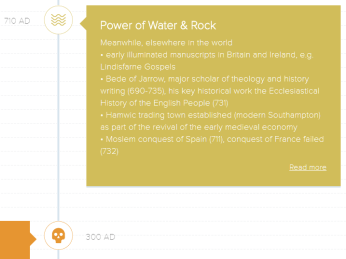
Exploring the timeline section, you can put the lessons from across the different units into conversation with one another chronologically. These timeline entries feature a “meanwhile, elsewhere in the world” feature that helps students contextualize the developments in Japan more globally. A full timeline is also downloadable with notes, if you want a quick reference or don’t intend to work with the interactive features on the site.

With the map option, you can sort the site’s entries by one or more of the three themes or simply click through them at their various locales, getting a sense of what objects or developments occurred across what parts of the archipelago. In the main menu section there is also a handy glossary for quick references to unfamiliar terms.

While the site is geared towards a younger audience of students (for use in upper secondary or senior high school teaching in English language speaking countries), anyone who isn’t familiar with Japan’s early history will find the site useful for its introductory information and great selection of archaeological and visual materials and material culture. Be sure to check it out!

Posted in graduate school, main posts, study tools, undergraduate, useful links | Tagged , , , , , , , , | Leave a comment