Wasei Eigo is オンリーワン

The term wasei Eigo (和製英語) literally means English Made in Japan. This is not to be confused with Engrish, the popular term for the ubiquitous nonsensical English that decorates clothing and accessories in Japan, or gairaigo (外来語), loan words. Rather, wasei Eigo refers to words that are based on English words but either are not used in standard English or have a different meaning than in standard English.

Languages evolve and change, and while wasei Eigo words are perfectly valid in their existence, they can be confusing for Japanese-learners and English-learners alike. The first problem is that native English speakers assume that a lot of English words will have entered Japanese with no changes to form. For example, when discussing film, I once tried to use the English word sci-fi instead of the correct Japanese wasei Eigo term, SF (pronounced esu-efu, エスエフ, but written SF).

The second problem is that it isn’t always clear which words are true loan words (using the original meaning) and which are wasei Eigo (using a new meaning), as in the case of スタイル (sutairu, style). Saying 「彼のスタイルはいい」doesn’t mean “he has good fashion sense” but can mean “he has a good body,” as スタイル tends to be used to mean figure, body or appearance. In case you were wondering, being stylish  is covered by センス (sensu, sense), as in fashion sense. Saying 「センスがいい」 means someone has good taste in clothes, music, etc., or that someone has a knack for something or discerning tastes in something.

"Topping service"

Wasei Eigo isn’t just a problem for students of Japanese but for English-speaking Japanese people, as well. Just as we assume some English words enter Japanese as-is, there is an equal assumption that wasei Eigo is proper English.  In Japan, freebies, bonus items, or discounts are referred to not as ボーナス (bônasu, bonus), but サービス (sâbisu, service). Bonus typically refers to your year-end bonus at work (this is gairaigo, a true loan word). The word サービス probably comes from complimentary service but means something closer to complimentary goods/discount in Japanese. Grocery stores might have タイムサービス (taimu sâbisu, time service), a discount for meats and deli goods at the end of the day. The awesome English-speaking staff of my local gelataria offer a “topping service”  (トッピングサービス, toppingu sâbisu), a free sample of another flavor of gelato with your regular cone, and I’ve been offered discounts at local restaurants with the explanation 「サービスです!」 .

My rule is that, if speaking Japanese, wasei Eigo‘s Japanese meanings are correct and trump the original English meaning. However, I think that those teaching ESL or working with Japanese learners of English ought to be really familiar with these terms so we can teach the proper English phrases.

『きのう何食べた?』Vol. 3, p. 71

For example, one person I know rarely uses the English word only correctly when we speak English, and I always assumed it was because in Japanese, だけ and しか。。。ない (only, just) are used after the noun. If I brought a salad for lunch, I would get asked, “Sarada only?” instead of “[You’re] only [eating] salad?” before getting a lecture on the importance of eating rice. I would correct his grammar but had no idea this was actually wasei Eigo until I read the phrase 鍋オンリー (nabe onrî, nabe only) in the manga What Did You Eat Yesterday? (『きのう何食べた?』). Here, the main character is preparing dinner and wondering if he should make a side dish for the pot of nabe he’s preparing or just stick to a one-pot meal.

My guess is that this phrase comes from phrases like “women only,” which is written in English on the doors of the 女性専用 (jôsei senyô) cars of trains in Japan. Still, “Is this car women-only?” is correct English, but “Are you eating salad-only?” is really awkward English. Since the usage of オンリーapproximates the usage of のみ in Japanese, that is, only, but clearly indicating a limit, and the phrase is an idea/concept rather than a grammatical phrase, サラダオンリー should only be used in Japanese. That’s precisely what is frustrating about wasei Eigo–it’s close but ultimately just not right to use when speaking English.

I don’t think wasei Eigo is bad, though, and I personally find that a lot of it has entered my English because it better describes a situation or idea. Just as the Japanese world umami (うま味) has entered English as a loan word to fill a gap in how we describe food, other wasei Eigo words fill a gap in my vocabulary.  Salaryman (サラリーマン, saraîman) conjures up a very specific image of non-managerial Japanese (male) office workers. Love hotels (ラブホテル, rabu hoteru) simply don’t exist in the US, so what other word can I use for them? Unlike アメリカンドッグ (Amerikan doggu, American dog = corn dog), there is not usually an equivalent English word or concept, so why not use these wasei Eigo culturally specific terms in English, too?

Where can you learn to navigate the world of wasei Eigo to increase your Japanese or English fluency? To start, wikipedia.jp’s list of wasei Eigo has a very comprehensive (but by no means complete) list of these Japanese words, the English origins, and their meaning.

More lists of wasei Eigo (with English explanations) appear on sci.lang.japan, a site dedicated to commonly asked questions about the Japanese language. These include “What are these pseudo English words like salaryman?“and “What ‘false friends’ are there between Japanese and English?.” (Check out “What English words come from Japanese?” for the inverse.)

Jim Breen’s WWWJDIC also has an extensive list of wasei Eigo terms marked in the dictionary as wasei (Japanese-English).

Attaining true fluency in Japanese means learning these words, and attaining fluency in English means learning the correct English translations of said phrases, so give it your best トライ! ガッツポーズするように!

-Leah

Posted in culture, main posts, study tools, useful links | Tagged , , , , , , , , , | 12 Comments

Japanese Studies Fellowship: Japan Foundation

Another great funding opportunity for scholars, researchers and professionals! Only select sections of the fellowship information are provided here. For a full list of requirements and benefits, see the original page at: http://www.jfny.org/japanese_studies/fellowship.html

—

1. Purpose

In order to promote Japanese Studies overseas, this program provides support to outstanding scholars in the field by providing the opportunity to conduct research in Japan.

2. Categories and Duration of Fellowship 

  • Scholars and Researchers (Long-Term) (2-12 months): Scholars and researchers in the humanities or social sciences.
  • Scholars and Researchers (Short-Term) (21-59 days): Scholars and researchers in the humanities or social sciences who need to conduct intensive research in Japan.
  • Doctoral Candidates (4-12 months): Doctoral candidates in the humanities or social sciences.

3. Eligibility

  • Applicants must be American citizens, American citizens temporarily residing abroad, or permanent residents of the United States. Americans with permanent residency abroad should submit their applications to the Japan Foundation’s office in the country where they reside or to the Japanese diplomatic mission of their resident country no later than December 1, 2011, using a different form.
  • Applicants residing in the United States who are neither U.S. citizens nor permanent residents should submit their applications to the Foundation’s Tokyo Headquarters no later than December 1, 2011, using a different form.
  • Doctoral Candidates must have achieved ABD status by the time the fellowship begins.
  • Applicants for Scholars and Researchers program (both Long-Term and Short-Term) must hold a Ph.D. or equivalent professional experience in research, teaching and writing in the fields of the humanities or social sciences.
  • Previous recipients of Japan Foundation fellowships, such as the Japanese Studies Fellowship, or Abe Fellowship, etc., are eligible to reapply only if, on April 1, 2012, a full three years have elapsed since the termination of their most recent fellowship. Previous Short-Term Research Fellows may reapply after one full year from the termination of their most recent fellowships.
  • Applicants must be in good health.
  • Applicants must be proficient in either Japanese or English.
  • Applicants must secure all affiliation arrangements by the application deadline (excluding the Research Fellowship (Short-Term)).
  • In principle, applicants must be able to stay continuously in Japan for the term of fellowship.

Ineligibility

  • Individuals meeting any of the following conditions are not eligible to apply:
  • Scholars or researchers in the natural sciences, medicine or engineering;
  • Undergraduates; Master’s degree candidates; those intending to enroll in Undergraduate or Master’s courses at universities in Japan; or graduates who are to pursue Ph.D. courses in Japan;
  • Those who intend to use the fellowship for political or religious purposes;
  • Those who primarily intend to enhance their Japanese language ability or technical skills;
  • Those who intend to develop and/or produce Japanese language teaching materials;
  • Those who intend to acquire artistic training in the area of Japanese traditional culture (tea ceremony, flower arrangement, etc);
  • Those who plan to receive other grants concurrently with the fellowship;
  • Those who will have been in Japan continuously between April 1, 2011 and April 1, 2012.

4. Selection Criteria

Project quality is evaluated on the basis of the following:

a. The project’s significance to the field and to the applicant’s professional development
b. The project’s feasibility in terms of time and resources
c. The securing of appropriate affiliation
d. Evidence that residence in Japan is necessary for completion of the project
e. Plans to disseminate research findings, etc., in Japan and abroad

Training, academic history, academic rank or position, professional reputation, and accomplishments are evaluated.

Former Japan Foundation fellows who have been awarded two or more Foundation fellowships will be put under particularly rigorous examination.

To the extent permitted by program requirements and selection criteria, efforts are made to maintain disciplinary, geographic, and institutional diversity. (Applications from the Social Science fields are highly welcomed.)

For the Doctoral Fellowship, higher priority will be given to those who are expected to submit their dissertation thesis shortly after the completion of the fellowship; preference will normally be given to doctoral candidates under 35 years of age.

For the Research Fellowship (Long-Term), priority will be given to relatively junior scholars and researchers, and to those with less research experience in Japan.

For the Research Fellowship (Short-Term), priority will be given to relatively experienced scholars and researchers who are expected to publish their research results shortly after the completion of their fellowship.

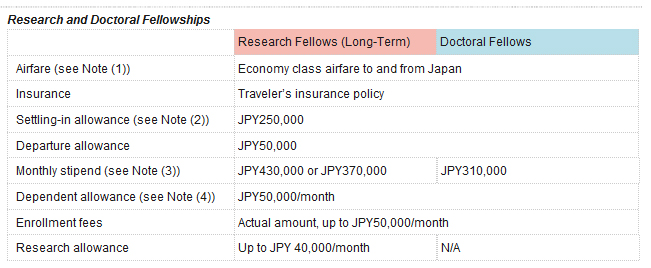
5. Benefits

You can refer to the past recipients of the Japanese Studies Fellowship in the URL below:
http://www.jpf.go.jp/e/intel/topics/fellows/index.html12 . Application Procedures

The application deadline is November 1, 2011. Applications must be submitted on-line at https://www.jfny.org/japanese_studies/fellowship/createaccount.php . For further information or questions, please contact info@jfny.org.

Japanese Studies Fellowship Program
The Japan Foundation, New York
Tel: 212-489-0209
Fax: 212-489-0409
Email Inquiry: info@jfny.org

Posted in announcements, financial assistance, funding, graduate school, living abroad, study abroad | Tagged , , , , , , , , | Leave a comment

More information on volunteering in Japan!

More great info from David Slater (who provided this previous list of volunteer opportunities) on how you can get to Japan this summer and help out. See below for details! Posted with permission.

—

Image from All Hands Volunteers

Welcome to Post-3.11 Japan.

As those on Western calenders finish up your spring semester and heading over to Japan for the summer circuit of research and conferences, you have perfect timing. I know many people who are interested in contributing to the relief effort in some way, but are unsure of how to do it. Things are all set here for you here. See below for some options.

Almost 3 months into it, the relief NPOs, esp. the larger international ones (some listed below), are completely set up to take scads of foreigners, even those who do not speak much Japanese, to come up and help out. This is still a disaster situation, and risk is involved, but they need the help and are set up to use it (something that was not true earlier).

During this period from the end of Golden Week until college students get out of Japanese universities (in July), there is a dire need of volunteers. If you make your living off of Japan, studying, teaching, writing, consulting, etc., about Japan, this is the time to pay back, time to help when Japan really needs help. Even if you don’t, you can still be of service. So, don’t wait until July–come for a week or even a few days right IN JUNE when you first come, when your contribution can make the most difference.

When you get up there, you usually work in small groups (gonin-gumi) going building to building; working together as a team. It is a good way to do it for safety and personal relationships.

Yes, digging mud or cooking for 500 is not easy, and yes, you may imagine it may not be the very best use of your Ph.D. but this is the work that is needed now. So, if you are older than 20 and healthy, then there is usually a wide enough range work for all to find suitable work. AND BILINGUAL INTERPRETERS ARE ESPECIALLY NEEDED.

There are different ways to go:

CHEAP ROUTE: You can take a bus from Tokyo (about 5 hours) right up to the relief site, sometimes it is chartered by the NPO organization itself; you can stay in the sleeping bags on the floor of warehouses, evacuation centers or tents arranged by the NPO (for free); your food you can bring or increasingly, you can buy there.

EASIER ROUTE: You can take the shinkansen to Sendai Station (about 2 hours, 22,000 yen); stay at a business hotel in Sendai (about 8000 yen per night), bus into the Ishinomaki (about 1 hour) or other relief areas; buy a bento and bring it in. And “commute” to work.

GROUP ROUTE: If you are interested in forming a group (30-45), we can set you up with some combination of this plan. Contact me at dhslater@gmail.com.

Below are three of the larger international NPOs that can accommodate those who do not speak Japanese. For those who are able to stay for a longer time, get to know more what is going on, there are more involved projects usually with smaller NPOs, but for a short stint, these are probably easiest.

Here is a good video I just found on YouTube that gives a pretty good idea of the why and what:

http://www.youtube.com/watch?v=KdkQZ0YKYDk&NR=1

Peaceboat: http://peaceboat.org/relief/
All Hands: http://hands.org/projects/project-tohoku/
JEN: http://www.jen-npo.org/en/

And if you want to volunteer while in Tokyo for a few days, check out Second Harvest Japan, the biggest food bank in Japan: http://www.2hj.org/ , a really great organization.

See you soon.

David Slater
Sophia U.

Posted in announcements | Tagged , , , , , , | 4 Comments

Job Openings: Translators/Interpreters and Legal Document Review

Via the University of Michigan Center for Japanese Studies:

My name is Matt Clarke, I am a partner with the law firm Ryley Carlock & Applewhite.  My firm has a practice area that is dedicated to litigation and litigation support.  We currently have openings in our practice group in both Grand Rapids, Michigan, and Phoenix, Arizona, for the following full time hourly positions: (1) persons who can interpret and translate Japanese text into English (no JD required) at $55 per hour, and (2) US licensed attorneys who are fluent in Japanese and can perform document review related to ongoing litigation – $65 per hour.

We have 20 positions available immediately.  We expect the work to last up to 18 months. The work must be performed on location in either Grand Rapids, Michigan, or Phoenix, Arizona.

 Contact:

Matthew T. Clarke, Esq.
Ryley Carlock & Applewhite
Document Control Group
Phoenix: One N. Central, Suite 1200, Phoenix AZ 85004
Grand Rapids: 801 Broadway, N.W., Suite 225, Grand Rapids, MI  49504
Phone (602) 440-4809
mclarke[AT]rcalaw[DOT]com

Posted in announcements, job openings, jobs | Tagged , , , , , , , | Leave a comment

Conference announcement: The 1st Annual Mechademia Conference

The 11th Annual Schoolgirls and Mobilesuits (SGMS) Workshop Presents:

The 1st Annual Mechademia Conference

SGMS 2011: Culture and Direction
September 30th-October 2nd, 2011
Minneapolis College of Art and Design (MCAD)

Submission Information:

Abstracts of no more than 200 words for presentations of 20 minutes are due by 1 June 2011 via email to sgms@mcad.edu . Please include institutional affiliation, if applicable. Authors will be notified by 15 July 2011.

2011 Featured Speakers:

Dr. Marc Hairston
Research Scientist, William B. Hanson Center for Space Science
The University of Texas at Dallas

Dr. Thomas LaMarre
Professor of East Asian Studies
Associate in Art History and Communications Studies
McGill University

Dr. Sharalyn Orbaugh
Professor of Asian Studies and Women’s Studies, University of British
Columbia Former Visiting Professor, Ritsumeikan University, Kyoto

Schoolgirls and Mobilesuits (SGMS) is an internationally-recognized, three-day workshop that explores and celebrates anime and manga. Through its unique merger of academic and fan audiences, SGMS engages both anime’s and manga’s creative and cultural implications and practices.

The 11th Annual SGMS Workshop marks the beginning of our second decade with a combination of festivities, including the Otaku bazaar, the Full Fashion Panic fashion show (i.e., part of Minnesota Fashion Week), as well as anime and J-drama screenings. Since its inception in 2001, the annual SGMS

Workshop has emerged as the cutting-age venue for discussions about and presentations on the global proliferation of Japanese manga and anime.

Workshop topics have included foci on a wide-array of issues in manga and anime production and reception, from creative processes, cultural formations, and aesthetic implications, to fan fascination with and audience wonder at the remarkably broad range of objects and practices.

As the SGMS Workshop evolved, it spawned the critically acclaimed Mechademiabook series, published by the University of Minnesota Press.

The heart and soul of Mechademia is found in the work of SGMS: Its invited speakers as well as the growing wave of young scholars and creators.

This year, the SGMS Workshop announces its first annual Mechademia Conference focused on scholarly work on manga and anime. Institutionally-affiliated as well as independent scholars are encouraged to submit individual or panel proposals related to the conference theme of “Creation and Direction.”

Scholars at any level, including graduate students and undergraduates, are encouraged to apply. Authors of selected proposals will be invited to present at SGMS’s Mechademia Conference. Undergraduate and unaffiliated scholars may present as part of the popular “Mechademia Emerging Scholars” panels. Presentations may be selected for publication in the Mechademia book series.

The theme, “Culture and Direction,” provides for a play of ambiguous “directions,” and the Mechademia Conference organizers welcome paper or panel submissions on any of the following themes, as well as on related themes not directly indicated:

• Analyses of specific artifacts, creators, or directors
• Future directions of manga and anime
• New technologies and influences, such as keitai novels
• Historical directions of mange and anime
• Cultural implications of manga and anime
• New directions in fan cultures
• Structural directions in historical and contemporary work
• Old and new narrative and visual directions in manga and anime
• Emerging topics in manga and anime

Submissions: Abstracts of no more than 200 words for presentations of 20 minutes are due by 1 June 2011 via email to sgms@mcad.edu . Abstracts can be for individual speakers or for prearranged panels of 3-4 speakers (i.e., if proposing a prearranged panel, include a 200 word abstract for each paper as well as a 200 word abstract for the panel in its entirety). Please indicate “Mechademia Conference Submission” in the email subject line. Accepted authors will be notified by 15 July 2011. Panelists accepted for the conference must confirm and pay the conference registration fee by 15

August 2011.

Conference Registration: Conference registration is available online at http://mcad.edu/sgms . Conference registration includes entrance to all SGMS events, festivities, and refreshments. The conference registration fee of $85 for presenters, and $100 in advance or on site for non-presenters. The student registration fee is $50 (i.e., MCAD students pay a reduced registration fee of $25). A valid student identification is required for the reduced student rate. MCAD alumni receive a $15 discount on registration. Panelists accepted for the conference must confirm their intent to present, and pay the conference registration fee, by 15 August 2011. Non-presenters can register online in advance, or on-site during the conference.

Accommodations: The conference organizers have reserved rooms at a reduced rate at the Millennium

Hotel http://www.millenniumhotels.com/millenniumminneapolis/index.html in downtown Minneapolis and in close proximity to the campus of the Minneapolis College of Art and Design.

Confirmed SGMS 2011 Invited Speakers:

Dr. Thomas LaMarre is Professor of East Asian Studies and Associate in Art History and Communications Studies at McGill University. His books include Shadows on the Screen: Tanizaki Jun’ichirô on Cinema and Oriental Aesthetics (2005); Uncovering Heian Japan: An Archaeology of Sensation and Inscription (2000); Impacts of Modernity (co-edited with Kang Nae-hui, 2003), a book on anime and media entitled Difference in Motion. LaMarre works on the editorial boards of positions, Traces, transtextes/transcultures, and is an Associate Editor for Mechademia. His latest book is The Anime Machine: A Media Theory of Animation (University of Minnesota Press, 2009).

Dr. Marc Hairston is a Research Scientist at the University of Texas at Dallas, where he investigates space weather and the study of the Earth’s upper atmosphere, its magnetic field, and the aurora using satellite data from NASA and the Air Force. He has written numerous articles for Animerica, and is a long time favorite speaker at SGMS. As part of the public outreach to middle and high school science students, Hairston developed the comic character “Cindi,” an android space girl. Cindi has starred in two manga-styled comic books, and is part of the only manga series paid for by NASA. In 1999, Hairston and Dr. Pamela Gossin co-taught the first mainstream literature course at a U.S. college that included anime and manga as part of its required texts. Hairston serves currently as editorial board member and reviewer for Mechademia.

Dr. Sharalyn Orbaugh is Professor with appointments in both Asian Studies and Women’s Studies at the University of British Columbia. She is former Visiting Professor at Ritsumeikan University in Kyoto. Her publications include among many others “Sex and the Single Cyborg: Japanese Popular Culture Experiments in Subjectivity,” currently under review at the University of Minnesota Press; guest editing a special issue on manga for the U.S.-Japan Women’s Journal; and “Creativity and Constraint in Amateur Manga Production” and “Busty Battlin’ Babes: the Evolution of the Shôjo in 1990s Visual Culture” in Gender and Power in the Japanese Visual Field(Hawai’i University Press, 2003) .

—

Thomas O. Haakenson, PhD
Chair and Associate Professor
Liberal Arts Department
Minneapolis College of Art and Design
2501 Stevens Avenue
Minneapolis, Minnesota, U.S.A.  55404
Email: thaakenson@mcad.edu
Telephone: 651.894.2894
Website: http://www.mcad.edu

Posted in announcements, conferences, culture | Tagged , , , , , , , , , , | Leave a comment

Fun Link Friday: Eigo Noto, DVD 1: Understanding Women

Eigo Noto (「英語ノート」) is the government-approved English language textbook for grades 5 and 6. While the overall content is decent, JET ALTs and CIRs who work in public elementary schools in Japan know just how incredibly awkward the conversations in the accompanying CDs are. Fortunately, some JETs created a hilarious video parody, in which the audio is re-purposed into a dating guide. I could go into further detail, but I think I’ll let the video “Eigo Noto, DVD 1: Understanding Women,” which won the Fukuyama Film Festival in 2010, speak for itself.

Whenever I feel down, this video is sure to bring a bit of mirth to my day. And yes, that “Yes! Yes! Yes! Let’s go!” bit is most certainly in the second volume of the text.

-Leah

Posted in fun links, JET, textbooks | Tagged , , , , , | 1 Comment

Call for Papers: Inter-Asian Connections III: Hong Kong

Deadline: Friday, June 24, 2011

Inter-Asian Connections III: Hong Kong (June 6-8, 2012)

The Hong Kong Institute for Humanities and Social Sciences (HKIHSS) at the University of Hong Kong, the National University of Singapore (NUS), and the Social Science Research Council (SSRC) (the Organizers) are pleased to announce an open call for individual research paper submissions from researchers in any world region, to participate in a 3-day thematic workshop at an international conference, “Inter-Asian Connections III: Hong Kong.”

To be held in Hong Kong, June 6-8, 2012 and hosted by HKIHSS, the conference will include concurrent workshops, coordinated by individual directors and showcasing innovative research from across the social sciences and related disciplines. Workshops will focus on themes of particular relevance to Asia, reconceptualized as a dynamic and interconnected historical, geographical, and cultural formation stretching from the Middle East through Eurasia and South Asia, to East Asia.

The conference structure and schedule have been designed to enable intensive ‘working group’ interactions on a specific research theme, as well as broader interactions on topics of mutual interest and concern. Accordingly, there will be a public keynote and plenary sessions in addition to closed workshop sessions. The concluding day of the conference will bring all the conference participants together for the public presentation and exchange of research agendas that have emerged over the course of the conference deliberations.

Individual paper submissions are invited from junior and senior scholars, whether graduate students or faculty, or researchers in NGOs or other research organizations, for the following six workshops:

–       Anatomies of Knowledge: Medicine, Science, and Health in Asia
–       Asian Crossings, 1789-1914
–       Just Society at Last? Ideals and Projects of the Common Good across Asia
–       Networks of Religious Learning and the Dissemination of Religious Knowledge across Asia
–       Shifting Geopolitical Ecologies and New Spatial Imaginaries
–       Sustainability and Citizenship in Asian Cities

Descriptions of the individual workshops, including information on the application process and the required application cover sheet are available at: http://www.ssrc.org/programs/pages/interasia-program/conference-on-inter-asian-connections-iii-hong-kong-june-6-8-2012/.

Application materials are due by Friday, June 24, 2011.  Please note that an individual cannot apply to more than one workshop. Selection decisions will be announced in August 2011.

Accepted participants are required to submit a DRAFT 20-25 page research paper by February 1, 2012; final papers are due April 15, 2012.

The Organizers will make every effort to ensure some level of funding for participants toward the costs associated with attending the Inter-Asian Connections III conference. However, at this point we plan to offer the following financial assistance – a) single room accommodations including breakfast, b) local transport to/from the conference site daily, c) lunch on-site, and d) dinner on two evenings. We cannot currently cover any airfare costs, and thus we encourage participants to seek funding from external agencies (such as their home institutions). We will not be able to confirm final details about funding availability until after the selection process has been completed.

For additional inquiries, please contact the Organizers at interasia@ssrc.org

This event is organized and co-sponsored by The Hong Kong Institute for the Humanities and Social Sciences (HKIHSS) at the University of Hong Kong, the National University of Singapore (NUS), and the Social Science Research Council (SSRC).

Posted in announcements, conferences | Tagged , , , , , , , , , | Leave a comment

Book announcement: Andreas Marks. Publishers of Japanese Woodblock Prints: A Compendium

This announcement is actually from some time back, but it got lost in my files! Still, this book looks to be a unique resource so it’s definitely worth posting up here.

—

http://www.brill.nl/default.aspx?partid=210&pid=42855

Japanese woodblock prints exemplified by such iconographic images as Hokusai’s Great Wave, Hiroshige’s Heavy Rain on Ohashi bridge, or Utamaro’s enticing beauties, constitute one of the most important and influential art forms in art history. Today, the names of these artists themselves are celebrated throughout the world, and yet very little is known about the publishers of these artworks, despite the fact that they played a crucial role in the production, visual appearance and actual distribution of the works within the highly commercial world of Japanese printmaking. It was the publisher who gauged the markets, commissioned the artists and took on the risks of production. Once a design was completed by an artist, it was the publisher who coordinated the production process, farming out the work to the block carvers and printers, and also managed the distribution of the prints in the appropriate markets.

This volume champions the publisher – the enabler – without whom the great artworks which influenced painters like Monet, Toulouse-Lautrec, Van Gogh and others, would never have been produced.

Publishers of Japanese Woodblock Prints: A Compendium focuses on the production process of Japanese woodblock prints with an emphasis on the role of the publisher. This publication presents over 1,100 publishers, with comprehensive lists of publications by a total of 572 artists and facsimiles of over 2300 publisher seals, spanning a time period from the 1650s to the 1990s.

The publisher entries include details on the residence of a publisher, his clientele, the period of his commercial activity as well as a list of issued print series in chronological order. This listing offers insight into the status and versatility of a publisher, as well as indicating the publisher’s specialties, favoured artists and the particular strategies pursued. With almost 600 pages of information on the publishers of Japanese woodblock prints, this publication is an essential reference work for scholars and collectors of Japanese prints alike.

About the author(s)

Andreas Marks, Ph.D. (Leiden University), is Director and Chief Curator of the Clark Center for Japanese Art and Culture in Hanford, California. He is the author of Japanese Woodblock Prints: Artists, Publishers and Masterworks, 1680–1900 (2010), Tokaido Print Series: Kunisada’s Puzzles (forthcoming), editor of Fukami: Purity of Form (2011), and co-editor of Dreams and Diversions, Essays on Japanese Woodblock Prints (2010).

Posted in announcements, study tools | Tagged , , , , , , , , , , | 2 Comments

Job opening: Post-Doctoral Researcher at the Global COE Program “Reshaping Japan’s Border Studies”

Institution Type:   Slavic Research Center, Hokkaido University
Location:   Japan
Position:   Post-Doctoral Fellow

The Global COE Program “Reshaping Japan’s Border Studies” at the Slavic Research Center at Hokkaido University is seeking candidates to fill a position for a post-doctoral researcher for one year (with possible renewal) beginning July 2011. Required are: Ph.D in humanities or social sciences with a concentration on border studies; a commitment to an interdisciplinary approach and interest in border related issues. Focus may be on any specific or general area in Slavic Eurasia.

Applications should include a curriculum vitae and samples of scholarship. For full consideration, all application materials should be received by May 31st, 2011. Electronic submission is allowed. Please send to: fujimori@123slav.hokudai.ac.jp  (please take off the 123 before slav when sending an email, for spam purpose) If materials cannot be sent electronically, please mail to: Global COE Program, Slavic Research Center, Hokkaido University, Kita 9 Nishi 7, Kita-ku, Sapporo, Japan 060-0809.

Please refer to the following for more details or at the program website at: www.borderstudies.jp/en/

The Slavic Research Center is an equal opportunity employer and everyone is encouraged to apply.

Related Information:

1. Position
Post-doctoral Researcher (by contract)

2. Period of Employment
July 1, 2011 to March 31, 2012 (renewal possible which will be decided upon evaluation)

3. Specialization: Border Studies (humanities or social sciences)

4. Position available: 1 part time researcher

5. Conditions

1)      Content of Work:Assisting with and conducting research for the Global COE Program “Reshaping Japan’s Border Studies”, editing the English journal “Eurasia Border Review”, editing and updating the website, organizing and coordinating international workshops and symposia

2)      Others
Working hours: 8:30AM to 17:00PM
38 hours and 45 minutes per week (7 hours and 45 minutes per day for 5 days)

Holidays: Saturday, Sunday and all national holidays, December 29-January 3 and other holidays designated by the university

Vacation: annual paid vacation and other special leaves (paid or unpaid)

Salary: Decided upon the candidate’s experience and regulations of Hokkaido University
(This will amount to approx. Yen 210,000-400,000 per month)
other allowances: commute allowance and overtime pay will be paid according to the regulations of Hokkaido University

Social insurances: Health insurance, pension, and employment insurance

Others: Moving expenses will not be paid (negotiable)

3) Place of work: Kita 9 Nishi 7, Slavic Research Center, Hokkaido
University, Sapporo, Japan

6. Qualifications

1) English native speaker or equivalent;
2) Has previous experience of editing English journals;
3) Holds relevant Ph.D or equivalent;
4) Should demonstrate a minimum command in Japanese sufficient to handle daily administrative matters in Japanese;
5) Some experience of creating a website and utilizing multimedia;
6) Should be available to conduct the above mentioned duties on the date mentioned below without any other obligations.
*Candidate should not be affiliated with any other institution. Graduate students or research fellows must ask for permanent leave before commencing work for the center.
7. Commencement: July 1, 2011
8. Required documents

1) Curriculum Vitae (with photo, educational background since high school, digital version is allowed but with handwritten signature)
3) 3 of the candidates previous work in Japanese and/or English(outprints, photocopies are allowed)
4) Certificate of Graduation (photocopy of diploma would be allowed)
5) Research Proposal (approx. 2000 words in English, the proposal should not be proofread professionally)
6) Proposal regarding the contents of the Global COE Program website and museum exhibition (approx. 1000 words in English)

(Reference: URL  http://borderstudies.jp/en/ )

*Documents will not be returned.

9.Deadline: May 31, 2011 (Tuesday)(postdated)

*When mailing the documents to the center, please write “Documents for the position of post-doctoral researcher” in red and send it by registered mail (Expack, EMS). We will also accept electronic submission.

10. Selection process: The selection method will be based on the screening process of the documents sent by the candidate but we may request an interview. The result will be notified to the candidate by mid-June, 2011..

Contact:  Mailing address
Secretariat of the Global COE Program “Reshaping Japan’s Border Studies”
Slavic Research Center, Hokkaido University, Kita 9 Nishi 7, Kita-ku,
Sapporo, Japan
060-0809

Contact information
Mr. Shinkichi Fujimori
Secretariat of the Global COE Program “Reshaping Japan’s Border Studies” at the Slavic Research Center
Tel.:011-706-2388 FAX:011-706-4952  E -mail :
fujimori@123slav.hokudai.ac.jp  (please take off the 123 before slav when sending an email, for spam purpose)

Posted in announcements, job openings, jobs | Tagged , , , , , , , , | Leave a comment

Blog Review: Contemporary Japanese Literature

For those looking for intelligent and entertaining discussions of Japanese literature and pop culture, I cannot recommend highly enough Kathryn Hemmann’s Contemporary Japanese Literature. Ms. Hemmann, a Japanese Literature PhD candidate at the University of Pennsylvania, describes her blog as a place to explore “various textual manifestations of contemporary Japanese culture, literary or otherwise.” The breadth of material is quite wide and includes reviews of popular Japanese literature in translation, reviews of academic works about Japanese culture, critical discussions of feminism in video games, and information on accessing Japanese literature, such an article on her experiences using a Kindle.

Ms. Hemmann’s writing is frank, witty and thoughtful. Her book reviews are a pleasure to read, particularly because she’s willing to take a hard look at cultural and gender factors within the concise space of the review. Furthermore, her writing is intelligent and academic but never obsequiously theoretical, and Ms. Hemmann has a knack for treating problematic material with a rare blend of respect and humor. Whether you’re looking for academic works for your thesis reading list, information on the state of publishing translations, or a new manga to read, check out Contemporary Japanese Literature.

To get started, here’s a list of my favorite articles:

“Feminism and Final Fantasy”

“Challenging Auteurship: Dōjinshi as Creative Fan Interpretation”

Review of Getting Wet: Adventures in the Japanese Bath

Review of Ôoku (the manga)

Review of Translucent Tree

-Leah

Posted in blogs, culture, useful links | Tagged , , , , , , , , , , , | Leave a comment