A couple weeks ago we began with a rundown of the IUC 10-month program coursework, beginning with an explanation of the entrance exam and then detailing the materials and expectations of quarters 1 and 2. This week we will close out our discussion of the year program with an outline of quarters 3 and 4 as well as the dreaded final project, a hallmark of the IUC experience. Students who wish to attend the IUC are often most interested in hearing about the final two quarters, as these are the periods in which students take elective courses and start to focus on learning Japanese through their own research materials. For this reason, it is also difficult for me to generalize about the coursework of students in the latter half of the program. However, here I’ll provide a list of the electives that were offered as well as brief descriptions where I highlight some of the great experiences I had during this time. Here we go!
Quarter 3
(in my year, 1/13/10 – 3/12/10)
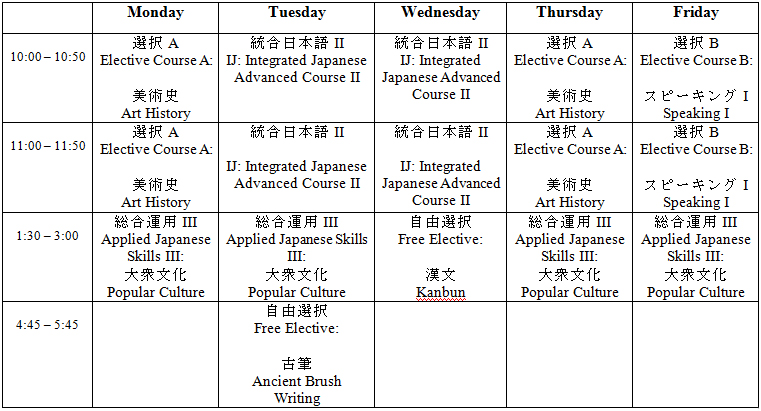
The third quarter is when the IUC starts to really switch up your schedule and give you many options for how you want to direct your study of Japanese. Although you continue to have courses on Integrated Japanese as well as Applied Japanese Skills, the latter becomes an elective with several options (instead of just newspaper and video work). In addition, you have another two electives to be taken in a field of your choosing. The schedule (for me) was as follows:
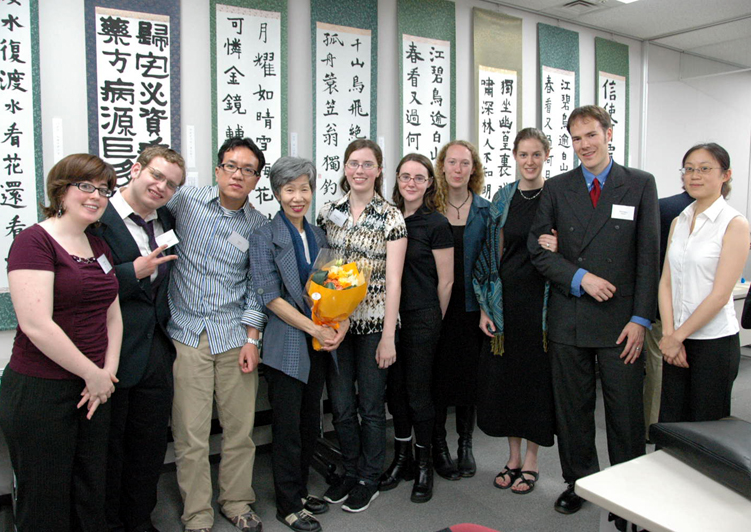
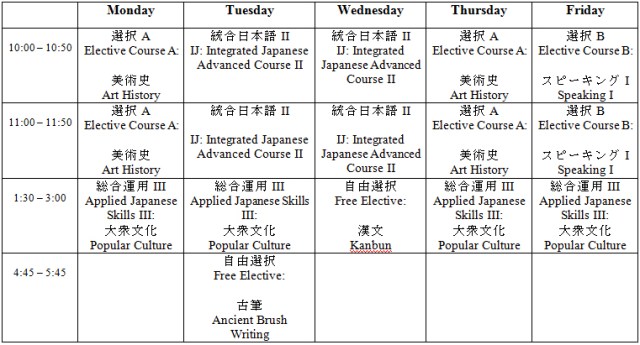 During this quarter afterschool elective courses also began in earnest. They were either Wednesday afternoons (in the 1:30 -3:00pm slot we always had free) or afterschool from 3:00 – 5:45pm other days depending on the class. These extracurriculars included Japanese calligraphy, kanbun 漢文, an introduction to classical Japanese, reading ancient brush writing 古筆, and business Japanese. The calligraphy class actually began during the first quarter to allow students more time for actual practice. At the final presentations, which I’ll talk about below, the calligraphy students displayed their final pieces.
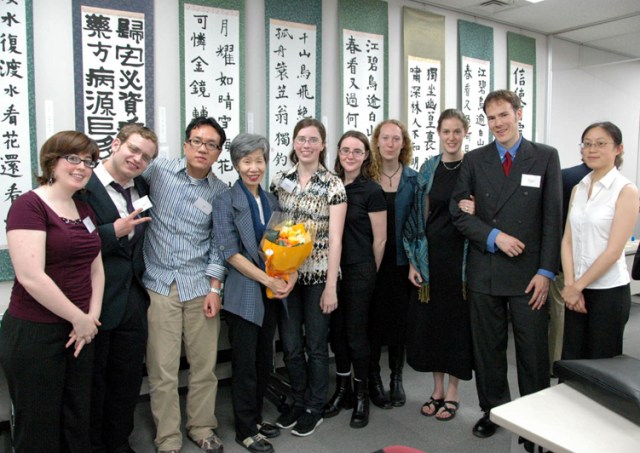
To return to coursework, here I will list all the courses and possible elective options we had during quarter 3, with a brief description of what I took and any particular points that were helpful as far as how the coursework was arranged, etc. Remember that these are subject to change year to year, since instructors often (but not always) teach the courses according to their own specialties.
Integrative Japanese Advanced Course II
Much like Integrative Japanese Advanced Course I from the previous quarter, this class uses the Integrative Japanese Advanced Course II統合日本語 book to cover advanced grammar points in detail. The book gives contextual writing samples, conversation samples, and draws comparisons to other similar grammar points/vocabulary. The grammar and vocab comparisons are REALLY helpful and I still refer to my textbook on these points quite a bit. The class content was basically as follows:
– textbook lessons
– regular grammar quizzes
– speeches (1 person per day)
– weekly composition assignments due outside of class
Elective Course A Options:
- Politics & Economics
- Art History
- Literature (Meiji to Modern)
- Cultural Anthropology
- Law
- History
For my Elective Course A, I chose Art History. Although my research (the history of medieval artisans) isn’t necessarily art history, there was a solid group of art history students that supported and encouraged one another and the instructor, who was previously my Applied Japanese I teacher, was wonderful and we all loved her. She was very willing to let me work on my own research (she encouraged this for all of us), so it didn’t matter that my topic leaned more towards history than art.
As for coursework, the instructor selected a few articles that discussed the history of art history in Japan to introduce us not only to much of the vocabulary used in the field, but also what is meant by “art history” in Japan as opposed to the West. She also had one person a day do a speech on a topic related to their research, followed by 15 to 20 minutes of discussion. After the introductory articles were finished, each student had to select an article in Japanese from their own research and assign it to the class, creating discussion questions and then conducting the class themselves in a seminar style. Our instructor was extremely flexible on content and style in how we presented our information and frequently consulted with us about providing vocabulary lists and other supplementary materials.
Elective Course B Options:
- Reading
- Listening
- Speaking
- Business Japanese
For my Elective Course B, I took Speaking, which was easily one of the most useful classes I had at the IUC (so much so that I took it for two quarters). In this class, we were taught how to prepare speeches (based on our research or any other topic we wanted) using the formal language necessary for a seminar/conference-type situation. Each person had to present twice a quarter, breaking down into two people presenting for each class meeting. For the speech, you prepared a 10 minute script, which was turned in before the presentation to the instructor and corrected. We were also required to make PowerPoint presentations, discussion questions for after the speech, and encouraged to use our script as little as possible or not at all when speaking.
After each speech, there was 15 minutes of Q&A where we had to engage the audience with proper phrases (thanking them for their questions, asking for confirmation of something they said, asking them to elaborate, etc.) while answering their questions to the best of our abilities. After the initial Q&A, there was then a discussion based on broader themes concerning our topic, and it was the speaker’s job to ask the discussion questions and facilitate conversation. At the end, the instructor would correct our mistakes, discuss what kind of vocabulary we said that should or shouldn’t be used, introduce new grammatical styles useful for this type of formal conversation, and help us with discussion techniques.
Although I can’t speak to the content of the other classes accurately, I do know that the Listening course was geared toward students who might be having trouble with listening comprehension in general, so it wasn’t really a class suited for more advanced students.
Applied Japanese Skills III Options:
- Modern History
- Popular Culture
- Business & Society
While the previous Applied Japanese Skills courses focused on introducing and using a wide variety of media materials, such as videos, audio, and newspaper clippings, there was no set theme for the entire quarter. However, the AJS III in the third quarter had the above options to choose from. Although I knew it would have been to my benefit to take modern history and get a better background in historical terminology, I had a feeling that the modern history course would be very demanding and cover a lot of things unrelated to my research (15th and 16th century Japan). I chose to take Pop Culture instead, where I could twist some of my topics into things related to medieval Japan. The class content was roughly:
– articles for reading practice and discussion
– videos for listening practice and discussion
– daily vocabulary quizzes
– speeches (1 person per day)
– speech discussion (15 – 20 minutes)
Although I was a bit frustrated at times that I couldn’t have another course or research option that focused more clearly on medieval Japan, instructors did give us a lot of wiggle room to do speeches on topics that interested us (even those not related to Japan per se). Not only that, but by this point in the program we had all done a LOT of speeches, and instructors encouraged us to start polishing previous speeches we had done for different classes, since we were able to make corrections and practice our speaking and discussion techniques.
Free electives
- Japanese calligraphy
- kanbun 漢文
- classical Japanese
- ancient brush writing 古筆
- business Japanese
Of the free electives, I took ancient brush writing and kanbun. Ancient brush writing was an introductory course to various styles of calligraphy from the 10th to 19th centuries. We looked at all kinds of different primary materials, from emakimono to letters and paintings, and learned many of the calligraphic forms of hiragana. Class time was spent talking about the kanji origins of many of the calligraphic shapes and reading the materials out loud as we tried to decipher them.
The kanbun course was a basic introductory to methods of reading kanbun (this is a type of writing which renders Chinese characters into classical Japanese for reading purposes, or classical Japanese written in a Chinese style, using markings to indicate how to read the characters). I think this course was less productive than I wanted it to be because there was unexpectedly so much interest in it that the number of students became somewhat unmanageable. What ended up happening was that there were nearly 25 students taking it (after another 15 or so were turned away because they were interested, but it wasn’t necessary for their research), and after a basic introduction to reading methods, we were split into sub-groups based on research specialty (classical/medieval Japanese, early modern Japanese, Buddhism, etc.). We had to bring in our own research materials in various forms of kanbun/hentai kanbun and struggled to read it with the help of the instructor coming around and other students who already had some kanbun experience. I think the IUC will be more equipped to handle a high volume of kanbun interest in coming years.
Quarter 4
(in my year, 3/29/10 – 6/11/10)
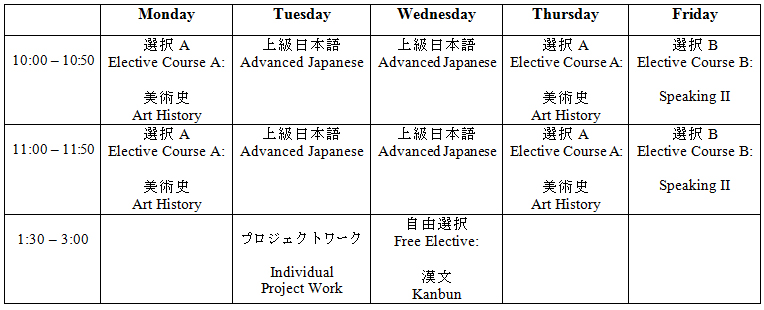
The fourth and final quarter at the IUC is by far the most individualized and research-oriented quarter. It is during this time that students begin to prepare for their final research presentation or a final project. As before, there are two elective options, but also Advanced Japanese and individual project work. My schedule was roughly as follows:

Elective Course A Options:
Elective Course A options were the same as the previous quarter, and you are encouraged (though it is not entirely necessary) to stick with your previous quarter’s selection. In my case, I stayed with Art History and the content/structure was roughly the same.
Advanced Japanese
Instead of the Integrative Japanese textbooks, the Advanced Japanese course was a bit freer and the content up to the instructors. As with previous quarters, two or more instructors rotated. My experience with Advanced Japanese was a bit different than other students, because the Art History class very much wanted to continue doing more Art History-oriented material, rather than more general grammar. Therefore, our instructor got special permission to place all the Art History students in Advanced Japanese together (rather than switching it up with other students), and one day a week we did advanced grammar through art history materials, and the other we did essays and other writings of a more general nature with a different instructor. This is just another example of the kind of specialized work that can be done at the IUC if you just ask! 🙂
Elective Course B Options:
- Speaking II
- Writing
- Japanese Culture Theory
- Contemporary Novels
Incredibly pleased with Speaking I, I decided to continue with Speaking II. The content was approximately the same (two students did speeches a day, Q&A, discussion, teacher instruction) but with two major differences: we were asked to NOT prepare a draft for our speeches, but instead learn to give a speech based solely on a PowerPoint (this helps in part to improve pronunciation), and the new job of “facilitator/moderator 司会者” was added. This meant that one person (not the speaker for the day) had to learn techniques for introducing the speaker and facilitating questions, answers, and discussion amongst the audience. This is a very important role at seminars and conferences, so the techniques learned were definitely invaluable. To be honest, when it came time for our midterm and final speeches, I could see a difference in politeness, comfort, and quality between how students who took Speaking I/II handled questions and discussion compared to those who hadn’t. I’m incredibly glad I took these elective courses.

This is actually a shot from summer speech presentations. But you get the idea.
Note: It’s possible that the Speaking courses were divided up by level as well; one student told me that her Speaking I was very much like my Speaking II, and that an instructor suggested she take something else if she was comfortable with her speaking.
Individual Project Work and other options
One of the things for which the IUC is known is its focus on individual research culminating in a final project at the end of the program. There were three different options available to students for this afternoon advanced study time. They were:
1) Project work (in anticipation of a final speech at the end of the program)
- meet with your project advisor once a week for 1 hour 50 minutes
2) Advanced Japanese class (to focus on the goal of taking the Japanese Language Proficiency Test (JLPT), level N1)
- meet twice a week for 90 minutes
- students created their own example sentences for the grammatical patterns each class
- at the end, the class as a whole submitted one file of example sentences for each grammatical pattern as the final project
3) Individual Japanese instruction
- meet once a week for 1 hour 50 minutes
- students write a composition roughly the length of the final speech, though you are not required to present it, OR some other individual project
For project work and individual instruction, you turn in a slip discussing what you plan to work on and an instructor close to your interest is selected to guide you and meet with you in the afternoons accordingly. Since my goals were research oriented, I did individual project work on medieval Japanese artisans based on the book of a scholar I was reading in my spare time. For a while I thought I might focus on castles. Since there was another art history student doing the same, we tried out a dual session arrangement with both of us sharing materials and a time slot. However, it didn’t work out and we split off with permission from our instructor.
As for the work itself, I read from my book (setting a goal for each weekly session) and then came in to discuss it one on one with my instructor/advisor, asking questions about parts I didn’t understand or words/names I couldn’t find in dictionaries. The pace and instruction was very individualized and productive. In the end, I produced the rough draft of my final speech, which my instructor then edited for me, and practiced it several times with her. She was quite the stickler for pronunciation, which was hard for me. But being very kind, she went so far as to record herself doing my entire speech in mp3 format so that I could shadow her pronunciation. Did I mention this was my favorite teacher?
Other students did all kinds of projects, such as continuing work from their Master’s theses, or even writing cell-phone novels. As long as you have a plan and the language study benefits are clear, instructors are very open-minded about what you work on.
Exit Exam
I would just like to briefly point out that there IS an exit exam, very similar to the entrance exam. This exam covers reading comprehension, kanji, listening comprehension, and an oral interview, though it is significantly shorter than the entrance exam and there is no grammar section. As with the entrance exam, you receive a sort of spider-chart that maps your progress from the entrance exam compared to the exit exam. My scores went up about 20% in every category!
Final Speech
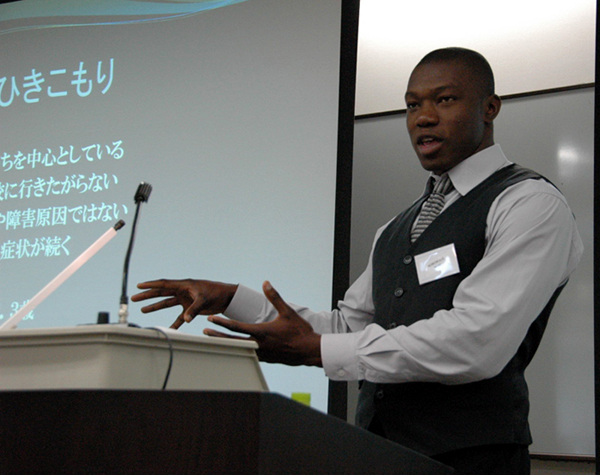
All dressed up in formal attire giving a final speech!
The dreaded final speech at the very end of the program causes many students a lot of stress. Essentially, you are asked to do a 10-15 minute speech with a 5-minute Q&A based on the research you conducted while attending the IUC. These speeches are meant to showcase your excellent Japanese skills and the program responsible for them—and by showcase, I do mean showcase. The speeches are delivered in a large conference room inside the neighboring Queen’s Square Plaza building, and all the students and faculty attend, along with many individuals and organizations that have connections with the IUC, such as scholarship organizations and alumni. So, although your friends and beloved instructors attend, so do complete strangers interested in hearing from the students they have supported in various (often financial) ways.

A view of the conference room from close to the back.
The pressure is on! But don’t worry, hopefully you’ve spent most of your fourth quarter preparing for this! Armed with well-practiced speeches and PowerPoints edited by your instructors, students given a 15-minute time slot within the last two days of school that are entirely dedicated to the卒業発表会 (graduation presentation). In our year, having a record number of 59 students, and we were literally booked from 10:00am to 5:00pm both of those days, with three 15 minute breaks and a lunch break scheduled. It certainly is a grueling experience, and wondering what you’ll get asked can be somewhat nerve-wracking. Some teachers did recommend that you have a plant in the audience. In some cases, the research could be specific enough that it might be good to have a question ready to answer that you had come up with yourself (maybe from Speaking I/II), instead of relying on your audience to know enough about a specific field to come up with a focused question. If you wanted to, you were allowed and even sometimes encouraged to pass a question to a friend to ask you during the Q&A. I had both a plant as well as a spontaneous question from a friend. Once it’s all over? Well, your local Friday’s is only a ten-minute walk away, and everyone’s ready to have some drinks at the end!
—
Honestly, I can’t say enough to recommend the IUC summer and 10-month programs. They truly are the top language training options out there, and the dedication and flexibility of the instructors to maximize what you get out of the experience is positively wonderful. There is no doubt that program is exhausting and very stressful, but it does leave you time to collect yourself and focus on what’s right for you. Before attending, several professors of mine in the States told me that their Japanese was never better than when they had just left the IUC. And having been gone from the Inter-University Center for a year, I can already understand why they said that. Nothing I’ve experienced matches that environment, which truly allows you get the most out of your language study and not only places high demands on you, but helps you meet them. I highly, highly recommend attending the IUC to anyone who is serious about studying Japanese for their future profession, whether it’s academia, business, economics, translation, law, or any other number of options.
I covered the program to the best of my ability here, but if you have any comments, questions, or experiences of your own to add, feel free to comment below or shoot us an email at shinpai.deshou@gmail.com ! Happy studying!