2012 Reischauer Scholars Program for High School Students

For all of you high school students interested in studying more about Japan, the Reischauer Scholars Program is a great opportunity to further your study through online classes. Check out their website for details about the program and how to apply! The deadline for the 2012 program is this October.

——–

The Reischauer Scholars Program (RSP) is an online course for high school students sponsored by the Stanford Program on International and Cross-Cultural Education (SPICE) at Stanford University. Named in honor of former Ambassador to Japan Edwin O. Reischauer, the RSP annually selects 25–30 exceptional high school students from throughout the United States to engage in an intensive study of Japan. Selected students will participate in this online course on Japan from February to June 2012.

Currently entering its ninth year, the RSP provides students with a broad overview of Japanese history, literature, religion, art, politics, economics, and contemporary society, with a special focus on the U.S.–Japan relationship. Ambassadors, top scholars, and experts throughout the United States and Japan provide online lectures and engage students in live discussion sessions. Students who successfully complete the course will earn Stanford Continuing Studies Program (CSP) credit and a Certificate of Completion from SPICE, Stanford University. The RSP will equip participants with a rare degree of expertise about Japan that may have a significant impact on their choice of study and future career. Students do not need to know the Japanese language to participate in this course, and there are no student fees.

The 2012 Reischauer Scholars Program is currently accepting applications from all current high school sophomores, juniors, and seniors (Classes of 2012, 2013, and 2014) in the United States. The RSP is opening up the application process to high school sophomores for the first time.

Please download the 2012 Reischauer Scholars Program application at http://reischauerscholars.org. The application deadline for the 2012 RSP is October 21, 2011. All applications must be postmarked by this date.

Thank you for your interest in the RSP. For more information, please e-mail Naomi Funahashi, Reischauer Scholars Program Coordinator, at nfunahashi@stanford.edu.

Posted in announcements, summer program | Tagged , , , , | Leave a comment

Conference update: The Early Modern Medieval: Reconstructing Japanese Pasts

I probably need not reiterate how ridiculously excited I am about this conference, seeing as it’s my field, but it’s a really rare opportunity to examine “medieval” history and how our ideas of the past are constructed! I highly suggest attending (and checking out their new website below) if you have any interest in the medieval and early modern periods. Registration not required to attend!

—

Organizers would like to update everyone on the status of the upcoming conference, “The Early Modern Medieval: Reconstructing Japanese Pasts.”

The conference is open to all and will be held on October 7-8, 2011 at the  Michigan League at the University of Michigan in Ann Arbor, Michigan.

We are pleased to announce that the complete program of events is now available on the website:

http://japanesepasts.lsa.umich.edu/index.php

The website also includes paper abstracts and information on keynote speakers,  panelists, sources, the student travel award, logistical information, and sponsors.

Conference description:

In the early seventeenth century, Japan entered a period of prolonged, relative stability under the dominion of the Tokugawa shoguns and other regional lords. This sustained period of peace, usually known by scholars as “early modern,” lasted until the mid-nineteenth century, and witnessed revolutions in printing, literacy, consumer culture, and scholarship in countless fields. The artifacts of this whirlwind of production were particularly shaped by their creators’ need to legitimize their present by reviving and revising motifs from earlier eras. Creators drew heavily from the period known to scholars as “medieval Japan” (c. 1200 – 1600). Writers and artists across early modern Japan appropriated medieval terminology and reinterpreted the words and images to fit their own political, artistic, or social-economic agendas. Literary scholars sifted manuscripts and compiled official, orthodox versions of classical texts. Artistic houses burnished their reputations by defining lineages and secret practices and giving them pre-seventeenth century provenances. Commercial writers and playwrights appropriated official histories of the past to craft panegyric local histories, while religious institutions enhanced their spirituality by reshaping their divine lineages. These projects reconstructed the history of medieval men and women of all walks of life — from samurai to outcastes, from pirates to merchants, and from warrior monks to tea masters.

The chronological division between medieval and early modern times in traditional periodization reflects the actual transition of the country from war to peace. But the division between periods has also had the effect of impeding connections in pedagogy, research, and publication across the chronological boundary. Scholars today on either side of the medieval-early modern divide share only rarely their sources or interpretations with each other. Japanese academic institutions maintain a discrete section for each of the two periods. As a result, relationships between the materials produced in each period often have been overlooked. Potentially more dangerous than the shape these particular chronological fields have taken is the impact this split has had on how modernity is understood. Modern Japan unwittingly and uncritically claims itself to be the heir of an early modern that in fact projected imaginary histories onto its past in order to fit early modern agendas. This conference begins to address these issues by inviting scholars and students from various disciplines of Japanese studies to explore the protean nature of memory in early modern Japan and the processes by which its inhabitants ascribed historical meaning. The conference is planned for two full days of keynote and panel presentations, source–reading workshops, and general discussion.

Please save the dates!

Posted in announcements, conferences | Tagged , , , , , , , , | Leave a comment

Job Opening: Tohoku University International Department Support Staff (Short Term)

Tohoku University’s International Exchange Department is looking for temporary support staff. Be sure to visit the employment section of Tohoku University’s website to see the original job posting in Japanese, available here. The following announcement is a completely unofficial translation.

Duties: English document translation in International programming, promotion, and other duties.

Requirements:
1) Native speaker of English, Japanese proficiency
2) Work experience at an educational research institution.
3) Skilled at Word, Excel, Powerpoint
4) Possesses a university degree

Location: Miyagi-ken, Sendai-shi

Start date: October 1, 2011 or soon after
Term: Until March 31, 2012

Compensation: 2,500/hr, commuting stipend, and health/workers’/accident insurance.

Working Hours: Regular shift, 9:00~16:00 (6 hrs)
Time off for Saturdays, Sundays, holidays, and New Years’ (12/29~1/3).
After 6 months of employment, 10 days of annual leave available.

Required Application Materials:
-Rirekisho, 1 copy (picture attached)
*Include your email address
– Jiko PR (personal essay), free format
– Resume/Work history, free format
– Proof of Japanese proficiency (JLPT certificate, etc.)

Submission Address:
〒980-8577 宮城県仙台市青葉区片平2-1-1
国立大学法人東北大学
本部事務機構国際交流課国際学術係

Contact: 国際学術係長 前野 TEL 022-217-4843

Note: For confidentiality, materials should be sent by registered mail (簡易書留).

Application Deadline: September 16, 2011 (Application materials will not be returned)
Selection: Written exam and interview

Posted in announcements, job openings, jobs, living abroad | Tagged , , | Leave a comment

Symposium: Visual Underground: Theatre Scorpio & Japanese Experimental Cinema of the Sixties

Location: Quebec, Canada
Symposium Date: September 16, 2011

Over the past few years the legacy of the Japanese cinematic and artistic experiments of the 1960s has received renewed international attention in academia in Japan, Europe and North America. Visual Underground: Theatre Scorpio & Japanese Experimental Cinema of the sixties presents and reflects on a body of rarely screened experimental Japanese films from this decade. Visual Underground is a uniquely conceived event, comprised of three days of film screenings (Sept. 16-18, 2011) and a one-day academic symposium (Sept.17), both of which are free and open to the general public.

Visual Underground will screen a series of experimental films associated with the legendary Theatre Scorpio (Sasori-za), as well as with Japan’s first art-house distributor and production house, the Art
Theatre Guild (ATG).

For more information, please visit our website:
www.visualunderground.ca

Posted in announcements, conferences | Tagged , , , , , , , , , , | Leave a comment

Fun Link Friday: TEDxTokyo 2011

Are you looking for a stimulating discussion of Japan from leaders in the here and now? Check out this week’s FLF–TedxTokyo.

TED (Technology, Entertainment, and Design) is a nonprofit making innovate content from thinkers, professionals, and artists around the world readily available online. Inspired by TED’s “ideas worth spreading” mission, TEDxTokyo has independently organized an annual event in Tokyo for the past 3 years with a growing number of speakers and participants. If you weren’t able to attend 2011’s event on May 21st, all of the 30+ talks/performances are viewable for free! The program page leads to the participants’ bios and a full video. Talks are digestible at 15 minutes or shorter. Additionally, simultaneous Japanese interpretation is available on the youtube channel.

The diversity of the speakers’ field of expertise means there is certainly something for everyone. My personal favorites so far are Kathy Matsui’s talk and SMILY’s didgeridoo and beatboxing. TEDxTokyo is a fun way to see and hear the energy and inspiring ideas spread by remarkable people concerned with the future of Japan. They may help you find your own inspiration, so get your thinking caps on!


Juggler/Dancer Maro performs first at TEDxTokyo 2011:Enter the Unknown

Posted in fun links, useful links | Tagged , , , , , , , , | 2 Comments

Applying to JET as a CIR, Part 1

Part 1: What is a Coordinator for International Relations?

For many fairly recent college graduates with degrees in Asian Studies, the Japan Exchange and Teaching (JET) Programme is the next stop on their career path. Last year, we ran several posts on the application process and role of for JET’s Assistant Language Teachers (ALTs), who make up 90% of the Japan Exchange and Teaching (JET) Programme. As a former CIR, I’d like to focus on the application process and the work of the other ~10% of JETs: the Coordinators for International Relations (CIRs; 国際交流員).

Who are CIRs? How are they different from ALTs?
When applying to JET, you cannot apply as both an ALT and a CIR at the same time. How do you know which is right for you?

ALTs are Assistant Language Teachers. While they participate in exchange activities other than teaching, teaching is their primary job. There is no Japanese language requirement for ALTs: some participants arrive with no Japanese skills; others are practically fluent.

CIRs, on the other hand, must possess a “functional command” of the Japanese language, which is comparable to passing the Japanese Language Proficiency Test N2. While N2 or N1 certification is desirable, it is not necessary for the application. CIRs may be asked to do school visits or teach English, but unlike ALTs, that is not supposed to be their primary job. JET describes CIR duties as working “in communities on international exchange activities”:

Major duties often include translation/interpretation for government officials, teaching community or school foreign language classes, and international exchange event planning and implementation.
Duties for a CIR may include:
・Receiving guests from abroad
・Editing and producing pamphlets in English or Japanese
・Advising and planning international exchange programmes
・Teaching English (or other languages) to government employees and local residents (from the official JET Programme website)

Because teaching English (or one’s native language) is not a primary duty, more CIRs than ALTs come from countries where English is not an official language. In my prefecture, we had CIRs from India, Belgium, France, Russia, China, Brazil, and Korea as well as the US, the UK, and Canada. I’m writing as an American who spent two years as a CIR, and so the information here pertains to the American application process.
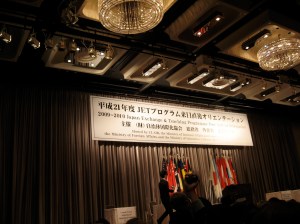
Tokyo Orientation 2009

Eligibility

This is an abbreviated list that focuses on the CIR position. For other positions and for more details regarding citizen status, see the website.

Hold at least a Bachelor’s degree or obtain such qualifications by the designated departure date of Group A participants (late July)

Have a functional command of the Japanese language. (Japanese language proficiency is necessary to function in a Japanese office environment). (See prior section.)

Have excellent pronunciation, rhythm, intonation and voice projection skills in the designated language in addition to other standard language skills. Have good writing skills and grammar usage. [For CIRs from English-speaking countries, this is Japanese and English.]

Not have lived in Japan for six or more years in total since 2002.

Placement
Like ALTs, CIRs may request a preferred region, prefecture, or city, as well as whether they would like to be urban, suburban, or rural. However, because CIRs only make up only 10% of the JET workforce, there are not as many positions or placements available. If you want to request a specific area, check the JET statistics (PDF) to see where the CIR positions are. After all, there’s no point in requesting a prefecture or city (Tokyo) with no recent history of CIRs!

CIRs often work for international exchange organizations, international divisions, city halls, and boards of education. Where you are placed will greatly determine what kind of work you do. A town or rural CIR at a board of education may teach elementary English and help plan local multicultural exchange events; an urban CIR working at a city hall might interpret for government officials and help with sister-city exchange events. The work of CIRs is extremely varied, so be prepared for anything!
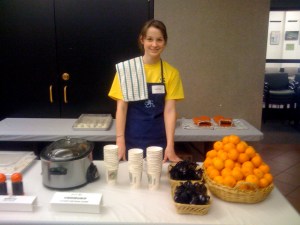
Volunteering at the Center for Japanese Studies’ Mochitsuki event, 2009.

Why I Applied as a CIR
I majored in Cultural and Critical Studies with my focus on Japan; during my undergrad career, I had interned at Japan America Society of Colorado. My time at JASC helped me realize that I was really drawn to a career in promoting Japanese culture in the US. I continued on this path academically and pre-professionally during my MA in Japan Studies, and in the final year of my grad work, I decided to apply as a CIR to help launch my career in this line of work.

Consider Your Qualifications

Your statement of purpose and your interview, if you are selected for one, are your chances to show the selection committee why YOU are the best candidate for a CIR position. Many candidates have a BA in Japan/Asian/Studies or International Relations, study abroad experience, and at least four years of university-level Japanese. What sets you aside?

In my case, I tried to show my dedication to linguistic and cultural study in my academic career, facilitating cultural exchange in my pre-professional work, and how gaining more experience in this field as a CIR would aid my future career. Interestingly, the CIR position I received was not at all what I expected, but the valuable experience I gained on the job and through my work with the JET community ended up taking me down a slightly different career path, which I’m enjoying very much. (More on this forthcoming.)

Stay tuned for
Part 2: The Application Process
and
Part 3: My Life as a CIR and Beyond

-Leah

Posted in JET, jobs, main posts, program review | Tagged , , , | 12 Comments


At the request of a commenter, we’ve added a few bits of information at the bottom of our “How can I fund my stay at the IUC?” article, showing how some students who were not affiliated with a school at the time of their attendance managed to pay for the program. More will be added if and when more former students respond, so be sure to check it out for new info!

https://shinpaideshou.wordpress.com/2011/08/16/iuc-series-how-can-i-fund-my-stay-at-the-iuc/

Posted on by Paula | Leave a comment

Travel grants and study opportunities through The Triangle Center for Japanese Studies

The Triangle Center for Japanese Studies, newly established with assistance from the Japan Foundation, has grants available for scholars who wish to visit the Japanese studies collection in the Duke University library, the Japanese materials in the Ackland Museum of Art at UNC Chapel Hill, the Gregg Museum of Art and Design at North Carolina State University, or another Japan-related resource in the Triangle region. Although these awards are primarily intended for scholars from universities in the southeast who lack regular access to such collections, applications from all interested scholars will be considered. For more information about this award or the Triangle Center for Japanese Studies, please see the TCJS website:

http://trianglejapan.org

The following opportunities are available:

  1. Travel Grants for Japanese Studies Visitors to the Triangle (to conduct research). These grants are not to bring speakers, but to encourage faculty at schools with less resources, particularly in the southeastern U.S., to visit the Triangle to use Duke’s Japanese studies library materials or the Japanese materials in our university museums.
  2. Research Travel Grants open to faculty and graduate students from Duke, NCSU, and UNC; they provide funding for travel to and accommodation in Japan.
  3. Cross-Institutional Study Groups. Proposals are invited from Duke, NCSU, and/or UNC faculty or graduate students on Japan-related topics. Study groups should include members from at least two participating institutions. The maximum number of proposals on which a faculty member may co-sign is two.

For application instructions, please visit:

http://trianglejapan.wordpress.com/2011/08/24/calls-for-proposals/

Posted in announcements, funding, graduate school, social networking | Tagged , , , , , , | Leave a comment

Job Opening: Modern Japanese History, Assistant Professor or Associate Professor

Institution:  University of Illinois – Urbana-Champaign
Location:   Illinois, United States
Position:  Department of History and Department of East Asian Languages and Cultures (Tenure-track assistant professor or tenure-eligible associate professor in Modern Japanese History)

The Department of History and the Department of East Asian Languages and Cultures at the University of Illinois at Urbana-Champaign invite applications for a tenure-track assistant professor or tenure-eligible associate professor in Modern Japanese History with a target start date of August 16, 2012.  This will be a joint appointment in two departments.  The successful candidate will have a record of research excellence and publication in modern Japanese history or have potential to develop such a record.  Minimum qualifications include a PhD by the start of appointment.  Salary competitive.  Please create your candidate profile through https://jobs.illinois.eduand upload application materials through this system.  To ensure full consideration, upload your application letter, curriculum vitae, teaching materials, and contact information for three professional references.  Referees will be contacted electronically upon the submission of the application.  All materials must be submitted by the closing date of November 1, 2011.  Questions can be addressed to the Department of History, 217-333-1155.

For information about Illinois, visit our web pages at www.history.illinois.edu and www.ealc.illinois.edu.  Illinois is an Affirmative Action/Equal Opportunity Employer and welcomes individuals with diverse backgrounds, experiences, and ideas who embrace and value diversity and inclusivity. (www.inclusiveillinois.illinois.edu)

Contact: Questions can be addressed to the Department of History,
217-333-1155.

Website: http://history.illinois.edu

Posted in announcements, job openings, jobs | Tagged , , , , , , , | Leave a comment

Job Opening: Bo Jung and Soon Young Kim Professorship in East Asian Science and Technology

Institution:  Johns Hopkins University, History of Science and Technology
Location:   Maryland, United States
Position:   Assistant Professor, Associate Professor, Full Professor, East Asian History of Science or Technology

The History of Science and Technology Department at Johns Hopkins University invites applications for the Bo Jung and Soon Young Kim Professorship in East Asian Science and Technology, starting 1 July 2012.  Rank is open and we encourage applications from scholars at all levels.  At the Assistant Professor level, the position is tenure-track, and at the Associate Professor level or above, the position will carry tenure.  Ph.D. required; junior scholars should complete all Ph.D. requirements by the summer of 2012.

The position is open to all areas of scholarship within history of East Asian science or technology in the 19thand 20thcenturies. Candidates should have a strong scholarly record and teaching experience.  The position involves undergraduate and graduate teaching as well as supervision of graduate students.  We seek someone who will be active in building the field of East Asian history of science and technology, who will work with scholars abroad and also with other faculty in Hopkins growing East Asian Studies Program. The Department emphasizes comparative study of history of science and technology and has strengths both in early modern and modern history of science and technology.  We are strongly committed to developing East Asian history of science and technology.  The Department has resources that will assist our candidate in this development through funds for research, cooperative projects with other scholars, conferences and other academic activities.

Please send a letter of application that describes scholarly activity and teaching experience, plus curriculum vitae and three references to the department c/o Mrs. Danielle Stout, History of Science and Technology, Johns Hopkins University, Gilman Hall 301, 3400 N. Charles Street, Baltimore MD 21218.   Applications may be sent electronically to: danielle@jhu.edu or by fax to 410-516-7502.  Please do not arrange for letters of reference to be sent at the time of application; we will solicit letters directly.   Review of applications will begin on December 15, 2011, and will continue until the position is filled.

Johns Hopkins University is an Affirmative Action/Equal Opportunity Employer and Educator.

Contact: Danielle Stout
Johns Hopkins University
Gilman Hall 301
3400 N Charles St.
Baltimore, MD 21218
danielle@jhu.edu

Website: http://host.jhu.edu

Posted in announcements, job openings, jobs | Tagged , , , , , , , , | Leave a comment