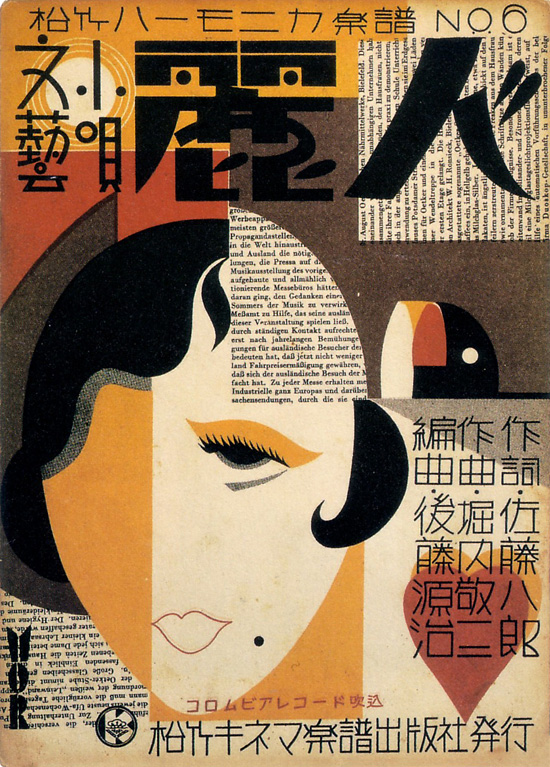
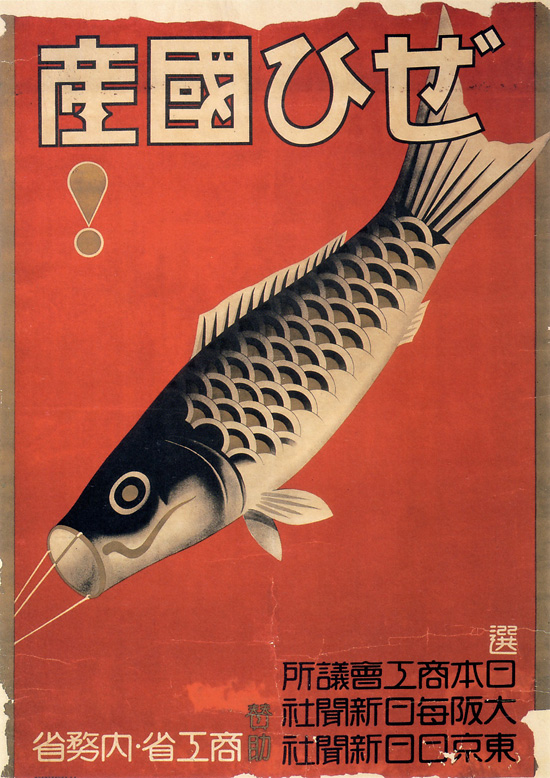
Fun Link Friday: Japanese Graphic Design from the 1920’s and 30’s.

I was first introduced to the art deco period reading F. Scott Fitzgerald’s The Great Gatsby, in high school. As I think is common with many American schools, my high school mostly focused on the European movement and its influence in the States lacking discussion of these movements in other countries. Today, one of my hobbies is still related to the exploration of art deco influenced works. You can imagine my giddiness when Bloggokin shared art deco influenced graphics from Japan!

Roughly translated from the site:

In the 1920’s and 30’s, Japan embraced this form of graphic design as a form of social change. These graphics were utilized in all print media confirming a change in politics and society as well as affirming change through industrial development and technology. Famous Japanese graphic designers from this time period include Kenkichi Sugimoto, Hiromu Hara, Gihachiro Okayama, and Shujiro Shimomura as their works are admired for a clean aesthetic.

I hope you enjoy these graphics as much as I did!

Posted in culture, fun links | Tagged , , , , , , , , | 1 Comment

Call for Papers: Conference of the Australasian Association of Buddhist Studies

December 7-9, 2011

The 2011 conference of the Australasian Association of Buddhist Studies (AABS) will be held in conjunction with the New Zealand Association for the Study of Religions (NZASR) Conference from December 7, 2011 to December 9, 2011 at the Mercure Queenstown Resort, Queenstown, New Zealand.

The conference will consist of two parallel streams of plenary lectures and panel discussions. For the AABS stream contributions are welcome from all academic perspectives of Buddhist studies including textual studies, history, sociology, religious studies, cultural studies, psychology, music, performance and art history. Speakers will have 30 minutes, approx. 20 minutes to deliver their paper with the remainder for questions and discussion. Postgraduates are particularly welcome to submit papers for either conference stream. Calls for papers and proposals for panel discussions (3 papers) for both AABS and NZASR streams can be found at http://www.nzasr.ac.nz/conference/. The call for papers will close on 31 October 2011.

Venue: Mercure Queenstown Resort, Queenstown, New Zealand
Date: December 7, 2011 to December 9, 2011

Full details of conference outline, registration, accommodation and
contacts can be found at http://www.nzasr.ac.nz/conference/

Posted in announcements, conferences | Tagged , , , , | Leave a comment

Job Opening: Position East Asia Hist., Univ of Cincinnati, Asst prof

Institution: University of Cincinnati, History
Location:   Ohio, United States
Position:   Assistant Professor (tenure-track) East Asia

The Department of History at the University of Cincinnati invites application for a historian trained in either the history of East Asia (preferably Japan, but not excluding Korea or pre-20th century China) or Southeast Asia (any period).  The candidate should expect to participate in teaching regional surveys as well as upper-division undergraduate and graduate courses in his/her specialty. The ability to teach comparative, thematically oriented courses is also welcome. In addition to teaching, the successful candidate is expected to engage in scholarly research, and to make service contributions to the missions of the department and the university.

The University of Cincinnati is an urban, public university with an enrollment of over 43,500 students. The History Department is home to 23 full-time faculty and offers BA, MA and PhD degrees. Significant support for faculty research is available through the Charles Phelps Taft Research Center and the University Research Council. The teaching load is 2-2 with the coming transition to semesters in Fall 2012. PhD by 31 July 2012 is required.

Contact:

Applicants should submit a cover letter, CV, and brief writing sample (approximately article length) to the university’s electronic application system at www.jobsatuc.com/applicants/Central?quickFind=79640.  Three letters of recommendation should be sent directly to

Chair, East Asia/SE Asia Search Committee

Department of History, University of Cincinnati

360 McMicken Hall, Cincinnati, OH 45221-0373.

Review of materials will begin November 21, 2011. We expect to conduct interviews at the American Historical Association Annual Meeting in Chicago, IL. Questions may be directed to  hope.earls@uc.edu. The University of Cincinnati is an Equal Opportunity Employer and encourages applications from minorities, women, disabled persons, and veterans.

Posted in announcements, job openings, jobs | Tagged , , , , , , , | Leave a comment

Now Available: The Ishikawa JET Kitchen: Cooking in Japan Without a Fight

Courtesy of Ishikawa JET

When I came to Japan as a JET Program CIR in 2009, I was completely befuddled by how to feed myself. With my 2kyuu certification in hand, I could read and speak Japanese well, but trying to adjust my favorite recipes to work with Japanese kitchen equipment (picture making cookies in a microwave for scale) and cook without the aid of prepared foods like veggie burgers or ravioli proved to be more difficult than I had imagined.

I decided that I wanted to help English-speaking foreigners navigate cooking in Japan, and so I created a project that became The Ishikawa JET Kitchen. With a team of about thirty JETs and friends, we took our favorite recipes from our home countries and from Japan, tested them extensively, and created a cookbook with the expat chef in mind: recipes you can make in your Japanese kitchen with ingredients available at your local store. There’s something for everyone: our Japanese, foreign, and fusion recipes include fare for vegetarians, vegans, and gluten-free folks, as well.

The book is incredibly user-friendly: the recipes are measured in metrics and have the Japanese pronunciation and kanji for the ingredients right on the page. Our amazing design team has made the this digital cookbook (pdf) searchable, linked, and indexed, so you can always find exactly what you need.

The cookbook costs 1000 yen; all proceeds will go to Second Harvest Japan, a charity that provides food and supplies to disaster zones, soup kitchens, orphanages, etc.. This charity was influential in getting supplies to those living in areas affected in the 2011 Tohoku Earthquake and Tsunami.

To order, go to our Paypal page for a downloadable pdf or contact Ishikawa AJET at ishikawaajet[at]gmail.com for information on transferring money (furikomi) to the AJET bank account to receiving the product via email.

Itadakimasu!

-Leah

Posted in announcements | Tagged , , , , , , , , , | 1 Comment

Resource: Hiroshima Archive

Following the footsteps of the Nagasaki Archive, the Hiroshima Archive has recently launched. If you’re someone with an interest in World War 2, want to learn more about the atrocities of the atomic bomb, and get first hand accounts of the atomic bomb, the Hiroshima Archive is a site not to be missed. The archive aims to promote a multifaceted and comprehensive understanding of the reality of the atomic bombing.

Background

It’s been 66 years since the atomic bombs were dropped in Hiroshima and Nagasaki. All the remaining A-bomb survivors will have died out in the coming decades. Those who have personal experiences and a strong desire for peace and a nuclear-free world will have passed. The Hiroshima Archive was produced by mixing resources obtained over the past 66 years combined with internet technologies hoping to share personal experiences and messages of Atomic bomb survivors to future generations.

Contents

The Hiroshima Archive is a digital archive that utilizes “Google Earth” to produce a multilayered presentation of all the resources. Content for this archive was accrued from the Hiroshima Peace Memorial Museum, the Hiroshima Jogakuin Gaines Association, and the Hachioji Hibakusha (A-bomb Survivors) Association.

Users can get a panoramic view over Hiroshima to browse survivors’ accounts, photos, maps, and other materials as of 1945, together with aerial photos, 3D topographical data, and building models as of 2010.

Search and Navigation

Because the archive relies heavily on Google Earth, it may be difficult to narrow your search and find something you believe would have the strongest impact. Additionally, the innumerable resources make it difficult for the user to easily recognize whether or not they’ve already looked at a resource. If you hope to come back to an item for a research paper or a presentation, you may find it difficult to locate the video, photo, or statement again.

There is a top bar faceted search option which lets the user change the content and view of resources. Users can look at all items at once (which is overwhelming) or seperately the videos, testimonials (in English or Japanese), Tweet mapping, Photographs, Map of 1945, Fireball, Circles, Burning Down Area, Black Rain, Hiroshima 2011, Building, and Border. Users can switch to a strictly Japanese Google Earth format or to the Nagasaki Google Earth site.

General Observations

If you aren’t confident in your Japanese skills, you may actually find much of the content difficult to understand and utilize. Additionally, the videos included in the archive are in Japanese without subtitles. The majority of the testimonials are also in Japanese only.  However, the faceted search does allow the user to look at testimonials available in English.

A benefit to this resource would be to allow the user to switch from Google Earth and search for and observe content in a format other than the way it is currently presented.

Overall, the Hiroshima Archive is an impressive site which uses the most current internet technology available. I highly recommend checking out this site and experience a unique presentation of important historical resources.

Posted in study tools, useful links | Tagged , , , , , , , , | Leave a comment

Call for Participants: Workshop – Reading Edo-period texts in the raw

Reading Edo-period texts in the raw: learning how to read manuscripts and woodblock-printed books as Edo-period readers read them

We welcome applications for the following workshop: “Reading Edo-period texts in the raw: learning how to read manuscripts and woodblock-printed books as Edo-period readers read them”.

Venue: The British Library (London, UK)

Address: St Pancras
96 Euston Road
London
NW1 2DB

Time: 27 June 2012 (Wednesday) – 29 June 2012 (Friday)

Organisers: The British Library (Hamish Todd), Cambridge University (Peter Kornicki), Newcastle University (Laura Moretti)

Instructors: Peter Kornicki, Laura Moretti, Rebekah Clements, Alessandro Bianchi

Distinctive features of the workshop:

1.     We shall work with a range of original materials containing hentaigana andkuzushiji and explore their diachronic development through the Edo Period.

2.     Easy and progressive approach starting from easier hentaigana in woodblock-printed texts of the later Edo period, moving on to an introduction to texts with kuzushiji and progressing towards more difficult forms of writing in both manuscript and printed books of the early Edo period. The texts used will be original editions from the superb collection of the British Library.

3.     A method developed to teach non-Japanese students with a small class of a maximum of twenty participants.

4.     An easy-to-follow manual for working on your own. By the end of the course students will be equipped to work on their own with materials relevant to their own interests.

Profile of the participants:

This course is suitable for students who have done at least three years of Japanese including bungo and will be useful for students interested in any field relating to pre-modern Japan.

Number of participants and selection process:

The number of participants for the course is limited to twenty. Priority will be given to those with more than three years of Japanese study and a research interest in a subject relating to the Edo period. If there are more than twenty suitable candidates then a selection will be made by the instructors.

Application process and deadline:

Applications must be sent to laura.moretti@ncl.ac.uk, with the title “BL Edo Texts Workshop 2012”.  In order to apply please send the following documents:

1. A Letter of Intent which explains your background, why you are applying to the workshop and what your research interests are.

2. Your updated CV.

The deadline is 15 December 2012. The names of the selected participants will be released by the end of January.

Tuition fees: There are no tuition fees for the workshop.

Travel and accommodation: The organisers do not cover travel or accommodation expenses. Participants will be responsible for making their own accommodation arrangements, but a list of nearby hotels will be provided.

For further information please contact: Dr. Laura Moretti at laura.moretti@ncl.ac.uk
.

Posted in announcements, study tools | Tagged , , , , , , , , , | Leave a comment

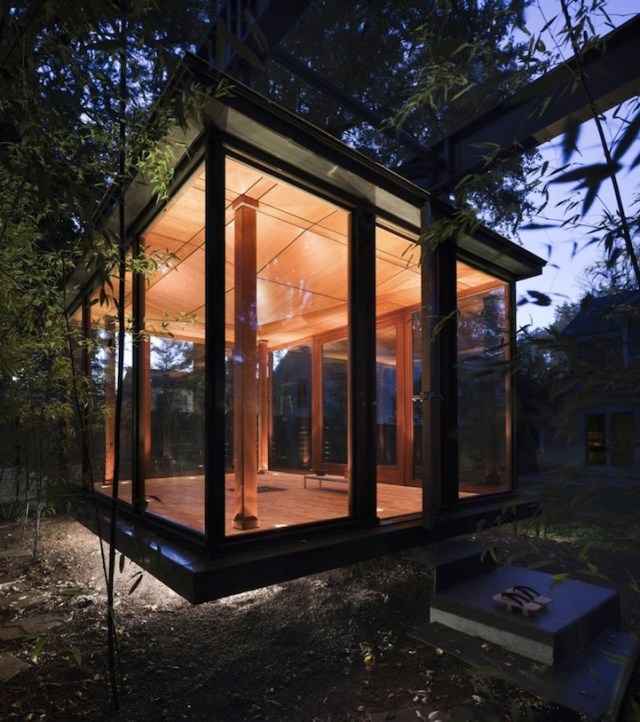
Fun Link Friday: Floating Japanese tea house in DC

Oftentimes I find myself looking at the architecture of Japanese homes and other buildings enviously. The designs are slick, compact, and simple. There’s an extra something that just resonates with me. And although I’m not usually one for giant steel beams, the floating tea house dangling from them in David Jameson’s garden is certainly something to behold that still captures this essential Japanese design of simplicity and ingenuity while combining a variety of traditional aesthetics.

Functioning as a dining room, meditation area, and stage , this floating tea house has been built in the personal garden of Jameson’s home. He describes the project on his website:

A hanging bronze and glass object inhabits the backyard of a suburban home. The structure, which evokes the image of a Japanese lantern, acts as a tea house, meditation space, and a stage for the family’s music recitals. After experiencing the image of the lantern as a singular gem floating in the landscape, one is funneled into a curated procession space between strands of bamboo that is conceived to cleanse the mind and prepare one to enter the object. After ascending an origami stair, the visitor is confronted with the last natural element: a four inch thick, opaque wood entry door. At this point the visitor occupies the structure as a performer with a sense of otherworldliness meditation.

Truly an incredible work! It definitely feels otherworldly to me.

For more images, see: http://www.mymodernmet.com/profiles/blogs/floating-japanese-tea-house

The rest of Jameson’s architectural designs and projects are equally fascinating as the tea house. You can check them out at his website here:

http://www.davidjamesonarchitect.com/

Happy Friday!

Posted in culture, fun links | Tagged , , , , , , , , | Leave a comment

Job Opening: Lecturer (Assistant Professor) in Modern Japan Studies

Call for Applications

Lecturer (Assistant Professor) in Modern Japan Studies Leiden University

Leiden University invites applications for a fulltime Lecturer in Modern Japan Studies. Appointment will be fixed-term from September 2012 through August 2015, with the possibility of extensions of up to three years, and of tenure thereafter. Requirements include a PhD degree, but candidates near completion of the PhD will be considered.

Before submitting your application or query, please read the full advertisement at
http://vacatures.leidenuniv.nl/wetenschappelijk/11-200.html.

Review of applications will commence 1 November 2011 and continue until the position is filled. Interviews are tentatively scheduled for the first half of February 2012.

The rank of lecturer (Universitair Docent) corresponds to that of Assistant Professor in North-American terms. Candidates from outside the Netherlands may be eligible for a substantial tax break. Queries to Maghiel van Crevel (m.van.crevel@hum.leidenuniv.nl), with cc to Katarzyna Cwiertka (k.j.cwiertka@hum.leidenuniv.nl).

Posted in announcements, job openings, jobs | Tagged , , , , , | Leave a comment

An introduction to the MEXT scholarship

Today’s feature article is a written by Chris Kern, a Ph.D. student of The Ohio State University who will be traveling to Japan this month as a MEXT (or Monbukagakusho 文部科学省) award recipient. He introduces what the MEXT scholarship is and his experience with the application process.

[EDIT 6/1/16: Employees of the consulate have offered some updated information on this article, which you will find noted with stars (**) and included at the end of each section.]

—

If you are working on a PhD in Japanese, eventually you will probably want to go to Japan on a research scholarship.  There are many opportunities — Fulbright, Fulbright-Hayes, Japan foundation, etc.  What I will cover in this post is the MEXT scholarship (official title: Japanese Government Scholarship for Research Students)**, a scholarship sponsored by the Japanese government (MEXT is the abbreviation for the ministry that handles education, among other things).  I will be going to Japan on this scholarship in a few months.  My advice is based on what I did in my application—obviously everyone’s experiences will differ, but this should at least give you an idea of what to do.  It’s also based on my position as a 6th year graduate student — if you’re not as far along in your research you may not be able to follow everything to the letter.  However, this doesn’t mean you can’t apply.  This is a general scholarship, not one exclusively meant for advanced research students.  Note that you have to be under 35 years of age to apply for this award.

I won’t cover general stuff like transcripts and recommendation letters which are common to most scholarships.  Obviously you want to find people who can speak to your ability to do the research you are going to be doing.

**[Note: This post covers Embassy Recommendations only. There are two other ways to be recommended (University Recommendations and Domestic Recommendations.) A short description of all three can be found here: http://www.studyjapan.go.jp/en/toj/toj0302e-30.html]

1. Be sure of the deadlines.

The deadline for the MEXT scholarship is very early — depending on when you are going, you may have to apply as long as a year and a half (yes, 18 months) before you leave.  You must check with your local consulate. Different consulates have different deadlines, and you have to apply to the consulate that is in your area — you can find out which area you’re in by checking the consulate’s web pages, and there are people to e-mail if you’re not sure.**

This is the reason I’m not providing links in this post – the details vary so much that I don’t want to run the risk of misleading people.  Just search google for your closest consulate city plus either “MEXT scholarship” or “monbukagakusho scholarship” and you should be able to find the information.

**[Note: You must be a citizen of the country where you apply. If, for example, you are a Canadian citizen living in the United States, you must apply through Japanese diplomatic mission located in Canada (usually the one under whose jurisdiction your permanent address in your home country is located.)

There is a list of all Embassies and Consulates here: http://www.mofa.go.jp/about/emb_cons/mofaserv.html
A few things to note about scholarship offerings and jurisdiction:
1) Scholarship offerings may vary from country to country.
2) Some of the smaller Consulates do not manage scholarships. For example, Portland has a Consulate, but that Consulate does not accept scholarship applications. Applicants from Oregon must go through Seattle.]

2. Find a professor in Japan to work with.

One of the best things you can do for your chances on any foreign research scholarship in general is to start a relationship with a professor in Japan.  Having an idea of who you want to study with strengthens your application because it shows that you’ll be able to do something with your time there.  There are several methods you can use to find a professor; ideally you can get a connection through your advisor or some other contact at your school.  Even if your contact turns out to be a friend of a friend of a friend, that’s OK.

Eventually you’ll have to e-mail the professor introducing yourself, explaining your research and the scholarship, and asking them to write a short letter.  Make sure that you use a book when writing this (such as Writing Letters in Japanese) and have people who know academic Japanese check it over.  An e-mail like this is one of the most formal things that you will write, so you want to make sure that at least your initial contact with the professor follows all the rules.  (Once you establish the relationship you probably don’t have to get every e-mail checked, since you do want the professor to have an idea of what your actual Japanese ability is.  But any time you need to make a request of the professor or thank them for a major service, it’s probably a good idea to get it checked.)

You may even want to find multiple contacts in Japan.  If you’re hoping to go to a major university that frequently deals with international students you may be OK, but if it’s a smaller university it’s possible that they may not accept you even if you get the MEXT award.  The government award does not force a university to accept you even if you get the award.

The professor may have to fill out a small form or write a brief letter for your application.

3. Define your research goals in Japan.

This is a common feature of any graduate research scholarship you apply to.  Even if you are still somewhat uncertain of your exact dissertation topic, you want to at least appear as if you have a clearly defined subject and goals.  If you have a clear dissertation topic that’s great, if not, you want to choose something that at least can be your topic.  No one will check up to make sure you are following what you said before, but presumably you have at least a general idea of what you’re doing.

A very important area to focus on is your purpose of study in Japan.  As much as possible you want to communicate the idea that you need to go to Japan to fulfill your research goals.  Don’t be afraid to put forth things you aren’t completely certain you’ll need.  You should probably avoid outright lying about what you want to do there, but you want to make your case as strongly as possible.

Photo by Rennett Stowe

4. Write the statement of purpose in both English and Japanese.

This is technically optional but if you are able to write your statement of purpose in Japanese it will help establish that you have the Japanese ability necessary to work with your professor in Japan, and it’s good practice for communicating with the professor there (and for the interview).

Your statement of purpose will be mostly the same as other applications, but make sure that you mention your scholar contact (if you have one) and explain why you will be working with him.  One of your major goals on your statement of purpose is essentially to tell the judging committee that you’re not going to have problems getting things done in Japan.

The only other somewhat unusual part to the application is the health form; you’ll need to schedule a doctor’s visit for this (and insurance may not cover it), and it is mandatory to submit it with your initial application materials.

Once you send off the materials, you should be notified relatively soon about whether you made it to the interview stage or not.  The speed of response differs based on the consulate.

5. The interview stage (preliminary screening)

If you are selected for the interview, you will have to go in person to the consulate to have your interview.  The interview will be conducted in the Japanese style, meaning that there will be a three or four person committee (and some of the interviewers may not ask any questions).  The questions they ask will be more or less what you would expect from any scholarship interview.  You may be asked to explain your research in Japanese – if you have already written your statement of purpose in Japanese you should be able to do this.

I also had to take a language test (with the option of also taking some sort of English test, which I didn’t do).  The language test was less than an hour, and to me it looked to be about JLPT 1 level.**

[Note: The English exam is now mandatory for all applicants, at least in the United States. You can find examples of past exams here: http://www.studyjapan.go.jp/en/toj/toj0302e-32.html#1

Additional information about the language requirements: The guidelines for 2017 state, “Applicants must be willing to learn Japanese. Applicants must be interested in Japan and be willing to deepen their understanding of Japan after arriving in Japan. Applicants must also have the ability to do research and adapt to living in Japan.” The scholarship may include 6 months of Japanese language training for applicants who require it.

However, later in the guidelines it is also stated that, “If an applicant with limited proficiency in Japanese desires to pursue studies in fields such as Japanese linguistics, Japanese literature, Japanese history, or Japanese law – fields that require sufficient knowledge of the Japanese language – he/she will not be selected as a grantee unless there are exceptional circumstances.”

2017 Guidelines (Japanese):http://www.mext.go.jp/component/a_menu/education/detail/__icsFiles/afieldfile/2016/04/22/1369740_01.pdf
2017 Guidelines (English):http://www.mext.go.jp/component/a_menu/education/detail/__icsFiles/afieldfile/2016/04/22/1369740_02.pdf]

6. Applying to the schools

If you pass the interview stage, the next step is to apply to the school or schools you want to study at.  You will receive forms from the consulate that you will send to the school.  If you have a contact there you may also need to have them write a letter.

You will probably have to contact the school in order to find out where to send the materials.  If the university you want to go to is a large one that frequently deals with foreign students, they will probably have a department devoted to international applications, which you can contact.  Otherwise you may have to work harder to find out where to send the materials.

7. The final round (secondary screening)

Once you get your acceptance to the university, there is one final round of judging in Tokyo.  I don’t know how this process works.  If I remember correctly, you don’t actually do anything (the schools send materials directly to Tokyo).  However, it’s possible you have to send some sort of acceptance letter to Tokyo.

photo by poolie

8. Waiting

All of this takes an extraordinary amount of time.  Once you get your final acceptance, you may have to wait months to find out where you’re living, when you’re going over there, etc.  Of course you will have to apply for a visa at the consulate, but finding housing and such is really beyond the scope of this post.

Currently I’m supposed to be going to Japan in two weeks or so, and I still don’t have the details of my plane flight or exactly when I’m going.  The wheels of bureaucracy turn slowly.

Good luck!

– Chris

—

Chris Kern is currently a PhD student of Japanese literature at The
Ohio State University.  He obtained a Master’s degree in Japanese at
the Ohio State University (2007) and has a B.A. in Computer Science
from Grinnell College (2002).  His present research is on Kamakura and Edo-period commentaries on the Tale of Genji.

Posted in applications, financial assistance, funding, graduate school, interviewing, main posts, study abroad | Tagged , , , , , , , , | 10 Comments

Funding: ATJ’s Bridging Scholarships for Undergraduates

The Bridging Scholarship program will award 20 scholarships to American students participating in study-abroad programs in Japan that begin in Spring 2012. Undergraduate students majoring in any field of study and attending any recognized exchange or independent program in Japan are eligible to apply for these scholarships.

Recipients of Bridging Scholarships will receive stipends of $2,500 or $4,000, depending on the length of their study program in Japan.

The scholarships are funded by donations from U.S. corporations and foundations to the US-Japan Bridging Foundation. Since 1999, the Bridging Scholarship program has awarded 1,150 scholarships to students studying abroad in Japan. Most recently, 85 students from colleges and universities in 32 states received scholarships for study in Japan beginning in the Fall 2011 semester.

The deadline for applications for Spring 2012 scholarships is October 7, 2011.

Applicants will be notified of the results by November 30. Selection will be based on academic potential and financial need. The scholarships are administered by the Association of Teachers of Japanese.

Spring 2012 programs are those beginning between January and April 2012 and continuing for at least three months. (Summer program participants are not eligible for Bridging Scholarships.) Students planning to study abroad in Japan beginning in Fall 2012 or for the 2012-2013 academic year should apply in April 2012 for the Fall 2012 scholarships.

Information on the Bridging scholarships and downloadable application forms are available at ATJ’s Web site: http://www.aatj.org/atj/studyabroad/scholarships.html.

Posted in funding, study abroad, undergraduate | Tagged , , , , , , | Leave a comment