Job Opening: Modern Asian History

Institution:   University of Birmingham, School of History and Cultures
Location:   United Kingdom
Position:   Assistant Professor, Lecturer (Assistant Professor), Modern Asian History

University of Birmingham
College of Arts and Law
School of History and Cultures
Lecturer (Assistant Professor) in Asian History

Starting salary 36,862 to 44,016 a year (potential progression on performance once in post to 49,539 a year).

We are looking for a historian who researches any aspect of modern Asian history. Geographic specialization is open, though we are especially interested in candidates whose research complements the departments existing thematic strengths. The appointment is conceived as part of a wider effort to strengthen our profile in this area.

The appointment would be expected to consolidate and expand our undergraduate teaching provision, expand Masters and PhD recruitment and work with one or more of our research centres to bolster the History department’s performance in the Research Excellence Framework.

There are opportunities in the School of History and Cultures in terms of:

Research:

  • developing and consolidating existing research interests within the School of History and Cultures, both individually and with others, with a view to publication of high-quality research
  •  initiating and participating in broader, cross-School initiatives, both multi-/inter-disciplinary and with historians working in other Schools of the College of Arts and Law, and/or with colleagues in the College of Social Sciences.

Teaching:

  • contributing to existing undergraduate courses (special subjects and more generally) and development of both new courses and programmes
  • taking a full part in the consolidation and development of postgraduate work, building on initiatives developed by our Centres (e.g., the MA in Contemporary History; a new MA in World History).


Administration and Career development:

  • learning about and participating in the organisation and management of a varied and dynamic section in one of Britains largest redbrick universities
  • opportunities to develop administrative and organizational skills in professional terms.

Interviews will be held in March.

Expected start date September 2012

Closing date:       17 February 2012

Contact:

To download the details and submit an electronic application online visit: www.hr.bham.ac.uk/jobs alternatively information can be obtained from 0121 415 9000. For informal enquiries, please contact Professor Naomi Standen or Professor Corey Ross, both at the Department of History, School of History and Cultures, The University of Birmingham, Edgbaston, Birmingham, B15 2TT, UK.  Email: n.standen@bham.ac.ukc.d.ross@bham.ac.uk

Website: www.hr.bham.ac.uk/jobs

Posted in announcements, job openings, jobs | Tagged , , , , , , , | Leave a comment

On Museum Volunteering / Internships

Our main article kicking off the 2012 year is a guest piece by Travis, an MA student in art history who also runs the blog “茶有の者 – A Man with Tea.” We’re happy to have him and look forward to hearing more about art and museum studies!

A career in the arts & museum field is one of the many paths one can pursue with a degree in Japanese Studies. An important step getting your foot in the door is to volunteer or intern at a museum, gallery, or other kind of cultural institution.
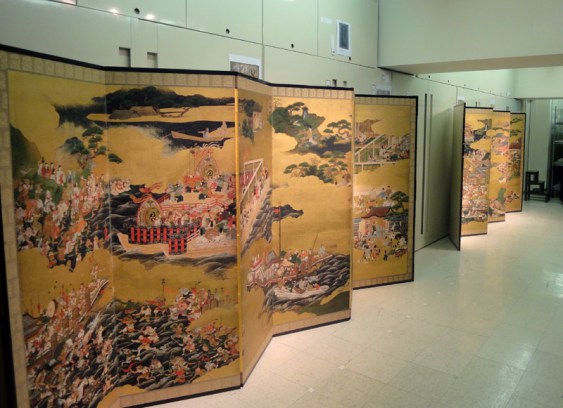
A behind the scenes look at 17th century Taishokan scrolls.

I did just that, interning with a curator of Japanese art at a major US art museum shortly after completing my BA. Since then, I’ve done several more volunteer/internships, earned a MA in Japanese Studies, and am right now working on finishing a MA in Art History, with the plan to go on to a PhD, and then (maybe, hopefully) a career in the museum world.

Thanks so much to Paula for offering me the opportunity to share a few guest posts about my experiences volunteering/interning in museums and other cultural institutions. What I originally conceived of as a single post is now quickly beginning to look like a short series. This post will attempt to focus on how to find volunteer/internship opportunities and apply for them. Future posts will discuss the kind of work you may be expected to do as a volunteer or intern, give advice for pursuing a career in the museum world, and touch upon what types of positions exist and what they entail. Disclosure, I have yet to actually work a full-time professional research or curatorial position myself; but having interned and volunteered at a number of institutions, I’ve gotten something of a sense of the variety of volunteer/internships and how they function, and am happy for the opportunity to share what I have learned.

The first step to securing a position as a volunteer or intern is to look for potential openings. Most museums list volunteer/internship opportunities on their websites. Sometimes these listings can be kind of hard to find, but often they’re under a link for “About the Museum,” or something like “Contribute” or “Support,” and are also often grouped in under “Employment” or “Careers.” Of course, asking in person at the museum’s information desk is always a good option as well.

Many museums, especially the larger and more major institutions, have set application procedures involving letters of recommendation and statements of purpose. Some, such as the Metropolitan Museum in New York, have rather early deadlines. The deadline, for example, for Summer 2012 internships for college students and graduate students to apply to intern there is January 6. So, this is something to watch out for.

At the same time, many museums (even larger ones) function on a more informal basis, while others may function only on an informal basis, posting no official volunteer opportunities, maintaining no set structure for how volunteers are handled, but remaining very much open to the possibility of bringing you in if you inquire about it. I found my first volunteer position by simply following the application procedures described on the museum’s website, where they advertised openings for summer volunteer opportunities. However, once I got that position, towards the end of that summer, I spoke with the Volunteer Coordinator (many larger museums have a designated department for managing volunteers) and asked if there was any possibility of a volunteer/internship in the curatorial departments working with Japanese art. There was no opening advertised or listed anywhere – I just asked. This is essentially the same thing your parents have been telling you about applying for a job; that even when there’s no listing advertised, sometimes you should just ask anyway if there are any openings. At first I, too, was loath to ask, loath to believe it could work. But, it’s true. Sometimes, even when there’s no opening advertised whatsoever, if you just ask about the possibility, a position will sometimes exist, or will be created. So, after an interview and submitting a few documents, I found myself interning with one of the top Japanese art curators in the country.
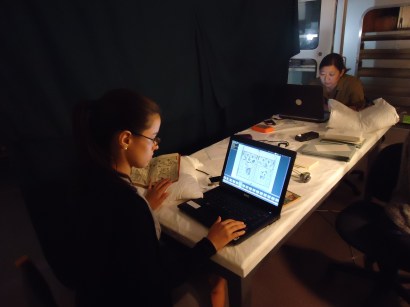
Two friends at work checking books. They go through the book page by page, comparing each page to the photograph of that page, to make sure they're all in focus, and clear, and that no pages are missing.

I guess that essentially what it comes down to is that it works both ways. Some of the most major museums, and many smaller ones too, have certain projects they are looking for volunteers or interns to work on and/or have well-coordinated programs specifically designed to help teach and train you as an intern. My latest internship worked this way – the museum had a very specific project that they needed interns for, and it was all coordinated out already, the timeline, the pay, the project, all funded by an outside grant for which they had applied.

Of course, many museums also have people banging down their doors, so to speak, to get their foot in the door, so they have relatively complicated application procedures. While many smaller institutions can get away with a more informal way of doing things, the largest museums need to have a formal procedure or else they would just be inundated constantly with questions and offers from people who want to volunteer.

Now, that said, pretty much every department in every museum is understaffed and has tons of work that needs to get done, and they could use the help. Whether they have the physical space to give you a workspace, or the time and flexibility to show you the ropes and to otherwise support you as a volunteer/intern is pretty much what will determine whether the second tactic – the cold call/email/letter when there is no posted opportunity – will enable you to get a volunteer/internship. So, especially if there’s something very specific you’d like to do – e.g. Japanese curatorial section, archives, museum library – for which there are no listings, it can never hurt to inquire.

And while, yes, to a certain extent, for the museum it is absolutely about them getting free (or cheap) labor, in my experience, there is also a willingness and an understanding, even a desire, to make it an opportunity for the volunteer/intern to learn, gain hands-on experience, and build networking. I’ll go into more detail about the kinds of tasks I found myself doing in my various internships, but suffice it to say that even if your job involves a lot of menial/clerical/busy-work, in my experience, the curator (or whomever it is you’re working with/under) will take out time as well to say “take a break and let me show you something.”

Sometimes this was a little more hands-on, as the curator walked me through an actual project she was working on at the moment, and explained about it; sometimes it was a bit more in the form of scheduled, planned events, such as having visiting scholars lead a workshop or lecture. If a visiting scholar had requested certain pieces be taken out for her to study, often so long as the objects were already out, we interns would get a chance to at least take time to look at them ourselves, and sometimes the curator would tell us more about them.

At the very least, even if no one is explicitly “teaching” you in the form of a lecture, tour, or workshop, you’ll be learning a ton just by doing the hands-on tasks, and just by sitting in on (or overhearing) department meetings. In my first internship, I was introduced to

A behind-the-scenes look with a museum curator: papers accompanying an early modern handscroll.

elements of how exhibits are planned, gallery layout, collections management, database organization, what different departments or professional positions do and how they interact, and other valuable behind-the-scenes skills and knowledge. Plus, as you work with people directly in your area and meet  staff members from other departments (either through occasionally collaborating with them or encountering them at museum-wide staff meetings, staff parties, etc.) you engage in valuable networking opportunities. While adding a prestigious museum to your resumé, you get to know curators and other professionals as you establish a relationship with the museum as a whole. This last part is of importance, since museums do very often hire their volunteers and interns; their familiarity with you, your familiarity with them, with their collections, with how they do things, are all very valuable.

Two more things. One, don’t worry if you’re not an Art History major, or if your Japanese isn’t so good, or if you are concerned that there are other particular skills or backgrounds you are lacking. Depending on the institution, and what tasks need to get done that season, volunteer/internship positions potentially exist for every skill level– for high school students, college students, college graduates, and graduate students. When I began that first Japanese art curatorial position, I had a BA in History and East Asian Studies, only the most limited formal classroom background in Art History, and a rather limited grasp of Japanese. I couldn’t hold a serious conversation in Japanese or read a whole page of formal writing, but I could recognize kanji well enough to be given something written out, and to then find the same thing on the shelf, or in the files. During that internship, I learned not only about museums & museum work, and hands-on skills such as how to work with that particular database software, but I also learned a ton about Japanese art. Most of my foundational knowledge in Japanese art in fact came from that experience, as I worked closely with the collections database (and physical files) and came to know the names of major artists, and representative artworks of theirs, examples in my mind of their style.

Two, don’t forget to look into other organizations that are not explicitly “museums.” While internships (or jobs) at a commercial gallery or auction house (e.g. Christie’s, Sotheby’s) are perhaps a different story entirely, there are many libraries, archives, Japan Societies, Asia Societies, cultural centers, and the like which also do interesting and exciting work, sometimes not all that different at all from museum work, and sometimes it may even be something more up your alley – e.g. organizing concerts or film screenings or special events, working in a library or archive, or being involved in coordinating language, music, art, or other culture classes rather than specifically art exhibits. And just because an institution may not seem quite so major, or quite so prestigious, on the surface, does not mean that it cannot provide an excellent experience, valuable networking, etc. My second internship experience was at an institution I had never visited before, and had scarcely heard of, located a bit of a ways outside of where a tourist would normally find themselves unless they were explicitly looking for this place. But I quickly learned just how active and vibrant the place was, how much a center it is for the city’s Japan-related activities, and how important it actually is in the wider (national/global) world of Japanese art in terms of groundbreaking exhibitions and important symposiums and events.

I know I haven’t gone into any real detail as to the application or interview process, but I think that these do not differ much at all from any job application/interview advice you’ve gotten elsewhere. It’s more about knowing how to find the positions/opportunities, what you might get out of it (i.e. why you should pursue it), that you should go for it even if you don’t think you’re their ideal type of candidate, and, finally, that you should not forget to think outside the box, in terms of institutions that are not explicitly “museums.”

I would love to hear your questions and comments, and will do my best to answer any questions you may have. I’ll be back with another post or two or three soon, discussing the types of tasks you might find yourself doing in a volunteer/internship at a museum, the different types of volunteer/internship positions that generally tend to exist, and more about professional career paths, what different members of the museum staff do, and perhaps (from what little I know) what you need to get to a museum career.

Posted in graduate school, interviewing, jobs, main posts, social networking, study tools, summer program, undergraduate | Tagged , , , , , , , , | 1 Comment

Annual Mochitsuki at the University of Michigan

The University of Michigan Center for Japanese Studies’ 8th Annual Mochitsuki will be held on Saturday, January 7, 2012.

East Hall Math & Psychology Atriums
530 Church Street, Ann Arbor, MI 48109-1043

The event features mochi-making in the traditional way (using an usu and kine), mochi taste-testing, games, origami, kamishibai (Japanese storytelling), kakizome (New Year’s calligraphy), manga-drawing, and live music by Miyabi and Raion Taiko.

Sponsored by the Center for Japanese Studies, Consulate General of Japan in Detroit, Subaru Research and Development, Inc., and Japan Roads Cultural Tours.

For more information, visit CJS’s website, call (734.764.6307), or email umcjs@umich.edu.

Posted in announcements, culture, events, social networking | Tagged , | Leave a comment

Call for Papers: The Asian Conference on Asian Studies

Location: Osaka, Japan
Date: 1-3 Jun 2012

Call for Papers: Deadline March 1, 2012

The International Academic Forum in conjunction with its global partners is proud to announce the Second Asian Conference on Asian Studies to be held from June 1-3 2012, at the Ramada Osaka, Osaka, Japan.

Hear the latest research, publish before a global audience, present in a supportive environment, network, engage in new relationships, experience Japan, explore Osaka and Kyoto, join a  lobal academic community…

Conference Theme: “Encounters and Exchanges”

The aim of this International Conference on Asian studies is to encourage academics, scholars and practitioners representing a exciting diversity of countries, cultures, and religions to meet and exchange research, ideas and views in a forum encouraging respectful dialogue. ACAS 2012 will afford the opportunity for renewing old acquaintances, making new contacts, and networking across higher education and beyond.

We hope that the conference theme will again encourage academic and personal encounters and exchanges across national, religious, cultural and disciplinary divides. We look forward to seeing you (again) in Osaka in 2012!

The Reverend Professor Stuart D. B Picken
Order of the Sacred Treasure, B.D., Ph.D., F.R.A.S.
Chairman, Japan Society of Scotland,
Chairman of the IAFOR International Advisory Board
ACAS/ACCS 2012 Conference Chair

Deadline for submission of abstracts: March 1 2012
Results of abstract reviews returned to authors: Usually within two weeks of submission
Deadline for submission of full papers: July 1 2012
Deadline for full conference registration payment for all presenters: May 15 2012
Conference Programme Published Online: May 20 2012

ACAS Conference: June 1-3 2012

Kiyoshi Mana
Email: acas@iafor.org
Visit the website at http://www.acas.iafor.org

Posted in announcements, conferences, graduate school | Tagged , , , , , , | Leave a comment

Funding: Japan Student Service Organization: Student Exchange Support Program Scholarship

JASSO Short-term study in Japan

Program Outline

This scholarship is available for qualified international students accepted by Japanese universities, graduate schools, or colleges of technology under the student exchange agreement on a short-term basis from about three months to one year.

Scholarship

For the 2012-2013 academic year:

  • Monthly stipend: ¥80,000 per month

The monthly stipend may change by the budget of financial year 2012.

Eligibility For Application

The applicant must satisfy following conditions:

  • MUST hold nationality of countries that have diplomatic relations with Japan.
  • DOES NOT hold nationality of Japan.

Application Overview

Japanese universities submit their yearly student exchange plans to JASSO.  According to the yearly plan, JASSO will allocate the quota of scholarships to each Japanese university. Within this quota, Japanese universities will recommend their exchange students to JASSO.  The student will be notified of the screening results through the Japanese host university.

  • Recommendations will not be accepted from universities without any quota of scholarships.
  • All applications must be processed through Japanese universities.  Direct applications from overseas universities or students will not be accepted.
  • Application deadlines for students will differ at each university.  The applicant must contact the university to confirm the application schedule and the necessary documents.

Detailed Application Process

1. Distribution of application guidelines (JASSO→Japanese Universities (Host U), Mid December)
2. Submission of yearly plan (Japanese Universities (Host U)→JASSO, Mid January)
3. Notice of scholarship quota (JASSO→Japanese Universities (Host U), Mid February)
4. Recruitment of students on the basis of scholarship quota (Japanese Universities (Host U)→Universities Abroad (Home U))
5. Recruitment of students (Universities Abroad (Home U)→Students)
6. Application (Students→Universities Abroad (Home U))
7. Recommendation of students (Universities Abroad (Home U)→Japanese Universities (Host U))
8. Recommendation of students by each of the following deadlines (Japanese Universities (Host U)→JASSO)

  1. Early March
  2. Late May
  3. Late September

9. Notice of screening results (JASSO→Japanese Universities (Host U))

  1. Late March
  2. Mid June
  3. Mid October

10. Notice of screening results (Japanese Universities (Host U)→Universities Abroad (Home U))
11. Notice of screening results (Universities Abroad (Home U)→Students)

Notes

Students are placed in three groups depending on when the study programs at  the Japanese host universities begin.

Different deadlines are set for each group as follows.

  1. The 1st Period: for students starting their studies between April 1 and July 31.
  2. The 2nd Period: for students starting their studies between August 1 and November 30.
  3. The 3rd Period: for students starting their studies between December 1 and March 15.

For further information contact:

 Student Exchange Programs Planning Division, Student Exchange Department
 Japan Student Services Organization(JASSO)

2-2-1Aomi, Koto-ku, Tokyo 135-8630 Japan
TEL +81-3-5520-6111        FAX +81-3-5520-6121

Also see the Short-term Stay/Short-term Visit program

Posted in announcements, financial assistance, funding, graduate school, study abroad, study tools, undergraduate | Tagged , , , , | Leave a comment

Book announcement: Grounds of Judgment: Extraterritoriality and Imperial Power in Nineteenth-Century China and Japan

Author: Pär Cassel
ISBN-10: 0199792054
ISBN-13: 9780199792054
Published: Oxford University Press, USA
Pages: 272
Language: English

Perhaps more than anywhere else in the world, the nineteenth century encounter between East Asia and the Western world has been narrated as a legal encounter. Commercial treaties-negotiated by diplomats and focused on trade-framed the relationships among Tokugawa-Meiji Japan, Qing China, Choson Korea, and Western countries including Britain, France, and the United States. These treaties created a new legal order, very different than the colonial relationships that the West forged with other parts of the globe, which developed in dialogue with local precedents, local understandings of power, and local institutions. They established the rules by which foreign sojourners worked in East Asia, granting them near complete immunity from local laws and jurisdiction. The laws of extraterritoriality looked similar on paper but had very different trajectories in different East Asian countries.

Pär Cassel’s first book explores extraterritoriality and the ways in which Western power operated in Japan and China from the 1820s to the 1920s. In Japan, the treaties established in the 1850s were abolished after drastic regime change a decade later and replaced by European-style reciprocal agreements by the turn of the century. In China, extraterritoriality stood for a hundred years, with treaties governing nearly one hundred treaty ports, extensive Christian missionary activity, foreign controlled railroads and mines, and other foreign interests, and of such complexity that even international lawyers couldn’t easily interpret them. Extraterritoriality provided the springboard for foreign domination and has left Asia with a legacy of suspicion towards international law and organizations. The issue of unequal treaties has had a lasting effect on relations between East Asia and the West.

Drawing on primary sources in Chinese, Japanese, Manchu, and several European languages, Cassel has written the first book to deal with exterritoriality in Sino-Japanese relations before 1895 and the triangular relationship between China, Japan, and the West. Grounds of Judgment is a groundbreaking history of Asian engagement with the outside world and within the region, with broader applications to understanding international history, law, and politics.

Posted in announcements | Tagged , , , , , , , , | Leave a comment

Fun Link Friday: In Search of Sake

The Guardian recently released a short three-video series called In Search of Sake, in which Londoner Henrietta Lovell, owner of the Rare Tea Company and nihonshu enthusiast, takes a tour of three famous nihonshu-producing cities–Kyoto, Kanazawa, and Miyagi–with nihonshu-expert Rie Yoshitake.

The editing and video quality on these videos are gorgeous, and the interviews with the owners and workers at the breweries (sakagura, 酒蔵) provide interesting insights into not just the brewing process but also the sights, sounds, and local flavor of these three cities.

Part 1: Kyoto
Part 2: Kanazawa
Part 3: Miyagi

Kanpai!
-Leah

Posted in culture, fun links | Tagged , , , , , , | Leave a comment

Job Opening: Non-western Art History, Florida International Univ., Asst prof

Institution:   Florida International University, Art and Art History
Location:   Florida, United States
Position:   Assistant Professor, Non-Western Art

Florida International University (FIU), Miami, Florida

Search for Art Historian (Assistant Professor level) specializing in art outside of the Euro-American tradition, such as historical Art of the Americas, Africa, Asia, and Middle East

General deadline for receipt of application is, Wednesday, February 1, 2012

FIU is a multi-campus public research university located in Miami, a vibrant, international city. FIU offers more than 180 baccalaureate, masters, professional, and doctoral degree programs to over 46,000 students. As one of South Florida’s anchor institutions, FIU is worlds ahead in its local and global engagement and is committed to finding solutions to the most challenging problems of our times. The Wolfsonian-FIU museum, the Patricia & Philip Frost Museum, and our Miami Beach Urban Studios Gallery represent our strong commitment to the visual arts; they provide opportunities for faculty research and collaborative, interdisciplinary projects.

The Department of Art & Art History at Florida International University in Miami seeks a full-time, tenure-track art historian at the Assistant Professor level who specializes in art outside of the Euro-American tradition (such as historical Art of the Americas, Africa, Asia, and Middle East). Candidates should have teaching and research interests in both historical and contemporary issues in their area of expertise. Interaction with MFA and BFA candidates, including participation in critiques and studio visits, is expected.

Applicants should have a Ph. D. in hand at the time of application (no applications from ABD’s please). Salary is commensurate with experience; competitive benefits package is offered. The successful candidate will have a commitment to interdisciplinary research, experience teaching beyond the GTA level, and evidence of a developing publication record in both peer-reviewed journals as well as museum catalogues and/or magazines. Experience in working with organizing exhibitions is a plus.

Please submit letter of application (2 pages only); statement of teaching philosophy (1 page); curriculum vitae; a separate list of publications; graduate transcript(s) (unofficial); three letters of support (to be sent under separate cover by the recommender); and a separate list of contact information for your recommenders to: Professor Alpesh K. Patel, Chair of Art History Search Committee, Department of Art & Art History, VH 216 Modesto Maidique Campus, Florida International University, Miami, FL 33199. In addition to this hard copy, applicants must submit an electronic version of the application via FIUs HR website:
http://hr.fiu.edu/index.php?name=career_opportunities

Official transcripts and writing samples will be requested only from those short-listed; please do not send any of the latter at this point. Any questions or clarifications about the position can be sent to Professor Patel via email: alpesh.patel@fiu.edu. Representatives from the search committee will be available at the College Art Association conference in Los Angeles for informal discussions about the job posting. General deadline for receipt of application is, Wednesday, February 1, 2012. On-campus interviews for finalists will be scheduled in early March.

Florida International University is a member of the State University System of Florida and is an Equal Opportunity/ Equal Access/Affirmative Action Employer.

Contact: Professor Alpesh K. Patel, Chair of Art History Search Committee,

alpesh.patel@fiu.edu
(305)348-2897
Website: www.saah.fiu.edu

Posted in announcements, job openings, jobs | Tagged , , , , , , | Leave a comment

Getting involved with Japan-America Societies

With New Years fast approaching it’s time to forget 2011 and look forward to what next year has to offer. While making your resolutions for 2012 why not use this fresh start as a way to get more involved with Japan and meet new people– right inside your community in the US? Today I’d like to talk about Japan-America Societies and how you can get involved and have Japan related fun all year round.

Continue reading

Posted in culture, main posts, social networking, useful links | Tagged , , , , , , , , , | 2 Comments

Call for Papers: Edited Collection: Techno-Orientalism in Science Fiction Film, Media and, Literature

Editors: David Roh, Greta Niu, and Betsy Huang

Deadline: March 15, 2012

We seek submissions for an edited collection on techno-Orientalism, dubbed by David Morley and Kevin Robins and refined by Greta Niu as the practice of ascribing, erasing, and/or disavowing relationships between technology and Asian subjects.  From Sax Rohmer’s Dr. Fu Manchu in the early twentieth-century to William Gibson’s late twentieth-century cyber adventures, figurations of Asian people and landscapes have been uncannily linked to societal desires and fears in speculative discourses of science and technology.  Fu Manchu, for instance, embody the onset of American techno-Orientalist anxieties through his occult-like ability to co-opt Western knowledge, while Gibson’s Asian landscapes and ninja bodyguards play upon late-capitalist fears of faceless, mechanical, de-individuated Japanese sarariman (Salarymen) who threaten American economic dominance. This volume aims to establish techno-Orientalism as a crucial and compelling cross-genre critical field, and to provide critical insight into the problematically persistent trope of the technologized Asian in science fiction literature, film, and new media.

Articles may address techno-Orientalist tropes in multiple media, including literature, film, digital games, and electronic texts in which the Asian subject, technological proxy, or cultural representation plays a central, contextual, or peripheral role.  We welcome submissions that examine, for example, the literary works of William Gibson, Neal Stephenson, and Ted Chiang; cinematic examples of the Fu Manchu films, Johnny Mnemonic, Goonies, Gung-Ho, The Matrix Trilogy, Bladerunner, Kill Bill, Robot Stories, Battlestar Galactica, and the heavily Sino-influenced futures of Joss Whedon’s Firefly/Serenity; televisual media such as a series of Verizon commercials featuring Asian American subjects; and electronic games/media such as World of Warcraft, Homefront, or Young-hae Chang Heavy Industries.

The editors invite articles (approximately 6,000 words) that respond to the focus of the volume. General inquires and article abstracts (300-400 words), along with a brief C.V., should be submitted by March 15, 2012, to David Roh at droh@odu.edu, while completed essays must be submitted by September 28th, 2012, following MLA formatting guidelines.

Posted in announcements, graduate school | Tagged , , , , , , , , | Leave a comment