
Call for Applicants: Funding for Japan Studies graduates at Cambridge

MPhil in Asian & Middle Eastern Studies (Japanese Studies) at the University of Cambridge: funding opportunities

The Iain Drayton Studentship for Japanese Studies (tenable only at Trinity Hall College)

This studentship is to support a student undertaking the MPhil in Asian and Middle Eastern Studies (Japanese Studies). The studentship is open to Home, EU and overseas applicants and will offer full or partial funding depending on the fee status of the successful candidate.

For more information go to: https://www.trinhall.cam.ac.uk/study-with-us/graduates/studentships-and-funding/

PhD in Asian & Middle Eastern Studies (Japanese Studies) at the University of Cambridge: funding opportunities

Cambridge Toshiba Japan and the World Graduate Scholarship

Quick Japan and the World Graduate Scholarship

Applicants should apply to take a PhD in Asian & Middle Eastern Studies (Japanese Studies) at the University, via the University’s online application process https://www.graduate.study.cam.ac.uk/. Candidates wishing to be considered for the scholarship will submit to the Japanese Studies section a one-page application explaining how their research embodies the University’s Japan and the World Initiative.

The deadline for submission of applications to the Faculty of Asian and Middle Eastern Studies is Tuesday 3rd December 2019. Funding is available for applicants beginning the PhD or MPhil course in Michaelmas Term, academic year 2020/21 (i.e., commencing Autumn 2020). Applicants are expected to apply to other sources of funding besides those offered by the Japanese Studies Group at Cambridge. Interested applicants are encouraged to apply well before the deadline and to make preliminary enquires via email with potential supervisors. A list of supervisors in Japanese studies in the department can be found at: https://www.ames.cam.ac.uk/graduates/prospective-phd-students. The scholarships are tenable at any college within the University.

The scholarship will cover the annual University composition (tuition) fee and an annual stipend for the living costs of the individual scholarship recipient. Funding will cover the duration of formal study for the PhD, including a generous research stipend. PhD students in Japanese Studies are also eligible to apply for the Aoi Scholarship, more information about which can be found on the faculty website here: https://www.ames.cam.ac.uk/research/research-region/east-asia/japan/aoi-scholarships

A PDF flyer can be downloaded from our japan and the World website here: https://japanandtheworldorg.files.wordpress.com/2019/10/cambridge-japanese-scholarships-4.pdf

Posted in announcements, funding, graduate school | Tagged , , , | Leave a comment

Call for Applications: Kokugakuin University Visiting Fellows Program

Kokugakuin University is pleased to announce a call for applications to The Kokugakuin University Visiting Fellows Program for the academic year 2020-2021.

“Toward the promotion of international academic communication and cooperation, and in the interest of stimulating global research on Japanese society and culture, Kokugakuin University administers a Visiting Fellows Program to support qualified foreign researchers with fellowships as Kokugakuin University Visiting Fellows.”

Qualifications:

  1. Applicants for the Visiting Fellows program shall be researchers engaged in a field of study dealing broadly with Japanese culture and society.
  2. The focus of a Visiting Fellow’s research must be one shared with one or more faculty members of Kokugakuin University to allow the provision of appropriate collaboration with and direction to the Visiting Fellow.
  3. In principle, Visiting Fellows must be candidates for the Ph. D. degree (or equivalent) affiliated with universities or research intuitions located outside of Japan.
  4. Citizenship or nationality is not taken into consideration when selecting Visiting Fellows.
  5. The successful applicant for the Visiting Fellows Program shall possess a sufficient command of the Japanese or English language to allow successful completion of research and academic activities in Japan.
  6. During the term of his or her designation as Kokugakuin Visiting Fellow, an individual may not receive other fellowships or funding exceeding JPY300,000 (or equivalent) per month, and may not take on any employment not permitted by the conditions of his or her visa.

For full details, please follow the link:
https://www.kokugakuin.ac.jp/en/global/globalization/p1

Application Deadline: December 12, 2019, Japan standard time

Posted in announcements, funding, graduate school | Tagged , , , | Leave a comment

Call for Applicants: Ise and Japan Study Program

Kogakkan University (located in Ise City, Mie Prefecture) will be hosting a sixth year of the “Ise and Japan Study Program.” The program is open to graduate (Master or PhD) or post-graduate researchers (including faculty) who are interested in learning more about Japanese language, history, and culture with a focus on the Ise-Shima region and the Shinto religious tradition.

The program covers the cost of food, lodging, and transportation for participants, who will attend lectures and go on field trips to significant archaeological, cultural, and historical sites. One of the field trips usually includes a visit to Nara and Kyoto.

The Ise and Japan Study Program is sponsored by Kogakkan University and Ise City, which is home to the Jingu shrine complex.

The application deadline is November 30, 2019 (Saturday), and the program will be held from February 17, 2020 (Monday) to March 7, 2020 (Saturday). Applicants can be based overseas or in Japan.

Please see the link below for the application form, details about eligibility, requirements, last year’s schedule, past participants, and so forth.

Website (Japanese) http://ise-japan.kogakkan-u.ac.jp

Call for Participants (English) http://ise-japan.kogakkan-u.ac.jp/upload/20191001-094940.pdf

Posted in announcements, graduate school, living abroad, study abroad | Tagged , , , , , | Leave a comment

MA in Japanese Studies, U of East Anglia

The Centre for Japanese Studies at the University of East Anglia (UEA), in Norwich, England, in conjunction with the Sainsbury Institute for the Study of Japanese Arts and Cultures (SISJAC) is now offering a new MA in Interdisciplinary Japanese Studies.

The one-year full time program consists chiefly of a year-long “Researching Japan” course, three more courses (modules) in each of the two semesters (Fall and Spring), and a Master’s dissertation. The program can also be done as a two-year part-time program. No Japanese language ability is required.

More information can be found here: https://www2.uea.ac.uk/study/postgraduate/taught-degree/detail/ma-in-interdisciplinary-japanese-studies

Posted in announcements, graduate school | Tagged , , , | Leave a comment

Fun Link Friday: Eiji Ohashi’s lonely vending machines

This week is just a quick fun link– a CNN feature on the photographer Eiji Ohashi, who has spent years photographing vending machines that often stand alone in Japan’s most isolated places. Travelers unfamiliar with Japan are often shocked by the ubiquity of vending machines, whereas those who have lived there for extended periods of time may not be surprised to find a brightly-lit machine standing in at the roadside in the middle of empty fields, far out in the country.

Photograph by Eiji Ohashi.

Ohashi beautifully captures the presence of these machines, and a dozen or so of his photographs can be seen in the original article highlighting the development of his work, and you can visit his site for information on purchasing the book of his photos, Roadside Lights.

Happy Friday!

Posted in culture, fun links | Tagged , , , , , | Leave a comment

Fun Link Friday: Interactive digital views of the Edo period

Although having digital views of any view you wish has long been a staple in science fiction film, that day is pretty much already upon us! Recently the Atmoph Window company released information on their high definition window displays, which bring to life a variety of views and their related audio as a part of smart display technology.

These windows include more than 1,000 views of the world (and can even be linked to show you your room when you’re away??), but what I find really interesting is that one view is of early modern Japan!

The company got footage from Toei Studio Park, an area of Kyoto managed by Toei Studios Kyoto, which is responsible for filming a number of historical drama series. I suppose this makes more sense than making a totally computer-generated site, or going back in time. 😉

Read a little more about the project at Japan Today‘s article!

Posted in culture, fun links | Tagged , , , , | Leave a comment

Fun Link Friday: Olympics meets Noh

A quickie Fun Link Friday for you all today! Those who have been following the 2020 Tokyo Olympics carefully probably know that their social media campaign is “Make the Beat,” inviting people to post to social media with the hashtag #2020beat to get amped up for the games.
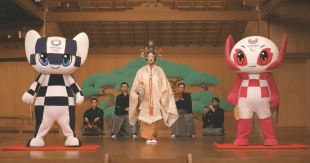
Recently a video was released with a somewhat special take on the beat– a performance by the Olympic mascots with a traditional noh theater performer. You can see the brief advertisement below:

This video maybe should come as no surprise though, given that the famous kyogen actor Nomura Mansai will be directing the opening and closing ceremonies. Do we have more premodern arts to look forward to in the upcoming games? I hope so!

Posted in culture, fun links | Tagged , , , , , | Leave a comment

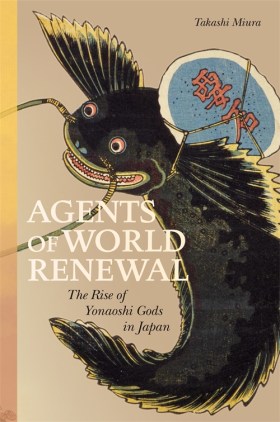
Book Announcement: Agents of World Renewal: The Rise of Yonaoshi Gods in Japan

AGENTS OF WORLD RENEWAL: THE RISE OF YONAOSHI GODS IN JAPAN

Takashi Miura

This volume examines a category of Japanese divinities that centered on the concept of “world renewal” (yonaoshi). In the latter half of the Tokugawa period (1603–1867), a number of entities, both natural and supernatural, came to be worshipped as “gods of world renewal.” These included disgruntled peasants who demanded their local governments repeal unfair taxation, government bureaucrats who implemented special fiscal measures to help the poor, and a giant subterranean catfish believed to cause earthquakes to punish the hoarding rich. In the modern period, yonaoshi gods took on more explicitly anti-authoritarian characteristics. During a major uprising in Saitama Prefecture in 1884, a yonaoshi god was invoked to deny the legitimacy of the Meiji regime, and in the late nineteenth and early twentieth centuries, the new religion Ōmoto predicted an apocalyptic end of the world presided over by a messianic yonaoshi god.

Using a variety of local documents to analyze the veneration of yonaoshi gods, Takashi Miura looks beyond the traditional modality of research focused on religious professionals, their institutions, and their texts to illuminate the complexity of a lived religion as practiced in communities. He also problematizes the association frequently drawn between the concept of yonaoshi and millenarianism, demonstrating that yonaoshi gods served as divine rectifiers of specific economic injustices and only later, in the modern period and within the context of new religions such as Ōmoto, were fully millenarian interpretations developed. The scope of world renewal, in other words, changed over time.

Agents of World Renewal approaches Japanese religion through the new analytical lens of yonaoshi gods and highlights the necessity of looking beyond the boundary often posited between the early modern and modern periods when researching religious discourses and concepts.

For more information: https://uhpress.hawaii.edu/product/agents-of-world-renewal-the-rise-of-yonaoshi-gods-in-japan/

Posted in announcements, culture | Tagged , , , , , , | 1 Comment

Fun Link Friday: Small Worlds Tokyo

If lately you’ve just been feeling insignificant compared to the vastness of the universe, maybe you need to plan on booking a trip to Small Worlds Tokyo, which is set to open next spring. Planned as the world’s largest diorama park, it will be a 8,000 square meter indoor facility, with the objects at 1/80th scale.

Visitors will get to choose from many different themes, including Kansai airport, towns across the world, the Space Center, areas of Tokyo, and even Sailor Moon and Neon Genesis Evangelion! Can a miniature immersion experience be just as intense as a life-size one?

There’s even the option to purchase a special ticket to create a 3D model of yourself and place it inside the action. So if you ever wanted to imagine yourself as a part of the world below a hulking mech, now might be your chance!

More information can be found on the Small Worlds website and various articles advertising the new park. Tickets aren’t open yet, but be on the lookout if you’re in Japan.

Posted in culture, fun links | Tagged , , , , | Leave a comment

Call for Applications: 7th Summer School in Japanese Early Modern Palaeography

The Seventh Summer School in Japanese Early Modern Palaeography will run between Monday 10 August and Friday 21 August 2020.

Core contents of the Summer School

As always our Summer School focuses on Edo-period materials. Our sustained work in teaching what we call holistic palaeographic literacy  総合的な和本リテラシー has resulted in a programme that works very effectively. In the seventy-two hours of tuition that we offer, we devote roughly the same amount of hours to the three linguistic/palaeographic areas of wabun in cursive (kuzushiji and hentaigana), kanbun in non-cursive and sōrōbun in cursive. We also actively encourage participants to explore research questions in the field of Japanese early-modern palaeography.

You can read more about our teaching philosophy in the forthcoming number of the journal Shomotsugaku 書物学 no.9, October 2016.

The theme of this year summer school is Daily life in Edo-period Japan 江戸時代の庶民生活 (III). As every year we cover new materials, so that returning participants can benefit as well.

For more information, visit: https://wakancambridge.com/

Deadline: 1 February 2020

Posted in announcements, graduate school, study tools, summer program | Tagged , , , , , , , , | Leave a comment