Book Announcement: Experimental Buddhism: Innovation and Activism in Contemporary Japan

BuddhismExperimental Buddhism: Innovation and Activism in Contemporary Japan from the University of Hawaii Press.

http://www.uhpress.hawaii.edu/p-9072-9780824838980.aspx

(320 pages, 11 illustrations, $32.00 paper, $60.00 hardcopy)

Experimental Buddhism highlights the complex and often wrenching interactions between long-established religious traditions and rapid social, cultural, and economic change. The book is aimed at undergraduate audiences in Asian studies, Buddhist studies, Japanese studies, Cultural Studies, Religious Studies, and Cultural Anthropology; it assumes no prior knowledge of Japanese religious or social history.

Experimental Buddhism examines the activities of a number of priests (both male and female) who are trying to “reboot” their temples and roles as religious specialists in order to respond to a growing crisis in temple Buddhism: the loss of parishioners due to demographic, generational, cultural, and even technological shifts.

Based on ethnographic fieldwork and archival research, Experimental Buddhism first provides an overview of contemporary Japanese society (both before and after the March 2011 earthquake disaster), taking care to position topics and trends within local, regional, national, and global networks of influence.  After an “executive summary” of Japanese Buddhist history, readers are introduced to a variety of examples of a “Buddhist-inspired activism” that embodies some of the characteristics of an experimental approach to religious practice.

From suicide prevention to care for the elderly and homeless, and from store-front temples to fashion shows, rap performances, chanting in jazz clubs, and bars run by priests, Experimental Buddhism conveys some of the creative and often controversial attempts to rejuvenate a religious tradition seen by many Japanese as having little relevance for today’s world.  Students (and perhaps instructors as well?) will appreciate particularly the first-person accounts from a number of priests, as well as examples of humor, risk-taking, and the importance of youth culture for the future of Japanese Buddhism.

For a longer description and ordering information, please visit http://www.uhpress.hawaii.edu/p-9072-9780824838980.aspx  This book is the latest in the series “Topics in Contemporary Buddhism” edited by Professor George Tanabe, at http://uhpress.wordpress.com/books-in-series/topics-in-contemporary-buddhism/


Posted in announcements, culture | Tagged , , , , , , , | Leave a comment

Job Opening: Modern Japanese Economy, University Lecturer

job opening - 5Institution:   Leiden University
Location:   Netherlands
Position:   University Lecturer in Modern Japanese Economy

Leiden University invites applications for a fulltime University Lectureship in modern Japanese economy in its (East-)Asian contexts, including economic history and political economy, with special attention to its historical, social, political, and cultural contexts, on the transnational (Asian and East-Asian) and global as well as the national level. Appointment will be fixed-term from August 2014 through July 2016, with the possibility of extensions of up to four years, and of tenure thereafter. Leiden University aims to employ more women in areas where they are underrepresented. Women are therefore especially invited to apply. Review of applications from 10 February 2014. Before submitting your application or query, please read the full Call at

http://werkenbij.leidenuniv.nl/vacatures/wetenschappelijke-functies/13-378-lectureship-in-modern-japanese-position.html

Contact:
m.van.crevel@hum.leidenuniv.nl

Posted in announcements, job openings, jobs | Tagged , , , , , , , | Leave a comment

Fun Link Friday: The Stray Cats of Kyoto

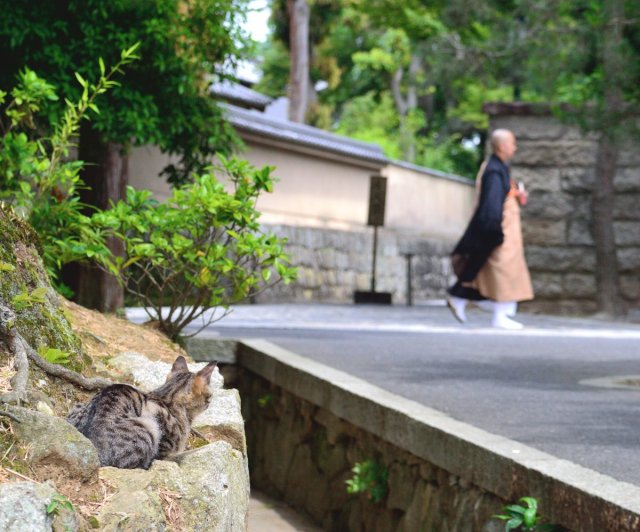
I’m rolling my eyes a bit at the title of this piece, but the photos are a great new lens through which to explore Kyoto.

Katayama has taken thousands of pictures of the legendary ancient city that once was the imperial capital of Japan. He has also found a favorite theme: the stray cats that are found all over Kyoto.

“I feel the strength to live from a stray cat,” Katayama wrote. “They seem to live a quiet life always looking for food and a place to live while keeping well their distance to the human.”

Read the full piece at Business Insider and check out Katayama’s photos on his Flickr (yuta35).

Posted in culture, fun links | Tagged , , , , , , | Leave a comment

Job Opening: Contemporary Literature, culture, media; Japanese literature

job opening - 5The Faculty of Liberal Arts, Sophia University, invites applications for an open-rank position in Contemporary Literature, Culture, and Media. Assistant Professor is a five year tenure-track appointment, while appointments of Associate Professor and Professor are tenured. The appointment will be effective from September 21, 2014 or April 1, 2015.

The candidate should be a comparative literature specialist or a Japanese literature specialist, and should demonstrate an expertise in film studies, performance, manga, animation, or other popular media such as television. The candidate should be able to teach a wide range of topics in contemporary literature from a comparative and/or transnational perspective and should be committed to interdisciplinary research that has a firm grounding in the issues and theories related to popular culture, media, and/or performance.

The successful candidate is expected to have research accomplishments and a Ph.D. in hand by the time the job is offered. Teaching experience is preferred. The language of instruction is English, but competence in Japanese language is necessary. Professional or scholarly experience in Japan are assets, as is university administrative experience. The normal undergraduate teaching load is two courses per semester, including one course per year in our Core Program. The successful candidate will also teach in the Graduate Program in Global Studies.

Sophia University, located in central Tokyo, was founded in 1913 by the Society of Jesus (Jesuits) and is one of Japan’s leading private universities. The Faculty of Liberal Arts offers a comprehensive program in humanities, international business and economics, and social studies. In addition to our degree students, we annually welcome about 200 exchange students from leading universities overseas. We also staff the Graduate Program in Global Studies, which offers degrees in Global Studies, Japanese Studies, and International Business and Development Studies.

Applications should include a cover letter (outlining academic background, fieldwork and research interests, teaching abilities and an explanation of your interest in seeking employment in Japan); a detailed curriculum vitae; the names and addresses of three referees; two publication or writing samples; and syllabi for courses the applicant would be prepared to teach.
Applications should be postmarked no later than February 15, 2014 and addressed to:

Professor Michio Hayashi, Dean
Faculty of Liberal Arts
Sophia University
7-1 Kioi-cho, Chiyoda-ku
Tokyo 102-8554, JAPAN

Faculty of Liberal Arts: http://www.fla.sophia.ac.jp/
Graduate Program in Global Studies: http://grad.fla.sophia.ac.jp/

Contact:

For further information please contact:
Professor Shion Kono: shion [at] sophia.jp

Website: http://www.fla.sophia.ac.jp/positions-open/1765

Posted in announcements, job openings, jobs | Tagged , , , , , , , , | Leave a comment

Call for Papers: BAJS Advanced Postgraduate Conference in Japanese Studies

call for papers [150-2]Call for Papers

*BAJS  Advanced Postgraduate Conference*

Friday, 25th April 2014

Plenary Session

Art, Religion and Money in the Early Trade of the English East India

Company in Japan

Professor Timon Screech, SOAS

The British Association for Japanese Studies (BAJS) and the Japan Research Centre (JRC) at SOAS announce a Call for Papers for an Advanced Postgraduate Conference to be held at SOAS, London on Friday 25th April 2014.

This conference provides the opportunity for PhD students in any field of Japanese studies working within any academic institution internationally to present an academic conference paper, engage with other postgraduate students as well as established academics in the field, and meet key academic publishers.

Submissions are welcome as individual papers or panels.  Individual papers will be grouped into thematic panels and assigned an established UK academic as Chair and Discussant.  Panel submissions should organize around a key theme or field of Japanese studies and if possible indicate a Chair/Discussant.

This one day conference will comprise a morning plenary session (details above) followed by parallel sessions of postgraduate academic panels.

Abstract submissions (including full contact details and name of PhD supervisor and university institution) should be sent by * 30th January 2014  *to Dr Christopher Gerteis at SOAS:  cg24@soas.ac.uk

Participants will be responsible for organising their own travel and accommodation.  Registration fees will be kept at nominal cost.

Posted in announcements, conferences, graduate school | Tagged , , , , , , , , | Leave a comment

Funding: Soon-Young Kim Award in the History of East Asian Science and Technology

money [150-2]http://www.nri.org.uk/Kim_studentship.html

*The Soon-Young Kim Award in the History of East Asian Science and Technology*

The Trustees of the Needham Research Institute invite applications from suitably qualified candidates for a Soon-Young Kim Award in the History of East Asian Science and Technology.*The Award will be tenable from October 2014.*

The Award may be held in either of two modes:
(a) A one-year post-doctoral research fellowship.
(b)The first year of a studentship to support research for the degree of PhD in the University of Cambridge, with the potential for renewal year by year thereafter.

Applicants must specify clearly under which mode they wish to hold the Award when making their
application.*Applications should be made by email, using the application form available here:
http://www.nri.org.uk/KIM_Application_form.doc

*Closing date is January 31st 2014.*

Priority in making awards will be given to applicants who propose to carry out research in the following areas, which are given in order of priority:

(1) The history of science and technology in modern Korea
(2) The history of science and technology in modern Japan
(3) The history of science and technology in modern China, or the history of modern medicine in any of the above three countries.

The word ‘modern’ here designates the period after 1850, and ‘science’ is taken to include mathematics, whether pure or applied. Strong preference will be given to projects centering on the 20th century or later.

Post-doctoral research fellowship mode:

If the Award is to be held under this mode, the applicant must hold the degree of PhD in a relevant area of research.The award will consist of a stipend to meet the expenses of living in Cambridge, where the Award holder will be expected to reside during tenure of the award. The Award holder will be given office space in the Needham Research Institute, and will be expected to participate fully in the academic life of the Institute.

Candidates should send the completed application form with a full curriculum vitae, a detailed research proposal, and the name of two academic referees who are prepared to report in confidence on the candidate’s work.

PhD studentship mode:

The purpose of the Studentship is to support students who have been admitted to work for a PhD degree in the University of Cambridge in the areas of study specified above. In the case of a student admitted  directly to work for the PhD degree, the award shall be for three years at maximum. In appropriate cases,
where the student is initially admitted to work for an MPhil preparatory to beginning work for a PhD, the Trustees may be prepared to consider making the award for up to four years at maximum. In all cases the continuation of the award from year to year will be conditional on the student making satisfactory progress in the view of the Trustees.The successful candidate will be given working space in the Needham Research Institute (www.nri.org.uk), which has unparalleled research facilities in the fields of the history of science, technology and medicine in East Asia. The Studentship is associated with Darwin College, and the successful award holder will normally be admitted to full membership of the College for the tenure of
the Studentship.

The amount of the Studentship will consist of payment of university fees and college dues for the candidate, plus an amount for living expenses. Where appropriate, fees will be paid at the rate for non-EU students.

It is expected that candidates will apply for admission to a department of the University that can provide the specialist supervision and disciplinary training appropriate to the particular topic chosen. Suitable departments might include the Department of History and Philosophy of Science (http://www.hps.cam.ac.uk/), or the Department of East Asian Studies (http://www.ames.cam.ac.uk/deas/).Candidates are encouraged to make informal enquiries of the relevant department at an early stage before making a formal application, in order to see whether their choice is appropriate. Candidates thinking of applying to a department other than the two named here should first contact the Needham Research Institute to discuss their plans.

Any holder of a Studentship who wishes to make a substantive change in the topic of his or her research after taking up the Studentship must first obtain the agreement of the Trustees, failing which the Studentship may be withdrawn.

Applications for this award will be treated separately from applications for admission to the University of Cambridge. Candidates should therefore:

(a) Apply as soon as possible for admission to the University of Cambridge in the normal way.For guidance, see the University website at http://www.admin.cam.ac.uk/offices/gradstud/prospec/apply/

Please address all queries about the University admission process to the appropriate part of the University, not to the Needham Research Institute. Candidates may however mention in their application that they are applying for this Studentship. Candidates should normally give Darwin College as their first choice of college. Candidates should note carefully the University’s demanding requirements in regard to English language ability: for instance, in IELTS applicants must have a band score of 7.0, with not less than 7.0 in speaking, listening and writing, and 6.5 in reading.

(b) Apply simultaneously to the Needham Research Institute for the Studentship.Candidates should send the completed application form with a full curriculum vitae, a detailed research proposal, and the name of two academic referees who are prepared to report in confidence on the candidate’s work. In most cases the best thing will be for the candidate to send the Needham Research Institute a hard printed copy of their University application, together with any further material necessary to give a clear impression of the
research they intend to carry out. Candidates should ensure that they produce evidence that they possess the language skills required for the purpose of their research.

(c) The University offers other financial support for PhD applicants: candidates must also

apply for any such schemes for which they are eligible at the same time as applying for this Studentship, and inform the Trustees of these applications and of their result.

All applications will be carefully considered. No announcement or notification of award of the Studentship will be made before University admission procedures have been completed and candidates have been told whether they have been given a place at Cambridge.The Trustees reserve the right to make no award if in their opinion no suitable candidate of sufficient merit applies.

All enquiries and applications should be addressed to:

The Institute Administrator
The Needham Research Institute
8 Sylvester Road
Cambridge CB3 9AF
UK
email: admin@nri.org.uk

Posted in announcements, financial assistance, funding, graduate school | Tagged , , , , , , , | Leave a comment

Book Announcement: Japan Copes with Calamity: Ethnographies of the Earthquake, Tsunami and Nuclear Disasters of March 2011

Japan Copes with CalamityJAPAN COPES WITH CALAMITY

Japan Copes with Calamity: Ethnographies of the Earthquake, Tsunami and Nuclear Disasters of March 2011. It brings together nine varied ethnographic studies from the disaster region with a pair of introductory chapters framing the studies in terms of Japanese society and anthropological writing on disasters.

Full details of the book may be viewed at the website of the publisher, Peter Lang: http://www.peterlang.com?430922. An electronic edition will shortly be available. The contents list is at the bottom of this notice.

A Japanese edition of the book, Higashi-Nihon Dai-Shinsai no Jinruigaku: Tsunami, genpatsu jiko to hisaishatachi no ‘sono go’(Anthropology of the Great Eastern Japan Disaster: The tsunami, the nuclear accident and what happened next to the victims) has already been published, by Jinbun Sho’in of Kyoto.
http://www.jimbunshoin.co.jp/book/b108281.html

It has been more than two-and-a-half years since 3.11, but as anyone following the news will know, the Great Tohoku Disasters are very far from over. We hope these ethnographic reports from Iwate, Miyagi and Fukushima will contribute to improving understanding of this very complex event.

Japan Copes with Calamity: Contents

* Tom Gill/Brigitte Steger/David H. Slater: ‘The 3.11 Disasters’
* David H. Slater: ‘Urgent Ethnography’
* Brigitte Steger: ‘Solidarity and Distinction through Practices of Cleanliness in Tsunami Evacuation
Shelters in Yamada, Iwate Prefecture’
* Nathan J. Peterson: ‘Adapting Religious Practice in Response to Disaster in Iwate Prefecture’
* Johannes Wilhelm and Alyne Delaney: ‘No Homes, No Boats, No Rafts: Miyagi Coastal People in the Aftermath of Disaster’
* David McNeill: ‘Them versus Us: Japanese and International Reporting of the Fukushima Nuclear Crisis’
* Ikeda Yoko: ‘The Construction of Risk
and the Resilience of Fukushima in the Aftermath of the Nuclear Power Plant Accident’
* Morioka Rika: ‘Mother Courage: Women as Activists between a Passive Populace and a Paralyzed Government’
* Tom Gill: ‘This Spoiled Soil: Place, People and Community in an Irradiated Village in Fukushima Prefecture’
* Tuukka Toivonen: ‘Youth for 3.11 and the Challenge of Dispatching Young Urban Volunteers to North-eastern Japan’
* David H. Slater: ‘Moralities of Volunteer Aid: The Permutations of Gifts and their Reciprocals.’
* Brigitte Steger: Epilogue: ‘Still Missing…’

Posted in announcements, culture | Tagged , , , , , , , , , | Leave a comment

Job Opening: Visiting lecturer in Japanese literature (any period)


job opening - 5POSITION (short term): Visiting lecturer (hijoukinkoushi) in Japanese literature for Master’s degree students in a small seminar format. The class will meet 1.5 hours each week for 15 weeks. Alternately, the visitor may offer an intensive course consisting of several days of teaching for the required number of class hours.

PERIOD: One course during each of two terms: (1) mid April 2014 until early August 2014 and (2) early October 2014 until early February 2015. Alternately, an intensive course(s). We may hire one person for both terms or two different persons.

TOPIC: Any period or topic of Japanese literature will be considered. (We are especially interested in one course in Nara- through Heian-period literature and one course in modern or contemporary Japanese literature.)

LOCATION: Kyushu University, Hakozaki campus, Faculty of Humanities, International Master’s Program in Japanese Humanities.
http://www2.lit.kyushu-u.ac.jp/en/impjh/

The Hakozaki campus is conveniently located in the northern part of Fukuoka city, easily reached by subway from the airport or Hakata station.

LANGUAGE OF INSTRUCTION: English (students have Japanese reading skills).

QUALIFICATIONS: Ph.D. and teaching experience required (preferably graduate-student level teaching experience).

OTHER: Salary and details commensurate with qualifications.

CONTACT:
Professors Cynthea J. Bogel and Ellen Van Goethem, Faculty of Humanities, Kyushu University

cjbogel@lit.kyushu-u.ac.jp
vgoethem@lit.kyushu-u.ac.jp

Posted in announcements, job openings, jobs | Tagged , , , , | Leave a comment

No Fun Link Friday Today

Sorry everybody, no Fun Link Friday today, due to the travel madness that tends to take over this time of year. Hope everyone is enjoying their holidays! 🙂

Posted in announcements, site maintenance | Leave a comment

Call for Papers: Cute Studies

call for papers [150-2]Call for Papers: “Cute Studies,” a special issue of the East Asian Journal of Popular Culture

Cuteness has a global reach: it is an affective response; an aesthetic category; a performative act of self-expression; and an immensely popular form of consumption. This themed issue of the East Asian Journal of Popular Culture is intended to launch the new, interdisciplinary, transnational academic field of Cute Studies.

Cute culture, a nineteenth century development in Europe and the US, with an earlier expression in Edo-era Japan, has flourished in East Asia since the 1970s, and around the world from the turn of the new millennium. This special issue seeks papers that engage with a wide variety of both the forms that express cute culture, and the platforms upon which its articulation depends. Thus, the field of Cute Studies casts a wide net, analyzing not only consumers of cute commodities, but also those who seek to enact, represent, or reference cuteness through personal presentation or behavior. Since these groups intermingle, cute culture may be seen as a type of fan community, in which the line between consumers and producers is continually renegotiated. Cute Studies also encompasses critical analyses of the creative works produced by practitioners such as artists, designers, and performers, as well as the circumstances that determine the production and dissemination of these works.

Defined as juvenile features that cause an affective reaction, somatic cuteness follows the Kindchenschema set down by Konrad Lorenz (1943), and supported by later research: namely, large head and small, round body; short extremities; big eyes; small nose and mouth. Whether genetic, or activated by learned signals, the cuteness response is also associated with a range of behavioral aspects, including: childlike, dependent, gentle,  intimate, clumsy, and nonthreatening. Such physical and behavioral features trigger an attachment based on the desire to protect and take care of the cute object. This deterministic nature of the cute affective register is highly pertinent to humanities scholars in the way it is expressed through categories of difference such as gender, race, or class. Furthermore, the difference in status between the subject affected by cuteness, and the harmless cute object, denotes a power differential with important political and ideological implications. The appeal contained within cuteness seeks to establish a reciprocal relationship of nurturing/being nurtured, and the subject who responds to this appeal faces very different ethical obligations depending on whether the cute object is a thing, an animal, or a human being.

Possible topics for papers include the following (Note: a specific focus on the geographical region of East Asia is not required of submissions):

Cute Cultures of East Asia

Cute Commodities and Consumers of Cute: Structure vs. Agency

Cuteness and Gender

The Science of Cute

Cute Histories

Practitioners of Cute

Cuteness and Race

Queering Cute

Cuteness and Disability

The Cuteness of Animals/Zoomorphic Cute

The Dark Side of Cute (the grotesque, violence, pedophilia, etc.)

Digital Cute (social media, memes, etc.)

The deadline for submissions to this special issue of EAJPC is: 15 April, 2014

Please submit papers to: CuteStudies@gmail.com

Joshua Paul Dale

Editor, Special Issue on Cute Studies

EAJPC

Note: To aid research, an annotated (and annotatable) bibliography may be found at:

http://cutestudies.tumblr.com

Posted in announcements, conferences, culture, graduate school | Tagged , , , , , , , , | Leave a comment