Living in Japan Part 1: Preparations Before You Arrive

As some of you following us on Facebook and Twitter probably know, I recently relocated to Japan for research, with the intention of sticking around for at least a year or two. Despite being several years into my doctoral work, and having studied abroad in Japan for six months and one year respectively in the past, I realized that this time around I was entering a whole new world: residency.

Previously, I either lived in an international dorm or stayed with host families or at sharehouses. With this trip, suddenly I became an adult in Japan without ever having any experience doing adult things, such as apartment hunting, setting up utilities, purchasing furniture and appliances, setting up a bank account, etc. Make no mistake—no matter how old you are, if you have never done these things in a foreign language before, they are terrifying. You’ll feel lost and frustrated and realize just how many minutiae you want to know that you didn’t even realize you didn’t know until faced with major decisions and loads of paperwork. But fear not—you are not alone!

I’m still learning the ropes myself, but in the next couple months I intend to put out several articles detailing some of the experiences I’ve had along with suggestions on how to go about them more efficiently that I probably did. I’ll be listing stores, writing up information on processes and procedures, and also providing links to other articles and blogs I found particularly helpful in my quest. Hopefully these articles will serve as a kind of “master list” compiling some of the best stuff out there and adding to them.

So where do you even begin planning for a long-term residency in Japan? What should you keep in mind before you leave, and expect to do after you arrive to get settled in? I’ll be writing these articles in several parts, and though some information may seem obvious, I’ll be adding extra comments with some advice based on my experience and research. Below you’ll find bullet-pointed suggestions on preparations before arrival, with details beneath each point. If you have anything to add from your own experiences, please feel free to leave comments below!

Photo by kozumel

Photo by kozumel

Before you leave

Packing

  • check the weight limits and charges for suitcases according to the carriers you intend to fly with, and ship anything extra

Depending on what airline you’re flying, charges for your suitcases will be different. Some airlines only allow one checked bag for free, others will let you have two. Depending on how much stuff you want to take with you, and depending on whether you’re flying domestic to make a connection to a major hub going to Japan, you may want to set aside around $200 for luggage fees. I had to check my two suitcases to fly to a hub, to the tune of $50 each, then had to pay a fee for my second bag flying to Japan for $100. This was in part because my reservations had to be booked separately for domestic and international carriers. Others may not have to pay quite so much. Also be careful about having overweight bags—my limit was 50 lbs (anything over was a $90 fee), but these policies sometimes fluctuate and differ by airline. Check your airline’s website to be sure of their conditions.

Anything extra you may need that doesn’t fit into two suitcases can be shipped—my large boxes cost about $100 each to send out, because airmail is now the only option to Japan from America.

  • pack those things that you might not be able to find easily in Japan that you really can’t live without

Be sure to pack daily use items that you may not be able to find readily in Japan. Some things you might not realize you can’t get until you arrive, or they might be difficult to come by without going to a store that carries imports (which can get expensive). Some things I’ve found I wanted to take with me as well as some things I’ve picked off of other lists on the internet include:

  • deodorant

The stick kind—Japan has mostly aerosol, which most people find unsatisfactory – there are stick deodorants, but you might have to work to find them – see article links below for some good information on this.

  • over-the-counter drugs

Things like Advil, Sudafed, etc. Check Japan’s policies on bringing in over-the-counters, though! many over the counter things like Nyquil are illegal, though I’ve heard of people bringing them anyway. You can get things for gas, cramps, headaches, etc. easily in Japan, but if you don’t know what they’re called you’ll have to do your research or be prepared to ask some awkward questions at the counter.

  • tampons

Although pads are abundant, tampons are sometimes difficult to find (only 1 brand or so), and if you need something more than regular or super, you’ll find yourself in a bind. Some alternatives are available through bilingual adult stores like Love Piece Club.

  • makeup suited to your skin tone

Foundation, in particular—everything else is abundant

  • socks/shoes

If you have larger feet—as a girl with size 9.5 feet in the states, this is about 28 cm or 29 cm in Japan, and the largest shoe/sock size most stores carry is 24 cm, or a ladies size 6/7. I can usually stretch out size 25 cm socks when and IF I can find them, but it can be frustrating.

  • condoms

Depending on your needs—I’ve known a number of people to order them online from overseas while in Japan for an extended period of time. You can also order them from places like Love Piece. If you have allergy-specific, non-latex needs it’s probably better to bring your own or have a friend on call in the States to send more your way when you need them.

  • tissue paper

When I wanted to wrap presents for immediately after my arrival, I absolutely COULD NOT find tissue paper to wrap a small gift in to put in a little bag – they usually sell little lacy bags to place presents in, but if you’re dead set on wrapping per-American-ways, bring some of your own tissue paper.

  • fluoride toothpaste

Several sites list this as a thing not easily able to be found, but a fellow blogger has informed me that Aquafresh has fluoride now. Look for フッ素 on the tube!

  • any prescription medication you may need

It may be difficult to obtain while abroad, so bring whatever you need with you. In my experience, it was fairly easily to ask my doctors to get a year supply of something I needed, provided I had proof of my travel and an insurance override from my carrier.

Links with more information:

  • don’t forget the appropriate omiyage (souvenirs/gifts) for people you will be indebted to

Photo by Steven Depolo

Photo by Steven Depolo

The tradition of gift-giving in Japan is deeply ingrained in everyday culture, and it is important for you to bring some small (relatively inexpensive) gifts for people whom you know you will receive help from. For example, I wrote an omiyage list for my arrival that included a good friend, my former host mother, her best friend (with whom I became close), both of their families’ children, the acquaintance of mine who was helping me apartment hunt, and my future academic advisor. Figuring out the most appropriate gift for each person or family can be difficult, but usually the best items to buy are local foods or items from the area you come from or go to school at. For example, Michigan’s cherries are very popular, so I brought several jars of cherry jam/preserves with me. For omiyage for my host brothers, I brought Amish-harvested honey sticks. Small candies or snacks not available in Japan also go over very well. The more “local” or “American,” the better. If you’re going to a setting where you need omiyage for a group (your department at school, your BOE, et al.), small, individually wrapped (if possible) items are good. A box of cookies or chocolates, etc.

Of course, your list of gifts aside, it also doesn’t hurt to plan for the unforeseen help you may receive with some extra omiyage. I brought an extra jar of local jam just in case, which was a good thing, because it ends up my landlady is extremely nice and has treated me to dinner a couple of times on top of helping me get some issues with my apartment sorted out after I moved in. I felt relieved to have some way to repay her kindness. Presentation is also important, so be sure whatever you bring is packaged and presented nicely.

Links on the do’s and don’ts of omiyage giving (though you might find some conflicting opinions):

  • don’t forget important documents like your identification (passport, license, documents, etc.)

Having your license and passport so you have identification is a no-brainer.  If you’ll be applying for a Japanese driver’s license, bring any old licenses you have too if you’ve changed states recently. (You have to prove you’ve been driving for 3+ years  or so and your new state license may not show that.) Also be sure you have copies of other important documents, like any acceptance papers for fellowships or notices of affiliations with universities. I had to have a statement of my fellowship benefits to provide to a real estate agency in order to get my guarantorship through my program confirmed. You may at one point or another need proof of your income, etc. Also, be sure to bring any tax documents you need to file during the following year, as being out of the country sadly does not exempt you from paying Uncle Sam.

Edit (10/02) – Nyssa added:

About drivers’ licenses right after you arrive: it depends on what country you are coming from but there is an international permit based on treaties that can be used with your home country license while in Japan. That document by itself has no legal authority; it acts as a translation of the valid license you are already holding. At least that’s my understanding of it. They usually only last a year and then you have to test for a Japanese license (again, varies by home country). I got mine at AAA in the US before I left and the fee isn’t huge ($25?). I’ve even done it the opposite way when my American license had expired, so I used a valid Japanese license plus international permit so I could drive in the States while on vacation. There are lots of resources about this online.

Planning

  • check the location of places you will be staying at after you arrive from the airport, print maps, and write down any phone numbers or addresses you might need – you cannot rely on there to be easily accessible internet!

As someone who didn’t own a smartphone until a month ago, I knew it was likely that I’d find myself lost in the various side streets and station exits trying to figure out where I was going after I arrived, with no internet alternatives to help figure it out. If you feel completely confident asking for directions, all the power to you; people are very nice and willing to help you figure out where it is that you’re going. But I knew that regardless of whatever abilities I had to ask how to get to my hotel, after 23 hours of traveling, 100 lbs of luggage to drag around, and arriving in 95 degree weather, I wasn’t going to feel like being lost and talking to anyone (in any language) during my jetlagged haze.

So I suggest being sure to print out maps, addresses, and phone numbers for anywhere you need to go immediately after arrival. There is a dearth of free WiFi in Japan (UNLESS you are a tourist in Tokyo) so you probably won’t be able to whip out your phone or iPad and connect anywhere that you are. More on the internet/WiFi in Japan in a future post. You will also need to have an address/phone number for the location you are staying (hotel, dorm, house, etc.) or that of an acquaintance to fill out your customs form upon arrival at the airport, so keep this on hand!

  • if you’re unfamiliar with the train system, look up any particular lines you’ll need to take to get from point A to point B
Are maps like this really even helpful? Sometimes, I wonder. But better safe than sorry.

Are maps like this really even helpful? Sometimes, I wonder. But better safe than sorry.

Also important for those of us that don’t have fancy smartphones. Be sure you know how to get from the airport to a major station and then how to switch train lines to get to your next stop. If you’re not familiar with extremely large train stations like Tokyo Station, even if they have English signs they can be intimidating when you’re exhausted and flustered going up or down four floors. If you’re going to end up in a much more local station that maybe that doesn’t have English signs, be sure to note the kanji somewhere and know the stations/lines you need by name/reading so that you can ask directions and show someone.

  • check how much traveling will cost you from the airport, and bring enough cash to exchange for travel/food/hotel money if you need it

Contrary to general opinions about money exchange at airports, it’s not going to be too much more expensive there than anywhere else to exchange your money upon arrival. I would say bring enough money to account for food for a few days, any trains you’ll have to take (the Narita Express from Narita airport, for example, is about $30), and anything more you might need for emergencies or hotel costs. Using international ATM cards can be done at local convenience stores or post offices, but you will get charged fees for overseas withdrawals.

  • make business cards

Much like gifts, the exchange of business cards is also a standard (and VERY important!) form of communication and connection. If you know that you’re going to be in contact with people who are important to your work or friend/acquaintance network, you might want to order business cards before you leave. I’ve only ever used http://us.moo.com/, though I had to use photoshop to make image-based templates to get a double-sided bilingual card going because their templates don’t allow text on both sides. I’m sure there are a number of other services for cheap cards in the states—if you have any particularly good suggestions for bilingual text options, please let us know! Alternatively, I have been told it’s very easy to find somewhere to do business cards on the Japan side very quickly, since it’s such a social staple. You may want to ask friends or colleagues where they go in Japan so that you have cards handy for any social occasion, but also be aware you may want to take care of this before you leave, too.

==

These suggestions have all been the very basics of preparing for your international trip to Japan, but I’ll be adding a series of articles with more detail on other aspects of everyday life in the near future, particularly about getting set up for 一人暮らし (living alone) in a Japanese apartment. Stay tuned for more soon! Any questions? Comments? Leave em below!

Next Article: Living in Japan Part 2: Getting Your Residency Started

Posted in culture, graduate school, housing, living abroad, main posts, study tools, useful links | Tagged , , , , , , , , , | 7 Comments

Job Opening: Program Assistant, Sasakawa Peace Foundation USA

job opening - 5Institution: Sasakawa Peace Foundation USA
Location: Washington, DC
Education: BA
Application deadline: October 10, 2014

Job description
Sasakawa Peace Foundation USA (SPFUSA) is a 501c3 non-profit located in Washington, DC involved in U.S.-Japan relations, providing conferences and seminars, think tank analysis, people-to-people exchanges and coordination of high-level dialogue between the two countries through our in-house and grant-giving programs. SPFUSA is independent from but works closely with our sister foundation in Tokyo, Sasakawa Peace Foundation.

SPFUSA seeks an entry-level Program Assistant to provide programmatic and administrative support to the Senior Program Officer and Director of Programs in all program functions, including preparation and evaluation of program proposals, event planning, execution and follow-up, and internal and external coordination and communications. The Program Assistant is a member of the quickly growing Programs team led by the Chairman and CEO and Director for Programs, and works with Research and Outreach Program Officers, Media Relations Coordinator, Outreach Coordinator, and the Administrative office.

Requirements:

  • Bachelor’s degree in relevant field (Japanese Studies, International Relations, History, Political Science, or area studies relevant to Japan and Asia)
  • Strong written and oral communications skills (English language)
  • Knowledge of and demonstrated interest in U.S-Japan relations
  • Attention to detail and ability to multi-task
  • Strong organizational skills
  • Excellent interpersonal skills
  • Demonstrated ability to work in a team
  • Proficiency in Microsoft Office
  • Authorization to work in the US (non-US citizens must possess work authorization that does not require employer sponsorship for a visa)

Preferred Skills

  • Proficiency in written and oral Japanese
  • Administrative support experience
  • Experience in non-profit programs and event planning

Responsibilities

  • Assist in drafting SPFUSA program proposals and documents
  • Assist in evaluating incoming proposals and documents from external organizations
  • Assist in formulating project budgets and tracking expenditure of funds
  • Provide administrative and programmatic support to the Program Officers as directed by the Senior Program Officer and Director of Programs
  • Research information as requested by the senior members of the Program team on potential project partners, current developments in U.S.-Japan relations and SPFUSA research areas
  • Help organize conferences, roundtables and other events on U.S-Japan relations in and outside of Washington, D.C. Travel as needed
  • Help organize visits to Japan by American scholars and practitioners or visits to the United States by Japanese scholars and practitioners as part of SPFUSA’s outreach programs. Travel as needed
  • Supervise program interns

Application details at Idealist.org.

Posted in announcements, job openings, jobs, Uncategorized | Tagged , , , , , | Leave a comment

Call for Papers: An International Forum on Asian History and Asian Studies

call-for-papers-150-21Call for Papers:  An International Forum on Asian History and Asian Studies, 30 June- 2 July 2015, in Athens, Greece. Organized by ATINER (Athens Institute for Education and Research).

For information on submitting an abstract, please go to: http://www.atiner.gr/histas.htm

Deadline to submit abstracts: 8 December 2014 (Decisions are reached in less than 4 weeks after the abstract submission).

Please direct any questions to:

Dr. Constantine N. Vaporis, Academic Member, ATINER, Director, Asian Studies Program, Professor of History, University of Maryland, Baltimore County (UMBC); Email: vaporis@umbc.edu

Posted in announcements, conferences, graduate school | Tagged , , , , , | Leave a comment

Job Opening: World History, Dominican University

job opening - 5Institution:       Dominican University of California
Location:          California, United States
Position:          Assistant Professor, Political Science and International Studies

The Department of History at Dominican University of California invites applications for a Modern World Historian (18th century to present) full-time (9-month) tenure track Assistant Professor to begin August 2015. Applicants should have academic and research experience in two of the following regions:  Europe, sub-Saharan Africa, Latin America (Mexico, Caribbean, Central America, or South America), Asia (China, Korea, Japan, or Southeast Asia), South Asia (India, Pakistan, Bangladesh), and the Middle East (including North Africa).  Additional areas that are acceptable include Atlantic or Pacific World or Indian Ocean exchange. Subsidiary areas of expertise may include:  imperialism and/or colonialism, indigenous history, gender, history of science, or environmental history. The candidate may also teach in our unique first year Big History program. We are a team-oriented department committed to teaching excellence and supportive of faculty and student research. Applicants should submit a cover letter, CV, three letters of recommendation, a teaching portfolio, and copies of unofficial transcripts tohttps://dominicanuniversity.hua.hrsmartpe.com/hrsmart/ats/Posting/view/306. PhD by August 15, 2015 is preferred.  Applications must be submitted by November 1, 2014.

Application Procedures:

  • Click the hyperlink below or cut/paste it into your browser and scroll to the bottom of the posting. Click the option, “Submit your resume/CV to this job”
  • Click upload Resume/CV button
  • Application submissions must include a CV, Cover Letter, three letters of recommendation, a teaching portfolio, and copies of unofficial transcripts
  • For further questions about the application process, please contactjobs@dominican.edu
  • Link:https://dominicanuniversity.hua.hrsmartpe.com/hrsmart/ats/Posting/view/306

For More Information Contact:

Alison Howard, Assistant Professor
Search Committee Chair
Department Chair of Political Science and International Studies
Dominican University of California
50 Acacia Avenue
San Rafael, CA 94901
Email: Alison.howard@dominican.edu

Website:           http://www.dominican.edu/about/employment/jobs/facultyadmin

Posted in announcements, job openings, jobs | Tagged , , , , , | Leave a comment

Call for Papers: Networks and Religious Difference in Asian Buddhist Traditions

call for papers [150-2]Call for Papers: “Networks and Religious Difference in Asian Buddhist Traditions,” Vanderbilt University,April 3-4, 2015

Buddhist traditions—in all their diversity—have been formed through processes of exchange, negotiation, and contestation in the face of perceived difference. These perceptions have existed both among individuals identifying as Buddhist (such as with regard to sectarian distinctions) and in situations when Buddhists encountered other religious traditions. This workshop will explore how Buddhists active in Asia have negotiated difference and categories of identity. We will pay special attention to networks, a term that in the context of this workshop refers not only to human relations but also to those among material objects, practices, texts, and ideas. We will consider both how theories of networks afford new insight into the ways Buddhists have negotiated identities and formed trans-regional communities, and how Buddhist communities have been constituted, in part, in relation to religious others. We believe that a focus on networks and on dynamic relationships as opposed to stable entities will open new research questions, offering alternatives to narratives that rigidly assert alterity through reified “sects” or “isms” and to the difference-effacing language of syncretism and amalgamation.

We will examine how theories of networks and a focus on negotiations of perceived difference shed new light on Asian Buddhist traditions in a workshop to be held at Vanderbilt University on April 3-4, 2015. While we hope that all participants will be able to converse on the links between networks and difference, we welcome innovative proposals that address either individual topic. We invite scholars of all ranks, including advanced doctoral students, to apply. Scholars working on both premodern and modern forms of Buddhism in Asia may participate. Please submit a title and maximum 250 word précis along with your current CV to Christen C. Harper, Administrative Assistant, Department of Religious Studies, Vanderbilt University, email: RLSTworkshops@vanderbilt.edu. The deadline for applications is October 31, 2014.

We will provide airfare, accommodations, and meals for the duration of the workshop. It is sponsored by the Department of Religious Studies with generous support of the Fant Fund, College of Arts and Sciences, Department of History of Art, and the Asian Studies Program.

Conveners: Robert Campany, Nancy Lin, and Bryan Lowe

Posted in announcements, conferences, graduate school | Tagged , , , , , , , | Leave a comment

2015 OAH-JAAS Japan Residencies Program

OAH-JAAS Japan Residencies Program

In cooperation with and support from the Japan-United States Friendship Commission, the OAH and the Japanese Association for American Studies (JAAS) plan to send two American scholars to Japanese universities for two-week residencies in the summer of 2015 (pending funding). During their residencies, the American historians give lectures and seminars in English in their specialty. They also meet individually and in groups with Japanese scholars, graduate students, and undergraduate students studying American history and culture, and participate in the collegial life of their host institutions. The purpose of this exchange program is to facilitate scholarly dialogue and contribute to the expansion of scholarly networks among students and professors of American history in both countries. We are pleased to announce the nineteenth year of the competition.

Round-trip airfare to Japan, housing, and modest daily expenses are covered by the award (note: if the host university is unable to provide housing, award recipients are expected to use the daily stipend to pay hotel expenses). Award winners are also encouraged to explore Japan before or after their two-week residency at their own expense.

Host institutions for 2015

Waseda University

Waseda University is one of the leading private institutions in Japan. Established in 1882 by Shigenobu OKUMA, the 8th and 17th Prime Minister of Japan, the university has developed into thirteen undergraduate schools and twenty-three graduate schools today with the current enrollment of approximately 55,000. Waseda’s main campus is located in Nishi-Waseda, Shinjuku-ku, on the west side of the Tokyo Metropolitan area, among the most exciting international cities in the world. With this locational advantage, Waseda has attracted not just overseas students but also international scholars who are seeking lively culture and intellectual ventures off campus

June 1, 2015 – June 14, 2015

Looking for a specialist in Asian American History, preferably with a special interest in transcultural/transnational/transpacific movements.

Kobe University

Kobe University was established in 1949, but the academic origins of Kobe University trace back to the establishment of Kobe Higher Commercial School in 1902, which was renamed as Kobe University of Commerce, and Kobe University of Economics. Kobe University comprises 14 graduate schools and 11 undergraduate faculties. The university holds a total of about 16,000 students enrolled in undergraduate and graduate programs. The institution welcomes overseas students, which accounted for a total of 1,108 students, as of 2011. It also has 3,300 staff members, including professors, associate professors and administrative officials. Located beside the foothills of Mount Rokkō, the university provides a view of the city and port of Kobe, providing an environment for the pursuit of academic studies, especially social science areas. Kobe University is one of the oldest and largest national universities in Japan. It is consistently one of the highest ranking national universities in Japan that is not one of Japan’s National Seven Universities.

Either July 20, 2015 – August 3, 2015 or July 21, 2015 – August 4, 2015

Hoping for a specialist in the areas such as the history of the US-Japan relations, the social and cultural histories of the 20th century United States, and the US diplomatic history with Western Europe or East Asia.

How to Apply

Applicants must be members of the OAH, have a PhD, and be scholars of American history. Applicants from previous competitions are welcome to apply again. Award winners are expected to attend the 2015 OAH Annual Meeting in St. Louis, Missouri, so that they can meet with visiting Japanese scholars and graduate students and with members of the OAH/JAAS Japan Historians’ Collaborative Committee before their trips to Japan.

Applications must include the items below. Please send all materials (in Microsoft Word format) toprizes@oah.org, and indicate “2015 Japan Residencies Program” in the subject line. The deadline for application is October 31, 2014. If you do not receive an e-mail confirmation that your application has been received within three (3) days of sending, please contact the OAH Committee Coordinator atkhamm@oah.org/812-855-9650.

  • A two-page curriculum vitae emphasizing teaching experience and publications. Also include the names and contact information of three references.
  • The institution(s) for which you would like to be considered.
  • A personal statement, no longer than two pages, describing your interest in this program and the issues that your own scholarship and teaching have addressed. Please devote one or two paragraphs to why you understand this residency to be central to your development as a scholar in the world community. You may include comments on any previous collaboration or work with non-US academics or students. If you wish, you may comment on your particular interest in Japan.

Committee Coordinator

Organization of American Historians
112 North Bryan Avenue
Bloomington IN 47408-4141
812-855-7311
812-855-0696
Email: http://www.oah.org/about/contact/
Visit the website at http://www.oah.org/programs/residencies/japan/

Posted in announcements, living abroad, social networking, summer program | Tagged , , , , , , , | Leave a comment

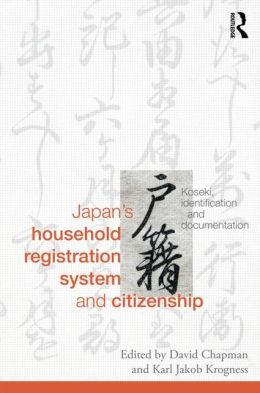
Book Announcement: Japan’s Household Registration System and Citizenship

Japanese householdJapan’s Household Registration System and Citizenship
Koseki, Identification and Documentation
Edited by David Chapman, Karl Jakon Krogness
Routledge – 2014 – 266 pages
Series: Routledge Studies in the Modern History of Asia

Japan’s Household Registration System (koseki seido) is an extremely powerful state instrument, and is socially entrenched with a long history of population governance, social control and the maintenance of social order. It provides identity whilst at the same time imposing identity upon everyone registered, and in turn, the state receives validity and legitimacy from the registration of its inhabitants. The study of the procedures and mechanisms for identifying and documenting people provides an important window into understanding statecraft, and by examining the koseki system, this book provides a keen insight into social and political change in Japan.

By looking through the lens of the koseki system, the book takes both an historical as well as a contemporary approach to understanding Japanese society. In doing so, it develops our understanding of contemporary Japan within the historical context of population management and social control; reveals the social effects and influence of the koseki system throughout its history; and presents new insights into citizenship, nationality and identity. Furthermore, this book develops our knowledge of state functions and indeed the nation state itself, through engaging critically with important issues relating to the koseki while at the same time providing a platform for further investigation. The contributors to this volume utilise a variety of disciplinary areas including history, gender studies, sociology, law and anthropology, and each chapter provides insights that bring us closer to a comprehensive grasp of the role, effects and historical background of what is a crucial and influential instrument of the Japanese state.

This book will be of great interest to students and scholars of Japanese history, Japanese culture and society, Japanese studies, Asian social policy and demography more generally.

Contents:

1. The Koseki, David Chapman and Karl Jakob Krogness

Part I: Early History
2. Early Modern Osaka Hinin and Population Registers, Takashi Tsukada
3. Household Registration and the Dismantling of Edo Outcaste Cultures, Timothy Amos
4. The Development of the Modern Koseki, Kenji Mori

Part II: Nation, Empire and Occupation
5. Creating Spatial Hierarchies: The Koseki, Early International Marriage and Intermarriage, Itsuko Kamoto
6. Managing ‘Strangers’ and ‘Undecidables’: Population Registration in Meiji Japan, David Chapman
7. Sub-Nationality in the Japanese Empire: A Social History of the Koseki in Colonial Korea 1910-1945, Michael Kim 8. Blood and Country: Chugoku Zanryu Koji, Nationality and the Koseki, Tong Yan and Shinichi Asano
9. Jus Koseki: Household Registration and Japanese Citizenship, Karl Jakob Krogness

Part III: The Present
10. The Koseki and Legal Gender Change, Shuhei Ninomiya
11. Sexual Citizenship at the Intersections of Patriarchy and Heteronormativity: Same-sex Partnerships and the Koseki,Claire Maree
12. Birth Registration and the Right to have Rights: The Changing Family and Unchanging Koseki, Vera Mackie
13. Officially Invisible: The Stateless (Mukokusekisha) and the Unregistered (Mukosekisha), Tien-shi (Lara) Chen
14. Challenging the Heteronormative Family in the Koseki: Surname, Legitimacy and Unmarried Mothers, Linda White

Posted in announcements, culture | Tagged , , , , , , | 1 Comment

Job Opening: East Asian History, University of Arkansas

job opening - 5Institution:       University of Arkansas – Fayetteville
Location:          Arkansas, United States
Position:           Assistant Professor in East Asian History

The Department of History at the University of Arkansas, Fayetteville, invites applications for a tenure-track assistant professor position in East Asian history to begin August 2015. Scholars with areas of specialization in any subfield of the history of East Asia are encouraged to apply. The successful candidate will have a 2/2 teaching load and the opportunity to participate in the interdisciplinary Asian Studies Program. A Ph.D. in History or related discipline is required at time of appointment. The deadline for applications is November 15, 2014. Please submit a letter of application, Curriculum vitae, and 3 letters of recommendation through: http://apply.interfolio.com/25192 (preferred) or East Asian History Search, Department of History, University of Arkansas, 416 Old Main, Fayetteville, AR 72701. Questions concerning the search may be directed to Professor Michael Pierce (mpierce@uark.edu).

The University of Arkansas is an Affirmative Action/EOE institution committed to achieving diversity in its faculty and staff. We encourage applications from all qualified candidates, especially individuals who contribute to diversity of our campus community. The University welcomes applications without regard to age, race, gender (including pregnancy), national origin, disability, religion, marital or parental status, protected veteran status, military service, genetic information, sexual orientation or gender identity. All applicant information is subject to public disclosure under the Arkansas Freedom of Information Act and persons must have proof of legal authority to work in the United States on the first day of employment.

Contact:            Professor Michael Pierce at mpierce@uark.edu

Website:           http://history.uark.edu


Posted in announcements, job openings, jobs | Tagged , , , , , , , | Leave a comment

Job Opening: Assistant Professor, Japanese Language, Literature, and Culture, Dartmouth College

job opening - 5The Department of Asian and Middle Eastern Languages and Literatures invites applications for a tenure-track position at the Assistant Professor rank in Japanese. Appointment will become effective July 1, 2015, with teaching duties beginning in September 2015. Applicants for this position must either hold a PhD or be ABD; additionally, they must have native or near native fluency in Japanese and English.

The field of specialization will be literature, film, or culture, with priority given to candidates whose research incorporates language and its relationship to issues of representation. In addition, candidates should have a demonstrated commitment to foreign language instruction. The successful candidate will participate in administering the Japanese language program and alternate direction of the annual ten-week study-abroad program in Chiba, Japan. The classroom teaching load is four courses per year, to be taught over three of the four quarters, and would include introductory classes and seminars in English as well as thematic courses in Japanese.

Applicants should submit, via email, a cover letter, curriculum vitae, and writing sample (25-50 pages) to http://apply.interfolio.com/26037

Three letters of recommendation should be e-mailed via Interfolio separately.

The review of applications will begin in mid-November 2014. Preliminary interviews will be conducted via Skype.  Questions should be directed to James Dorsey at: james.dorsey@dartmouth.edu.

Dartmouth College combines a commitment to innovative scholarship with dedication to excellent teaching. One of the most diverse institutions of higher education in New England, Dartmouth College is an equal opportunity/affirmative action employer, has a strong commitment to diversity, and in that spirit encourages applications from women, minorities, veterans, and people with disabilities.”​

Posted in announcements, job openings, jobs | Tagged , , , , , , , , | Leave a comment

Fun Link Friday: Crochet yourself a delicious meal

Japan is famous for its obsession with fake food, but step outside your plastic comfort zone and get your crochet needle ready for this delicious looking bowl of fake ramen, brought to you with a full “how to” by Youtube user betibettin:

Happy Friday!

Posted in culture, fun links | Tagged , , , , , , | Leave a comment