
Call for Papers: Animals and Human Society in Asia

call for papers [150-2]The Asian Sphere: Trans-Cultural Flows
An Inter-University Graduate Program of
the Hebrew University of Jerusalem and the University of Haifa

Call for Papers for an International Conference on

Animals and Human Society in Asia
The Hebrew University of Jerusalem, Israel
26 February to 2 March 2017

We are delighted to announce the second conference of the Asian Sphere Program. The conference will take place from February 26 to 2 March 2017, at the Hebrew University of Jerusalem, Israel.

We invite proposals for novel or integrative (unpublished) papers in one of the following thematic domains:

# Animal Domestication and Animals in Prehistoric Societies in Asia
# Animals, Medicine, Diet and Culinary Taboos in Asia
# Draft Animals and their Place in Asian Society
# Animals and their Representations in Asian Cultures, Religions and Ideology
# Animals in Wars and Diplomacy Across Asian History
# Pets in Asian Societies
# Animals in Asian Economies

Proposals, as well as further enquiries, should be sent by email to the conference secretariat (TheAsianSphere@gmail.com).

Proposals should include:

  • Name and affiliation
  • Name of the domain the paper is applicable.
  • Title and a short abstract (150-200 words)
  • Brief CV (1-3 pages).

The deadline for submitting proposals is 15 August 2016. Accepted proposals will be notified by15 September 2016. We require participants to send a full paper (4,000-5,000 words) by 15 January 2017.

The organizers will cover five-night accommodation in Israel including participation in a 1-2-day study trip). Pending on available funding we will also assist in airfare costs (priority to early-career and/or Asian scholars).

The conference will be conducted in English. It is open to the public and participation is free of charge. We would be grateful if you could distribute this call for papers among your colleagues.

Please save the dates!

Conference steering committee:

Prof. Gideon Shelach: Gideon.shelach@mail.huji.ac.il
Prof. Guy Bar-Oz:  guybar@research.haifa.ac.il
Prof. Meir Shahar: mshahar@post.tau.ac.il
Prof. Michal Biran: biranm@mail.huji.ac.il
Prof. Rotem Kowner: kowner@research.haifa.ac.il

Conference’s secretariat: TheAsianSphere@gmail.com

The Asian Sphere program: http://asian-sphere.huji.ac.il/

This new journal has just been launched under the editorship of Cynthea Bogel. The premier issue includes articles relevant to premodern Japanese studies by Ellen Van Goethem, Florian Reiter, Lindsay DeWitt, William Matsuda, Lisa Kochinski, and Yuzhi Zhou.

The full text is available at:

https://www.academia.edu/25726497/Envisioning_History_Editor_Journal_of_Asian_Humanities_at_Kyushu_University_JAH-Q_vol._1_March_2016_

Posted in announcements, conferences, graduate school | Tagged , , , , , , , | Leave a comment

Book Announcement: Radicalism in the Wilderness: International Contemporaneity and 1960s Art in Japan

Reiko Tomii, Radicalism in the Wilderness: International Contemporaneity and 1960s Art in Japan, MIT Press, 2016.

Description from the publisher:

1960s Japan was one of the world’s major frontiers of vanguard art. As Japanese artists developed diverse practices parallel to, and sometimes antecedent to, their Western counterparts, they found themselves in a new reality of “international contemporaneity” (kokusaiteki dōjisei). In this book Reiko Tomii examines three key figures in Japanese art of the 1960s who made radical and inventive art in the “wilderness”—away from Tokyo, outside traditional norms, and with little institutional support.

These practitioners are the conceptualist Matsuzawa Yutaka, known for the principle of “vanishing of matter” and the practice of “meditative visualization” (kannen); The Play, a collective of “Happeners”; and the local collective GUN (Group Ultra Niigata). The innovative work of these artists included a visionary exhibition in Central Japan of “formless emissions” organized by Matsuzwa; the launching of a huge fiberglass egg—“an image of liberation”—from the southernmost tip of Japan’s main island by The Play; and gorgeous color field abstractions painted by GUN on accumulating snow on the riverbeds of the Shinano River. Pioneers in conceptualism, performance art, land art, mail art, and political art, these artists delved into the local and achieved global relevance.

Making “connections” and finding “resonances” between these three practitioners and artists elsewhere, Tomii links their local practices to the global narrative and illuminates the fundamentally “similar yet dissimilar” characteristics of their work. In her reading, Japan becomes a paradigmatic site of world art history, on the periphery but asserting its place through hard-won international contemporaneity.

—-

Read more about the book on the arts blog Hyperallergic: Japan, in from the Wilderness: Reiko Tomii’s Expanded Modern-Art History.

Posted in announcements, culture | Tagged , , , , , | Leave a comment

Call for Papers: Women in East Asian Religions

call for papers [150-2]CALL FOR AUTHORS: Scholars are needed for articles on women in Buddhism, Confucianism, Daoism, and Shinto, to cover a range of topics, including:

women’s religious art, women’s worship, women’s rituals, women’s leadership and organization in religion, women’s social and environmental issues in religion, the feminine divine, religious expectations and ideals for women, women’s and feminist movements in religion, women and holy days and seasonal celebrations, women in sacred texts

Articles are factual and historical, providing an overview of each topic with examples and selected details. The focus in each area is on the ways in which women live and have lived their faith – their activities, movements, leadership, and contributions; expectations, perceptions, and images of women according to scripture, tradition, and organizational structures; and ways that religions view and have viewed women and the feminine.

The deadline for the current round of entries is September 1, 2016. Please provide a brief summary of your academic credentials in related disciplines (or CV)  to Susan de Gaia, Ph.D., General Editor, Encyclopedia of Women in World Religions at sjdegaia@gmail.com. The encyclopedia title should appear in the subject line of your message.

Contact Info:

Susan de Gaia, Ph.D.

General Editor, ABC-CLIO, Encyclopedia of Women in World Religions: Faith and Culture Across History

Contact Email:

sjdegaia@gmail.com

URL:

http://SusanDeGaia.weebly.com


Posted in announcements, conferences, graduate school | Tagged , , , , , | Leave a comment

Fun Link Friday: Hatching eggs outside of shells

A quickie fun link this week– recently Japanese high schoolers demonstrated a fascinating technique of hatching chickens from eggs without the shells. This special kind of incubation allows students (and scientists!) the ability to watch the progression of the embryonic process, all the way from tasty-looking egg yolk to delicious (and maybe still tasty-looking?) adorable little chicks. Check out the video below to see it in action!

Posted in culture, fun links | Tagged , , , , | Leave a comment

Call for Papers: Japan in the World and the World in Japan: A Methodological Approach

call for papers [150-2]Call for Papers:  “Japan in the World and the World in Japan: A Methodological Approach” International Symposium

We are pleased to announce that the second annual symposium, “Japan in the World and the World in Japan: A Methodological Approach” will be held on December 3rd and 4th, 2016, at Otemae University’s Sakura Shukugawa Campus.

(Nishinomiya, Hyogo. Access: http://www.otemae.ac.jp/about/access.html).

The symposium centers on content and language integrated learning (CLIL) methodologies and materials. In particular, we are interested in the instruction of subjects related to Japan (history, culture, literature, etc.) in ways that aim to place knowledge in the context of an internationally oriented education, appropriate in this age of globalization. To this end, the conference invites proposals for individual papers and panels from various academic fields, but also demo lessons and presentations of teaching materials. We welcome pedagogically based papers on the instruction of content courses in Japan, as well as papers that take up the challenges and benefits of CLIL.

Topics may include, but are not limited to: content and language integrated learning (CLIL) in Japanese universities (English and other languages); Japanese as a language of education; bilingual education; language pedagogy; material development; culture and CLIL; specialized CLIL in Japanese universities.

Abstracts should be 250 words for 30-minute paper proposals, and 150 words for a 30-minute demo lesson proposal or materials presentation. Together with the abstract, please include a paper title and a brief presenter bio and contact information.

For questions or more information, please contact Kathryn Tanaka at k.tanaka@otemae.ac.jp.

Please submit abstracts by June 30, 2016 to japanintheworld1@gmail.com.

A selection of presentations, lesson plans, materials, etc., will be collected in a volume of conference proceedings, to be published by Otemae University in March, 2017.

※ We are able to offer a small, domestic travel stipend to those who demonstrate need.

Important Dates

Abstract Proposal Due 30th June, 2016 (Thu)
Notification of Result 7th August, 2016 (Sun)
Deadline Registration for Participation 1st November, 2016 (Tues)
Symposium Days 3rd-4th December, 2016 (Sat, Sun)
Full Paper (For Publication) Due 31st January, 2017 (Sun)
Posted in announcements, conferences, graduate school | Tagged , , , , , | Leave a comment

Call for Papers: Evolving through Context: The Transformation of Buddhism(s) and their Legitimation(s)

call for papers [150-2]The Doctoral Program in Buddhist Studies at Munich University is pleased to announce a call for papers for the international workshop

“Evolving through Context: The Transformation of Buddhism(s) and their Legitimation(s),”
to be held on March 24-25, 2017 in Munich, Germany with keynote addresses by Prof. Peter Schwieger (Bonn) and Prof. Stefano Zacchetti (Oxford).

We invite applications from early career researchers. The application deadline is September 4, 2016.

For further information, please see
http://www.en.buddhismus-studien.uni-muenchen.de/currentissues/cfp_2017/index.html

Posted in announcements, conferences, graduate school | Tagged , , , , , | Leave a comment

Job Opening: Postdoc, modern Japanese history, University of Zurich

job opening - 5Institution:           University of Zurich, Department of History
Location:              Switzerland
Position:               3-year Postdoc (80% position) in Modern Japanese History

Starting Date: 1 September 2016

Applicants are invited to join an international team in the Humanities in the European Research Area (HERA) funded project, ‘East Asian Uses of the European Past: Tracing Braided Chronotypes’. The appointee will be based at the Historisches Seminar, University of Zurich, and work under Zurich’s Principal Investigator, Prof. Dr. Martin Dusinberre (Global History with a speciality in East Asian History). At the same time, she/he will be expected to work closely with the University of Zurich’s other HERA collaborators: Heidelberg University, the London School of Economics, and Universidad Autónoma de Madrid, and local partners.

Applicants are expected to propose a post-doctoral project within the broad theme of the HERA project (for a brief summary of research aims, see here: http://www.hist.uzh.ch/fachbereiche/neuzeit/lehrstuehle/dusinberre/hera.html). The University of Zurich’s sub-theme is ‘Decline and Fall’, with a focus on 19th and 20th-century Japanese history: post-doctoral researchers working on the history of Japanese imperialism and/or Japanese industrialization are particularly encouraged to apply.

During the three-year project, the appointee will be employed on an 80% contract (non-renewable) by the University of Zurich and will be treated as a normal employee of the university. She/he will be provided with workspace and access to the University of Zurich’s outstanding research resources. She/he will join one of Europe’s leading history departments (seventeen chairs), with thriving postgraduate and postdoctoral communities. The position offers attractive working conditions, including dedicated office space for the Chair of Global History, and a salary according to the guidelines of the Swiss National Science Foundation.

Essential qualifications and experience:

  • Completed PhD dissertation by 1 September 2016
  • Fluency in reading post-1868 Japanese sources
  • Native or near-native ability in Academic English
  • Ability to work in an international team
  • Time management, especially the ability to meet deadlines

Desirable experience:

  • Design and/or management of Digital Humanities projects
  • Previous contribution to international research projects
  • Fluency in other European and/or East Asian languages
  • Collaboration with non-university partners (e.g. museums, schools)

How to apply:

  • Interested applicants should send one PDF file consisting of a cover letter, CV, a two-page HERA research proposal, and an academic writing sample (in English, up to 40 pages) to Martin Dusinberre (globalhistory@hist.uzh.ch). Applicants are also responsible for ensuring that two confidential academic letters of reference are sent directly to globalhistory@hist.uzh.ch by the application deadline.
  • The application deadline is midday (CET), Thursday, 23 June 2016.
  • Interviews with shortlisted candidates (by Skype and/or in person) will be held on Tuesday, 5 July 2016.

For further questions, please contact Prof. Dusinberre (globalhistory@hist.uzh.ch).

Contact:

For further questions, please contact Prof. Dusinberre (globalhistory@hist.uzh.ch).

Prof. Dr. Martin Dusinberre
University of Zurich
Department of History
Karl-Schmid-Strasse 4
8006 Zürich

Website:       http://www.hist.uzh.ch/fachbereiche/neuzeit/lehrstuehle/dusinberre.html

Posted in announcements, job openings, jobs | Tagged , , , , , , , | Leave a comment

Book Announcement: Science, Technology and Medicine in the Modern Japanese Empire

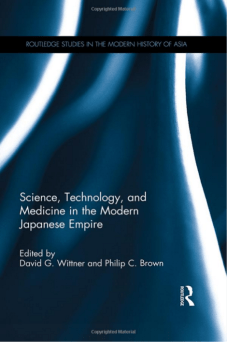
scitechDavid G. Wittner and Philip C. Brown, eds., Science, Technology, and Medicine in the Modern Japanese Empire (Routledge Studies in the Modern History of Asia) has just been released by Routledge Press.
Science, technology, and medicine all contributed to the emerging modern Japanese empire and conditioned key elements of post-war development. As the only emerging non-Western country that was a colonial power in its own right, Japan utilized these fields not only to define itself as racially different from other Asian countries and thus justify its imperialist activities, but also to position itself within the civilized and enlightened world with the advantages of modern science, technologies, and medicine.

This book explores the ways in which scientists, engineers and physicians worked directly and indirectly to support the creation of a new Japanese empire, focussing on the eve of World War I and linking their efforts to later post-war developments. By claiming status as a modern, internationally-engaged country, the Japanese government was faced with having to control pathogens that might otherwise not have threatened the nation. Through the use of traditional and innovative techniques, this volume shows how the government was able to fulfil the state’s responsibility to protect society to varying degrees. The contributors push the field of the history of science, technology and medicine in Japan in new directions, raising questions about the definitions of diseases, the false starts in advancing knowledge, and highlighting the very human nature of fields which, on the surface, seem to non-specialists to be highly rational.

Challenging older interpretative tendencies, this book highlights the vigour of the field and the potential for future development.

CONTENTS

Introduction
DAVID G. WITTNER AND PHILIP C. BROWN

1 On Science and Faith in the Life of a Meiji Engineer

ALEKSANDRA KOBILJSKI

2 Academia–Industry Relations: Interpreting the role of Nagai
Nagayoshi in the development of new businesses in the Meiji

period and beyond

JULIA S. YONGUE

3 An Emperor’s Chemist in War and Peace: Sakurai Jo – ji during the
Russo-Japanese War and World War I
YOSHIYUKI KIKUCHI

4 Buddhism contra Cholera: How the Meiji state recruited religion
against epidemic disease
WILLIAM D. JOHNSTON

5 The Influenza Pandemic of 1918, Taisho- Democracy and
Freedom of the Press during the Siberian Intervention

SUMIKO OTSUBO

6 The Politics of Manic Depression in the Japanese Empire

JANICE MATSUMURA

7 A Colony or a Sanitorium?: A comparative history of segregation politics of Hansen’s disease in modern Japan

WAKA HIROKAWA

8 “They are not human”: Hansen’s disease and medical responses to Ho- jo- Tamio
KATHRYN M. TANAKA

9 Dr. Baelz’s Mongolian Spot: German medicine, discourse of race in Meiji Japan, and the local response 000
ROTEM KOWNER

10 When Precision Obscures: Disease categories related to cholera during the Sino-Japanese War (1894–1895) 000
ROBERTO PADILLA

11 Kampo- in Wartime Sino-Japanese Relations: The Association of East Asian Medicine and the search for a tripartite medical partnership
MIZUNO NORIHITO

12 The Question of Research in Prewar Japanese Physics
KENJI ITO

13 Architects of ABC Weapons for the Japanese Empire: Microbiologists and theoretical physicists
TOMOKO Y. STEEN

14 The Science of Population and Birth Control in Post-war Japan
AYA HOMEI

Afterword: Is there anything unique about modern Japanese science?
JAMES R. BARTHOLOMEW


Posted in announcements, culture | Tagged , , , , , , | Leave a comment

Job Opening: Program Assistant, Japan Center for International Exchange, Inc. (JCIE/USA)

job opening - 5Employer: Japan Center for International Exchange, Inc. (JCIE/USA)
Location: New York City
Education: 4-year degree
Posted May 26, 2016

The Japan Center for International Exchange (JCIE/USA) is a leading nonprofit organization in the field of US-Japan relations that conducts international political exchanges and fosters dialogue between policymakers and policy researchers on both sides of the Pacific. JCIE/USA is seeking a full-time program assistant for its small New York office to assist in program management and support office administration. The job requires considerable flexibility and organization.

Responsibilities will include:

1) Program Support (approx. 40% of time)

  • Assist with coordinating exchange programs, study projects, and conferences related to international affairs
  • Assist with ad hoc background research on US-Japan relations and other topics relevant to JCIE programs
  • Correspond with donors, participants, partner organizations, vendors, and other parties necessary for program management
  • Help keep track of grant budgets
  • Make necessary travel and logistical arrangements
  • Help write grant proposals, reports, and other program-related communications

2) IT & Website (approx. 30% of time)

  • Manage internal IT system (server, office network, etc.)
  • Work with IT providers
  • Maintain office database systems
  • Help to oversee and implement website updates (basic html coding skills a plus)

3) Office Administration & Communications (approx. 30% of time)

  • Assist with email newsletters, website content writing, etc.
  • Handle incoming calls, oversee office circulations, and light filing

Preferred Candidate Attributes & Qualifications:

  • Strong writing and communications skills needed
  • Detail oriented, yet flexible, and curious to learn about US-Japan relations
  • Comfortable handling IT-related issues, including working on websites, database management, and internal and web servers
  • Team player who is willing to work in a small office environment with a can-do attitude
  • Interest in the nonprofit sector, international affairs, and US-Asia relations
  • English fluency required, proficiency in Japanese strongly preferred

See Idealist.org for full details.

Posted in announcements, job openings, jobs | Tagged , | Leave a comment

Postdoc position: Center for Global Asia, NYU Shanghai

Institution: Center for Global Asia, NYU Shanghai
Location: Shanghai, China
Position: one-year postdoctoral fellowship

Two postdoctoral positions for the study of intra-Asian interactions are available at the Center for Global Asia at NYU Shanghai. These fellowships are for a period of up to one year, commencing on or after September 1, 2016.

Candidates working on any aspect of pre-twentieth century intra-Asian interactions are welcome to apply, but topics related to Indian Ocean and overland Eurasian connections are of particular interest to the Center.

Candidates are expected to hold a PhD, preferably completed within the past five years (2011 and after).

Round trip airfare to Shanghai, a housing subsidy, and a monthly stipend will be provided by the Center for Global Asia. In addition to working on individual research and publication, the postdoctoral fellows are expected to assist in the activities of the Center. There is no teaching requirement.

The Center for Global Asia at NYU Shanghai serves as the hub within the NYU Global Network University system to promote the study of Asian interactions, both historical and contemporary. The overall objective of the Center is to provide global societies with information on the contexts for the reemerging connections between the various parts of Asia through research and teaching. This includes exploring how the polities and societies of Asia have interacted over time and are now beginning to interact again on broad fronts.

The deadline for applications is July 1, 2016 and the position will be open until filled. To be considered, applicants should submit curriculum vitae, a 3-5- page research proposal, a writing sample, and two letters of reference, all in PDF format. Please visit our website at http://shanghai.nyu.edu/about/work/fellowships for instructions and other information on how to apply. If you have any questions, please e-mail postdoc.cga@nyu.edu

Posted in announcements, job openings, jobs | Tagged , , , | Leave a comment