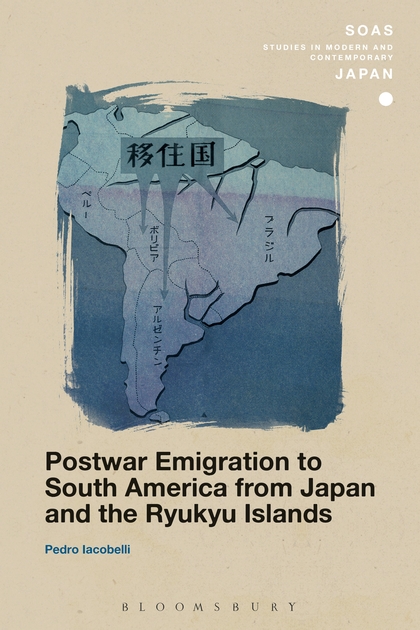
Book Announcement: Postwar Emigration to South America from Japan and the Ryukyu Islands

Postwar Emigration to South America from Japan and the Ryukyu Islands

Pedro Iacobelli

SOAS Studies in Modern and Contemporary Japan

Placing a distinct focus on the role of the sending state, this book examines the history of postwar Japan’s migration policy, linking it to the larger question of statehood and nation-building in the postwar era. Pedro Iacobelli delves into the role of states in shaping migration flows by exploring the genesis of the state-led emigration from Japan and the US-administered Ryukyu Islands to South America in the mid-20th century.

The study proposes an alternative political perspective on migration history to analyze the rationale and mechanisms behind the establishment of migration programs by the sending state. To develop this perspective, the book examines the state’s emigration policies, their determinants and their execution for the Japanese and Okinawan migration programs to Bolivia in the 1950s. It argues that the post-war migration policies that established those migration flows were a result of the political cost-benefit calculations, rather than only economic factors, of the three governments involved.

With its unique focus on the role of the sending state and the relationship between Japan, Okinawa and the United States, this is a valuable study for students and scholars of postwar Japan and migration history.

https://www.bloomsbury.com/uk/postwar-emigration-to-south-america-from-japan-and-the-ryukyu-islands-9781474297264/

Posted in announcements, culture | Tagged , , , , , , , , , , | Leave a comment

Call for Papers: Mechademia: Second Arc, Vol. 1 “Childhood”

“Childhood”

As the inaugural issue of this “second arc” of the narratives initiated by the Mechademia book series, the topic of “childhood” seems appropriate and timely, for several reasons. Primarily, this new book series expands the vista of the Mechademia series to encompass not just Japan, but Asia and even the world beyond, covering manga/manhua, anime, and gaming, but also the expansions to those art forms that have in the last decade, begun to absorb, innovate, morph, and expand to a panoply of new media, new expressions, new narratives, and new categories of transnational and transcultural work. In addition, these set of art forms which had in the past been considered by most mainstream considerations to be for children, have now been accepted as work that defies age, racial, gender, and sexual boundaries to become all the more globally consumed and appreciated. These aesthetics have influenced the world of fashion, literature, filmmaking, and virtually every game design.

But most poignantly, these works have always, and continue to deliver important narratives about the childhood experience. As a time of discovery, desire, disappointment, and creativity, childhood is the source of the adult experience. These experiences shape the trajectory of the adult in their approach to the world, to other people, and to the creative exploit. The child is perceivable as a “trace” under the image of the adult, as a map that lays out the journeys and spaces of experience and loss, love and despair, discovery and repression that become the founding text of the larger narrative of a life. And because the creative work can speak to the dense complexity of both the times and spaces of these events, the narratives of anime, manga/manhua, and gaming become especially profound because of their specific aesthetic in their ability to tell these tales.

This first volume, then, seeks to lay the foundation of the volumes to come in this series. Bringing forward the works of Mechademia, and expanding the parameters of its approach, the work of the Second Arc, the part of a narrative that deepens the discourse, the mystery, the characters, and the play of the narrative string — will begin by exploring the profundities of childhood, to set upon a new narrative toward maturity. Possible topics cover a vast territory: but we ask not for a simple recounting of the many narratives found in these works, but a critique, a theoretical troubling, and a creative projection from the connections and complications found in the secret places of these works. In addition to narrative considerations and explorations of the “symbolic” child, we would also welcome essays that explore children as readers, consumers, and creators, and the material conditions of transnational production that market to children.

Please send abstracts of 200 words, a keyword list of four terms, and essays of no more than 5000 words to: frenchy_lunning [at] mcad.edu by August 15, 2017.

http://www.mechademia.net/journal/call-for-papers/

Posted in announcements, graduate school | Tagged , , , , , , , | Leave a comment

Call for Papers: Non-Latin Type Design and Human-Computer Interaction

FACE/INTERFACE
Type Design and Human-Computer Interaction Beyond the Western World

December 1-2, 2017
Stanford University

In connection with the Fall 2017 Stanford University Libraries exhibition, “Facing the World: Non-Latin Type Design, 1450 to Now,” we will be holding an international conference bringing together scholars, designers, engineers, and technologists to explore Non-Latin type design, book design, interface design, and human-computer interaction beyond the Latin alphabetic world.

We are now seeking paper proposals.

DATES & LOCATION

Face/Interface will take place December 1-2, 2017 on the campus of Stanford University.

ELIGIBILITY

Scholars, Designers, Artists, Engineers, and Technologists working in all disciplines and time periods are welcome to apply. We are particularly eager to identify early-career candidates. All ranks are eligible and encouraged to apply, however.

CONFIRMED SPEAKERS

Confirmed Speakers for the Face/Interface conference include:

* Fiona Ross (Associate Professor, University of Reading | Non-Latin Typeface Design Director | Foundational figure in South Asian script typeface design)
* Gerry Leonidas (Associate Professor, University of Reading | Typeface Design Programme Director | World-leading Greek typeface designer)
* Lara Captan (leading contemporary Arabic type designer & researcher + co-founder of Arabic Type Design-Beirut program)
* Liron Lavi Turkenich (leading contemporary Hebrew type designer & researcher + regional director of ATypI)
* Ken Lunde (Senior Computer Scientist, Type Development in Chinese/Japanese/Korean/Vietnamese scripts at Adobe)
* Ramsey Nasser (NY-based Arabic-language computer science theorist/artist)
* Scott Klemmer (HCI specialist & Associate Professor of Cognitive Science and Computer Science & Engineering at UC San Diego + Co-Founder and Co-Director of the Design Lab, UC Irvine)

APPLICATION & DEADLINE

The deadline for applications is AUGUST 4, 2017. Materials should be submitted via email/attachments to Tom Mullaney (tsmullaney@stanford.edu) with the subject header “FACE/INTERFACE APPLICATION.” (This subject header is REQUIRED.)

Applications should include:

I. Cover letter summarizing applicant’s field of study, research, and/or design practice in connection with the themes of the conference

II. Title, 250-word Abstract of Proposed Conference Paper

III. CV (3-page)

IV. Two references including contact information (please do NOT request or provide letters of recommendation – but references may be contacted as part of application review process)

FINANCIAL SUPPORT

A limited number of partial travel stipends will be offered to help offset cost of travel to Stanford. This support will not cover the full cost of attendance, and so successful applicants should plan accordingly.

Posted in announcements, conferences, graduate school | Tagged , , , , , , | Leave a comment

Fun Link Friday: Pop-up Kirigami

Though I don’t speak French, I couldn’t resist posting this as a fun link when I came across the video online at golem 13: Nakamura Haruki, an expert in kirigami (paper cutting), has come up with incredibly adorable animal creations that literally pop-up to life. From a bouncing penguin to a defensive armadillo, they’re absolutely adorable! Check out the video below and go to his site to see more of his amazing work!

Posted in culture, fun links | Tagged , , , , | 1 Comment

Job Opening: Critical Language Mentor Research Associate

EXIGER DUE DILLEGENCE

Exiger assists organizations worldwide with practical advice and technology solutions to prevent compliance breaches, respond to risk, remediate major issues and monitor ongoing business activities.

Exiger has a current need for Hebrew, Korean, Dutch and Japanese proficient candidates. Reading comprehension skills are above conversational skills. They are searching for candidates with the aforementioned language skills to be research associates. Clearances are not required, and this is a great opportunity for recent college graduates with language and research skills.

Position Summary

Research Associates are creative and inquisitive. They use a wide range of research tools to gather risk and compliance intelligence on individuals and companies. The research is then analyzed and developed into a narrative report, which is used by clients to understand the general background of the subject, assess the subject’s legitimacy and reputation, and inform strategic decision-making. Research Associates work both independently and collaboratively on research and reports for a variety of domestic and international clients.

Key Responsibilities

Research Associates are key members of the Exiger Diligence research team.  Responsibilities include:

  • Extensive primary and secondary research using a variety of open-source web-based tools
  • Identification of pertinent information and development of useful insights into the subject
  • Write clear, concise, and thorough reports for clients
  • Learn to own cases from start to finish with review of cases by senior researchers
  • Assist with research, writing, and editing of large and complex cases
  • Commitment to integrity and thoroughness of research
  • Under certain circumstances some travel may be required

Knowledge & Skills

  • Excellent writing skills
  • Rigorous attention to detail
  • Superior comprehension and analytical abilities
  • Excellent logical thinking
  • Ability to work in fast-paced and self-driven environment
  • Ability to manage and prioritize several projects and assignments simultaneously
  • Organizational and time management competency required
  • Interest and understanding of current events, international affairs, financial regulations, economics and/or finance
  • Professional fluency/proficiency in a foreign language with a particular emphasis on Portuguese, Spanish, Russian, Italian, and Japanese a plus.

Professional Experience Required

  • Bachelor’s degree required, 0-3 years of relevant work experience.

Application and more information:

http://criticallanguagementor.net/jobs/exiger/

Posted in announcements, job openings, jobs | Tagged , , , , | Leave a comment

Call for Papers: Japan in the Digital Age

Date: Saturday 28th October, 2017

Venue: The Shed, Manchester Metropolitan University, Manchester

Keynote Speakers

Prof. Ian Condry, Professor of Japanese Cultural Studies, Massachusetts Institute of Technology

Mr. Kazuhito Gen-I (源井 和仁), award-winning media practitioner, working on 2.5 Dimension project (theatre adaptation of anime, manga and videogame)

Japan has been a place of fascination throughout the years, particularly to those interested in media and popular culture, business, science and technology, and other related areas such as transport and tourism. Yet surprisingly, there is little sustained discussion on how contemporary Japan is situated within the rapidly changing landscape of digital technologies in the New Millennium. How has digitisation changed Japanese aesthetics and values? Have mobile phone technologies altered the way Japanese business language is used? How does ‘tradition’ shape Japanese digital cultures? Such questions need urgent attention as currently, there are a number of significant and innovative digital initiatives in Japan which have impacted on Japanese culture and arts, technology, business and society, but are little known outside of Japan.

We invite academics, PG students, industry researchers and practitioners for contributions which examine the transformation of Japan in the Digital Age, and the transformation of the Digital Age through Japanese culture, practice, politics, technologies, industries and beyond. The overall aim of the Symposium is to provide a supportive and inspiring environment to encourage cross-disciplinary and cross-sector dialogues, to learn about innovative digital projects in Japan, and to build a network of those engaged with Japan through their work and lives.

Suggested topics include:

  • Digital technologies and Japanese popular culture (e.g. anime/manga, games, fashion)
  • Japanese digital identity, politics and society
  • Digital communications, Japanese language and business
  • Innovative Japanese digital design and technologies

Please submit a 250-word abstract to e.miyake@mmu.ac.uk by 4th August 2017, using the following format: title + abstract; name of author(s); affiliation; email; key words. For any enquiries, please get in touch with Dr. Esperanza Miyake (e.miyake@mmu.ac.uk)

Posted in announcements, conferences, graduate school | Tagged , , , , , , | Leave a comment

Funding: 2017 Abe Fellowship Program Competition

Deadline: Sep. 1, 2017

Webpage: https://www.ssrc.org/fellowships/view/abe-fellowship/

Overview

The Social Science Research Council (SSRC) and the Japan Foundation Center for Global Partnership (CGP) announce the annual Abe Fellowship Program competition. Funding for the Abe Fellowship Program is provided by CGP.

The Purpose of the Fellowship

The Abe Fellowship is designed to encourage international multidisciplinary research on topics of pressing global concern. The program seeks to foster the development of a new generation of researchers who are interested in policy-relevant topics of long-range importance and who are willing to become key members of a bilateral and global research network built around such topics. It strives especially to promote a new level of intellectual cooperation between the Japanese and American academic and professional communities committed to and trained for advancing global understanding and problem solving.

Research support to individuals is at the core of the Abe Fellowship Program. Applications are welcome from scholars and nonacademic research professionals. The objectives of the program are to foster high quality research in the social sciences and related disciplines, to build new collaborative networks of researchers around the four thematic foci of the program, to bring new data and new data resources to the attention of those researchers, and to obtain from them a commitment to a comparative or transnational line of inquiry.

Successful applicants will be those individuals whose work and interests match these program goals. Abe Fellows are expected to demonstrate a long-term commitment to these goals by participating in program activities over the course of their careers.

The Abe Fellowship Research Agenda

Applicants are invited to submit proposals for research in the social sciences and related disciplines relevant to any one or any combination of the four themes below. The themes are:

1) Threats to Personal, Societal, and International Security
Especially welcome topics include food, water, and energy insecurity; pandemics; climate change; disaster preparedness, prevention, and recovery; and conflict, terrorism, and cyber security.

2) Growth and Sustainable Development
Especially welcome topics include global financial stability, trade imbalances and agreements, adjustment to globalization, climate change and adaptation, and poverty and inequality.

3) Social, Scientific, and Cultural Trends and Transformations
Especially welcome topics include aging and other demographic change, benefits and dangers of reproductive genetics, gender and social exclusion, expansion of STEM education among women and under-represented populations, migration, rural depopulation and urbanization, impacts of automation on jobs, poverty and inequality, and community resilience.

4) Governance, Empowerment, and Participation
Especially welcome topics include challenges to democratic institutions, participatory governance, human rights, the changing role of NGO/NPOs, the rise of new media, and government roles in fostering innovation.

Across the program’s four dominant themes, projects should demonstrate important contributions to intellectual and/or policy debates and break new theoretical or empirical ground. Within this framework, priority is given to research projects that help formulate solutions that promote a more peaceful, stable, and equitable global society or ameliorate the challenges faced by communities worldwide. Applicants are expected to show how the proposed project goes beyond previous work on the topic and builds on prior skills to move into new intellectual terrain.

Please note that the purpose of this Fellowship is to support research activities. Therefore, projects whose sole aim is travel, cultural exchange, and/or language training will not be considered. However, funds for language tutoring or refresher courses in the service of research goals will be included in the award if the proposal includes explicit justification for such activities.

Policy-Relevant, Contemporary, and Comparative or Transnational Research

Rather than seeking to promote greater understanding of a single country—Japan or the United States—the Abe Fellowship Program encourages research with a comparative or global perspective. The program promotes deeply contextualized cross-cultural research.

The Abe Fellowship Program Committee seeks applications for research explicitly focused on policy-relevant and contemporary issues with a comparative or transnational perspective that draw the study of the United States and Japan into wider disciplinary or theoretical debates.

Policy Relevance

The program defines policy-relevant research as the study of existing public policies for the purpose of (a) deepening understanding of those policies and their consequences and (b) formulating more effective policies. Policy relevance can also be found in research questions that are pertinent to understanding public dialogue on contemporary issues of concern to various sectors of society. All proposals are expected to directly address policy relevance in theme, project description, and project structure.

Contemporary Focus

The program is concerned with present day issues and debates. Thus, proposals in history or with a historical component must demonstrate how the research is specifically intended to inform contemporary concerns.

Comparative or Transnational Perspectives

The Abe Fellowship Program does not support research on a single country. Priority is accorded to comparisons of processes, problems, and issues across time and space. Successful proposals will explicitly address how the project will be comparative or transnational in construction and goals.

Typically projects involve data collection in more than one country or across several time periods. Data from a single country may be collected under the auspices of the fellowship only if the purpose of collecting that data is explicitly comparative or transnational. Single-country proposals that merely imply that the data have broader comparative relevance will be eliminated from the fellowship competition. Further, it is not sufficient for a proposal to implicitly suggest a comparative perspective because of the pervasive or global distribution of the phenomenon being studied.

Eligibility

  • This competition is open to citizens of the United States and Japan as well as to nationals of other countries who can demonstrate strong and serious long-term affiliations with research communities in Japan or the United States.
  • Applicants must hold a PhD or the terminal degree in their field, or have attained an equivalent level of professional experience at the time of application.
  • Previous language training is not a prerequisite for this fellowship. However, if the research project requires language ability, the applicant should provide evidence of adequate proficiency to complete the project.
  • Applications from researchers in professions other than academia are encouraged with the expectation that the product of the fellowship will contribute to the wider body of knowledge on the topic specified.
  • Projects proposing to address key policy issues or seeking to develop a concrete policy proposal must reflect nonpartisan positions.

Please note: Past recipients of the Abe Fellowship are ineligible. You may hold only one fellowship sponsored by the Japan Foundation, which includes the Abe Fellowship, during any one Japanese fiscal year, which runs from April 1 through March 31. Current recipients of a Japan Foundation Fellowship and those who will commence that fellowship by March 31, 20178, are ineligible to apply for an Abe Fellowship in 2017. Fellowship awards are contingent upon receipt of funding from the Japan Foundation Center for Global Partnership.

Fellowship Terms

Terms of the fellowship are flexible and are designed to meet the needs of researchers at different stages in their careers. The program provides Abe Fellows with a minimum of 3 and maximum of 12 months of full-time support over a 24-month period. Fellowship tenure must begin between April 1 and December 31 of a given year. Fellowship tenure need not be continuous, but must be concluded within 24 months of initial activation of the fellowship.

  • The fellowship is intended to support an individual researcher, regardless of whether that individual is working alone or in collaboration with others.
  • Candidates should propose to spend at least one third of the fellowship tenure in residence abroad in Japan or the United States. In addition, the Abe Fellowship Committee reserves the right to recommend additional networking opportunities overseas.
  • Abe Fellows will be expected to affiliate with an American or Japanese institution appropriate to their research. Fellowship funds may also be spent on additional residence and fieldwork in third countries as appropriate to individual projects.
  • Fellows will be required to attend specific Abe Fellowship Program events.

Applications

The application deadline is September 1 annually. Applications must be submitted online at https://soap.ssrc.org. For further information, please contact the program directly at abe@ssrc.org.

In the US

Abe Fellowship Program
Social Science Research Council
One Pierrepont Plaza, 15th Floor
Brooklyn, NY 11201 USA
Email: abe@ssrc.org
Tel: 212-377-2700 / Fax: 212 377-2727
https://www.ssrc.org/fellowships/view/abe-fellowship/

In Japan

Abe Fellowship Program
SSRC Tokyo Office
c/o Japan Foundation
Center for Global Partnership
Shinjuku Gyoenmae Building, 6F
4-16-3 Yotsuya, Shinjuku-ku Tokyo 160-0004
Email: ssrcABE@gol.com
Tel: 3-5369-6085 / Fax: 3-5369-6142

Posted in announcements, funding, graduate school | Tagged , , , , , , | Leave a comment

Book Announcement: Individuality in Early Modern Japan: Thinking for Oneself

Individuality in Early Modern Japan: Thinking for Oneself
By Peter Nosco

Two of the most commonly alleged features of Japanese society are its homogeneity and its encouragement of conformity, as represented by the saying that the nail that sticks up gets pounded. This volume’s primary goal is to challenge these and a number of other long-standing assumptions regarding Tokugawa (1600-1868) society, and thereby to open a dialogue regarding the relationship between the Japan of two centuries ago and the present. The volume’s central chapters concentrate on six aspects of Tokugawa society: the construction of individual identity, aggressive pursuit of self-interest, defiant practice of forbidden religious traditions, interest in self-cultivation and personal betterment, understandings of happiness and well-being, and embrace of “neglected” counter-ideological values. The author argues that when taken together, these point to far higher degrees of individuality in early modern Japan than has heretofore been acknowledged, and in an Afterword the author briefly examines how these indicators of individuality in early modern Japan are faring in contemporary Japan at the time of writing.

For more info: http://208.254.74.112/books/details/9781138308787/

Posted in announcements, culture | Tagged , , , , , , | Leave a comment

Fun Link Friday: The Most Loyal Cat in Japan

Unrelated cat photo taken by Travis at Yanaka Cemetery in Tokyo, June 2013.

Louise Hung is an American writer currently living in Japan. Her latest post on The Order of the Good Death, entitled “Paying my respects to the most loyal cat in Japan,” relates her adventure in visiting the grave of the Hachikô of cats.

Maybe Nagai really did have a cat he dearly loved. Maybe that cat did appear to be distraught when his master didn’t come home. Maybe somebody got confused and when a cat died near the grave, they conflated the cats and a legend was born. Maybe the people at the time needed such a story. Why look a good legend in the mouth?

And if nothing else, the story of Nagai’s cat led me to a cheery, little graveyard (for a warlord) that I might not have ever known existed. Death folklore (with cats!) plus historic graves? I’ll take it!

To read the rest of the story, check out The Order of the Good Death. And follow Louise on Twitter for more stories about death, folklore, and cats.

Posted in culture, fun links | Tagged , , , | Leave a comment

What can you do with a BA in Japanese? The Struggles and Successes of Translating Mobile Apps

Starting to study Japanese in undergrad or high school, I think a lot of us imagine translating our favorite Japanese video games, anime, and movies. When I started studying Japanese in college I had a vague image of my future self working in an international business or “maybe doing some translation”. Since graduating I’ve done all kinds of translation including company pamphlets, event fliers, websites, legal documents, and most recently, smartphone apps!

Over the past 4 years I’ve worked helping to translate and localize several apps from Japanese to English and every project has been both a fun and rewarding experience. Today I’d like to share some of my experiences with you so you can get an idea if app translation might be something you would enjoy as well!

Continue reading

Posted in graduate school, jobs, main posts, study tools, undergraduate, useful links | Tagged , , , , , , | 2 Comments