
 “Narratives of (Il)legibility in East Asia”
Call for Papers: 5th Annual SEAS Graduate Student Symposium
University of Illinois at Urbana-Champaign
May 5th, 2018
Application: https://goo.gl/forms/aSnO4QCeNjHmb4VH2
Keynote Speaker: Johanna Ransmeier, University of Chicago
The deadline for submissions is Friday, February 2, 2018.
Society of East Asian Studies (SEAS) at the University of Illinois at Urbana-Champaign is pleased to welcome abstracts, papers, and panel proposals for its 5th annual graduate student symposium. The symposium will be held at the University of Illinois at Urbana-Champaign on May 5th, 2018. The theme for this year is:
“Narratives of (Il)legibility in East Asia”
With the theme “Narratives of (Il)legibility in East Asia,” this conference aspires to nurture interdisciplinary discussions that contribute to understandings of East Asia. The conference aims to explore various questions relevant to past and present lived experiences in East Asia including: What criteria has been used to produce social categories and how has such criteria operated as techniques of inclusion and exclusion? How has the construction of legible bodies and practices in East Asia been involved in the (re)production of social hierarchies related to class, gender, sexuality, race, nationality, and (dis)ability? We invite papers that explore social, cultural, historical, religious, and political factors that have been influential in shaping communities in East Asia. We encourage submissions from diverse subfields and welcome papers that engage with issues related to Korea, Japan, Taiwan, China, and the broader East Asian region, including diasporic East Asian communities.
We are interested in papers from various disciplines, including but not limited to: history, law, gender studies, anthropology, film/media studies, sociology, literature, comparative literature, art history, religious studies/religion, linguistics, musicology, and political science.
Submission Information:
Abstracts for individual papers (20 minutes maximum) should be no more than 300 words in length and may be submitted using this online form. We also welcome proposals for integrated panels. Those wishing to propose a panel are invited to email Qianhui Ma at seas.uiuc@gmail.com. A panel should consist of no more than three papers, each twenty minutes in lengt
 Hawaii Tokai International College (HTIC) is an American two-year liberal arts college located in Kapolei, Hawaii, adjacent to the University of Hawaii–West Oahu campus. The only American campus of the Tokai University Educational System (TES) of Japan, HTIC focuses on a general liberal arts education. Its International Programs, which chiefly include courses in English language and liberal arts subjects for Japanese and other international students, are a prominent element of the college’s activities.
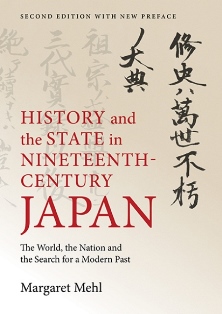 Margaret Mehl. History and the State in Nineteenth-Century Japan: The World, the Nation and the Search for a Modern Past. Second Edition with New Preface. Copenhagen: The Sound Book Press, 2017.
 Although we have a number of articles about whether or not
 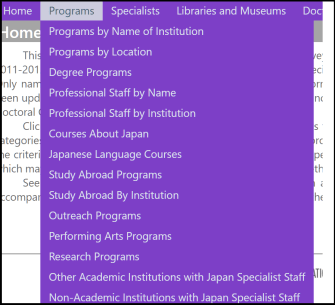 As seen on the left, there are numerous ways to navigate your particular interests, whether you would like to search by type of institutional program, study abroad program, language course, or something very particular like a performing arts program. With each selection there are more specific ways to narrow your fields. For example, a search by location, with the fields United States – Mid-Atlantic Region returns 52 results, while further narrowing it to just Pennsylvania returns 19. Clicking on individual institutional entries pulls up a PDF with an overview of the program, including their faculty, past courses offered, doctoral candidates (if a university), undergraduate and/or graduate programs, certificate or study abroad programs, libraries, museums, outreach, general contact info, and more. Nearly an overwhelming amount of information!
 If you are looking for something very specific, such as a specialist working in a particular time period or geographic location, you should also read faculty profiles carefully. Though they include many helpful details like major publications, scholars’ research areas often shift over the years as their projects and passions develop, and they can also be quite broad in listing their interests and specializations. On the right for example, is a result from searching for someone with a specialization in Kamakura period history– note how many different periods and areas of specialty get listed in faculty profiles! And while one person might list themselves as interested or proficient in, say, the medieval, they may consider themselves more of an early modern scholar, and not intend to take on graduate students outside of their preferred time period. The information on the site is also self-reported, user-driven collection, so errors are possible in what you read. All of this to say, be discerning in what you take from the database, and if you have a serious interest and it could affect your future academic pursuits, double-check everything!
 What can I do with a B.A. in Japanese Studies?