Job opening: The Center for Historical Research at The Ohio State University

The Center for Historical Research brings together faculty, students, and the general public to examine the historical foundation and development of critical issues of global importance.  The Center offers resident fellowships for senior and junior faculty, as well as those completing dissertations.  We also invite members of the academic community and independent scholars to make presentations at our seminars. In the academic years, 2011-2013, we will be studying “Health, Disease, and Environment in World History.”

Image from CHR

All human groups have modified their environments and battled endemic and epidemic diseases.  Societies have collapsed due to environmental degradation or pandemics.  We will examine many of the key issues and events in the interaction of peoples with their planet from the Ancient World to the present.  In the first year of this two-year program (2011-2012), we will explore demographic transitions and epidemiology in history.  (2012-2013 will focus on the dialectic between environment and disease, and the relationship of race, poverty, and inequality to disease.)  We are open to scholars from any discipline, and we are interested in exploring these issues on global, regional, and local levels.

Application information for fellowships can be found on our website, http://chr.osu.edu/, and are due by March 15, 2011.  Those interested in making presentations at the seminars should contact the CHR director, Alan Gallay, at osuchr@osu.edu.

Senior Fellow Faculty Applicants

It is preferred that the Senior Fellow will participate in the full program extending from late September to early June, but consideration will be given for shorter term fellowships of 1 or 2 quarters (with a proportional reduction in compensation). The Senior Fellow will receive a stipend of $60,000 with benefits at a rate of 8.5%, and a research fund of $4,000. Affiliated fellows will be invited to participate in all History Department activities, including our ongoing seminars:  the Early Modern Seminar, the Women’s History Seminar, the Early American Seminar, the Modern U.S. Seminar, and any other seminars and conferences supported by the department.  Fellows will have access to facilities of The Ohio State University, its libraries, and the normal social amenities sponsored on campus.  The History Department and the College of Humanities will provide visiting fellows with office space equipped with personal computers, staff assistance, research support, copying facilities, telefax and e-mail service, and access to the internet.

Junior Fellow Faculty Applicants

Junior Fellows will receive a stipend of $40,000 plus benefits at a rate of 28.6%, and a research fund of $1,500. Affiliated fellows will be invited to participate in all History Department activities, including our ongoing seminars:  the Early Modern Seminar, the Women’s History Seminar, the Early American Seminar, the Modern. U.S. Seminar, and any other seminars and conferences supported by the department.  Fellows will have access to facilities of The Ohio State University, its libraries, and the normal social amenities sponsored on campus.  The History Department and the College of Humanities will provide visiting fellows with office space equipped with personal computers, staff assistance, research support, copying facilities, telefax and e-mail service, and access to the internet.

The Ohio State University is an Equal Opportunity/ Affirmative Action employer.  Women, minorities, veterans, and individuals with disabilities are encouraged to apply.
Posted in announcements, funding, graduate school, job openings, jobs | Tagged , , , , , , , , , | Leave a comment

Job opening: Associate Professor, Asian Studies, University of Tokyo

Institution Type:   College / University
Location:   Japan
Position:   Associate Professor
Deadline: January 28, 2011

Academic Recruitment for Associate Professorship
Institute for Advanced Studies on Asia, University of Tokyo

International application is invited for the position of associate professor, to be based in the Institute for Advanced Studies on Asia, University of Tokyo.

Description:

The successful candidate will belong to the Department of Pioneering Asian Studies, to be newly created from 1 April 2011, the aim of which is to develop new perspectives in the field of Asian Studies through challenging and innovative approaches. Depending on the experience of the successful candidate, he/she may teach his/her own research topic in related faculties and graduate schools. Proficiency in Japanese language is not required, but will be welcome.

Expected date of appointment: April 1, 2011 or by negotiation
Term of office: Five years (with no possibility of extension)

For more detail, please visit the following web site:
http://www.ioc.u-tokyo.ac.jp/eng/recruit/index.html

Contact: koubo01@ioc.u-tokyo.ac.jp

Posted in announcements, job openings, jobs, living abroad | Tagged , , , , | 1 Comment

Website announcement: Visualizing Cultures – Image-Driven Scholarship

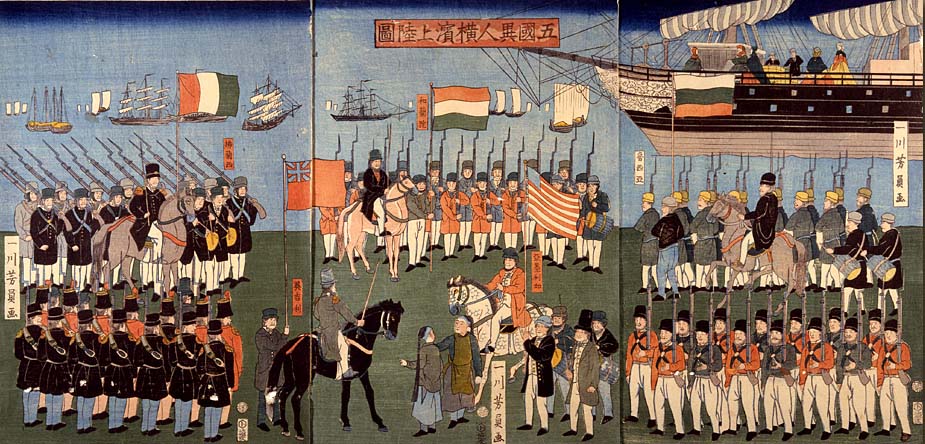
A new spectacular resource for historical and artistic scholarship, MIT’s Visualizing Cultures presents a multimedia approach to looking at Asian history and international social and cultural relations. We have a lengthy description here, but you can also check out the site and let it speak for itself.

—

Visualizing Cultures – Image-Driven Scholarship
Massachusetts Institute of Technology (MIT)

What is Visualizing Cultures?

Visualizing Cultures weds images and scholarly commentary in innovative ways to illuminate social and cultural history. Founded in2002 by MIT Professors John Dower and Shigeru Miyagawa, Visualizing Cultures exploits the unique qualities of the Web as a publishing platform to enable scholars, teachers, and others to:

(1) examine large bodies of previously inaccessible images
(2) compose original texts with unlimited numbers of full-color, high-resolution images
(3) use new technology to explore unprecedented ways of analyzing and presenting images that open windows on modern history.

This website offers a growing number of titles referred to as ‘units.’ This first, pioneering set of units visualizes diverse aspects of Japan in the modern world. Units in development move into China and beyond. Units are generally comprised of four sections:

# Essay

A topical essay written by a Visualizing Cultures scholar and driven by the visuals themselves features full-color images, often enlarged to reveal telling details. Images are isolated and juxtaposed to highlight diverse perspectives and points. Reading images involves asking who the artists are, when they worked, what mediums they used, and how the audiences of the times responded to them.

# Visual Narratives

Graphics dominate the Visual Narratives. Themes from the essay as well as pathways and details within the image collection are explored visually in many different ways-series, close ups, recurring visual motifs, juxtapositions, changing media, and so forth — with a minimum of text.

# Image Database (Gallery and VCID)

Each unit has a database that features every image in the essay, plus many more. The database generally takes the form of a simple view (Gallery) that enables users to easily scroll through the collection of source images. Some units feature a more complex database (VCID) with a federated search function that hooks directly into museum databases. All databases include at least basic metadata.

# Video and Animation (VCTV)

Visualizing Cultures has more than a hundred short clips that include author commentaries, interviews, tours, animation, and archival source footage. Video is also downloadable for the iPod.

Site contents:

  • Rise & Fall of the Canton Trade System I, China in the World(1700-1860s)
  • Rise & Fall of the Canton Trade System II, Macau & Whampoa Anchorage (1700-1860s)
  • Rise & Fall of the Canton Trade System III, Canton & Hong Kong(1700-1860s)
  • Rise & Fall of the Canton Trade System IV, Image Galleries
  • The First Opium War, The Anglo-Chinese War of 1839-1842
  • The Opium War in Japanese Eyes, An Illustrated 1849 Story from Overseas
  • The Second Opium War [to be available in 2011], The Anglo-Chinese War of 1856-1860
  • Black Ships & Samurai, Commodore Perry and the Opening of Japan(1853-1854)
  • Black Ships & Samurai II, Visual Narratives;
  • Yokohama Boomtown, Foreigners in Treaty-Port Japan (1859-1872)
  • Felice Beato’s Japan: Places, An Album by the Pioneer Foreign Photographer in Yokohama
  • Felice Beato’s Japan: People, An Album by the Pioneer Foreign Photographer in Yokohama
  • Globetrotters’ Japan: Places, Foreigners on the Tourist Circuit in Meiji Japan
  • Globetrotters’ Japan: People, Foreigners on the Tourist Circuit in Meiji Japan
  • John Thomson’s China I, Illustrations of China and Its People, Photo Albums (1873-1874)
  • John Thomson’s China II, Illustrations of China and Its People, Photo Albums (1873-1874)
  • Visual Narratives, John Thomson’s China III, Illustrations of China and Its People, Photo Albums (1873-1874)
  • Albums & Galleries, Throwing Off Asia I, Woodblock Prints of Domestic ‘Westernization’ (1868-1912)
  • Throwing Off Asia II, Woodblock Prints of the Sino-Japanese War(1894-95)
  • Throwing Off Asia III, Woodblock Prints of the Russo-Japanese War(1904-05)
  • Asia Rising, Japanese Postcards of the Russo-Japanese War(1904-05)
  • Yellow Promise, Foreign Postcards of the Russo-Japanese War(1904-05)
  • Selling Shiseido I, Cosmetics Advertising & Design in Early20th-Century Japan
  • Selling Shiseido II, Cosmetics Advertising & Design in Early20th-Century Japan, Visual Narratives
  • Selling Shiseido III, Cosmetics Advertising & Design in Early20th-Century Japan, Image Galleries
  • Tokyo Modern I, Koizumi Kishio’s ‘100 Views’ of the Imperial Capital (1928-1940)
  • Tokyo Modern II, Koizumi Kishio’s ‘100 Views’, Annotations & Gallery
  • Tokyo Modern III, ‘100 Views’ by 8 Artists (1928-1932), Image Galleries
  • Ground Zero 1945, Pictures by Atomic Bomb Survivors
  • Ground Zero 1945: A Schoolboy’s Story, Testimony of Akihiro Takahashi, Illustrations by Goro Shikoku.

URL:  http://visualizingcultures.mit.edu


Internet Archive
http://web.archive.org/web/
http://visualizingcultures.mit.edu

Scott Shunk
Program Director
shunk@mit.edu

—

Image from http://visualizingcultures.mit.edu

Posted in announcements, culture, study tools, useful links | Tagged , , , , , , , , , , , , | 1 Comment

Summer program at the Inter-University Center for Japanese Language Studies

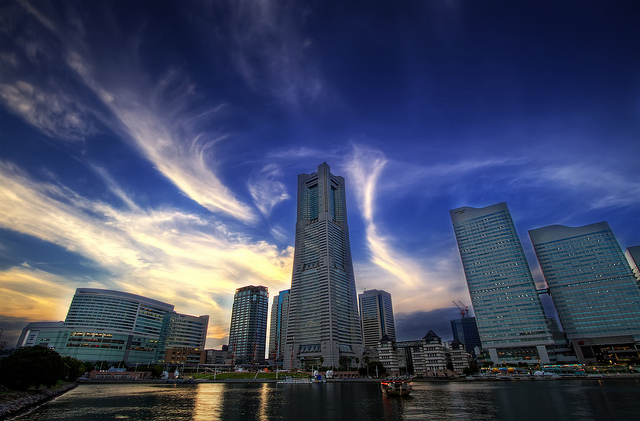
If you’re interested in an advanced summer language program, the Inter-University Center for Japanese Language Studies is one of the very best of its kind. Located in beautiful Yokohama (a five minute walk from the buildings in this photograph!), I can say from experience that the program is tremendously helpful and the professors are wonderful. Be sure to check it out! Deadline to apply is March 15.

—


Photo by Agustin Rafael Reyes

—

The Inter-University Center for Japanese Language Studies (IUC) is pleased to announce the thirteenth year of our summer program in Advanced Japanese.

The 2011 summer program begins June 23 and ends on August 5.  The six-week program totals 140 contact hours.  The IUC intensive program of study is aimed at both undergraduate and graduate students and is designed to provide intermediate and advanced level training in spoken Japanese and reading comprehension.

The morning sessions are focused on advanced spoken Japanese while afternoon sessions are devoted to conversation, field trip classes, and kanji.  Three times weekly, students engage in discussion based on a variety of topics during a one hour conversation class designed to improve fluency through free discussion.  Morning classes meet five days a week, afternoon classes meet four days a week and one afternoon is devoted to a field trip class.  Class size is limited to eight students or less.

Tuition for the 2011 summer program is $4,800 (US).  A student officially enrolled at an IUC consortium institution during the 2009-10 or 2010-11 academic year will receive a partial tuition remission of $600 (US) to attend the 2011 summer program. Fees include instruction, all textbooks or instructional materials, and field trip transportation costs.  The program should be eligible for Foreign Language and Area Studies (FLAS) summer language support.

The application deadline is March 15, 2011.

For further information about the IUC Summer Program in Advanced Japanese, please visit www.stanford.edu/dept/IUC/summer.html

Indra Levy
Executive Director, IUC
Stanford University

Posted in announcements, graduate school, language schools, living abroad, study abroad, study tools, summer program, undergraduate | Tagged , , , , , , | 1 Comment

Job opportunities: teaching fellowships

University of San Francisco, Center for the Pacific Rim

Two Teaching Fellowships (Post-Doctoral and Open Rank)

Institution Type: College / University
Location: California, United States
Position: Fellow, Other Teaching, Post-Doctoral Fellow

Center for the Pacific Rim Teaching Fellowships at the University of San Francisco

The Center for the Pacific Rim at the University of San Francisco invites applications for two Teaching Fellowships for the 2011-12 academic year.

1. One Post-doctoral Teaching Fellow is open to applicants who have received their doctoral degrees within the past five years. Appointments are for one year, renewable for a second year.

2. One Teaching Fellow – Open Rank is open to applicants of all ranks including senior scholars who may wish to spend a sabbatical semester or year at USF. Appointments may be from one semester to two years.

During their tenure, the Fellows are expected to teach one course per semester at the undergraduate or graduate level, and pursue research for publication in peer-reviewed scholarly journals, with possible contribution to the Center’s Asia-Pacific Perspectives.

They are also expected to interact productively with students and faculty, and with one or more of the Center’s constituent parts – the Ricci Institute for Chinese-Western Cultural History, the Japan Policy Research Institute, China Dialogue, and the Nautilus Institute for Security and Sustainability.

We invite research proposals in two distinct areas: Chinese-Western cultural encounters; and more broadly in Asia Pacific studies, especially as it relates to transnational issues within the ‘Pacific world’ (including but not limited to human rights and social justice; environmental sustainability; conflict resolution, democracy and civil society in emerging nations; international relations and security; non-governmental interactions; and social and cultural change).

Application

Submit by February 28, 2011 the following: (1) curriculum vitae; (2) a 5-10 page double-spaced description of proposed research and deliverable outcomes for a semester or year, including the contribution the research would make in the relevant field(s) and to the USF Center for the Pacific Rim’s mission and focus; (3) other funding sources, if any; (4) two letters of recommendation, at least one of which should be from a scholar outside the applicant’s home institution.

Applications may be submitted electronically; letters of recommendation must be submitted directly from recommender.

The University of San Francisco is a Jesuit Catholic University founded in 1855 to educate leaders who will fashion a more humane and just world. Candidates should demonstrate a commitment to work in a culturally diverse environment and to contribute to the mission of the University.

USF is an Equal Opportunity Employer dedicated to affirmative action and to excellence through diversity. The University provides reasonable accommodations to qualified applicants with disabilities upon request.

Submit applications for the Center for the Pacific Rim Teaching Fellow positions to:

Contact:

Prof. Angelina C. Yee
Chair, Search Committee
Executive Director and Professor
USF Center for the Pacific Rim
2130 Fulton St., LM 280
San Francisco, CA 94117-1080 USA

Email: acyee@usfca.edu
Website: http://www.pacificrim.usfca.edu

Posted in announcements, job openings, jobs | Tagged , , , , , , , | Leave a comment

Conference: Publishing the Stage: Print and Performance in Early Modern Japan

Publishing the Stage: Print and Performance in Early Modern Japan

Location: University of Colorado, Boulder
Date: March 5 – 6, 2011

The conference is free and open to the public, and it will feature 13 speakers from the U.S., Japan, and the U.K.  Papers will be devoted to exploring the confluence of theater and publishing in seventeenth- through nineteenth-century Japan.  Presenters will seek to examine these vibrant and mutually supporting worlds by considering a variety of performance and bookselling traditions from the perspectives of marketing, manufacturing, and visual and artistic license.  Because of its interdisciplinary nature, the conference should be of interest to scholars in the fields of literary, art historical, and theater studies alike.  Papers will be presented in either English or Japanese, with no translation.  For further information, including a conference schedule, list of panels, and hotel and transportation options, please see our website at http://colorado.edu/cas/publishingthestage.htm .  Or, feel free to contact either Keller Kimbrough or Satoko Shimazaki at keller.kimbrough@colorado.edu and satoko.shimazaki@colorado.edu.

Conference speakers and their paper titles are as follows:

  • Drew Gerstle, “Creating Celebrity: Poetry in Osaka Actor Surimono and Prints”
  • Robert Goree, “The Virtual Stage: Performance, Geography, and Takizawa Bakin’s Yakusha meisho zue”
  • Hioki Atsuko, 「近世期における中将姫説話の展開」 (“Staging Chujohime in the Edo Period”)
  • Janice Kanemitsu, “Kinpira Joruri and its Textual Transformations”
  • Adam Kern, “Kabuki on Page: The Scopic Regime of Theatrical Comics in Early Modern Japan”
  • Keller Kimbrough, “The Truth about ‘True Texts’: Publishing Sekkyo and Ko-joruri in the Seventeenth Century”
  • Matsuba Ryoko, 「江戸の役者絵本-大英博物館蔵役者絵本コレクションを中心に-」 (“Edo Yakusha ehon in the British Museum”)
  • Katherine Saltzman-Li, “Kabuki Knowledge: Professional Manuscripts and Commercial Texts on the Art of Kabuki”
  • Satoko Shimazaki, “Reading Ephemera: Imagining Genji from the Edo Stage”
  • Yamashita Noriko (Takahashi Noriko), 「幕末役者見立絵の見立て-『見立三十六歌撰』について-」 (“Late Edo-Period Formulations of Actor Mitate Prints: The Case of Portraits of the Thirty-six Poetic Geniuses”)
  • Yamashita Takumi, 「19世紀末欧米出版物の中の歌舞伎」 (“Kabuki in Late Nineteenth-Century European and American Publications”)
  • Yano Akiko, “Capturing the Body: Ryukosai’s Notes on ‘Realism’ in Representing Actors on Stage”
  • Jonathan Zwicker, “The Moving Image in an Age of Print: Ephemera, Scrapbooks, and the Archives of Early Japanese Cinema”

R. Keller Kimbrough
Associate Professor
Dept. of Asian Languages and Civilizations
279 University of Colorado, Boulder
Boulder, CO  80309-0279
keller.kimbrough@colorado.edu

Posted in announcements, conferences, graduate school, social networking, undergraduate | Tagged , , , , , , , , | 1 Comment

Exploring History in Japanese Castles

One look at my keychain (mostly chains, very few keys) will alert you to the fact that I am a huge castle nerd. Besides the fact that medieval Japan is my research specialty (and IMO the coolest time period ever, thanks – warfare! castles! art galore!), I have always loved the sheer beauty and power of Japanese castles.

Keychains for Matsumoto, Inuyama, Tsuruga, Odawara, and Nagoya castles

So when I came across Daniel O’Grady’s site Japanese Castle Explorer, I knew I had hit the jackpot of castle joy and thesis procrastination. Therefore I’m selfishly proclaiming the Japanese Castle Explorer today’s Fun Link Friday highlight. 🙂

This site is the kind of resource I wish I had stumbled across years ago to explore more of Japan’s rich castle history (and figure out where I wanted to tour on vacations while overseas). O’Grady has compiled a variety of historical and technical information on castles coupled with a spectacular array of photographs taken himself.

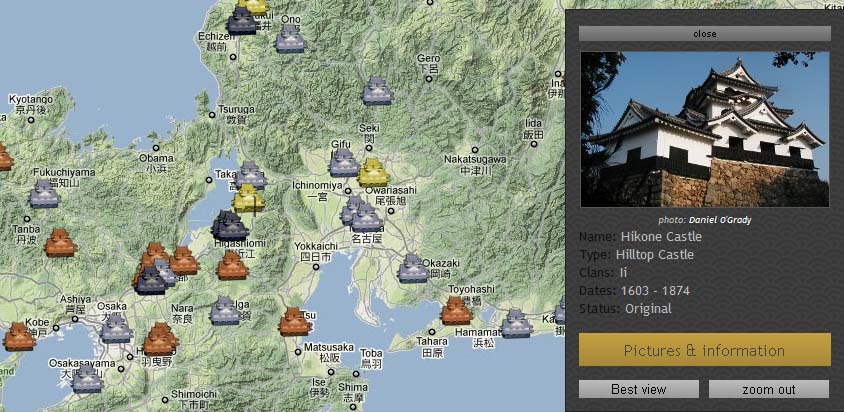
O’Grady’s castle information is arranged conveniently in dropdown menus and sidebars, and can be searched by several categories, including region (all over Japan and also two castles in Korea!), the main castle tower (whether it’s original or reconstructed), or whether the castle is with buildings or in ruins. All of these options are accompanied by copious graphics, and a search of the photos are divided up in individual categories of interior, main towers, turrets, interiors, gates, walls, buildings and bridges. Granted, not all of these categories are fully populated with photos, but one man can only travel so much!

The individual castle pages are arranged with basic who, what, where, when technical information, as well as brief historical biographies of each castle, domain information on the clans who occupied the area at various times, a timeline concerning castle-related historical affairs, and finally the various types of historical recognition given to castles or parts of castles by Japan. Some posts, such as Matsumoto Castle (a favorite of mine!) also feature personal videos from O’Grady’s trips these locations.

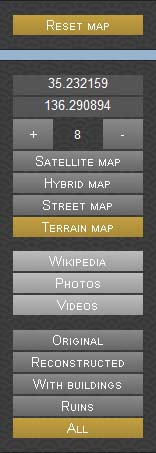
One of the most fascinating parts of the site is its integrated overlay map detailing all of the castles in Japan. Little colored icons indicate if they’re castles whose main tower was built before 1868, castles that have retained one or more of their original gates or turrets from before 1868, castles where a central tower exists but is a modern reproduction, most likely concrete, or castles where very little remains. Powered by Google, you can view the map according to satellite, terrain, street, or hybrid features and also see pictures and videos attributed to each area. Needless to say, I’ve lost a lot of time cruising this map and fantasizing about visiting more castles the next time I make it back to Japan. (For more on the map options, see his blog post on putting Japanese castles on the map.)

Also great is the blog area of the site, where O’Grady posts on a number of fun and informative topics related to castles and his travels. His compilation of statistics on when castles lost their tenshu (castle keep, or main tower) and the costs of rehabilitating castles are pretty amazing, but you’ll have just as much fun checking out info on the Japanese castle in Inception and what squatting on the throne in a Japanese castle was like.

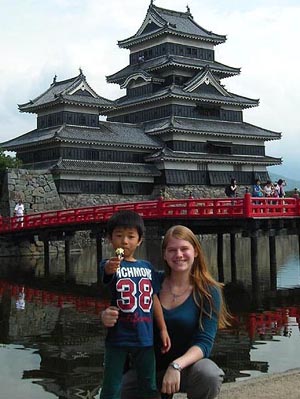
Castle props: My host brother and me at Matsumoto castle!

—

Navigating the site is very easy and the design is clean and appropriate. If I had to stop fangirling for a moment and be nitpicky, I would say that my only complaint is that there aren’t links to the Japanese homepages of these castles featured or brief tourist information on the webpages to make traveling to these places easier for non-Japanese speaking tourists. Of course, that isn’t necessarily the goal of this site, so it’s easily overlooked. If you’re interested in learning more about Japanese castles or just seeing some spectacular photography, procrastinate on that paper and definitely check out the Japanese Castle Explorer!

-Paula

Posted in culture, fun links, living abroad, study tools | Tagged , , , , , , , , | Leave a comment

Book announcement: Food and Fantasy in Early Modern Japan

We do love food here at Shinpai deshou, so we have another new book announcement for you on the topic that looks just as interesting as the last. If you find food history fascinating, it’s surely going to be a must-have item.

—

How did one dine with a shogun? Or make solid gold soup, sculpt with a fish, or turn seaweed into a symbol of happiness? In this fresh look at Japanese culinary history, Eric C. Rath delves into the writings of medieval and early modern Japanese chefs to answer these and other provocative questions, and to trace the development of Japanese cuisine from 1400 to 1868. Rath shows how medieval “fantasy food” rituals—where food was revered as symbol rather than consumed—were continued by early modern writers. The book offers the first extensive introduction to Japanese cookbooks, recipe collections, and gastronomic writings of the period and traces the origins of dishes like tempura, sushi, and sashimi while documenting Japanese cooking styles and dining customs.

For more information, see the book website:

http://www.ucpress.edu/book.php?isbn=9780520262270

—

Image from UCPress

Posted in announcements, culture | Tagged , , , , , , , | Leave a comment

Job opening: Historian In Residence

If you’re an accomplished researcher already or just wondering what other options might be available to you after a history Ph.D. in a Japan-related topic, see the following job opening:

—

The National World War II Museum

Institution Type:   Nonprofit
Location:   Louisiana, United States
Position:   Research Professional

Historian in Residence

Senior Historical Expert at The National WWII Museum in New Orleans. Responsible for leading Research Services Department, management of oral history collection, development of research capabilities, educational programs, and publications. Ph.D. in History, record of publishing, and public speaking experience required. Prior administrative experience desired. Send resume, writing sample, and three references to: Historian In Residence, The National WWII Museum, 945 Magazine St, New Orleans, LA 70130 by February 1. More information available on line at http://www.nationalww2museum.org/

Contact:

The National World War II Museum
945 Magazine Street
New Orleans, LA 70130

Website: http://www.nationalww2museum.org/
Closing Date 02/01/2011

Posted in announcements, job openings, jobs | Tagged , , , , , , | Leave a comment

Call for Papers: “Languages of Dissent in Modern Japan”

Conference: The Rocky Mountain Modern Language Association Convention
Date: October 6-8, 2011
Location: Scottsdale, Arizona
Proposal deadline: March 1, 2011

Website: http://rmmla.wsu.edu/conferences/conf11Scottsdale/default.asp

Post-WWII Japan has confronted an array of social problems: environmental pollution, social injustice, bullying, gender discrimination, hikikomori (shut-ins) and youth crises of various forms, etc.  Lacking a strong tradition of activistic political participation, however, Japanese have labored to internalize their rights and vocalize their demands as citizens.  This panel seeks to explore the literary, journalistic, activistic, and other forms of expression that Japanese groups and individuals have employed since WWII as they strive for sociopolitical engagement.

Interested participants are requested to send paper abstracts (roughly 250

words) to Puck Brecher ( wbrecher@wsu.edu ) by March 1, 2011.  Proposals should include institutional affiliation and AV requirements.  In order to present their papers, all panel members must be members of the RMMLA by April 1, 2011. Please see http://rmmla.wsu.edu/member/join-renew.asp for details.

Posted in announcements, conferences, graduate school, social networking | Tagged , , , , , , | 1 Comment