SSRC/JSPS fellowships for PhDs and ABDs

The JSPS Postdoctoral Fellowship Program for ABDs and recent PhDs provides promising and highly qualified researchers in the humanities and social sciences with the opportunity to conduct extended research at leading universities and research institutions in Japan. Fellowship terms are for single continuous stays from 1 to 12 months (short-term) or 12 to 24 months (long-term). Short-term fellowships must commence between April 1, 2012 and March 31, 2013, and long-term fellowships must commence between April 1, 2012 and September 30, 2012. Applicants for short-term fellowships must submit proof of a doctoral degree received no more than six years prior to April 1, 2012 or a letter from an advisor attesting to the fact that the applicant is within 2 years of completion of degree. Long-term fellowship applicants must submit a copy of a PhD diploma dated no more than six years prior to April 1, 2012. JSPS currently provides round-trip international airfare for fellows originating in the U.S., insurance coverage for accidents and illness, a monthly stipend of 362,000 yen for PhDs (200,000 yen for ABDs), a settling-in allowance of 200,000 yen, and eligibility for an additional 1,500,000 yen annually for research expenses for stays of 12 to 24 months.

The application deadline for both short-term and long-term fellowships is December 1, 2011.

For eligibility requirements and to download the application form, please consult our website at http://www.ssrc.org/fellowships/jsps-fellowship/

Social Science Research Council
Japan Program
One Pierrepont Plaza, 15th Fl.
Brooklyn, NY 11201
Tel: 212-377-2700
japan@ssrc.org<mailto:japan@ssrc.org>

Posted in announcements, funding | Tagged , , , | Leave a comment

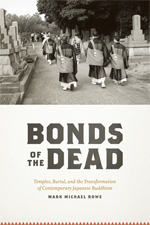
Book announcement: Bonds of the Dead: Temples, Burial and the Transformation of Contemporary Japanese Buddhism

http://www.press.uchicago.edu/ucp/books/book/chicago/B/bo12046404.html

Despite popular images of priests seeking enlightenment in snow-covered mountain temples, the central concern of Japanese Buddhism is death. For that reason, Japanese Buddhism’s social and economic base has long been in mortuary service–a base now threatened by public debate over the status, treatment, and location of the dead. Bonds of the Dead explores the crisis brought on by this debate and investigates what changing burial forms reveal about the ways temple Buddhism is perceived and propagated in contemporary Japan. Mark Rowe offers a crucial account of how religious, political, social, and economic forces in the twentieth century led to the emergence of new funerary practices in Japan and how, as a result, the care of the dead has become the most fundamental challenge to the continued existence of Japanese temple Buddhism. Far from marking the death of Buddhism in Japan, Rowe argues, funerary Buddhism reveals the tradition at its most vibrant. Combining ethnographic research with doctrinal considerations, this is a fascinating book for anyone interested in Japanese society and religion.

“Bonds of the Dead is an intriguing and impressive work of social analysis that helps us understand the current state of religious practice and spiritual concern in Japan. It makes us think not only about how these Buddhist practices are responding to changes in Japanese society but about how they are helping to constitute those changes. Rowe succeeds in triangulating field observations and interviews with textual analysis, and he uses his time in Niigata, Tokyo, and elsewhere to situate his analysis of these movements in convincing detail. An appealing, instructive, and entertaining book.”–William Kelly, Yale University

“Reading this book, I came away with renewed admiration for Rowe’s skills as an interviewer and as an analyst of contemporary developments in Japanese Buddhism. Bonds of the Dead will be widely recognized as setting a new standard in studies of contemporary Japanese religious life.”–Helen Hardacre, Harvard University

“Bonds of the Dead contains a wealth of fascinating information that reminds us that human societies rely on religion to confront the insurmountable problem of death. Rowe’s first-person perspective allows the reader to gain insights into how ordinary people approach Buddhist temples and how ordinary priests attempt to serve them, and he writes in a breezy and entertaining manner that is accessible to a broad audience of people interested in contemporary Japanese society and religion.”–William Bodiford, University of California, Los Angeles

Posted in announcements, culture | Tagged , , , , , , | Leave a comment

Scholarship: Dissertation scholarship:Buddhist Studies at the Ludwig-Maximilians-Universitat

The doctoral program in Buddhist Studies at the Ludwig-Maximilians-Universitat in Munich, Germany offers a PhD scholarship for a dissertation project related to Buddhism.

Deadline for application: 15th November 2011
Start of scholarship: 1st January 2012 or later
End of scholarship: 31st December 2013; an extension may be possible, depending on positive evaluation and available funding
Scholarship amount: 1000 euros per month + support for travel expenses
Application via: http://www.graduatecenter-lmu.de/buddstud/index.php

The doctoral program in Buddhist Studies at the Ludwigs-Maximilian-Universitat in Munich is based on a cooperation of Asian Studies (Indology, Japanology, Sinology, Tibetology) and Religious Studies and promotes and supervises PhD theses related to Buddhism within a broad range of subjects and disciplines. To strengthen the disciplinary and communicative skills of the doctoral students, the research-oriented study program is complemented by workshops and teaching placements as well as by transferable skills training.  Intensive supervision by mentoring teams will help students to accomplish doctoral projects at the highest level. In addition, the integration of the doctoral students into interdisciplinary and international networks will promote their professional development as young scholars. The program is currently funded by the DAAD (German Academic Exchange Service) and by a grant of LMUexcellent promoting doctoral research training.

The doctoral program is launching a scholarship for an excellent PhD project related to any field of Buddhism from 1st January 2012 until 31st December 2013.

The prerequisites for application are non-German citizenship, a Master of Arts or Magister Artium degree or equivalent, excellent knowledge of at least one Buddhist source language, outstanding qualifications in the subject and fluency in English. A basic knowledge of German is also desirable and the willingness to learn German/improve German language skills will be expected.

To apply please fill out and submit the “Online Application Tool of the LMU Doctoral Program Buddhist Studies”
(http://www.graduatecenter-lmu.de/buddstud/index.php) and upload the following documents:

1.  proof of qualification for university entrance
2.  certified copies of all relevant school and university diplomas
3.  an outline of the planned dissertation project (maximum 5 A4 pages) containing information about when you started or will start your PhD project and when you can start in our doctoral program.

If you have any questions concerning the program or with regard to the scholarship please do not hesitate to contact us at: buddhist-studies@lrz.uni-muenchen.de

Posted in announcements, financial assistance, funding, graduate school | Tagged , , , , , , , | Leave a comment

Call For Papers: Graduate Student Conference on East Asia

Twenty-first Annual Graduate Student Conference on East Asia
Columbia University in the City of New York
Friday February 10 to Saturday February 11, 2012

Graduate students are invited to submit papers for the Twenty-First Annual Graduate Student Conference on East Asia. This two-day conference provides a forum for students from institutions around the world to meet and share ideas and research with their peers. The 2012 conference marks the beginning of a new decade in the conference’s history. As such, this year’s participants will have the opportunity, in the spirit of reinvigoration, to use this year’s conference as a forum for the promotion and circulation of new ideas within East Asian Studies. In addition, participants will gain valuable experience in presenting their work for discussion with other graduate students as well as Columbia faculty.

We welcome applications from graduate students engaged in research on all fields in East Asian Studies, including history, literature, political science, economics, art history, religion, sociology, archaeology, law, environmental studies and anthropology.

PARTICIPATION:

Participants can take part in the conference as presenters and/or discussants:

Presenters deliver talks no longer than 15 minutes that summarize research in progress.

Discussants introduce the panelists and facilitate the 20-minute discussion session following the presentations.

APPLICATIONS (due November 27, 2011):

Please fill out the application on http://www.columbia.edu/cu/ealac/gradconf/form.htm with the required
information:

Your full name as you would like it to appear in the abstract booklet and conference schedule
Contact info (e-mail)

Institutional affiliation
Major area of study (region and discipline)
Title of your paper
One-page (250 words max.) abstract in print-ready format, including your name and institution
We will not accept applications without abstracts (Please provide five keywords for your paper in the abstract).

Notification of acceptance – within two weeks of application deadline.

Final Papers (5-7 pages maximum) are due January 8, 2012.

NOTE:

Please indicate any audiovisual equipment you will need for your presentation. Please note that our A/V resources are quite limited, and we may not be able to satisfy everyone’s needs. Presenters must bring their own laptops and VGA adapters for computer presentations.

Since presentations will be limited to 15 minutes, full-length research papers or theses will not be accepted.

There is a required $7 registration fee payable on arrival at the conference.

__________________________________________________________

HOUSING:
We encourage everyone to arrange their own accommodations. The conference runs from Friday afternoon to late Saturday evening. Travel and lodging information can be found on the conference website.

CONFERENCE ORGANIZERS:
Joshua Batts
Glenda Chao
Jae Won Chung

Clay Eaton
Matthieu Felt
Nicole Kwoh

CONTACT INFORMATION:

http://www.columbia.edu/cu/ealac/gradconf/

2012eagradcon@gmail.com

Graduate Student Conference on East Asia
Department of East Asian Languages and Cultures
407 Kent Hall, Mail Code 3907
Columbia University
New York, NY 10027

FAX: 212-678-8629

Posted in announcements, conferences, graduate school | Tagged , , , , , , , , , , , | Leave a comment

Fun Link(s) Friday: Halloween Bento

In Japan and missing Halloween? Celebrating Halloween and missing Japan? Why not combine the two with a delicious Halloween bento?

Makiko Itoh of Just Bento and Just Hungry has featured a variety of Halloween-themed bento art from bento bloggers across the internet.

Original from Lian Mama Bento, appeared on Just Bento.

“Great Bento Ideas: More Halloween bentos!” (26 Oct. 2010)

“Great Bento Ideas: Simple and clever Halloween bentos by a really cool mom” (11 Oct. 2010)

“Halloween bentos galore!” (30 Oct. 2009)

“Bento no. 54: Hallowe’en Zombie Kitty Bento” (28 Oct. 2008)

Photo from The Hungry Mouse.

Jessie of The Hungry Mouse received a Halloween candy bento.

Photo from Happy Little Bento

Sheri Fujihara Chen posted several Halloween bento made for her children at Happy Little Bento: “Mummy Musubi and Ghosties Bento.”

From Bento Anarchy

Finally, Natakiya at Bento Anarchy has posted quite a few festive Halloween bento recently:

“A Proper Orange”

“It was a dark October night”

“Candy Corn Onigiri”

“The Ghost Army Wants You”

ハッピーハロウィン!

Leah

Posted in culture, fun links | Tagged , , , , , | 6 Comments

Job Opening: Japanese History, rank open, Georgia Gwinnett College

Institution: Georgia Gwinnett College, School of Liberal Arts
Location:   Georgia, United States
Position:   Assistant Professor, Associate Professor, Full Professor History (Japan)

In anticipation of increases in enrollment for the 2012-2013 academic year, Georgia Gwinnett College (GGC) invites applicants for faculty positions in History (Japan) starting August 1, 2012. The successful candidates will be expected to teach the world history and/or US history survey courses as well as courses within their specialties. Applicants should demonstrate significant innovations in teaching, superior service to the institution, and established research credentials. Commitment to building a new college is also essential. GGC emphasizes a student-centered learning environment. Faculty will be expected to teach lower-division courses in addition to upper-division courses.

Founded in 2005, GGC is the 35th institution of the University System of Georgia. GGC is a premier 21st century four-year liberal arts college accredited by the Southern Association of Colleges & Schools. With a current enrollment of over 8,000 students, GGC expects within two years to exceed 10,000 students, including both residential and commuter students. Located in the greater Atlanta metropolitan area, GGC provides a student-centered, technology-enriched learning environment. Gwinnett County (pop. 780,000+) is home to a variety of businesses, including organizations involved in health care, education, and information technology.

SALARY: Commensurate with education and experience with excellent benefits.

Minimum Qualifications:  Ph.D. in history
Specialty in Japan history. Period of specialization is open.
Candidates should have at least 18 graduate hours in history courses.

MUST APPLY ONLINE TO(copy and paste link into URL): jobs.ggc.edu/applicants/Central?quickFind=51644

REVIEW OF APPLICATIONS WILL BEGIN IMMEDIATELY

Questions:  apply@ggc.edu
GGC website:  www.ggc.edu
All jobs:  https://jobs.ggc.edu

Due to the volume of applications, applicants may not receive a reply from the College unless an applicant is selected for an interview. Review of applications will continue until positions are filled. Hiring is contingent upon eligibility to work in the United States and proof of eligibility will be contemporaneously required upon acceptance of an employment offer. Any resulting employment offers are contingent upon successful completion of a background investigation, as determined by Georgia Gwinnett College in its sole discretion. Georgia Gwinnett College, a unit of the University System of Georgia, is an Affirmative Action/Equal Opportunity employer and does not discriminate on the basis of race, color, gender, national origin, age, disability or religion. Georgia is an open records state.

Contact: MUST APPLY ONLINE TO (copy and paste link into URL):jobs.ggc.edu/applicants/Central?quickFind=51644

Questions:  apply@ggc.edu
GGC website:  www.ggc.edu
All jobs:  https://jobs.ggc.edu
Website: www.ggc.edu

Posted in announcements, job openings, jobs, Uncategorized | Tagged , , , , , , | Leave a comment

Job Opening: Researcher

http://www.iiicareer.com/applicant/en/detail.php?recid=41160

Location: Washington D.C.
Level/Type: Experienced/Full
Start date: the beginning of November
Languages: English/Japanese/Spanish

Job description:

Job Description: -To assist Chief Representative with research and production of reports on South America, Latin America, US economy, finance, foreign trade and other international issues. -To do administrative reporting to the headquarters. -To develop personal network within Washington D.C. through attendance to congressional hearings, seminars, and other meetings. Qualifications: -Masters in economics, finance or international relations preferred. -Research experience -Proficiency in English and Japanese. (writing and verbal) Spanish is a plus

Thanks to Korey for the job listing!

Posted in announcements, job openings, jobs | Tagged , , , , , , | Leave a comment

Applying to JET as a CIR, Part 3

Part 1: What is a Coordinator for International Relations?
Part 2: The Application Process

Part 3: Life as a CIR

Placement

Positions for CIRs are extremely varied in terms of location, duties, and expectations. ALTs know from the start that their primary duty at work will be teaching English at public schools. There’s a lot of variation between what grade level, what type of school, location, staff, and the involvment of the ALT with the teachers, but teaching English is the main objective. With CIRs, you really don’t know what sort of work you’re going to get, and the nature of the job varies wildly based on your office, location, and budget. I think a lot of CIR applicants go into the process with high hopes of working at a city office translating and interpreting, but there’s quite a range.

For example, some CIRs inherit an established position where there are yearly events or consistent work that is expected of them. Some CIRs have to build up their jobs and create their own work.  Some CIRs work chiefly with their contracting organization (an international division); others work mainly with an international friendship club; others work with a variety of organizations. A lot of this depends on the history of your position and the budget of your contracting organization.

Your work depends so completely on your placement that it redefines the motto of Every Situation Is Different (ESID). For example, among CIRs I knew during my two years on JET,

  1. CIR A (urban) does translation and interpretation almost exclusively.
  2. CIR B (urban) works on developing mid-to-large-scale cultural events, sister-city relations, and translation, as well as some school visits.
  3. CIR C (town) focuses on school visits for young children and organizing local cultural events; often works with an international club on events.
  4. CIR D (rural) holds a speech series, writes a monthly column, does school visits, and organizes multicultural events.
  5. CIR E (rural) does school visits everyday and organizes low-budget multicultural events.

Work as a Rural CIR

My rural seaside town.

One thing I would like to emphasize no CIR should be made to feel bad about his or her job or placement. Your interests and workplace preferences will probably not be taken into account when you are selected for your actual position. In my case, I had academic experience translating and pre-professional experience in event planning, but I was assigned to a position with a heavy emphasis on teaching English to elementary-school children. Considering I had no experience with or interest in teaching or working with children, it was a shock to me.

My contracting organization was a rural town board of education, and their only expectation for me was for me to teach English at two elementaries and one junior high. I was well aware that I might be doing eikaiwa activities or school visits, but I did not expect to have the amount of teaching hours for which I was scheduled. “Teaching CIRs,” as we call ourselves, have it rough because the amount of non-teaching work you can do is based on your board of education’s budget. While other established CIRs might have a bit of the budget set aside for their events, teaching CIRs may not, as some contracting organizations really just want a Japanese-speaking ALT. Essentially, I was doing two jobs: putting in the same number of hours in the classroom as an average ALT while spending the rest of my work day doing translation work, event planning, and AJET outreach (more on this below).

Most CIRs find that duties they initially were apprehensive about turn out to be fun and rewarding: school visits, interpretation sessions, big events aimed at children. I tried my best to do what the BOE wanted, but I don’t think I ever became comfortable with my time in the classroom, despite getting to work with some exceptional and creative students. Furthermore, I was hoping to leave JET after 2 years with event planning and translating work on my resume so that I could pursue a career at a Japan-based cultural non-profit or as a translator.  Because the basic job duties did not include anything I would need to pursue my dreams, I spent two years working to expand my role.

Making Jack-o-Lantern(ish) cookies for a cooking lesson.

Fortunately for me, my immediate bosses really wanted to help me create more projects. I got approval to run a series of international cooking lessons in cooperation with the local children’s club (児童館),and with a lot of pushing, I was able to do some translation work—the town garbage chart, legal documents, tax documents, a children’s book about our town. (However, if you are trying to go outside your role, be prepared to deal with the bureaucracy: start early and don’t bank it all on one project.)

I also got involved in the local JET community. I volunteered for other JETs’ events from cooking lessons to international salons. I started and acted as editor of The Ishikawa JET Kitchen, a cookbook for English-speaking expats in Japan. I also started blogging for the Ishikawa JET blog soon after arriving and took over as editor in my second year, and my experience with writing, translating, tourism, and culture for the blog helped me get my current position as the web content manager of Art of Kanazawa and Discover Kanazawa, an art-based tourism project in Kanazawa funded by METI.

Post JET

Traveling in Gokayama, Sept. 2011

Although I originally had intended to go into non-profit work, I actually got really interested in work in the tourism and travel industries in my second year of JET after I had spent a year blogging about events and destinations in Ishikawa and planning trips for my family and eventually my friends. My knowledge of Ishikawa and my experience translating, researching, and writing, as well as my connections to the JET community (a colleague recommended the job to me and me to my employer) were crucial to my being able to work in this field. Even though my CIR experience wasn’t what I had expected, it was thanks to my work as a JET that I am here doing something I am truly passionate about.

I hope everyone who is lucky enough to receive a CIR position finds enjoyment and fulfillment in the work, and that every CIR learns more about her/himself in the process of working and living here in Japan. Sometimes the career- and life skills you develop while working as a JET aren’t the ones you set out to acquire–you may surprise yourself!

Good luck to all the 2012 applicants!

-Leah

Posted in applications, JET, jobs, living abroad, main posts | Tagged , , , , , | 6 Comments

Symposium: Imperial Exposure: Early Photography and Royal Portraits Across Asia

Imperial Exposure Symposium

Location: Freer and Sackler Galleries, Washington DC, District of Columbia, United States
Symposium Date: December, 5-6, 2011

I would like to announce the symposium, Imperial Exposure: Early Photography and Royal Portraits Across Asia, at the Freer and Sackler Galleries in Washington, DC, on December 5 and 6, 2011. Fifteen scholars from around the world will present talks on aspects of royal portraiture across Asia, from the Ottoman empire to Korea and Southeast Asia, providing a rare opportunity for a comparative dialogue on the history of photography outside of Europe.
Conference speakers include Ali Behdad, John Clark, Deepali Dewan, Holly Edwards, Maki Fukuoka, Luke Gartlan, Yi Gu, Christine Kim, Yuhang Li, Hyung Il Pai, Maurizio Peleggi, Ying-chen Peng, Claire Roberts, Mary Roberts, and Roberta Wue.

To learn more about the conference and to register, please visit the website: http://www.asia.si.edu/events/IESymposium/.

{the program includes presentations on Japan}

Posted in announcements, conferences, culture | Tagged , , , , , , | Leave a comment

Job Opening: Art History (incl. Asia, Middle East, Africa)

Institution: University of Dayton, Department of Visual Arts
Location:   Ohio, United States
Position:   Lecturer (renewable) in Art History, African, Asian or Middle Eastern

Lecturer in Art History. Lecturer with specialization in African, Asian, Middle Eastern, or broadly global art history and visual culture. Strong preference given to candidates with a secondary area in either Western or non Western traditions.

This is a one-year, full-time, and non-tenure track position with possibility of renewal. 4-4 course load may be comprised each term of one upper-division course in the lecturer’s primary area of specialization, one survey course or upper-division course in a second area of specialization, and two sections of a non- chronological, thematically-based Introduction to the Visual Arts course for non-majors. ABD in Art History required, Ph.D. preferred with U.S. university-level teaching experience and strong oral communication skills preferred; innovative teaching pedagogy and experience working with students from diverse backgrounds preferred.

Send CV, application letter, a sample scholarly writing, statement of teaching philosophy,  and evidence of teaching effectiveness to jobs@udayton.edu by January 14, 2012. Three letters of recommendation should be sent to: Roger Crum, Art History Search Committee, Department of Visual Arts, University of Dayton, Dayton, Ohio, 45469-2923.

The University of Dayton, founded in 1850 by the Society of Mary, is a top ten Catholic research university. The University seeks outstanding, diverse faculty and staff who value its mission and share its commitment to academic excellence in teaching, research and artistic creativity, the development of the whole person, and leadership and service in the local and global community.

To attain its Catholic and Marianist mission, the University is committed to the principles of diversity, inclusion and affirmative action and to equal opportunity policies and practices. We act affirmatively to recruit and hire women, traditionally underrepresented minority groups, people with disabilities and veterans

Contact: Roger Crum, Art History Search
Committee, Department of Visual Arts,
University of Dayton, Dayton, Ohio, 45469-2923.

Website: www.udayton.edu/artssciences/visualarts/index.php

Posted in announcements, job openings, jobs | Tagged , , , , , , , , , | Leave a comment