
Call for Papers: “The United States in East Asia”

Location: Seoul, South Korea, September 21-22, 2012

“The United States in East Asia”
The 47th International Conference Organized by The American Studies Association of Korea (ASAK)
Seoul, South Korea
September 21-22, 2012

The American Studies Association of Korea (ASAK) is pleased to announce a conference on The United States in East Asia to be held in Seoul, South Korea, September 21-22, 2012.

East Asia is a region of growing significance in the twenty-first century, where the US has been a marked presence and a persistent influence. The three biggest economies of the region–Japan despite its recent decline, South Korea, and China–currently account for 22.3% of the world population, 19.6% of global production, and 45.7% of international reserves. Each nation in the region has witnessed a complicated history of interactions with the US: political and economic cooperation as well as contention, circulation of ideas and cultural practices, and educational and social exchanges, to name a few. A truly interdisciplinary approach is called for to capture the sense of the United States as a geopolitical actor and a cultural imaginary in East Asia. A further challenge lies in attending to the local and transnational specificities that have produced diverse ways of accommodating the US influence.

Recognizing this intricacy, the 2012 ASAK conference aims to further the understanding of the US in East Asia by bringing together scholars in diverse disciplines from different parts of the world. In doing so, we hope to widen and deepen the local, national, and transnational perspectives on the US. We believe the East Asian vantage point of our conference will provide a forum for rethinking the practice and methods of American Studies in the current world order.

We welcome paper proposals in either English or Korean from various disciplines on topics such as:

-Economic ties and political interests of the US in East Asia, and vice versa
-Elections or power transitions in East Asia and the US and their foreign policy implications
-The influence of US economic policies and models, business corporations, and/or financial institutions
-Issues of immigration and migration, including reverse migration, labor migration, and brain drain
-Specific examples depicting the importance of the US presence in East Asia
-The circulation and exchange of popular culture between the US and East Asia
-Appropriations of US modes of fashion and cuisine
-Representations of the US in the media, literature, and popular culture of East Asia
-US influence on East Asian educational systems and orientations
-The English fever phenomenon in East Asia
-The teaching of American literature, culture, and history in East Asia
-Representations of East Asia in American literature and/or popular culture
-Asian American and/or diasporic literature
-Comparative American Studies in other nations or regions such as South Asia, the Middle East, the Americas, and Europe

These topics in no way comprise an exhaustive list. You are encouraged to submit proposals on other topics related to the overarching theme of the conference. Interdisciplinary perspectives and new research methodologies are especially welcome.

Proposals may be submitted as individual paper proposals or as session proposals. Individual proposals should include a brief abstract of no more than 250 words and a one-page abbreviated CV. Session proposals should include a one-page proposal with title and topics for a session of three to four presentation papers along with individual abstracts and bios. Each presentation, delivered in either Korean or English, will be limited to twenty minutes followed by discussions and Q&A. Graduate students are also welcome to submit their proposals and participate in the conference. All proposals should be sent to the Organizing Committee at asakorea@gmail.com by March 15, 2012. Participants will be notified of the acceptance of their proposals by April 15, 2012. The registration fee for overseas participants (waived for students) will cover accommodations for three nights and meals for two days during the conference. Participants will be responsible for travel expenses, including airfare and medical insurance, if applicable. For further questions, please do not hesitate to contact the Organizing Committee.

Important dates:
Deadline for submitting abstracts: March 15, 2012
Notification of acceptance of papers: April 15, 2012
Submission of papers for the conference proceedings: July 31, 2012

Registration fees:
Early bird (before June 30, 2012) USD 75
Standard (after June 30, 2012) USD 100

Peggy Cho
Email: asakorea@gmail.com
Visit the website at http://www.asak.or.kr
Posted in announcements, conferences, graduate school | Tagged , , , , , , , , , , | Leave a comment

Job Opening: Simons Visiting Chair in International Law and Human Security

Institution: Simon Fraser University, School for International
Location:   British Columbia, Canada
Position:   Visiting Professor, Simons Visiting Chair in International Law and Human Security

Simons Visiting Chair in International Law and Human Security
School for International Studies

SIMON FRASER UNIVERSITY

The School for International Studies invites applications from scholars and from those with relevant professional experience in international law or diplomacy for this visiting position, to be taken up in the Fall Term (September-December) 2012. The successful candidate will be asked to teach one senior undergraduate course, to mount a workshop on her/his research interests, and to contribute to the research activity of the School. The position will be remunerated at a level appropriate to the successful candidate’s seniority and experience and assistance may be given with travel and housing costs.

Continue reading

Posted in announcements, job openings, jobs | Tagged , , , , , , , , , | Leave a comment

Fun Link Friday: Ideal Japanese Leaders Poll

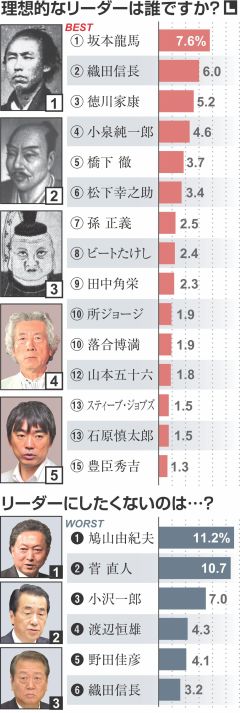
This week’s Fun Link Friday comes from Japan Probe’s posting of an online poll from Sankei Shinbum in a leadership series on January 2nd. The poll asks participants to rate who they thought were ideal leaders and the worst leaders, past and present.

Sakamoto Ryōma 坂本龍馬 (1836-1867), the rebel leader who attempted to overthrow the Tokugawa shogunate, is at the top of the ideal leader list and maintains a wide popular appeal.

Oda Nobunaga 織田信長 (1534-1582) appears on the best list at number 2 and also the worst list at number 6. You can’t have it all, I suppose, when you change the face of warfare both effectively and brutally, but at least in burning things to the ground and conquering half the provinces back in the day you can say you’ve been decisive.

Tokugawa Ieyasu 徳川家康 (1543-1616) rounds out the top best three as the type of cunning leader who makes sure he’s in the right place at the right time with the right people.

An overwhelming majority of participants in the poll answered “yes” when asked if there is a greater need for strong leadership in today’s government. Having these iconic historical figures at the top three may certainly be a reflection of that. Is there a government leader from the last few years who could be called the “Ryoma of Heisei”? The poll results seem to answer with a resounding “no.” The top 3 worst leaders selected are the some of the most recent prime ministers, with Hatoyama Yukio taking the top spot. If you want to see the full translated list of the best and worst voted, check out the translations provided by Japan Probe.

Have a great weekend!

Posted in culture, fun links | Tagged , , , , , | Leave a comment

Job Opening: Mitsubishi UFJ Trust & Banking Corporation (U.S.A.)

Via the NAJAS Employment Connection. View original post here.

Company: Mitsubishi UFJ Trust & Banking Corporation (U.S.A.)
Category: Finance and Accounting
Job Title: Clerk
City: New York
State/Province: NY

Brief Description of Duties
This is an entry level position, responsible for supporting the client service operations of the Bank’s custody business; by opening and closing client accounts; communicating and handling client inquiries in both English and Japanese. In addition, by performing other duties as deemed necessary and appropriate by the Supervisor and/or Department Head.

Language Skills: Bilingual English/Japanese
Contact: Human Resources
Email: hrrecruiter@us.tr.mufg.jp

How To Apply
Interested and qualified candidates should submit their cover letter, indicating salary history and requirements to the Human Resources Department at hrrecruiter@us.tr.mufg.jp, by March 2, 2012.

EDUCATION & REQUIREMENTS

  • Bachelor’s degree preferred
  • Minimum 1-2 years of work experience and/or training in a financial institution is highly desired
  • Experience in client service or operational area in the Custody business is a plus
  • Fluency in Japanese and English, both verbal and in writing (business level) is mandatory
  • Candidate must be detailed oriented, organized and a fast learner
  • Candidate must possess strong interpersonal and communication skills
  • Proficiency in Microsoft Word, Excel, PowerPoint and Access is required
  • Flexible to work overtime when necessary Must be legally qualified to work in the U.S.

URL: us.tr.mufg.jp

Posted in announcements, job openings, jobs | Tagged , , | Leave a comment

Job Opening: International History, Professor, London School of Economics

Institution: London School of Economics and Political Science, International History
Location:   United Kingdom
Position:   Full Professor, Professor in International History

Department of International History
Chair in International History

The Department of International History is seeking an exceptional candidate to provide academic leadership in research and teaching. The appointee will have an international reputation for his or her outstanding record of world class research and publication as well as a PhD in the discipline. She or he will be expected to teach and conduct research in international history together with contributing to departmental administration.

Continue reading

Posted in announcements, job openings, jobs | Tagged , , , , , , , | Leave a comment

Internship Opening: Summer 2012 Communications Intern, Japan Society (New York)

For full details and other internship opportunities, see Japan Society’s internship page.
The Japan Society volunteer internship program offers individuals opportunities to increase their awareness of contemporary Japan and gain knowledge of its history and cultural heritage while simultaneously preparing for professional and academic careers. Select, qualified interns are invited to volunteer to contribute their talents and abilities to assist Japan Society’s programs in the arts, business, education and public affairs. Interns participate in the day-to-day activities of these programs, in addition to specific projects. While at the Japan Society, interns serve alongside experts on Japan from diverse disciplines and enjoy the benefits of its many resources.

Communications Intern
Japan Society’s Communications Department seeks interns to assist with publicity and promotion for Summer 2012 (June-September).

Interns for Japan Society’s Communications Department assist with marketing the Society as a whole and dozens of individual events from the Corporate, Education, Film, Gallery, Lectures, Performing Arts and Policy Programs. By joining Japan Society’s Communications team, candidates will have an opportunity to gain a well-rounded understanding of nonprofit communications while developing valuable skills in all facets of publicity, promotion and advertising.

Responsibilities:

    • Assist drafting publicity materials (press releases, pitches, photo tips), and outreach to press.
    • Maintain press archives and create press clips.
    • Contribute to Japan Society’s blog and social media sites.
    • Attend events and provide assistance for press check-in.
    • Maintain press database.
    • Construct press kits.
    • Research publicity, promotion and advertisement opportunities.
    • Distribution of promotional materials.
    • Administrative duties including data entry, filing, photocopying, etc.

Qualifications:

    • Excellent communication skills (written and verbal).
    • Proficiency in Microsoft Word & Excel.
    • Ability to self-start and follow through on lengthy projects.
    • A consecutive 15-20 hours per week (including some evenings) commitment is preferred.
    • Interest in Japanese culture and Japanese language skills are a plus.

This is an unpaid internship. Please e-mail a cover letter and a resume to Kuniko Shiobara, at kshiobara@japansociety.org. No phone calls please.

Posted in announcements, job openings, jobs, senior year, undergraduate | Tagged , , , | Leave a comment

FAQ: The content of “What can I do with a B.A. in Japanese Studies?”

This week I’d like to take a moment to address a frequently asked question we get here at Shinpai Deshou to clarify for our readers some of the reasons behind our daily content:

If the title of your blog is “What can I do with a B.A. in Japanese Studies?” why don’t you have more content related to BAs instead of MAs and PhDs (especially job postings)?

It is true that many of our job openings listed are for PhD or MA level applicants, and continuing on for your MA or PhD is one of many options people have after acquiring their BA. There are three main reasons our information leans towards higher level education and academia:

1) More and more, the market demands higher levels of Japanese to acquire positions, and often getting an MA or PhD before continuing into the job market (regardless of where your focus is!) is a natural or necessary move for people. Most people will tell you that you have to study Japanese for 7 or 8 years to become “fluent.” If you’re thinking of getting even a non-academic job that does happen to require high level language skills, you may have to consider MA and PhD programs in order to get the training you need. But keep in mind that we also often post positions such as international program coordinators, directors of international programs, internships, etc., which are not necessarily “academic” positions, but can be rooted in academic programs. Learning and language are natural partners.

2) These jobs offer insight into the variety of fields people who are pursuing their BA might focus their studies if they are serious about continuing with Japanese. Aside from the humanities, there’s political science, international relations, film, media… with many non-academic jobs into which these areas could certainly branch off. Unless already entrenched in the academic community and familiar with the mailing lists that post many of these jobs (I know that as a BA I certainly wasn’t!), people may be unaware of these diverse opportunities. We try to post as many non-academic positions as come our way. These hopefully serve as a useful guide for others to see how Japanese can be used, but they can’t be all inclusive. What comes into our inboxes directly is what we sift through and post a variety of. The majority of jobs advertised via mailing list happen to be in academia, where you’re going to find the demand for higher degrees.

3) We simply don’t have the time or resources to search out all of the translation positions, business opportunities, etc. that are out there on the internet (although we are currently recruiting people with this experience to write articles for us!). Our blog should not be considered a one-stop source for potential employment opportunities. A number of these are not the type of positions that have mailing lists, or if they do, our writers may not be in those fields or have access to their mailing lists. Many have to be searched for on databases and individual websites. This is why we provide links under our “Employment” section (such as “Job Sites” – which we hope to update with more soon!) for people to seek out other options as applicable to them. In addition, under our “Articles” section we have a broader selection of information for people who may want to start their careers directly after a BA (such as pursuing military options, teaching abroad, amateur translation, using consulting agencies for the job search, etc.). Our site otherwise tries to provide a variety of information on events, written works, personal experiences, and other aspects of working on Japanese that will be helpful for BA students to decide where they’re taking their Japanese next. Our job opening posts are meant not only to be helpful for those actually looking for this level of position, but people who want to see what types of positions open up and what fields seek what kind of qualifications. They are meant to be supplementary content to our more permanent materials which are more relevant to non-academic pursuits and prompt people to think about the variety of fields that use Japanese.

That being said, the title of the blog “What can I do with a B.A. in Japanese Studies?” should not be interpreted that people stopping at the BA are our primary focus. Rather, that getting asked this question, or something similar (“So, what do you do with Japanese??”) is typically a starting point from which many of us begin to think critically about our future in the Japanese field and what we can do after that BA. Some will stop at the BA, some won’t. Shinpai Deshou hopes to alleviate some of the fears surrounding this question by offering more insight into how to tackle the future and become aware of the variety of options out there, regardless of your intended level of degree. And “What the heck do I do with Japanese?” just isn’t as catchy of a title, is it? 😉

We greatly appreciate feedback from people who have expressed concern over this, and if anyone who did stop at the BA and hop directly into a Japan-related career feels they have advice or insight that they’d like to share with other readers, feel free to email us at shinpai.deshou@gmail.com and we can discuss a contribution to the blog! We welcome writers from all different areas of the field.

Posted in announcements, graduate school, job openings, jobs, site maintenance, undergraduate | Tagged , , , , , , , , | 6 Comments

Study Traditional Theatre in Kyoto this summer!

Traditional Theatre Training 2012 is accepting applications for its 28th annual intensive program July 20-August 10th. Advanced undergraduate and graduate students, teachers and researchers, and artists from many fields are invited; Japanese language is not necessary. Designed to overcome obstacles of time, introductions, finances, and language, T.T.T. offers daily study with masters in noh dance-drama, kyogen stylized comedy, or nihonbuyo classical dance. A three-day Orientation to Japanese performing arts conducted by T.T.T. program director Dr. Jonah Salz is followed by nightly lessons. Classes of 6-8 persons study under masterful teachers with little interpreting needed. A recital on the hundred-year old Oe Noh Theatre culminates the training. There are partial scholarships for artists and teachers, veterans and early-application specials.

Those completing applications before April 15th will receive a discount.
Please see the Kyoto Art Center homepage for further details on tuition, housing expenses, and to download application forms at http://en.kac.or.jp/bi/334

(Japanese-language homepage= http://www.kac.or.jp/bi/259)

For more information please contact jonah@world.ryukoku.ac.jp

Dr. Jonah Salz, T.T.T. Program director

Posted in announcements, culture, graduate school, living abroad, summer program, undergraduate | Tagged , , , , , , , , , , , , , | Leave a comment

Flying University of Transnational Humanities Summer School for Graduate Students and Young Scholars

Flying University of Transnational Humanities
Summer School for Graduate Students and Young Scholars July 15-18, 2012
Hanyang University, Seoul, Korea

Introduction

The Flying University of Transnational Humanities (FUTH) is an annual summer school for graduate students and young scholars interested in the transnational paradigm of humanistic inquiry. FUTH takes its name and immediate inspiration from Poland’s Flying University, an underground institution that offered an alternative education outside the confines of state control and government censorship. The program is particularly concerned with developing critical understandings that resist the ideological and conceptual hegemony of the nation-state and the epistemological and hermeneutic conventions that support it. This does not mean that FUTH seeks to dispense with the “national” and construct a reified “transnational” with which to replace it, or to foster “transnationalism” as an ideological alternative to “nationalism.” Rather, FUTH aims to free our imaginations from essentialist approaches to the nation or the state and to offer new ways of thinking about the political, social and cultural order of the world, both past and present.

The Flying University of Transnational Humanities is accordingly:

Trans-cultural: FUTH not only critically examines the production and circulation of (transnational knowledge and culture, but it also problematizes imagined geographies of the “East” and the “West.” We explore periods, places, and subjects as fluid and hybrid, rather than as confined and constrained by geopolitical or cultural boundaries.

Trans-disciplinary: FUTH seeks to comprehend the complex nature of various trans-cultural issues through trans-disciplinary approaches. To that end, FUTH is open to scholars, educators, researchers and students from all academic specializations.

Trans-institutional: FUTH is an intellectual network, founded and run by a global consortium of scholars, departments, and institutions. With the support of this network, we hope to facilitate trans-cultural and trans-disciplinary collaborations.

Program

Started in 2010, the Flying University of Transnational Humanities is organized annuall–usually in the summe–by the Research Institute of Comparative History and Culture (RICH), Hanyang University, Seoul, Korea. FUTH consists of a series of advanced lectures, student presentations and feedback sessions where renowned scholars from RICH’s partner and other institutions are invited to share their knowledge, insights and perspectives. Student participants are required to study the recommended readings in advance. They are also expected to present their own scholarly work related to the theme of each year. The official language of FUTH is English, although the possibility of trans-lingual practices is being considered. Graduate students and recent PhDs interested in the transnational turn in the humanities and social sciences are welcome to apply with a presentation proposal.

The overarching theme for the first three years (2010-2012) is “borders.” There have been numerous studies on how borders are constructed, negotiated, and policed and how they are simultaneously transgressed, challenged, and renegotiated. Borders are no longer seen simply as physical divisions but as discursive practices and cultural institutions. However, the multiplicity and hybridity of borders (e.g., national, cultural, geographical, gender, political, economic, etc.), as well as their transnational scalability (e.g., local, national, supranational, global, etc.), have yet to be intensively investigated. To address this gap, the first FUTH “Regions and Regionalization” in 2010 examined regions as sites of bordering practices and processes. In 2011, the second FUTH “Border-crossing Self” extended the scope of discussion to explore the ways in which the construction and performance of subjectivities and identities are connected to the demarcation and transgression of borders.

The third FUTH will take place at Hanyang University, July 15-18, 2012, under the title of “Borders of Knowledge.” As numerous empirical studies in intellectual history, sociology of knowledge, and history/sociology/anthropology of the social, human, and natural sciences have convincingly demonstrated for several decades, the production, dissemination and use of knowledge, though seemingly universal, are always embedded in specific social, cultural, and historical contexts. Often, the subject, the object and the modus operandi of knowledge are defined, construed, and constrained by (national) borders. Knowledge and its associated practices thus shaped may in turn reinforce, reproduce or redefine those very borders. How then, does knowledge travel across borders? Rather than following the naive modernist assumption that knowledge is spread because it is true and/or is channeled through universally transferable methodical practices, one should approach the travels of knowledge as themselves explananda rather than merely explanans for other phenomena. For instance, one may ask, what are the ways in which locally-produced knowledge is translated, adapted, appropriated, or contested in different local contexts? By the same token, one may also ask, how does knowledge, despite its local origins, come to acquire a proclaimed universality or globality? With such questions as a basis, the third FUTH in 2012 aims to provide graduate students and young scholars with a unique opportunity to critically examine the making and unmaking of the borders of knowledge–including the social sciences, humanities, natural sciences, and other forms of knowledge.

Lecturers (surname-alphabetical order)**

Alice L. Conklin (Department of History, Ohio State University, U.S.A.)

Christian Fleck (Department of Sociology, University of Graz, Austria)

Sari Hanafi (Department of Social and Behavioral Sciences, American University of Beirut, Lebanon)

Johan Heilbron (Centre Europeen de Sociologie et de Science Politique de la Sorbonne, France / Erasmus University Rotterdam, The Netherlands)

Michael Kim (Graduate School of International Studies, Yonsei University, Korea)

– And other lecturers will be announced soon.

Eligibility / How to Apply

FUTH 2012 welcomes applications from graduate students as well as recent PhDs of all fields who are interested in the transnational paradigm of humanistic inquiry and also currently conducting research on topics related to the theme of the making and unmaking of borders of knowledge. All student participants are expected to give a full paper presentation on their own scholarly work.

Applicants should fill out the form on our website (http://www.rich.ac/eng/fly/apply.php) and send it as attachment to hk.transnational@gmail.com along with their CV, research statement and an abstract of proposed presentation. The deadline for applications is March 16, 2012.

Costs / Accommodation

There is a registration fee of USD 80. While accommodation including breakfast and lunch will be provided, participants are expected to arrange their own funding for travel and daily living expenses. Partial travel grants may be awarded to a limited number of applicants.

For further details, please contact:

Research Institute of Comparative History and Culture
College of Humanities, Hanyang University
Seoul 133-791, Korea
E-mail: hk.transnational@gmail.com
Fax: +82-2-2298-0542
Website: http://rich.ac/eng/fly/introduction.php?pageNum=5&subNum=1

Posted in announcements, graduate school, summer program | Tagged , , , , , , , , , , | Leave a comment

Call For Papers: New York Conference on Asian Studies (Asian Religions in the West and Asian American Religions)

NEW YORK CONFERENCE ON ASIAN STUDIES

September 28-29, 2012
State University of New York at New Paltz

Asian Religions in the West and Asian American Religions: Contesting Identities and Praxis

Graduate students and scholars working in all areas and disciplines of Asian Studies and Asian American Studies are invited to submit proposals on papers that engage the theme of “Asian religions in the West and Asian American Religions”. Topics may include, but are not limited, to the following:

–Contesting established gender and social roles
–Resistance to established canons and epistemological models
–Contesting identities and the politics of identity
–Performance of identities and ritual constructions of community
–The role and impact of globalization
–The role and impact of new media, social media, cyber-space and cyber-communities
–Invented traditions and their political, social, historical, or cultural repercussions

Proposals should include the name, institutional affiliation, and e-mail address of the presenter, the title of the paper, and an abstract not exceeding 250 words in length. Please submit individual paper proposals to Cuong T. Mai at (cmai@uvm.edu), by March 15, 2012.

Posted in announcements, conferences, graduate school | Tagged , , , , , , | Leave a comment