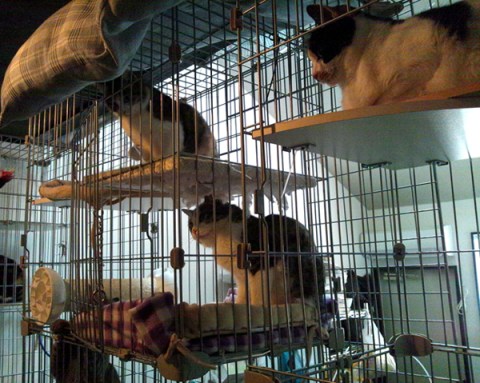
Some of the cats at the JCN shelter.
Here’s a fun fact that most people find very difficult to believe: the Great Tohoku Earthquake was my first day at work. And not just any “first day at work”, it was the first day of my first real job at my first command in my first overseas position as a Naval Officer. Trust me, I have my stamped orders to prove that, in the history of people arriving to command posts right before a major event, I am a card-carrying member. I arrived in Japan six hours before and was lounging around my hotel room when everything started to move.
I could go into detail about the devastation and the clean-up and the “everything else”. But I know you’re like me: you’ve seen all the horrifying videos and reports. If there was one thing the aftermath was missing, it was a positive story. For me, that positivity came radiating out of a news report on April 1, 2011.
Right around that time I was spiraling back to earth and this newsreel was just making the rounds. It was about a dog named Ban that had been stranded on the roof of a house as it was washed out to sea. Ban had been living on this roof for roughly 3 weeks without proper food or water. There was something heartwarming about the videos of the dog happily lapping at her rescuers’ faces, gobbling down food, and, eventually, being reunited with her very relieved owner.
So that was the moment, in the middle of the still busy tempo, that I decided I wanted to help the animals. Whenever I heard of a food drive being conducted on the base, I was sure to purchase some dog and cat food for the cause. I read up on volunteer opportunities online. I tried to organize my life around the idea of going north for a few days. It wasn’t until nearly a year after the tragedy that I finally made my way to the Japan Cat Network’s (JCN) Inawashiro shelter.
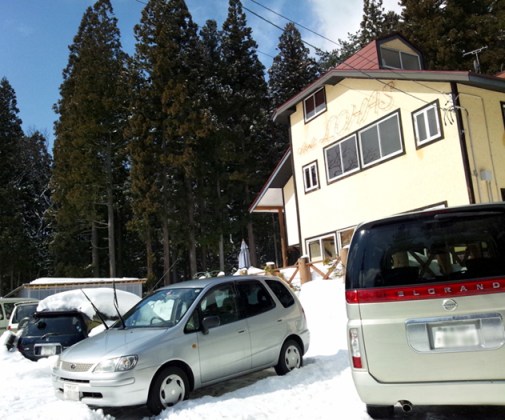
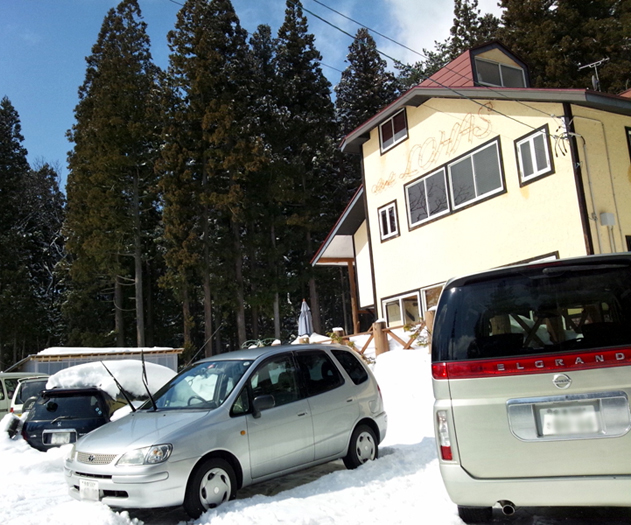
Club Lohas
The town of Inawashiro, although located within Fukushima prefecture, is pressed into the mountains as far west as is possible while still remaining within the prefecture. It is bordered by the popular ski destination of Niigata and was once quite popular among winter aficionados. Now it’s decidedly less busy. The shelter is located within the spare rooms of Club Lohas, a café and spa that caters to the dog lovers among the tourists. Most of its customers are either volunteers or locals. Needless to say, being a part of Fukushima isn’t a big perk now.
But that has failed to stifle the efforts of this band of animal lovers. The shelter is divided into three rooms and one dog kennel. It is home to any number of cats and dogs, ranging in age from young kittens to a 13 year-old beagle. The weekend I was there, it housed 8 dogs, 9 puppies and too many cats and kittens to count. That last figure might just be because I am a cat lover and was too overcome by their sheer adorableness to bother counting.

My walking companion, Jenny, looking out over the frosty abyss.
My volunteering schedule was dictated by the animals. The mornings started with dog walks. My usual companion was Jenny, a beautiful and spirited black and white pup who consistently gave me this curious look whenever she decided I was walking much too slow up the hills covered in snow and ice. She was most fond of a vast meadow that looked over Lake Bandai and was backed by ski resorts. Our walks were never long enough and, I learned recently, the sad look in her eyes when we got back to the kennel was her desire to curl up on my lap and nap. An energetic lap dog, who knew?

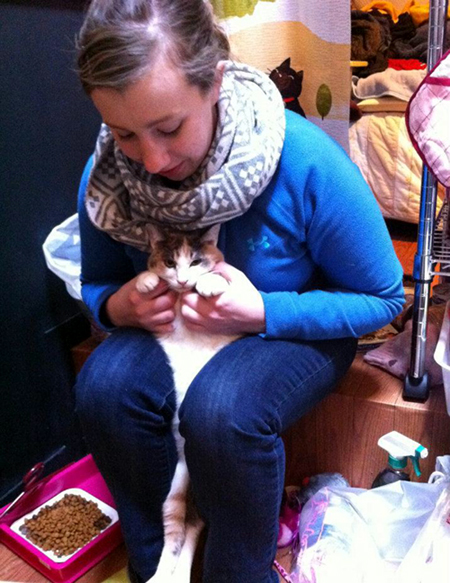
Me and Joni, my cute, cuddly calico friend who liked to sleep with me at night.
Dog walks and feeding were followed by kitty duty. As I mentioned before, there were so many cats I could hardly pet them all, so that meant a considerable number of litter boxes and food bowls. Naturally, there was no way to do this without a little quality string time and maybe a cuddle here and there. This would be intermixed with medicinal treatments. Living nearly a year in an area devoid of humans had left a few a little worse for the wear. The JCN accepts animal medicines, so the usual treatments were available, although there is never such a thing as too much medicine stockpiled.
What struck me most was the devotion of the volunteers. It was almost tangible just how much they loved animals. Everyone was dedicated to the happiness of their charges, even if there were moments when the charges weren’t in agreement.
Keeping in mind the devastation to animal lives as well as human that resulted from the 3/11 earthquake, here are the main points to take away from this:
- It isn’t routine in Japan for cats and dogs to be spayed and neutered, so the animals left behind in the evacuation zone have been breeding.
- Nearly a year without humans means no more food, no more edible garbage, no more slightly-edible anything.
- Due to current government regulations, many evacuees are still stuck in shelters that do not permit animals and it takes a special permit to get inside the evacuated area to do allowed activities.
- And, as a direct result of all of these, there is still very much a need for help and support!
This specific shelter in Inawashiro is the holder of a special permit that allows them to go into the 30km and 20km evacuated areas to set up feeding stations for the animals left behind. It allows them to check on the animals of evacuees within those zones who have reached out for help in an area where they can’t go. It also allows them to pick up young puppies and kittens and properly socialize them for eventual adoption. AND it facilitates adoption and fostering initiatives for these animals. There is a constant turnover of animals as the ones they have already rescued are adopted and new rescues are brought in. Needless to say, that’s a lot of puppy/kitten/dog/cat (and at one time chicken) chow! Plus, there are the volunteers to consider, a few of whom work full-time to foster and care for these animals. Donations, in any form, are always welcome.
If you want to help and are in Japan, I strongly recommend a volunteer trip. It might be the best thing I’ve ever done in Japan. Check out www.japancatnet.com for more information (they’ve been renovating the site lately, so don’t be discouraged if all the links don’t work just yet). If you’re not in Japan, there’s a subscription service you can join to help the animals there. For $5, $10, or $20 a month, you can effectively buy food, litter and toys for these survivors, and get some good perks for yourself in the process. There are several other opportunities outlined on the site, pick the one that works best for you!

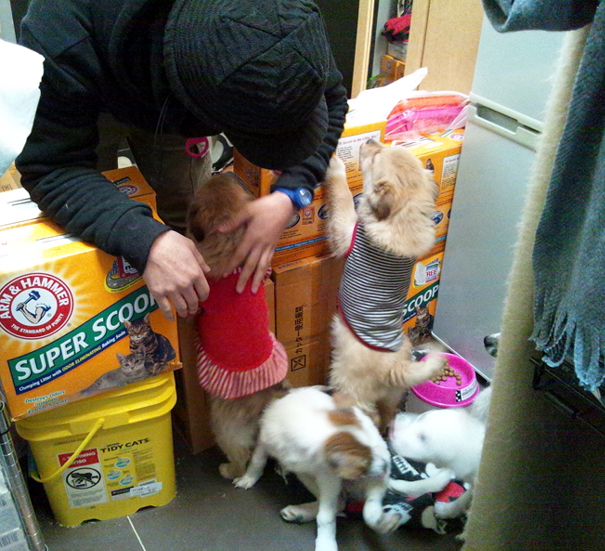
Some of our puppies!
Also, tune into Animal Planet on March 10th at 8pm ET (“Must Love Cats”) for a visual rundown of both of the JCN shelters (they also have one in Shiga). I have a feeling that actually seeing all of these little warriors will make anyone have a change of heart. Now just imagine getting to spend a weekend with them! Perhaps you will even be encouraged to give one a home. I recommend the cuddly lap dog, she’s a keeper!
===
Katie McDaniel graduated from Gettysburg College with a BA in Japanese Studies and a minor in Political Science (2009). After working a year with ESE elementary students, she was commissioned an officer in the Navy through Navy Officer Candidate School (OCS).





 What can I do with a B.A. in Japanese Studies?