In my previous two posts, I attempted to provide an overview of museum internships / volunteerships: how they’re structured, how to look for them and apply for them and a little bit of what you’ll be getting out of them. Today I would like to discuss some of the positions within a museum, and what exactly these different job positions involve. Sure, you could just look up “curator” on Wikipedia, or Google terms and find a dozen other resources. But, I figured since you’re already here, and already reading, I might try to offer a bit of my own knowledge, based on what I’ve seen and who I have met. Maybe you’ll find something in here Wikipedia didn’t mention.
*Archives & Libraries
Yes, museums have archives, too. Some museums have a very lengthy history, and are truly historical institutions unto themselves. The museum archives generally include archived correspondence between the museum and other museums, donors, artists, and the like, and sometimes include some pretty extensive collections of objects, such as antique photographs, that for one reason or another are not included in the main collection.
The same goes for the museum’s library. Most museums have libraries, chiefly for the use of in-house staff to do research for the purposes of writing labels, researching objects in the collection, etc. Some of these libraries are circulating – at least for the museum’s staff, who are permitted to take books out – and most museum libraries, so far as I’ve seen, are accessible to visiting researchers or even the more general public, sometimes by appointment and sometimes simply by walking in. But returning to my comparison with the archives, museum libraries often also include things that might fit just as easily in the main collection, but for whatever reason are kept here (e.g. Edo period woodblock printed books).
These days, with graduate degrees in Information and Library Science or graduate certificates in Archives becoming more and more common, it may be difficult to secure a career-track job working in a museum library or archives without one. But, those of us specializing in History, Art History, Museum Studies or the like certainly can try. It seems a rather attractive position in some respects; you get to work with a collection, and yet with a lot less of the kind of paperwork and overwhelming workload that curators have to deal with. And, if you’re the kind of person who enjoys working with visiting scholars and helping them find resources, or the kind of person who prefers not bothering with other people and would rather just be left alone to organize and catalog and research a collection, working in archives could be quite enjoyable. Sometimes you might even get to organize an exhibit of pieces from the archive or the library.
It is easy to forget about archives and museum libraries as we so often associate the museum so strongly with only the exhibitions, the art collection, and the curatorial staff. Or, if you’re coming from the other side of things, to think of Archives & Library work as applying solely to public libraries, university libraries, and places that function primarily as archives. But these exist within museums too, and in case you were not aware, I wanted to mention that as an option. It’s certainly a path I’m considering myself, assuming I can get in there without having explicitly majored in Library & Information Science.
*Conservation
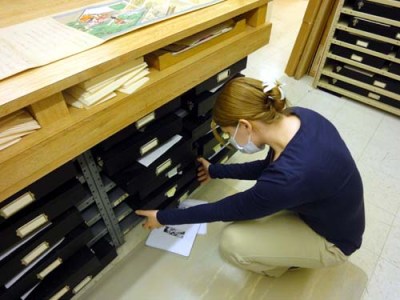
behind the scenes looking at storage boxes
Even more so than archives & library work, conservation is an extremely specialized skill set, requiring extensive training. I never cease to be fascinated, truly fascinated and amazed at what these people do. Conservators work to protect artworks from deterioration and damage, often working to clean and repair them. However, these days, “repair” more often than not does not mean restoration – that is, repainting or otherwise restoring the appearance of the artwork – so much as it means simply structural repairs to protect the work from further damage. This can mean gluing a pot back together from shards, pasting a tear in a book, or cleaning an artwork so that biological or chemical accumulations cannot do further damage; whatever conservators do, they always make sure that their work is well-documented, and reversible, so that in the future, if and when better technologies or techniques are available, future conservators can do what they need to do more easily. Conservators also advise curators and the rest of the staff as to whether certain pieces are stable enough to be exhibited, and how to best show them (and for how long) to minimize the risk of damage. Light and moisture alone can be rather damaging to certain types of artworks – fading or discoloring pigments, and discoloring paper or silk – and so, certain types of artworks, especially Japanese woodblock prints, cannot be left up for too long.
Becoming a conservator, as I understand it, generally involves a rather involved process of formal pre-degree internships, combined with conservation degrees focusing explicitly on materials sciences and other rather technical science subjects alongside art history and the like. In the case of Japanese or Chinese art, the formal Master’s degree is quite often followed by an apprenticeship period of as much as ten years studying in Japan or China with traditional practitioners – professionals in a specific trade, such as the mounting of paintings. China and Japan use very similar materials, but very different methods, applying multiple layers of paper behind the paper of the painting itself, using a sort of paste made from traditional plant or animal materials, and then mounting the paper painting within a rectangle of silk brocade, before attaching wooden rollers. Some of the top museums for Asian art, such as the Freer-Sackler and the Museum of Fine Arts, Boston, have their own dedicated Asian conservation labs, where paper and silk paintings, prints, and the like can be conserved, handled, researched, re-mounted, etc. by professionals specifically expert in East Asian materials and methods, rather than simply more generally in Western techniques of handling paper or cloth.
*Registrar / Collections Manager
Now we get into the real meat of this post. I think everyone has some sense of what conservators do, and most certainly what security, Human Resources, or certain other departments in a museum do. But I for one was never really clear, at all, what a Registrar or Collections Manager did until I actually started working with these people as an intern. This is why I thought of writing this blog post to begin with. The positions of Curator and Registrar/Collections Manager (the two terms are pretty much interchangeable) are, to my mind, two of the most obscure or should I say, misunderstood, positions in museums. At the same time, they are among the most central positions, as these are the people who manage the collections and organize the exhibitions.
Every museum works differently, and so I honestly cannot guarantee that this description covers every situation. One institution I worked at had no official Registrar or Collections Manager at all, nor a Curator, because, officially, on some level, they do not have a collection. At this institution, all the tasks that a registrar, collections manager, or curator would normally do were instead handled by the Gallery Director and the rest of the Gallery staff.
Yet, at the other two museums that I have worked at, the registrars or collections managers were the chief people responsible for coordinating and organizing objects coming in and out (acquisitions aka accessions, de-accessions, gifts, promised gifts, incoming loans, and outgoing loans), as well as where objects were in the building at any given time. At some museums, collections storage is divided up somewhat by department, and is located within (or easily accessed from) the curatorial offices – in these cases, the curatorial staff might take on more of the Collections Management responsibilities. But, at other museums, storage is more consolidated, and the team of collections managers, rather than the curators, oversees how objects are stored, where they are stored (how they are organized), and which objects are out of storage (on loan, on exhibit, in conservation) at any given time. Collections managers also, often, play a large part in exhibit installation, crafting stands and mounts.
Another large part of a collections manager’s responsibilities is the handling of requests from visiting researchers (or members of the general public, school field trips, etc.) to view objects in the collection. At any given time, a museum most likely has less than 10% (often as little as 2%) of its collections on display. A collections manager (or sometimes the curator) coordinates with researchers wishing to see the collections. They take out the requested objects and often stay with the researcher, to take out and put away objects for them, to answer questions, and to oversee the researcher to safeguard the objects.
Collections managers often also get to serve as couriers, accompanying artworks to or from other institutions (e.g. when they are to be on loan for an exhibition), and to visit the homes of collectors or donors. Their expertise in handling artworks is put to use in safely packing up artworks to be brought to the museum. I have heard more stories of exciting adventures from collections managers than, I think, from anyone else in the museum business. Flying in the cockpit in a cargo plane; visiting a donor’s house and getting to discover what’s in their collection as you pack it up; getting stuck in foreign countries when the logistics of your courier trip just don’t quite work out as planned…
Collections managers, sadly, rarely get to be involved in organizing exhibitions, choosing artworks or themes, composing gallery labels, or even really doing much historical or art historical research on the works. But, on the flip side, they get to work much more closely with the objects than anyone else, becoming intimately familiar with the collections, and getting to show them off to those visitors who request access.
While the collections managers I have worked with are, no doubt, amazingly skilled and experienced at what they do, and I would never mean to belittle that in any way, it’s encouraging to know that of all these positions I’m discussing today, Collections Manager requires the least specialist degrees or certifications. Some collections managers I have met had backgrounds in Studio Art, especially woodworking or sculpture, which provided them the skills (which I myself don’t really have at all) to think creatively and effectively in building stands, boxes, shipping crates, or mounts for storing, displaying, and shipping artworks. Some worked their way up to full, lead Collections Manager quite easily or quickly from an entry-level position after those above them retired or otherwise moved on. I share this not by means of ratting anyone out, or sharing secrets I shouldn’t be sharing, but rather simply by way of being encouraging to readers interested in pursuing this path. If you don’t have the specialty degrees in archives, library science, or conservation, and enjoy working with collections, Collections Manager seems a fine way to go, and relatively accessible. After working with the Collections Managers I have worked with, I have myself grown quite excited for the prospect of following in their footsteps, and not necessarily aiming so exclusively for “Curator” any longer.
*Curator
Which brings us, finally, to the big one. Despite the growing popularity of Museum Education (I cannot count the number of people I’ve met who have expressed great interest in becoming a Museum Educator), it has always seemed to me that Curator was the chief position people have in mind when they talk about wanting to work in museums. But what exactly does a curator do?
I had believed that a curator’s chief responsibilities were to organize exhibitions, doing research, writing gallery labels, writing essays, choosing artworks for a given show, and managing the collection, primarily in the sense of playing a major role in determining which artworks the museum is to acquire, as well as coordinating or managing the efforts of other staff members (e.g. dept assistant, curatorial assistants, research assistants, interns) in organizing and maintaining object files, the museum’s online database, and various projects such as online catalogs and public databases. In short, I believed that a curator’s primary responsibilities centered around applying his or her art historical expertise. I would love to do that kind of work, if that was indeed the core of what I got to do.
After all, these days, I am told that one really ought to have a PhD in Art History, and more than that, to have a graduate certificate in Museum Studies and/or significant internship experience if one wants to be at all competitive in securing a position as a curator at a major museum. One has to be intimately familiar with a wide range of art history – e.g. all of Japanese art history, or all of East Asian art history, or even all of non-Western art history, depending on which museum you end up at and how they are organized. One has to be fluent in multiple languages (e.g. Japanese, as well as English), and extremely competent at art historical research; one needs to have excellent connoisseurship abilities, able to distinguish an early edition from a late one, a fake from an authentic piece, a piece in good condition from one in poor condition, and the ability to recognize something as rare enough, or cheap enough, or special enough in whatever way to be a “must buy,” when those situations emerge.
Yet, increasingly I have come to realize that a curator’s responsibilities also involve an extensive amount of paperwork, logistics, inter-museum politics and handshaking and hob-nobbing, working closely with donors and the board of trustees and all of the political and financial issues that come with that. Curators must negotiate loan contracts, and other touchy and technical legal situations, as well as insurance and shipping for truly priceless artifacts. In short, I get the impression that curators are absurdly busy, all the time. It’s still a very prestigious position, and the chief way in which one would get to organize exhibits, sharing stories and objects according to one’s own interests or preferences. Increasingly, people in other positions sometimes get to organize exhibitions, but curatorial remains very much the dominant position in guiding both exhibitions, and collections (accessions).
This is only a brief overview, but as always, I would be more than happy to answer any questions or comments you might have. Any readers particularly interested in a museum career?

 CALL FOR APPLICATIONS FOR ARTS NETWORK ASIA (ANA) PROJECT GRANTS 2012




 What can I do with a B.A. in Japanese Studies?