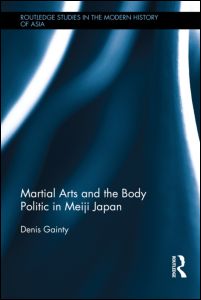
Book Announcement: Martial Arts and the Body Politic in Meiji Japan

Martial ArtsIn 1895, the newly formed Greater Japan Martial Virtue Association (Dainippon Butokukai) held its first annual Martial Virtue Festival (butokusai) in the ancient capital of Kyoto. The Festival marked the arrival of a new iteration of modern Japan, as the Butokukai’s efforts to define and popularise Japanese martial arts became an important medium through which the bodies of millions of Japanese citizens would experience, draw on, and even shape the Japanese nation and state.

This book shows how the notion and practice of Japanese martial arts in the late Meiji period brought Japanese bodies, Japanese nationalisms, and the Japanese state into sustained contact and dynamic engagement with one another. Using a range of disciplinary approaches, Denis Gainty shows how the metaphor of a national body and the cultural and historical meanings of martial arts were celebrated and appropriated by modern Japanese at all levels of society, allowing them to participate powerfully in shaping the modern Japanese nation and state. While recent works have cast modern Japanese and their bodies as subject to state domination and elite control, this book argues that having a body – being a body, and through that body experiencing and shaping social, political, and even cosmic realities – is an important and underexamined aspect of the late Meiji period.

Martial Arts and the Body Politic in Meiji Japan is an important contribution to debates in Japanese and Asian social sciences, theories of the body and its role in modern historiography, and related questions of power and agency by suggesting a new and dramatic role for human bodies in the shaping of modern states and societies. As such, it will be valuable to students and scholars of Japanese studies, Japanese history, modern nations and nationalisms, and sport and leisure studies, as well as those interested in the body more broadly.

http://www.routledge.com/books/details/9780415516501/

Posted in announcements, culture | Tagged , , , , , , | Leave a comment

Job Openings: Mellon Postdoctoral Fellowships

job opening - 5Institution:   University of Illinois – Urbana-Champaign, Illinois Program for Research in the Humanities (IPRH)
Location:   Illinois, United States
Position:   Andrew W. Mellon Post-Doctoral Fellowships, 2014-16

The Illinois Program for Research in the Humanities (IPRH) at the University of Illinois at Urbana-Champaign seeks to hire two Andrew W. Mellon Post-Doctoral Fellows in the Humanities for two-year appointments to begin Fall 2014.

Fellows spend the two-year term in residence at Illinois; conduct research on the proposed project; and teach two courses per year in the appropriate academic department. Fellows also participate in activities related to their research at the IPRH, in the teaching department, and on the Illinois campus. Each Post-Doctoral Fellow gives a public lecture on his or her research.

The search for Mellon Fellows is open to scholars in all humanities disciplines, but we seek applicants whose work falls into one of the following broad subject areas:

– Race and Diaspora Studies
– History of Science/Technology
– Empire and Colonial Studies
– Memory Studies

The fellowship carries a $45,000 annual stipend, a $2,000 research account, and a comprehensive benefits package. To be eligible for consideration, applicants must have received their Ph.D. betweenJanuary 1, 2009 and August 31, 2013. (Ph.D. in hand required at time of application.)

Application Deadline: October 28, 2013

Detailed eligibility requirements and application guidelines can be found at www.iprh.illinois.edu.

Applications must be submitted through the online application system. No paper or e-mailed applications will be accepted. The submission period opens September 1, 2013. Please do not contact IPRH about the status of an application; we are unable to answer questions about individual applications.

Contact: Nancy Castro, Associate Director
Illinois Program for Research in the Humanities (IPRH)
University of Illinois at Urbana-Champaign
ncastro@illinois.edu

Website: www.iprh.illinois.edu

Posted in announcements, job openings, jobs | Tagged , , , , , , | Leave a comment

Job Opening: Political Science Global Affairs, especially comparative Asia

job opening - 5Institution:   Yale-NUS College
Location:   Singapore
Position:   Full Professor, Tenure Track Faculty, Political Science

The newly established Yale-NUS College (www.yale-nus.edu.sg) in Singapore, a collaboration between the National University of Singapore (NUS) and Yale University, seeks to hire three or more political scientists working on global affairs, especially those who study Asia in comparative perspective.  We are particularly interested in candidates who work in the following areas: comparative politics, including political institutions, political parties, and elections; and security, broadly defined to include such issues as human security, gender, inequality, and migration in addition to traditional issues of international security.  This search is open with regard to rank.  We are especially interested in candidates who combine an active research agenda with interest in a collegiate liberal arts environment and a demonstrated commitment to creative and effective undergraduate teaching and mentoring.

In addition, the College seeks to hire two distinguished senior scholars to serve as the inaugural JY Pillay-Global Asia Professors of Social Science.  We encourage applicants in any area of the Social Sciences including areas that can serve our majors in Global Affairs/Political Science, Economics, Psychology, Anthropology, Urban Studies, Environmental Studies, and Philosophy, Politics and Economics (PPE).  Within these broad areas, we are open to sub-specialty.

Yale-NUS College seeks outstanding teacher-scholars, who are committed to innovative pedagogy and curriculum development, who are active researchers, and who enjoy closely mentoring students. Regardless of their field of specialization, candidates should be enthusiastic about contributing to an interdisciplinary common curriculum in the liberal arts.

Salary, benefits, and leave policies will be competitive at an international level.  The College expects further rounds of hiring over the next few years as the student body increases.  Yale-NUS College is committed to supporting faculty research through generous startup grants, annual research and travel budgets, and sabbatical leave.

To express interest, candidates should submit a current CV and cover letter, which includes information on a candidates research interests and teaching philosophy.  Candidates should also be prepared to submit the names of possible referees.  Prospective senior candidates should feel free to contact Professor Steven Wilkinson at steven.wilkinson@yale.edu.  For all general inquiries, please contactyale-nus.college@yale.edu.  Review of applications will begin August 15th, 2013, and continue until the positions are filled.

The College values diversity and is committed to equality of opportunity.  All particulars of the application process can be found at http://www.yale-nus.edu.sg/index.php/prospective-faculty.html.

Contact:
Prospective senior candidates should feel free to contact Professor Steven Wilkinson at steven.wilkinson@yale.edu.  For all general inquiries, please contact yale-nus.college@yale.edu

Website: http://www.yale-nus.edu.sg/index.php/prospective-faculty.html

Posted in announcements, job openings, jobs | Tagged , , , , , , , , , | Leave a comment

Fun Link Friday Reblog: Body Tattoo Marketing

Just a quickie FLF this week with some links, as I’m still drowning in a sea of kanbun getting my medieval on this month at a workshop!

Several articles have been floating around my Facebook these past couple weeks since The Guardian put out this video on the recent trend of young women selling out their thigh space for advertising. Spoon & Tamago featured a review of this phenomenon back in February, questioning whether or not it would catch on, but I guess if we’re still seeing reports pop up about it, that answers that question! While it may seem silly to some and exploitative to others, the one thing we can all probably agree on is thank goodness nobody thought permanent ones were a good idea instead. What do you all think? Will this bring any new shifts to popular Japanese culture or expand mass marketing?

green day

And, weird, but does anyone suddenly feel like listening to some Green Day?

Posted in culture, fun links | Tagged , , , , , | 2 Comments

Call for Submissions: Japan Media Arts Festival 2014

Via Art Radar.

Deadline: Sept. 12, 2013

The Japan Media Arts Festival is a comprehensive festival of MediaArts (=Media Geijutsu) that honors outstanding works in the four divisions of Art, Entertainment,Animation, and Manga, as well as providing a platform for appreciation of the works that have won awards.

For the 17th festival in 2014, entries will be accepted from across the globe until September 12. Entries are sought in various disciplines of the Media Arts.

Entry Outline

Divisions

The Four Divisions (Art, Entertainment, Animation, Manga)

・Art Division

Works of art created with new media and digital technologies.
Interactive art, media installations, video works, graphic art (digital illustration, digital photography, computer graphics, etc), web-based works, media performances, etc.

・Entertainment Division

Works for entertainment created with digital technologies.
Games (video games, online games, etc.), video works (music videos, advertising videos, special effects videos, etc.), gadgets, electronics, websites, application software, etc.

・Animation Division

Animated feature films, animated short films, animated series, etc.

・Manga Division

Comics published in book form, comics published in a magazine (including works still being serialized), comics published online (for computer or mobile), self-published comics, etc.

In all divisions professional, amateur, independent, and commercial works are eligible for submission.

Eligibility

Works must be completed or released between:

Friday, September 21, 2012 and Thursday, September 12, 2013

* Works completed, changed, renewed, presented or released during the above period are eligible for entry.
* While the number of entries made is unlimited, the same work may not be entered in multiple divisions.
Works must be completed or released between:

The entrant must hold the copyright to the submitted work. If the work is submitted by a representative, permission from the copyright holder must be obtained.

Awards

For each division, one Grand Prize, four Excellence Awards, and three New Face Awards will be awarded on the basis of artistic quality and creativity. In addition, a Special Achievement Award will be awarded on the recommendation of the Jury to an individual or group who has made a special contribution to Media Arts in any of the four divisions.

Grand Prize: Certificate*, trophy, 600,000 Japanese Yen

Excellence Award: Certificate*, trophy, 300,000 Japanese Yen
New Face Award: Certificate*, trophy, 200,000 Japanese Yen
Special Achievement Award: Certificate*, trophy
Other outstanding entries will be chosen by the Jury as Jury Selections

(* Certificates will be presented by the Minister of Education, Culture, Sports, Science and Technology)

Full application details at Japan Media Arts Festival.

Posted in announcements, applications | Tagged , , , , , , , , , | 1 Comment

Job Opening: Associate Program Officer, Japanese Studies, The Japan Foundation

job opening - 5
Institution: The Japan Foundation
Location: New York, NY
Education: BA required, MA preferred
Posted on July 26, 2013
Deadline: August 15, 2013
Start date: September 25, 2013

Job description
Responsibilities: The Associate Program Officer will report to the Program Director in Japanese Studies and will contribute to the following:

1. Program coordination:

  • Assist in the implementation of The Japan Foundation’s programs, with a particular focus on, but not limited to, institutional support and individual fellowships for Japanese Studies;
  • Manage and oversee all phases of the grant process, including communication with and guidance to grant seekers and grantees;
  • Conduct site visits and represent The Japan Foundation at meetings and conferences;
  • Prepare materials for the AAC, organize annual as well as special meetings and produce meeting summary reports;
  • Research fields to identify and monitor trends, new models, and new initiatives.

2. Foundation coordination:

  • Coordinate various programs including in-house events such as roundtables, seminars, and outreach events;
  • Explore creative ideas and develop new networks to foster innovative program ideas and funding initiatives;
  • Participate in the development and implementation of a public relations strategy;
  • Carry out other logistical and administrative duties as assigned by the Program Director and senior management;
  • Assist in the proof reading of English documents.

Qualifications:

  • Bachelor’s degree required. Master’s degree or equivalent work experience in a relevant field preferred;
  • Strong analytical skills; ability through questioning and informal research to understand the feasibility and implications of submitted proposals;
  • Strong oral and written communication skills in English;
  • Strong organizational skills, keen attention to detail and the ability to manage multiple projects simultaneously
  • Understanding of contemporary Japan; experience living in Japan and proficiency in the Japanese language, including translating ability, preferred;
  • Proficiency in basic software such as MS Word and Excel; database experience preferred;
  • US citizenship, permanent residency visa, or valid working visa in US.

Full details on Idealist.org.

Posted in announcements, job openings, jobs | Tagged , , , , , , | Leave a comment

Job Opening: Communications Assistant, Embassy of Japan, Ottawa

job opening - 5Institution: Embassy of Japan
Location: Ottawa, Ontario
Education: Post-secondary degree or diploma
Posted on July 25, 2013
Application deadline: August 12, 2013
Start date: September 2013

Job Description
Opening for a Communications Assistant

The Embassy of Japan is seeking a Communications Assistant for its Information and Culture Section.

Job Summary
The Communications Assistant provides support to officers in the Information and Culture Section of the Embassy. Primary duties include the following;

  • Writing and editing speeches
  • Writing media releases
  • Responding to media inquires and networking with the media
  • Arranging media interviews
  • Maintaining and updating the Embassy website
  • Creating event flyers and programs
  • Assisting with planning and hosting of cultural events
  • Providing research support

The Communications Assistant may also be asked to work after office hours or on weekends, in order to assist with the hosting of cultural events.

Date and period of employment
A two-year contract commencing early September, 2013 (the exact date is to be determined), renewable if completed with good working performance.

Qualifications

  • Fluency in English (with experience in speech writing preferred)
  • Strong working knowledge of MS Office Suite (Word, Excel, PowerPoint)
  • Strong background in web and graphic design preferred (Adobe Design Standard CS6, Dreamweaver)
  • Post-secondary degree or diploma
  • Knowledge or experience in public relations or international relations/political science preferred
  • Canadian citizenship or permanent resident status in Canada
  • Valid police record check

For full details, see Idealist.org.

Posted in announcements, job openings, jobs | Tagged , , , , , , , , , , | Leave a comment

Resource: jisho.org

denshijishoThere are numerous online resources for students of Japanese out there who need to find a word or kanji on the fly, many of which we covered in Leah’s article on Making the Most of Japanese Dictionaries. Still, new ones pop up all the time or we realize we overlooked something good, so I wanted to be sure we included Denshi Jisho (http://jisho.org/) among them.

In a recent kuzushiji workshop, I threw my hands up to the sky and cursed the world when my electronic dictionary’s batteries died, and I had to pull out the ole laptop to find something easy and fast for looking up radicals. Our workshop instructor introduced us to Denshi Jisho, and I immediately wondered where it had been all my life. Although we’ve covered kanji radical searches briefly on Tangorin, I feel that jisho.org is in some ways more accessible in terms of search options and format.

Powered by the data of everyone’s favorite WWWJDIC Jim Breen project, Denshi Jisho lets you do basic searches in Japanese or English in the typical J / E and E / J fashion, including searches for example sentences. One of the features that I like about the basic searches here is that even if you don’t have Japanese language keyboard abilities, when you’re searching starting from Japanese, the English text will automatically convert to hiragana. I find this really useful when I’m on a library computer that for the love of everything holy just can’t get the language bar functional for Japanese, despite claiming it has the capability.

denshijisho2

denshijisho3

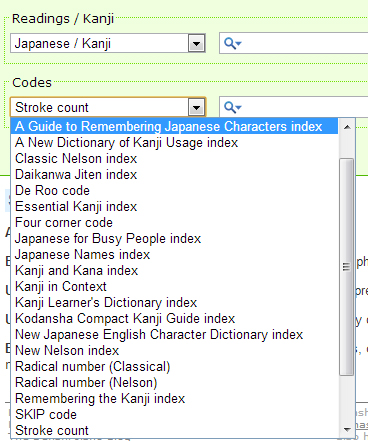
denshijisho4When you search for kanji, you have the drop-down option of inputting Japanese, Chinese, or Korean, or by searching via more complex options like stroke count, radical numbers, or the indices of various dictionaries. So if you really know your stuff for kanji, you can get pretty complex in how you try to find what you’re looking for. This is especially helpful for those of us who work with premodern texts, since the old forms of kanji can be rather difficult to look up in online dictionaries at times.

But most useful for many of us is the kanji by radical option, which, much like Tangorin, is done by clicking on radicals. Once you’ve clicked one, those which do not appear together with your selection in any kanji will fade into the background, and you’ll automatically get a list of kanji below, with the non jōyō kanji faded a little to distinguish regular use kanji from less common ones. You can select multiple radicals to narrow your search, and once you’ve found what you want, you can click on it to get the information.

denshijisho5

While Tangorin includes helpful lists of compounds that include the kanji, Denshi Jisho includes the indexed information for looking the kanji up in larger dictionary sets. Notably, Denshi Jisho appears to include more radicals in their search options than Tangorin (which is helpful for my premodern stuff!), but each site has its own benefits depending on what the user wants to look up.

Any other sites we don’t have on here that you guys love to use? Let us know via email or in the comments!

Posted in graduate school, study tools, undergraduate | Tagged , , , , , , | 2 Comments

Call for Papers: Nadel Essay Prize 2013

call for papers [150-2]The Asia Pacific Journal of Anthropology invites the submission of essays by early career researchers for the Nadel Essay Prize.

The Nadel Essay Prize celebrates excellence in ethnographic writing. Ethnographically-based original papers are invited on social and cultural anthropology relating to the Asia Pacific region, including Australia. This annual prize, inaugurated in 2011 to commemorate 60 years of Anthropology at the Australian National University, is named after S.F. Nadel, who was appointed Foundation Professor of Anthropology in 1951.

The Prize

The winner of the prize will be announced in January 2014. The winner will receive a prize of $250, a year’s subscription to the journal and promotion on the journal’s website.

Jury

All papers submitted for the prize will be evaluated by the Editorial Board. The jury will evaluate on the originality, the quality of the argumentation, conceptual clarity and overall readability. The jury decision will be final. There is only one prize per year and the Board reserves the right to award no prize if submitted material is not of an appropriate standard. Shortlisted submissions for the prize will be peer reviewed for publication in the journal.

Conditions

Anthropologists who have earned their doctorate within five years prior to submission are invited to submit. Papers should be on the topic of the journal: please visit the journal’s website:www.tandfonline.com/rtap. The submission should not be under consideration for publication elsewhere, and should not be submitted to any other journal until the outcome of the competition is known.

Word limit: 8,000 words

Closing date for submissions: 31 October 2013

Papers must be submitted online at: http://mc.manuscriptcentral.com/rtap

For inquiries please contact the journal: tapja@anu.edu.au

Posted in announcements, funding | Tagged , , , , , | Leave a comment

Funding: Fellowships at the Centre for Global Cooperation Research, University of Duisburg-Essen

money [150-2]Fellowships at the Centre for Global Cooperation Research, University of Duisburg-Essen

Location: Germany

Joint Call of the four Research Units
The Kate Hamburger Kolleg / Centre for Global Cooperation Research invites applications for fellowships starting in April 2014. The Centre will offer six to eight fellowships across the four research units. The fellows will work at the Centre for a period of six to twelve months.

The Centre is calling for people working on Culture as a limit and/or a resource for global cooperation. Within this research topic, we intend to overcome substantialist views of culture (as a civilisational substance) as well as residualist views (culture as a black box). The research question can be approached from different disciplinary angles and shall be elaborated in a multi- and interdisciplinary setting.

The Centre is interested in the following questions:

What has, historically, been the role of cultural change for global cooperation? Does time (for instance as experience of acceleration) have an effect on cooperation? Were there periods of change in regard to global cooperation that reflect different levels of organisations (such as villages, nation-states)? What can we learn from those experiences for a better understanding of global cooperation in the 21st century?

Does cooperation have the same meaning in different cultural settings? What are the implications of different historical meanings for global cooperation in the 21st century?

How can we understand and explain the proliferation of supralocal and supranational we-identities, their inscription into cosmopolitan norms, rules and citizenship regulation? How do cultural differences and diversity interfere in international bargaining processes and situations (global challenges universal rules vs. universalised rules cultural references)? Do new technologies have an effect on rules of international diplomacy? In how far does the meaning and importance of cultural diversity have an impact on nation-, democracy-, and peacebuilding operations?

Invited are applicants from behavioural sciences, anthropology, social sciences, history as well as cultural studies, but also practitioners from governance and non-governmental organisations, social movements and networks who would like to discuss their experiences in an academic framework. Sure enough, further research perspectives beyond the four questions mentioned above, are more than welcomed.

Continue reading

Posted in announcements, financial assistance, funding, graduate school, study abroad | Tagged , , , , , , , , | 1 Comment