Life after Japanese Studies:
Identifying, Maintaining, Contributing to and Building (non-academic) Professional Networks
—
This guest series features Danielle Reed, who launched her own consulting practice PinPath, LLC in November 2019. Previously she worked as the Senior Program Director of S&R Foundation, a private family foundation with the mission of supporting talented individuals with high aspirations in the arts, sciences, and social entrepreneurship. She began her career as a diplomatic assistant in the Economics Section at the Embassy of Japan in Washington, DC from 2008-2011, then became an Assistant Language Teacher on the JET Program in Sendai-City from 2011-2014 before working in the nonprofit sector.
===

Photo by Coffee Channel
When I returned to the US after JET, I did not have a concrete plan. I knew I wanted to continue doing impactful work related to grassroots cultural exchange between the U.S. and Japan, but opportunities in the field were limited. Utilizing my support network, I learned about a job opening as an executive assistant (EA) at a small nonprofit called S&R Foundation. I knew I did not want to be an admin assistant forever, but based on my prior experience at the Embassy, I had a solid background in it and a good chance at getting it. Still, I was skeptical about applying since I worried I’d be stuck in a position I knew I could perform well in, but was not overly passionate about. A former Embassy colleague and good friend was employed at S&R at the time and she offered to give me an informational interview so I could learn more about the organization. After speaking with her, I learned that S&R was in a growth phase and advancement opportunities would most likely materialize. I took the risk and applied. Luckily after a first round interview, I was selected to meet the CEO and COO directly to test for compatibility. We clicked in the interview and I voiced my interest in becoming a project manager within 5 years leading U.S.-Japan focused or other international exchange programming. I was hired in December 2014.
After three months, with my boss’s full support, I was promoted to special projects coordinator in addition to my role as EA. A colleague left after launching her own non-profit, creating a sudden vacancy for a programming position. With very little lead time, I heartily agreed to take on the additional responsibility. The program was the Kingfisher Global Leadership Program – a two week study abroad program for Japanese University Students with the mission of empowering the next generation of leaders with the networks and skills they need to thrive in an increasingly globalized society. Through luck, openness, and willingness to step out of my set job description, I achieved my 5 year goal in three months. My role continued to grow after I successfully implemented Kingfisher and I was promoted every year afterwards. I directed high level dialogues, planned alumni activities, developed new organizational processes and partnerships. I eventually took over all operations and programs for S&R in July 2017 when I decided to stay on board after we launched most of our newly developed programs under a new non-profit called Halcyon.
Relationships were and still are the cornerstone of my successes and ultimately enabled me to do the work I’m passionate about. I began my Japan-focused professional career in 2008 and now, 12 years later, I’d like to share what I’ve learned about the impact a robust community of supporters has on building a career.
Since basic networking in the academic field of Japanese studies was covered in an earlier article, this series focuses on establishing and maintaining relationships in non-academic sectors.
I’m going to break this process down into four main sections:
- Identifying your community
- Maintaining your community
- Building your community
- Contributing to your community
====
1) Identify your community- Arena-mapping
Even if you developed a strong community prior to departing on JET, you may have experienced challenges reconnecting when you returned as well as challenges maintaining relationships you made in Japan. I’ve experienced feeling adrift while contending with the financial need to find a job coupled with the hope it will be something you care about. The stress of being unemployed or underemployed can be paralyzing, not to mention contending constantly with sneaky reverse culture shock. This section will give you a structured way to identify your community so you can build on what you most likely already have and recognize potential professional networking gaps. But let’s start by thinking about what it means to “network.”
Like me, you may have suffered early frustration when learning how necessary networking is for success. You may have underestimated and ignored its importance, or viewed it through a popular culture lens– all smarmy handshakes and business deals. “But I’m an overly anxious introvert,” you quietly justified to yourself, “networking is a business concept for MBAs to further climb the corporate ladder.” Like me, you may have also followed that up with an unhealthy dose of self-imposed guilt over not being more proactive with networking. Telling yourself you just aren’t good at it with more justifications – “Surely my grades will prove my ability; surely the system will fairly judge me against a sea of other faceless, equally qualified candidates.” I’m at a stage now where I can admit I had those feelings and they held me back for far too long.
Thankfully, I had mentors and experiences that helped me overcome my early hesitancy to practice this skill. I realized I thought of “networking” as a cold, impersonal term, and I’ve since traded it for a more relatable one: “relationship building.” Everything is built on human relationships. It’s the glue that keeps societies and organizations of any size together. I began to internalize this term shift and that’s when my outlook actually started to change. I embraced the community around me and began to engage in more meaningful ways.
Fully recognizing your personal and professional network is the first step to reviewing what relationships are supporting you and which ones may be holding you back. In order to maintain, contribute to, and build your community ties, you have to map where you currently are and plot where you want to be. This activity can make you feel vulnerable. By its nature, its raw and forces you to confront things you may not want to see. Therefore, I’m only going to discuss this in a professional context related to Japan and share what I personally chose to do before and after JET to remain connected.
To start, let’s make some lists with the following criteria to help you visualize your current community. These do not include employment history, which you should already have a good outline of in your resume or CV. My examples are by no means comprehensive – include any you think are relevant to you. Make a list of:
1. All the people you can contact who would actively help you. When in doubt, list them anyway if they present no harm to you. You don’t always know who will come through until you ask. Examples are:
-
- Former or current Co-workers
- Former or current Teachers
- Friends
- Acquaintances (often the most helpful group when looking to enter new circles)
- Family members
- Former or current club members from activities you’ve joined
2. Current goals for re-establishing or activating these connections. Be honest! Are your goals personal, professional, casual? I recommend starting small and building to bigger goals. If you start with something you know you can accomplish, you can build on that momentum to keep moving forward.
Personal Example: After making my list, I focused on professional goals. I wanted to continue to work in the U.S.-Japan relations field so one of my goals when I first returned was to reconnect with former colleagues – specifically people whose names I was comfortable enough to include on my list. For those who don’t have prior Japan-related working experience, attending Japan-related events or joining your local JET or University Alumni Association are good goals to start. Even if you aren’t a JET, many alumni chapters include “Friends of JET” who are welcome to attend organized activities.
3. Japan-related organizations in your community that genuinely interest you. If you don’t know where to start, try your local Japanese consulate or the embassy if you are in the DC area. They typically have a list of Japan related resources. Look for orgs like the Japan Information and Culture Center and your local Japan America Society. I
4. Communities you are involved in outside of work. This can be many things and it doesn’t matter if you’ve only done it once. The goal is to see where you are spending your time and note connections you may want to rekindle.
-
- Volunteer Organizations
- Professional Organizations
- Alumni Communities
- Hobbies
Now, I’m going to give a personal example of how I used the 2nd and 4th lists to build my relationships in an intentional way. The 1st and 3rd lists are very specific to each person, and while I will share resources related to the 3rd throughout this post, sharing the 1st would be a bit too personal. Below is a comparison of my 2014 and 2019 community lists. I used a simple tool called “Arena Mapping,” I learned about in Anne Barber and Lynne Waymon’s, “Make Your Contacts Count: Networking Know-How for Business and Career Success.” Aspects of this book are outdated now in 2019 USA (specifically some gender dynamics mentioned), but it doesn’t discount the effectiveness of arena mapping. There are a ton of books available on this subject if you are interested in looking into it further. If you’ve read one you like, please list it in the comments for others!
Arena Mapping Description – this is a personal assessment tool to not only show your current standing at an organization or in a community, but also to identify opportunities for growth within those communities. You can’t “lose” or “win,” you can only grow and deepen skills (or cut out unhelpful/unwanted time wasters). The good news is that almost everyone is already a member of one or more communities. Take the time to map these so you have an accurate idea of what is already available to you. It doesn’t have to be snazzy -a simple bullet list would be helpful. Remember, it’s a tool just for you. One helpful rule to follow is that it should only include organizations where it is still possible for you to be a member – don’t taunt yourself with impractical aims here. For example, I joined a local dance group while I was a JET in Sendai, but I can no longer be a member (it’s not physically possible) so it is not included. However, I did include my volunteer experience on the Sakura Matsuri Committee since it’s still possible for me to volunteer again. It is a part of my 2019 map, but with myself as a lapsed “member.”
August 2014 Arena Map – Just returned from JET
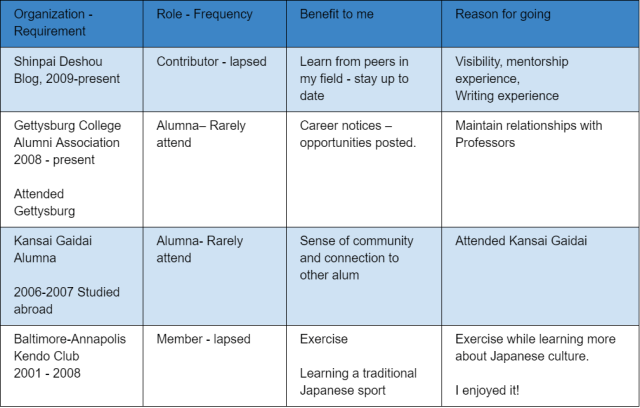
August 2019 Arena Map


As you can see, I’m fairly connected to Japan as of August 2019 when I made this list, but I was very disconnected in August 2014 right after I returned from JET. Volunteering for the Sakura Matsuri Committee was my first foray back into these communities, and to be honest, it didn’t go very well. It was incredibly challenging to do while I was working full time. I was in over my head, which is why I only volunteered for one year. However, even though I only volunteered for one year, I was still able to maintain my relationships with the Sakura Matsuri volunteer community.
In the next post, I will share the list of goals I created in 2014 to show how I came to be where I was in 2019. I’ll include strategies for maintaining your community ties. I’ll use examples from my life that relate to my arena map. I hope this quick tool helps you to identify your current community. Stay tuned for more!
 Travel grants are available to visit the University of Michigan’s Asia Library, which holds more than one million volumes in Chinese, Japanese, and Korean and subscribes to a multitude of electronic resources.
 We are pleased to announce the forthcoming
 Japan’s Imperial House in the Postwar Era, 1945–2019
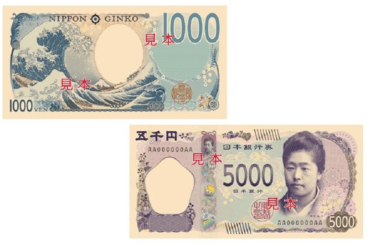 What’s on your country’s money? After traveling overseas, I always come back to the US thinking about how boring our own bills seem! And it appears that Japan is putting even more thought into new and exciting illustrations for their currency. Last year the Ministry of Finance revealed that they’ve got new designs for the 1000, 5000, and 1000 yen bills in the works, which are planned to be released in 2024.
 The Center for East Asian Studies at the University of Chicago invites applicants to its annual Kuzushiji Summer Workshop, which offers advanced undergraduates, graduate students, faculty, and independent scholars intensive instruction in reading print and manuscript materials from the Tokugawa and early Meiji periods. This year’s workshop will meet from June 15-19 and conclude with an informal symposium on the afternoon of the 19th. The workshop has two tracks. The introductory level, led by Dr. Nobuko Toyosawa (PhD, University of Illinois at Urbana-Champaign, Researcher, Oriental Institute of the Czech Republic), focuses on the reading of print materials. This year’s instructor for the intermediate/advanced group, which focuses on manuscript materials, will be Prof. Aratake Kenichiro of Tohoku University’s Northeast Asia Center (
 Position: Associate Program Officer for Arts and Cultural Exchange
 What can I do with a B.A. in Japanese Studies?