
Job Opening: Louis Frieberg Post-doctoral Fellowships

job opening - 5Institution:       Hebrew University of Jerusalem, Department of Asian Studies
Location:          Israel
Position:          Louis Frieberg Post-doctoral Fellowships

Louis Frieberg Post-doctoral Fellowships

The Louis Frieberg Center for East Asian Studies offers post-doctoral fellowships for the year 2015-2016. The post-docs are open to scholars in the humanities and social sciences specializing in East Asia, especially China, Japan, Korea and Mongolia. Fellowships are granted for one academic year or one term with the possibility of extension for an additional year. The starting date of the visit should not be later than four years after receipt of the Doctoral Degree; the fellow must hold a valid Doctoral Degree no later than September 2015.

Contact:

Louis Frieberg Post-doctoral Fellowships

The Louis Frieberg Center for East Asian Studies offers post-doctoral fellowships for the year 2015-2016. The post-docs are open to scholars in the humanities and social sciences specializing in East Asia, especially China, Japan, Korea and Mongolia.

Fellowships are granted for one academic year or one term with the possibility of extension for an additional year. The starting date of the visit should not be later than four years after receipt of the Doctoral Degree; the fellow must hold a valid Doctoral Degree no later than September 2015.

The fellowship consists of a monthly stipend (tax free) of $1,500, paid in Israeli NIS and linked to the “representative rate of exchange.” Fellows are entitled to one airline ticket (economy class, up to 1500$) for a direct flight from their home town to Israel and back.

The fellows are expected to teach one semesterial course at the Hebrew University (for additional payment, according to the Hebrew University regulations). The ability to teach a course in Hebrew is welcome, but is not a prerequisite for attaining the fellowship. The fellows are also expected to actively participate in the life and activities of the Louis Frieberg Center for East Asian Studies. The fellows will present their research at the department seminar of the Asian Studies Department, and possibly at other relevant forums. Any work outside the Hebrew University would be allowed only after specific approval by the Frieberg Center.

Applicants should submit one hard copy and an electronic copy- in one file- of their application to the address below, no later than March 31, 2015. The application must include:

1. CV
2. Research plan
3. A sample of applicant’s publications (if relevant)
4. Two letters of recommendation

The applicant should indicate the names and positions of the recommenders, but the letters of recommendation should be sent by the recommenders directly to the email address below.

Please send materials to:

The Louis Frieberg Center for East Asian Studies
Rm 6300, The Faculty of Humanities
The Hebrew University of Jerusalem
Mt. Scopus Jerusalem 91905
ISRAEL

For questions and further info please contact eacenter@mail.huji.ac.il

http://www.eacenter.huji.ac.il/uploaded/fck/frieberg%20post-doc%202015-16.pdf 

Posted in announcements, graduate school, job openings, jobs | Tagged , , , , , , | Leave a comment

Book Announcement: Inventing the Way of the Samurai: Nationalism, Internationalism, and Bushido in Modern Japan

Inventing SamuraiInventing the Way of the Samurai: Nationalism, Internationalism, and Bushido in Modern Japan

Oleg Benesch

Oxford University Press.

“Inventing the Way of the Samurai examines the development of the ‘way of the samurai’ – bushidō – which is popularly viewed as a defining element of the Japanese national character and even the ‘soul of Japan’. Rather than a continuation of ancient traditions, however, bushidō developed from a search for identity during Japan’s modernization in the late nineteenth century. The former samurai class were widely viewed as a relic of a bygone age in the 1880s, and the first significant discussions of bushidō at the end of the decade were strongly influenced by contemporary European ideals of gentlemen and chivalry. At the same time, Japanese thinkers increasingly looked to their own traditions in search of sources of national identity, and this process accelerated as national confidence grew with military victories over China and Russia.

Inventing the Way of the Samurai considers the people, events, and writings that drove the rapid growth of bushidō, which came to emphasize martial virtues and absolute loyalty to the emperor. In the early twentieth century, bushidō became a core subject in civilian and military education, and was a key ideological pillar supporting the imperial state until its collapse in 1945. The close identification of bushidō with Japanese militarism meant that it was rejected immediately after the war, but different interpretations of bushidō were soon revived by both Japanese and foreign commentators seeking to explain Japan’s past, present, and future. This volume further explores the factors behind the resurgence of bushidō, which has proven resilient through 130 years of dramatic social, political, and cultural change.”

Posted in announcements, culture | Tagged , , , , , , , | 1 Comment

Job Opening: News Assistant/Staff Reporter, Asahi Shimbun America [temporary]

job opening - 5Via the JETWit mailing list.

News Assistant/Staff Reporter position

Company: Asahi Shimbun America Inc.
Position: News Assistant / Staff Reporter
Job Status: Full-time (40 hours per week), Temporary –
Location: Los Angeles, CA (Torrance)
Salary: $18-$23 per hour (depending on the qualifications)
Posted Jan. 7th, 2015

Asahi Shimbun America Inc. is a subsidiary of a Japanese company who publishes The Asahi Shimbun newspaper and is seeking a skilled and highly motivated News Assistant/Staff reporter for its Los Angeles office. The position will directly report to the Bureau Chief.

Qualifications: Applicants must have a bachelor’s degree (master’s degree preferable). Excellent communication skills and ability to work independently are required. Interest in pursuing a career in journalism are preferable. Japanese and/or Spanish language skills desirable but not required.

Job Description: Primary duties include assisting the Los Angeles Bureau Chief by attending press briefings, conducting thorough background research, gathering news and views, arranging and conducting interviews, taking notes during interviews, and closely following developments in political and social issues and the entertainment industry, with a primary focus on the Southwestern part of the United States, Central America and the Caribbean. However, candidates must be flexible and willing to work with other correspondents on other issues when necessary. Some administrative support, such as transcribing interviews, maintaining office supplies, and other tasks, is also required. Some domestic travel, and evening and weekend work, may be required.

This is a reporting position with no/limited article-writing or byline opportunities. Employment at will. Duration of employment will not exceed 6 months and is not guaranteed.

Application Procedure: Please email cover letter and resume. Please provide names and contact information for two references. No clips or phone calls, please.

Contact Information
Ari Hirayama
Bureau Chief
Los Angeles, CA
The Asahi Shimbun America, Inc.
asahila@asahiam.com

Posted in announcements, job openings, jobs | Tagged , , , | Leave a comment

Job Opening: Mitoyo City International Exchange Association [Shikoku]

job opening - 5Via National AJET.

Progressive International Exchange Association seeks experienced English teacher or CIR.

The Mitoyo City International Exchange Association is one of the most active and progressive on Shikoku. We are seeking an experienced English teacher or CIR to join our close-knit team as we continue to connect our community to the wider world. If you are interested to know more about this great opportunity, please contact us!

Position Details
The ideal candidate will be a native English speaker from an English speaking country with a university degree. They will have a minimum of one year’s experience teaching English in Japan. Exceptional communication skills are essential. A valid driver’s license is also necessary.
Both the English teacher and CIR positions will visit kindergartens and schools in the Mitoyo area as well as adult English language classes. The successful candidate will also assist with a wide variety of international activities such as homestay programs and cultural exchange events.
For those applying for the English teacher position an intermediate knowledge Japanese is preferred. Those applying to the CIR position must possess a command of the Japanese language comparable to Level 1 or 2 of the Japanese Language Proficiency Test.

Working Location: Mitoyo International Exchange Association, Takuma, Mitoyo City, Kagawa, Japan

Period of Contract:
Contracts are available for both of the following periods:
(1) 1 April, 2015-31 March, 2016
(2) 1 August, 2015-31 July, 2016

Working Hours: 8:30-17:15 (Break time 12:00-13:00), 38 hours 45 minutes per week

Holidays: Every Tuesday, Sunday, Japanese national holidays and New Year’s holidays

Remuneration: Monthly salary begins at 250,000 yen and is supplemented by overtime entitlement, monthly travel allowance and a performance-based bonus system. The anticipated average monthly salary is 280,000 yen per month.
For further information, please contact the Directing Manager of the Mitoyo International Exchange Association, Yukari Ishii, at yukari1220_81@yahoo.co.jp.

Please send your resume with recent photo, a copy of residence card to the following address:
1338-127 Takuma, Takuma-cho, Mitoyo City, Kagawa Prefecture, Japan 769-1101, Mitoyo International Exchange Association

Application Deadline: January 22, 2015

We invite you to visit our website at http://mitoyo.org/ to learn more about the Mitoyo International Exchange Programme and its activities.

Details here (google doc).

Posted in announcements, job openings, jobs | Tagged , , , , | Leave a comment

Job Opening: Post-doctoral fellow, East Asian religions

job opening - 5Institution: Washington University in St. Louis, Religious Studies Program
Location: Missouri, United States
Position: Post-Doctoral Fellow,  East Asian Religions

The Program in Religious Studies at Washington University in St. Louis, in cooperation with the Department of East Asian Languages and Cultures, invites applications for a one-year postdoctoral teaching fellowship in East Asian Religions to begin in August 2015. While the area of specialization is open, expertise in Buddhism in the context of East Asian Religions is preferred. The course load will be three courses over two semesters. Teaching responsibilities will include introductory courses in Buddhist traditions and/or East Asian religions; successful candidates may also be asked to teach a course in methods and approaches to the study of religion. Candidates must have a Ph.D. in Religious Studies or closely related field prior to the start of the appointment, and should be able to demonstrate prior successful teaching experience, as well as evidence of an active research agenda.

Applicants are asked to apply through the Washington University HR website: https://jobs.wustl.edu/ Job ID number: 29662. Applications must include a cover letter, descriptions and/or syllabi of the courses you would be prepared to offer, a CV, and a statement of up to 1,500 words describing your research interests; all material must be uploaded to the online application. Three letters of reference should be sent under separate cover directly to

Beata Grant, Search Committee Chair
Religious Studies Program
Campus Box 1065
Washington University in St. Louis
One Brookings Drive
St. Louis, MO 63130-4899.

Application review will begin by February 15, 2015. Washington University in St. Louis is an Equal Opportunity/ Affirmative Action employer, and encourages women, minorities, and persons with disabilities to apply. Employment eligibility is required upon appointment.

Contact:
Beata Grant, Search Committee Chair
Religious Studies Program
Campus Box 1065
Washington University in St. Louis
One Brookings Drive
St. Louis, MO 63130-4899.

Website: http://religiousstudies.artsci.wustl.edu/

Posted in announcements, job openings, jobs | Tagged , , , , , , | Leave a comment

Resource: Interactive Resources on the Mongol Invasions

Looking back at 2014, there was big news in October that underwater remains of a shipwreck likely to be part of the 13th century Mongol fleet that attacked Japan were found near Nagasaki. Similar finds stirred historians and archaeologists alike back in 2011.

titleBut even if you’re not a marine archaeologist, thanks to Bowdoin College there are some great interactive tools you can use to check out primary resources related to the invasions as well as interactive maps track the progression of the historical figures involved. The Scrolls of the Mongol Invasions of Japan website is an ongoing project led by Thomas Conlan, Associate Professor of History and Asian Studies at Bowdoin, and author of the book In Little Need of Divine Intervention: Takezaki Suenaga’s Scrolls of the Mongol Invasions of Japan.

002

The site is divided into two major parts. One is an exploration of the illustrated Mongol scrolls commissioned by Takezaki Suenaga, a warrior who participated in both the 1274 and 1281 campaigns.  Here the site is divided into three sections, the first of which is for viewing the scrolls, where you have a choice between four different versions of the Mongol scrolls from different centuries. 001High resolution imaging allows you to pan through the scrolls and zoom in at great detail. There are also areas that you can click to access a pop-up glossary that explains certain images in the scroll, be it a historical figure or a representation of objects held by the persons depicted.
003

Since the site includes these four versions of the scrolls from different times, the Compare Scrolls viewing option is especially interesting, as you can line each scroll up on top of one another to see how the progression of the story and the images, etc. have changed over time. Since scrolls such as these were at times cut up and the images or text rearranged, this is a particularly valuable tool. And if you want to go even more in-depth into the technical aspects of scroll production or the stories behind particular scenes, the Guided View option provides even more information by Conlan, who is the leading expert on these scrolls.

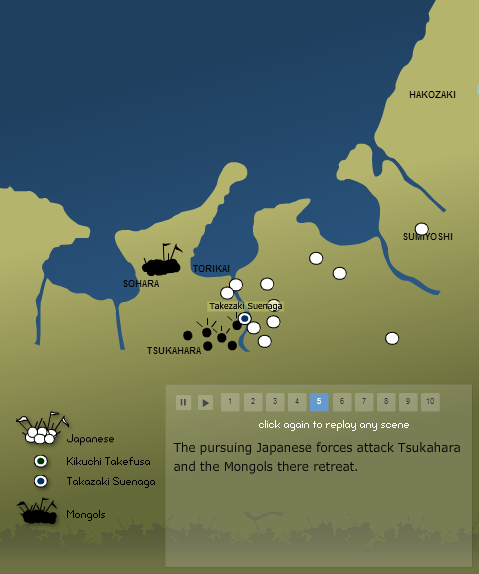
004The second main section of the site provides interactive maps of the invasions. Here you can see the movements of both Japanese and Mongol forces over the course of the campaigns in 1274 and 1281, including destruction wrought by the Mongols and the construction of defensive stone barriers by the Japanese. Broken down into ten sections per map, the progression is briefly described as it plays out. You can click through to your desired point in the battles or press the play button to watch it visually play out.

The Scrolls of the Mongol Invasions of Japan website is a great resource for gaining both a basic and in-depth understanding of these influential historical events, with easy navigation and an excellent deployment of digital resources for exploring visual historical materials. If you’ve got a passing or serious interest in the subject, be sure to check it out or recommend it to others!

Posted in culture, graduate school, main posts, study tools, undergraduate, useful links | Tagged , , , , , , , | 2 Comments

Job Opening: East Asian Popular Culture/Media Studies

job opening - 5Institution: Dickinson College
Location: Pennsylvania, United States
Position: Visiting Assistant Professor

The East Asian Studies Department at Dickinson College invites applications for a two-year visiting position in East Asian popular culture or media studies. Applications from scholars who take a transnational approach to these topics and/or have a regional specialty in Korea are especially welcome. The teaching load is five courses a year. Applicants should be prepared to teach courses their area of study, and also be willing to supervise senior theses and teach introductory survey courses for the department. A Ph.D. is preferred, but ABD will be considered.

Send a letter of application, curriculum vitae, three letters of recommendation, unofficial transcripts, available evidence of teaching success (for example: student evaluations) and a research sample.

Review of applications will begin March 2nd and will continue until the position has been filled.

Please submit application material online at: https://jobs.dickinson.edu

Questions about the position should be directed to Prof. Alex Bates (batesa@dickinson.edu)

Dickinson College is a top-tier liberal arts college that prides itself on a dynamic faculty who combine excellent teaching and research. Dickinson is located in Carlisle, PA, near Harrisburg, Pennsylvania’s state capitol, and within two hours of Washington D.C., Philadelphia, and Baltimore.

The College is committed to building a representative and diverse faculty, administrative staff, and student body. The ability to create inclusive learning environments for an increasingly diverse student body will be important characteristics of the successful candidate. We encourage applications from all qualified persons.

Contact:

Prof. Alex Bates
Dickinson College
Carlisle, PA 17013
batesa@dickinson.edu

Posted in announcements, job openings, jobs | Tagged , , , , , , , , | Leave a comment

Job Opening: Assocate Professor/Professor in Media Studies (Asia-Pacific)

job opening - 5Institution: Victoria University of Wellington
Location: New Zealand
Position: Associate Professor

The School of English, Film, Theatre and Media Studies at Victoria is seeking to make a senior appointment, at either Professor or Associate Professor level, in its Media Studies Programme. Established in 2001, the Programme has a sizeable undergraduate student population, a fast-growing MA and PhD programme and an excellent research culture. The Programme adopts a critical media studies approach in its research and teaching.

Applicants should have research and teaching expertise in one or more of the following areas:

Media in the Asia-Pacific region
Global media industries
Popular culture

The appointee will be expected to have a PhD in Media Studies or related field, to have an excellent research record with an international reputation in her or his specialist field; to have significant supervisory experience and the potential to attract new post-graduates; and to have extensive experience of teaching at the tertiary level. The ability to build positive working relationships within the discipline and to work in an interdisciplinary context is also important. Experience of academic administration would be an advantage.

Applications should include the following material: a letter of interest addressing teaching, research and leadership goals; a curriculum vitae with the name of three referees; writing samples, teaching evaluations and a research plan will be required for the next phase of the process but can be submitted initially.

Further information can be obtained from Dr Thierry Jutel, Head of School of English, Film, Theatre and Media Studies (thierry.jutel@vuw.ac.nz).

Applications close, midnight New Zealand time, 1 March 2015

Victoria University of Wellington is an EEO employer and actively seeks to meet its obligations under the Treaty of Waitangi.

Please complete the online application form and submit your CV and cover letter by attachment at http://www.victoria.ac.nz/about/careers/current-vacancies

Reference 412

Contact:

Further information can be obtained from Dr Thierry Jutel, Head of School of English, Film, Theatre and Media Studies (thierry.jutel@vuw.ac.nz).

Website:http://www.victoria.ac.nz/about/careers

Posted in announcements, job openings, jobs | Tagged , , , , , , , | Leave a comment

Funding: PhD Fellowships: The Asian Sphere

money [150-2]The Asian Sphere: Trans-Cultural Flows Program

The Asian Sphere offers a unique opportunity for outstanding candidates, at the MA and PhD level, to enroll in a multidisciplinary and inter-university graduate program that deals with the Asian continent.

The Asian Sphere is a joint Israeli program between the University of Haifa and the Hebrew University, funded by the Humanities Fund of the Planning and Budgeting Committee of the Council for Higher Education in Israel (VATAT) and Yad Hanadiv. It is a structured graduate program of excellence that deals with the entire Asian continent as a continuous civilizational zone and addresses cross-regional contacts and processes among Asian societies, cultures and states and to a lesser extent between Asia and other continents throughout history until present time.

Apart from a dynamic and exceptional environment of learning and research, the program offers a large number of scholarships for graduate students. The scholarship for PhD students are in the amount of 60,000 NIS per year + full tuition for three years.

The Asian Sphere accepts students from different disciplines in the humanities and social sciences, such as Asian Studies, Islamic and Middle Eastern Studies, Art History, Archaeology, Geography, Political Science, International Relations, Cultural Studies, History, Religious Studies, Philosophy, Anthropology, Sociology, Economics, and more. Research topics are open and can deal with past or current societies. The core of the Asian Sphere teaching activity revolves around high-level seminars on trans-regional, trans-continental and trans-cultural themes, each taught by two or more internationally renowned scholars. In addition, students that are accepted to the program will participate in yearly academic retreats, research trips in Israel and abroad, academic conferences and other activities.

Criteria for the selection of candidates for the Asian Sphere Program scholarship:

  • Proven academic excellence.
  • Preliminary research topic and interest that address cross-Asian topics such as analysis of contacts or comparison between two or more regions or cultures in Asia.
  • Candidates should indicate the advisor (or preferably advisors) of their thesis, from one or both universities and will be enrolled at one of the relevant departments or faculties in either the University of Haifa or the Hebrew University.

Requirements of the Asian Sphere Program and Renewal of the scholarship:

  • Doctoral students must participate in at least three of the program’s interdisciplinary seminars and actively participate in the program yearly academic retreat as well as other activities of the program.
  • Annual renewal of the scholarship will depend on demonstrated progress of the Asian Sphere Program fellows and on continued recommendation of their thesis supervisor.
  • To pass from the first to the second  year, Ph.D students will have to participate in at least two of the program’s seminars, successfully write at least one seminar paper, complete their Ph.D. proposal which will be approved by their advisor(s), and successfully advance from stage A to stage B in their doctorate program.
  • To pass from the second to the third year, Ph.D. students will have to submit a report with regard to their academic progress and complete at least one chapter of their dissertation approved by their advisor(s).
  • D. students will be encouraged to submit research articles to refereed journals and required to present at least one paper in an international conference held during either the second or the third year of the program.

Interested individuals are requested to send one electronic and one printed copy of the following documents (in English whenever applicable). The electronic copy should be in one file.

  • Curriculum vitae.
  • Report of grades  (BA, MA, PhD if applicable).
  • Abstract of one’s Master’s thesis and samples of writing (e.g., a seminar paper, parts of the Master’s thesis, or a paper that is already published).
  • A document describing one’s research interests, presenting the research questions that interest the candidate, the research context, methodology and how the research topic is related to the goals and scope of the Asian Sphere Program (up to 500 words).
  • Two letters of recommendation to be sent separately to the program coordinator  at AsianSphere@gmail.com
  • Candidates should obtain a written consent from the proposed advisor(s) of their thesis.

For additional information regarding terms of acceptance and the procedures, contact Prof. Gideon Shelach (Gideon.shelach@mial.huji.ac.il) and Prof. Rotem Kowner (kowner@research.haifa.ac.il).

All the documents should be sent to the Asian Sphere Scholarships Committee by February 28, 2015.

Applications should be sent to this address:

The Asia Sphere Program
The Hebrew University, Mt. Scopus, Jerusalem
91905
Israel
Email address: AsianSphere@gmail.com

Posted in announcements, funding, graduate school, jobs | Tagged , , , , , | Leave a comment

Book Announcement: Kyoto: An Urban History of Japan’s Premodern Capital

KyotoKyoto: An Urban History of Japan’s Premodern Capital

by Matthew Stavros (University of Hawai’I Press, 2014)

For more information and to explore the companion web site, visit www.kyotohistory.com

Overview

Kyoto was Japan’s political and cultural capital for more than a millennium before the dawn of the modern era. Until about the fifteenth century, it was also among the world’s largest cities and, as the eastern terminus of the Silk Road, it was a place where the political, artistic, and religious currents of Asia coalesced and flourished. Despite these and many other traits that make Kyoto a place of both Japanese and world historical significance, the physical appearance of the premodern city remains largely unknown. Through a synthesis of textual, pictorial, and archeological sources, this work attempts to shed light on Kyoto’s premodern urban landscape with the aim of opening up new ways of thinking about key aspects of premodern Japanese history.

The book begins with an examination of Kyoto’s highly idealized urban plan (adapted from Chinese models in the eighth century) and the reasons behind its eventual failure. The formation of the suburbs of Kamigyō and Shimogyō is compared to the creation of large exurban temple-palace complexes by retired emperors from the late eleventh century. Each, it is argued, was a material manifestation of the advancement of privatized power that inspired a medieval discourse aimed at excluding “outsiders.” By examining this discourse, a case is made that medieval power holders, despite growing autonomy, continued to see the emperor and classical state system as the ultimate sources of political legitimacy. This sentiment was shared by the leaders of the Ashikaga shogunate, who established their headquarters in Kyoto in 1336.

The narrative examines how these warrior leaders interacted with the capital’s urban landscape, revealing a surprising degree of deference to classical building protocols and urban codes. Remaining chapters look at the dramatic changes that took place during the Age of Warring States (1467–1580s) and Kyoto’s postwar revitalization under the leadership of Oda Nobunaga and Toyotomi Hideyoshi. Nobunaga’s construction of Nijō Castle in 1569 transformed Kyoto’s fundamental character and, as Japan’s first castle town, it set an example soon replicated throughout the archipelago. In closing, the book explores how Hideyoshi—like so many before him, yet with much greater zeal—used monumentalism to co-opt and leverage the authority of Kyoto’s traditional institutions.

Richly illustrated with original maps and diagrams, Kyoto is a panoramic examination of space and architecture spanning eight centuries. It narrates a history of Japan’s premodern capital relevant to the fields of institutional history, material culture, art and architectural history, religion, and urban planning. Students and scholars of Japan will be introduced to new ways of thinking about old historical problems while readers interested in the cities and architecture of East Asia and beyond will benefit from a novel approach that synthesizes a wide variety of sources.

 http://www.uhpress.hawaii.edu/p-9220-9780824838799.aspx

Posted in announcements, culture | Tagged , , , , , | 4 Comments