Workshop: Kambun Workshop on Chūyūki at USC

A KAMBUN WORKSHOP
Reading the Chūyūki of Fujiwara Munetada
June 15 – July 10, 2015


The Project for Premodern Japan Studies based in the History Department of the University of Southern California announces this summer’s Kambun Workshop, which will focus on the later Heian-period courtier journal, Chūyūki, by Fujiwara no Munetada (1062-1141). Munetada’s journal is one of the most important sources for its time. Professor Sanae Yoshida, a specialist on the journal who has spent her career at the University of Tokyo’s Historiographical Institute (Shiryō Hensanjo), will lead the workshop with Professor Joan Piggott of the USC History Department. Themes will include family and residence in Munetada’s Kyoto. The primary language of the workshop is Japanese, but translation and annotation in English is also emphasized. Morning and afternoon sessions will be held Monday through Friday (10 AM – 5 PM). Applicants must be fluent in Japanese and have completed coursework in Classical Japanese and either Kambun or Classical Chinese.


The cost of the workshop, including lodging, is $5100 ($3500 tuition, $1600 lodging). Thanks to the Henry Luce Foundation, some scholarship funding is available. Applications can be downloaded from the website of the Project for Premodern Japan Studies, at http://dornsife.usc.edu/ppjs. Please submit applications by March 30, 2015. 

For further information contact Prof. Joan Piggott

University of Southern California
Department of History, Social Sciences Bldg.
Los Angeles, CA 90089-0034
joanrp@usc.edu


Posted in announcements, graduate school, study tools, summer program | Tagged , , , , , , , | Leave a comment

Call for Papers: Sungkyun Journal of East Asian Studies

call for papers [150-2]Call for Papers: The Sungkyun Journal of East Asian Studies (SJEAS)

SJEAS published by the Academy of East Asian Studies, Sungkyunkwan University in Seoul, Korea invites you to submit papers in Japanese Studies. Research areas SJEAS prefers are in the field of humanities- history, literature, culture, sociology, religion, and philosophy. The deadline for the Oct issue is May 31, 2015. SJEAS accepts papers all the year around. 

Email: sjeas@skku.edu
Visit the website at 
http://sjeas.skku.edu

Posted in announcements, graduate school | Tagged , , , , | Leave a comment

Resource: The Peace Learning Archive in Okinawa

Paula brought to my attention this beautiful site, which describes itself as following:

The Peace Learning Archive in OKINAWA is a culmination of the creation methods of “pluralistic digital archives” established with the workings of the archives related to Nagasaki, Hiroshima, and the Great East Japan Earthquake. Information regarding time and space are supplemented to all of the testimonials and photo materials and it allows the user to freely move about in the skies of Okinawa in the 1940s for a deeper understanding of the actual circumstances of the Battle of Okinawa. The website is devised to allow the user to view the video and text for each of the testimonials. Additionally, photo data are carefully laid out and arranged to replicate as precisely as possible the conditions at which the photos were taken. We hope that the visitors to the website will take the opportunity to view our archives and retrace the steps of the days past and walk through memories that shall not be forgotten.

I have only just begun to explore the site’s features, but, located at http://peacelearning.jp/ and organized by a branch of the Okinawan prefectural government, the site seems to primarily consist of an archive of photos and video testimonials by survivors of the Battle of Okinawa, navigable through a plug-in integrated with Google Earth. The website itself is in English & Japanese, but the Google Earth feature is, amazingly, available in Japanese, English, Chinese, Korean, Portuguese, or Spanish. You can click on a series of options in the top left to show or hide layers for a 1945 Okinawa map, photos from the Prefectural Archives, the testimonial videos, and a tactical map used in Operation Iceberg, among others.

There is also an AR (Augmented Reality) app for iPhone and Android which, if you are in Okinawa, will connect to the camera or GPS on your phone to show you photos and testimonials from the Battle related to the place you are at.

I spoke this summer to, well, quite a few people, but one in particular stands out, a woman from Yambaru, in the north of Okinawa Island, about the war. She is a bit too young to have been around at that time, but she told me how many people from Yambaru, thinking it would be safer to stay close to the Japanese Army, moved south with the armies, rather than stay in the north, as the Allied assault began. How could they have known that, in the end, the south end of the island would be hit hardest by the battle, and the north all but untouched? As Japanese citizens, they thought the Imperial Army would protect them. Roughly one-quarter of the total population of the island was killed in those few months in 1945, most of them in the south. She went on to talk about how, growing up in Okinawa after the war, even in Yambaru, a little geographically and culturally removed from the “big city” of Naha, they grew up learning little of Okinawan history, which is why she felt so strongly about working at the new Okinawa Museum of History and Folklore, as a site where Okinawan children might come to learn more about their heritage. The Museum opened in 2013 at one of the major highway rest-stops in Yambaru, and displaying the personal collection of pottery, lacquerwares, folk tools, and so forth of the CEO of Okashi Goten, a major Okinawan restaurant & sweets company.

If you are interested in the Battle of Okinawa, let me quickly suggest two more museums to visit: for those in the Tokyo area who might not get the chance to visit Okinawa, I think it quite something that the very last display in the Modern Japan section at the National Museum of Japanese History (Rekihaku) in Chiba is a video of people talking about their experiences of the Battle of Okinawa – in native Okinawan language (Uchinaaguchi), with no subtitles, Japanese or otherwise. Second, for those who might make it to Naha, in addition to the more well-known Peace Memorial Museum & Park, and especially if you can’t make it down to Mabuni to see that, there is a small, private, unofficial museum right in Naha called the Battle of Okinawa / Holocaust Photo Exhibition Hall (沖縄戦・ホロコースト写真展示館) which consists almost entirely of just photos from before, during, and after the Battle, and brings a more grassroots perspective on the place of the Battle in Okinawan memory and identity today.

Apologies for the digression from discussing the Resource at hand. The Peace Learning Archive site is really quite something, and my thanks to Paula for letting me know about it. I invite you to go take a look, explore the features, watch some of the testimonials. I look forward to perhaps making use of it in the classroom myself, if/when I get a chance to talk to my students about Okinawa, and the Battle.

Posted in graduate school, study tools, undergraduate, useful links | Tagged , , , , , , | Leave a comment

Call for Papers: Midwest Conference on Asian Affairs

call for papers [150-2]Location:  Missouri, United States

The Department of East Asian Languages and Cultures at Washington University in St. Louis is pleased to host the 64th Annual Meeting of the Midwest Conference on Asian Affairs, October 16-18, 2015. The MCAA seeks to promote Asian studies both at the university and the secondary and primary levels and particularly to encourage scholarly interchange between Asianists located in the Midwest, though scholars from all regions are invited to participate.

Proposals are solicited for panels, roundtables, individual papers, posters, and “diamond presentations” in all fields dealing with East, South, and Southeast Asia, the Asian Diaspora, and topical and comparative panels. Faculty, graduate, and undergraduate students, as well as independent Asianists, are encouraged to participate and attend.

Proposals are due May 31, 2015. Persons presenting papers must be members of MCAA and should pre-register by August 31, 2015.

The MCAA also awards a number of student prizes at the graduate and undergraduate level.  More information about the deadlines for these prizes will be posted soon.  Please keep an eye on the website.

For details on how to submit a proposal and for additional information about this meeting, please visit the 64th Annual MCAA website:http://ealc.wustl.edu/mcaa


Posted in announcements, conferences, graduate school | Tagged , , , , , , | Leave a comment

Program: UNO-Japan: Study at Doshisha University Program

The UNO-Japan: Study at Doshisha University Program is a 5-week study abroad adventure offered by the University of New Orleans (UNO) for undergraduate students to pursue college credit in Japanese studies (or elective credit) and to get a taste of this fascinating land. Limited space is still available, so please encourage your students to apply now!

Course offerings: Students choose two courses from the following:

  • Basic Japanese II
  • Recent Japanese History
  • Consuming Japan: The Politics of Food
  • Contemporary Japanese Literature
  • Philosophy and Film

Dates: May 24-June 27, 2015 (5 weeks)

Cost: $4,495.00 This includes: TUITION, HOUSING, weekday LUNCHES on campus, a FIELD TRIP, CULTURAL ACTIVITIES, TOMODACHI PROGRAM, STUDY ABROAD HEALTH INSURANCE, a 1-MONTH BUS PASS for the city of Kyoto, and more!

Earn 6 college credit hours (fully transferable, check with home institution for course equivalencies). Open to anyone over 18 years of age at the time of departure who meet the UNO admissions requirements.

No previous knowledge of the Japanese language required.

Sign up now – only 14 spots (or less by now) are available on this popular program!

The program has been very well received by previous students – several of them have participated twice!

For more information, please visit our website at: http://inst.uno.edu/Japan/, or e-mail us at:UNOJapan@uno.edu.

Also, feel free to “like” us on Facebook: http://www.facebook.com/UNOJapan.Doshisha.

Posted in announcements, graduate school, living abroad, summer program | Tagged , , , , , | Leave a comment

Job Opening: Lecturer in Japanese History at UW Seattle

job opening - 5(cross-posted from PMJS)

Institution: University of Washington
Location: Seattle, WA
Position:  Full- or Part-Time Lecturer in Japanese History (1- or 2-year appointment from September 16, 2015 to June 15, 2016 or June 15, 2017)

Job Description:

The Department of History and the Henry M. Jackson School of International Studies seek a full- or part-time lecturer to teach six (if full-time) or four (if part-time) courses, including a large lower-level lecture course in Japanese civilization, and one upper-level lecture course on the history of modern Japan (from the late Tokugawa period to the present). Other possibilities include four (if full-time) or two (if part-time) other undergraduate courses such as an upper-level lecture course on pre-modern Japan and some seminars.  If candidates are able to teach a Korean history course as part of their load, that would be a positive but secondary consideration.

Qualifications:

Candidates are expected to possess: a Ph.D. in Japanese history, and experience teaching history to undergraduates as an instructor or teaching assistant.  Candidates with an ongoing research agenda and scholarly publications are preferred.

Deadline:

Applications will be accepted until the position is filled, but preference will be given to applications received by April 15, 2015.

To Apply:

Please send to the below address:
*a cover letter that describes your teaching interests and experience, and academic preparation, and, if they exist, publications;
*a curriculum vitae;
*syllabi for courses in Japanese civilization, history of modern Japan, and any other courses the candidate has taught in Japanese or Korean history.
*Three letters of recommendation

Japanese History Lecturer Search Committee
Department of History
Smith 315
University of Washington
Campus Box 353560
Seattle, WA  98195-3560

Questions regarding the application process should be directed to the Department of History at: (206).543.6224 or histfacs@uw.edu

Posted in announcements, job openings | Tagged , , , , , | Comments Off on Job Opening: Lecturer in Japanese History at UW Seattle

Call for Papers: 70 Years After Hiroshima: Conceptualizing Nuclear Issues in Global Context

call for papers [150-2]Prince Takamado Japan Centre, University of Alberta will host a conference to commemorate the 70th anniversary of the dropping on the atomic bombs on Hiroshima and Nagasaki, at the University of Alberta, 18-19 September 2015. We are currently accepting papers / panel proposals. For details, please visit:https://events.gobigevent.com:443/events-web-public/event/start/714

We welcome submissions from faculty members, postdoctoral fellows, and students!

This conference is innovative in that it expands the historic event into the nuclear issues of the contemporary era, taking the approach that history speaks to the present. It contemplates what Japan’s historic lessons can offer to the world, focusing on the debates over war, nuclear energy issues, and peace constitution. Its cope is broad, covering the area from popular culture and Hibakusha literature to energy issues.

Posted in announcements, conferences, graduate school | Tagged , , , , , | Leave a comment

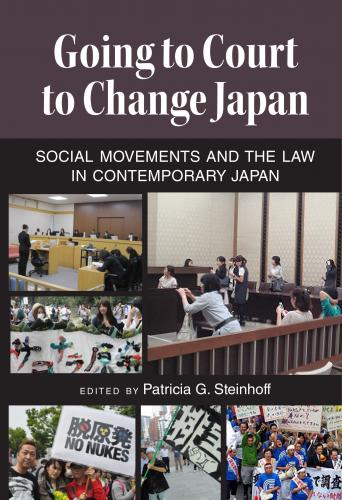
Book Announcement: Going to Court to Change Japan: Social Movements and the Law in Contemporary Japan

CourtGoing to Court to Change Japan: Social Movements and the Law in Contemporary Japan

Edited by Patricia G. Steinhoff

Michigan Monograph Series in Japanese Studies No. 77

2014, viii + 187 pages, ISBN 978-1-929280-83-4. Paper only. $20.00

https://www.cjspubs.lsa.umich.edu/books/list/mono77.php

Published by the Center for Japanese Studies, The University of Michigan

  • Going to Court to Change Japan examines the relationship between social movements and the law in bringing about social change in Japan. Six fascinating case studies take us inside movements dealing with causes as disparate as death by overwork, the rights of the deaf, access to prisoners on death row, consumer product safety, workers whose companies go bankrupt, and persons convicted of crimes they did not commit. Each of the case studies stands on its own as a detailed account of how a social movement has persisted against heavy odds to pursue a cause through the use of the courts.The studies pay particular attention to the relationship between the social movement and the lawyers who handle their cases, usually pro bono or for minimal fees. Through these case studies we learn much about how the law operates in Japan as well as how social movements mobilize and innovate to pursue their goals using legal channels. The book also provides a general introduction to the Japanese legal system and a look at how recent legal reforms are working.Going to Court to Change Japan will interest social scientists, lawyers, and anyone interested in the inner workings of contemporary Japan. It is suitable for use in a wide range of undergraduate and graduate courses on Japan in social sciences and law, and can also provide a comparative perspective to general courses in these fields.

    Contributors include: John H. Davis, Jr., Daniel H. Foote, Patricia L. Maclachlan, Karen Nakamura, Scott North, Patricia G. Steinhoff, and Christena Turner.

Posted in announcements, culture | Tagged , , , , , , , | Leave a comment

#Program: KCJS Deadline extended

Dear Colleagues,

The deadline for KCJS Summer Programs in Advanced & Classical Japanese has been extended to March 13, 2015. Please share this information with your colleagues and students, and forward to appropriate email lists.

The KCJS intensive summer programs, held at Doshisha University in Kyoto, offer training in advanced or classical Japanese for highly motivated undergraduate and graduate students who have completed one year of Japanese or the equivalent. Students enroll in the advanced or the classical course, each of which carries eight points of credit on a Columbia University transcript upon completion. Language instruction will be provided by the regular faculty of KCJS, which is now in its 26nd year as a highly successful junior-year-abroad program in Kyoto, and by visiting faculty from member schools of the KCJS consortium.

Conversation partners will be arranged for students of modern Japanese to provide additional speaking practice. Field trips (including one overnight trip), guest lectures, and other activities that utilize Kyoto’s rich cultural resources complement classroom instruction. Students live in homestays or apartments near campus.

We look forward to a great summer in Kyoto!


Posted in announcements, graduate school, language schools, living abroad, study abroad, study tools, summer program | Tagged , , , , | Leave a comment

Program: Summer Intensive Kanbun at IUC

Summer Intensive Kanbun Program at IUC Yokohama

Applications due March 13, 2015
Program Dates: Friday, June 19, 2015 – Thursday, July 9, 2015

The Inter-University Center for Japanese Language Studies, Yokohama (administered by Stanford University), will offer a three-week intensive course in reading kanbun in the summer of 2015. The course is intended for students — primarily graduate students — who need to master the fundamentals of kanbun in order to conduct specialized research in various disciplines.

Hours: 4 class hours per day, 5 days per week, 3 weeks, total 60 class hours (including field trips)

Eligibility for Admission: To qualify for admission, an applicant must

  1. be engaged in specialized professional work or an academic field of study for which proficiency in reading kanbun is required;
  2. possess an advanced level of proficiency in Japanese language and have knowledge of classical Japanese grammar;
  3. have an understanding of the grammar and sentence patterns of modern Japanese, and be able to read and write at least 1,000 kanji as well as hiragana and katakana.

Aims and focus:

This course will train students to be able to read early modern (kinsei) and modern (kindai) kanbun writings with the aid of dictionaries and without reference to transliterations/translations into Japanese (yomikudashibun) of the kanbun texts.

Students will learn old forms of kanji (kyūjitai), epistolary style Japanese (sōrōbun), and the Japanese way of reading Chinese writing (kundokutai).

As for kanbun texts from the medieval (chūsei) period and earlier, because specialized background knowledge is required, the course will train students to understand such texts while making reference to yomikudashibun.

Level of proficiency required for enrollment:

The class will be conducted entirely in Japanese. A high level of proficiency in reading and speaking Japanese is needed.

Knowledge of classical Japanese grammar (bungo bunpō).

Electronic dictionaries: Students will be expected to have their own electronic dictionaries. It is desirable that they have the editions of Kanjigen and Kōjien that feature stylus pen input capability.

Field trips: One afternoon each week, participants will join students in the regular IUC Summer Program on an excursion.

Hours: 4 class hours per day, 5 days per week, 3 weeks, total 60 class hours (including field trips)

Attendance Fees
Tuition: $2,800.00 (U.S. dollars)

Application Instructions and Forms

Application Deadline (received by): March 13, 2015

For all application forms as well as detailed instructions, please see http://web.stanford.edu/dept/iuc/cgi-bin/resources/applications.php.

All Inter-University Center application forms are available in either Adobe Acrobat PDF or Microsoft Word.

Yokohama Office for delivery of Summer Application Materials:

IUC Summer Kanbun Course
Inter-University Center for Japanese Language Studies
Pacifico Yokohama, 5F
1-1-1 Minato Mirai, Nishi-ku ,
Yokohama, Japan 220-0012

Contact Information for 10-Month Program and Applications:

Email: kanabun@iucjapan.org
Web: http://www.stanford.edu/dept/IUC
Tel: (045) 22302002
Fax: (045) 223-2060

Please see http://web.stanford.edu/dept/iuc/cgi-bin/resources/applications.php for all application forms as well as detailed instructions.

Disclaimer: This course is being offered subject to a minimum enrollment of three students and a maximum enrollment of eight students. If fewer than three applicants meet the required proficiency level, the course will not be taught in 2015. If more than eight applicants meet the basic requirements for eligibility, admission of eight students will be based on consideration of applicants’ need to read kanbun, their stated objectives, and their proficiency in Japanese.

Admission decisions will be announced by e-mail not later than May 10.

Tuition payments are due before the beginning of instruction on June 19. Checks should be made payable to Stanford University.

Any admitted applicant who decides not to enroll in the program should immediately notify IUC Yokohama.

All inquiries, including questions regarding attendance that arise after the application period, should be sent to the Center via email at kanbun@iucjapan.org. Please do not make inquiries by telephone.
Posted in announcements, language schools, living abroad, study abroad, study tools, summer program | Tagged , , , , , | Leave a comment