Book Announcement: Time and Place Are Nonsense: The Films of Seijun Suzuki

VICTIMVia University of Washington Press.

Time and Place Are Nonsense: The Films of Seijun Suzuki
TOM VICK
paperback not available
$30.00 HARDCOVER (ISBN: 9780934686334)
PUBLISHED: November 2015
SUBJECT LISTING: Perfoming Arts; Biography, Autobiography, and Memoir
BIBLIOGRAPHIC INFORMATION: 242 pp., 126 illus., 52 in color, 6 x 8 in.
DISTRIBUTED FOR: Freer Gallery of Art and Arthur M. Sackler Gallery

CONTENTS

Japanese film director Seijun Suzuki began his career making increasingly outrageous B movies for Nikkatsu Studios in the 1950s and 1960s (he was eventually fired for his stylistic excesses). More than ten years later, he reinvented himself as an independent filmmaker with a uniquely eccentric vision. He remains a cult figure outside of Japan and his influence can be seen in the work of directors as diverse as Jim Jarmusch, Baz Luhrmann, and Quentin Tarantino. Time and Place Are Nonsense, the first book-length study of his work in English, aims to enhance the appreciation of his films by analyzing them in light of the cultural and political turmoil of post-World War II Japan and the aesthetic traditions that inform them.

TOM VICK is curator of film at Smithsonian’s Freer and Sackler Galleries. He is the author of Asian Cinema: A Field Guide. He lives in Rockville, Maryland.

Posted in announcements, culture | Tagged , , , , | Leave a comment

Call for Papers: Sungkyun Journal of East Asian Studies

call for papers [150-2]The Sungkyun Journal of East Asian Studies (SJEAS) published by the Academy of East Asian Studies, Sungkyunkwan University, in Seoul, Korea would like to invite you to submit your papers on Japanese Studies for our 2016 Oct issue.

Research areas SJEAS prefers are in the field of humanities – history, literature, culture, sociology, religion and philosophy.

The deadline of the Oct issue is Feb 28, 2016. SJEAS accepts papers all the year around.

For more information, please visit our website at http://sjeas.skku.edu

Contact Info:

Jieun Han
Managing editor
Sungkyun Journal of East Asian Studies
Academy of East Asian Studies
Sungkyunkwan University
25-2 Sungkyunkwan-ro, Jongno-gu, Seoul, 03063, Korea

Contact Email:  sjeas@skku.edu
URL:  http://sjeas.skku.edu

Posted in announcements, graduate school | Tagged , , , , , , | Leave a comment

Job Opening: Assistant Professor, Japanese Language and Literature

job opening - 5California State University – Sacramento, World Languages & Literatures

Tenure Track Instructional Faculty – World Languages and Literatures (Japanese)

California State University, Sacramento, seeks applications for a Japanese full-time tenure-track position at the Assistant Professor rank to start during the fall 2016 semester. Duties include:  teach and develop courses in undergraduate Japanese language, literature, and culture; engage in scholarly activities; advise students; provide service to the department, campus, and the community. Review of applications will begin November 6, 2015. See the details at http://www.csus.edu/about/employment (Job ID#101475). Applications are only accepted through this website.

Contact:http://www.csus.edu/about/employment

Website:http://www.csus.edu/fl

Posted in announcements, job openings, jobs | Tagged , , , , , , | Leave a comment

Funding: 20th Century Japan Research Award

money [150-2]20th Century Japan Research Award for 2015-2016

The Nathan and Jeanette Miller Center for Historical Studies and the University of Maryland Libraries invite applications for two $1,500 grants to support research in the library’s Gordon W. Prange Collection and East Asia Collection on topics related to the period of the Allied Occupation of Japan and its aftermath, 1945-1960. Holders of a Ph.D. or an equivalent degree are eligible to apply, as are graduate students who have completed all requirements for the doctorate except the dissertation. The competition is open to scholars in all parts of the world and from any discipline, but historical topics are preferred. University of Maryland faculty, staff, and students may not apply. More information can be found on the Prange Collection website.

The application deadline is November 20, 2015.  The grant must be used by October 28, 2016. Grant funds will be disbursed in the form of reimbursement for travel, lodging, meals, reproductions, and related research expenses. Such costs as computers or software are not eligible. Reimbursement will require submission of receipts for processing by the University.

All applications must be submitted electronically by attachment to millercenter@umd.edu with “Twentieth-Century Japan Research Awards” in the subject line. Applications must include a curriculum vitae and a two-to three-page description (double-spaced) of the research project. Applications from graduate students must be accompanied by a letter from the principal faculty advisor attesting to the significance of the dissertation project and to the student’s completion of all other degree requirements.

Materials in the Gordon W. Prange Collection include virtually all Japanese-language newspapers, news agency releases, magazines, pamphlets, and books dating from the period of Allied censorship, 1945-1949, in addition to over 10,000 newspaper photos.  There are also materials published by Chinese and Korean residents, most of which are written in Japanese.  Related collections in English include the personal papers of Charles Kades and Justin Williams.  Office correspondence documenting policies and decisions of the Publications, Pictorial, and Broadcast Division, Civil Censorship Detachment (Civil Intelligence Section), Supreme Commander for the Allied Powers Japan, are complementary to official Occupation records housed at the National Archives, College Park.  Japanese newspapers and magazines from the Prange Collection are available for research on microform. Other Prange materials are made available for research in the Prange Collection reading area after consultation with the Prange Curator or Manager.  The East Asia Collection contains Japanese-language books published during the wartime period, scholarly monographs on Occupied Japan, and a wide variety of reference works.

A one-page summary of research findings is required at the conclusion of the grant period and sharing of research findings during an informal lunchtime talk while the recipient is on campus is encouraged.

For further information about the collections, consult the following websites: http:/www.lib.umd.edu/prange andhttp://www.lib.umd.edu/EASIA/eastasia.html

Posted in announcements, funding, graduate school | Tagged , , , , , | Leave a comment

Book Announcement: Like No Other: Exceptionalism and Nativism in Early Modern Japan

Via University of Hawai’i Press.

Like No Other: Exceptionalism and Nativism in Early Modern Japan9780824852849

Author: McNally, Mark Thomas;

344pp. November 2015
Cloth – Price: $67.00
ISBN: 978-0-8248-5284-9

Like No Other: Exceptionalism and Nativism in Early Modern Japan probes the association of the early modern Japanese intellectual institution called Kokugaku with the phenomenon of nativism. Uncovering profound differences that cast serious doubt on this association, Mark McNally argues that what Japanologists viewed as nativistic about Kokugaku were actually more typical of what Americanists call exceptionalism. By severing the link between Kokugaku and nativism, he is able to explore within early modern Japanese history instances that were more genuinely nativistic, such as the upheaval associated with the intercultural encounters with Westerners during the 1850s and 1860s that culminated in the overthrow of Japan’s last shogun. He also documents, for the first time in Japanese studies, the ways in which exceptionalism applies to Japanese history; not by focusing on either Nihonjinron or on Kokugaku—the connection between the former and exceptionalism is one that Americanists have already made, and the connection between the two Japanese institutions is one that Japanologists already know well—but by highlighting the central role of Confucianism.

While Americans looked to the Judeo-Christian tradition for their exceptionalist ideas, their counterparts in early modern Japan looked to Confucianism, whose foundational connections to exceptionalism were perhaps stronger than any analogous tradition in the West. Despite the fact that exceptionalism and nativism occupy distinct positions within the historiographical traditions of both the United States and Japan, they also intersect and overlap in the latter case, which strongly suggests that this situation may also be true in other places, including the United States.

Posted in announcements, culture | Tagged , , , , , , , | Leave a comment

Fun Link Friday: Halloween Oden

ハッピーハロウィン!

Halloween oden by Shiropakuchan via Cookpad via Japan Huffington Post

Halloween oden via Japan Huffington Post

In the past, we’ve hosted Halloween FLFs on Halloween bento, so today I’m pleased to present the Halloween oden! Here are instructions on how to make all the normal oden ingredients (plus carrots and tomatoes) into adorable pumpkins, mummies, and ghosts. Recipes are a great way to learn more Japanese, too–and, wow, has Japan sure turned up the hype on Halloween in the last 10 years!

Halloween oden from Cookpad user Shiropakuchan

Halloween oden from Cookpad user Shiropakuchan

Check it out on the Japan HuffPo here or Cookpad here.

Posted in culture, fun links | Tagged , , , , , | Leave a comment

Job Opening: University of Hong Kong: Centre of Buddhist Studies

job opening - 5Founded in 1911, the University of Hong Kong is committed to the highest international standards of excellence in teaching and research, and has been at the international forefront of academic scholarship for many years.  The University has a comprehensive range of study programmes and research disciplines spread across 10 faculties and over 140 academic departments and institutes/centres.  There are over 27,700 undergraduate and postgraduate students who are recruited globally, and more than 2,000 members of academic and academic-related staff coming from multi-cultural backgrounds, many of whom are internationally renowned.

Non-Tenure Track Professor in the Centre of Buddhist Studies (Ref.: 201501193)

Applications are invited for appointment as Non-Tenure Track Professor in the Centre of Buddhist Studies, to commence from September 1, 2016 or as soon as possible thereafter, on a two-year fixed-term basis, with the possibility of renewal.

The successful candidate will be considered for the conferment of Endowed Professorship, with the title ofGlorious Sun Professor in Buddhist Studies.

Applicants must possess a Ph.D. degree in Buddhist studies with at least six years of teaching and supervision experience in a recognized tertiary institution.  They should have expertise in Pāli language and textual criticism for teaching and research purposes.  It is an advantage, but not necessary, if they have fieldwork experience in a traditional Theravāda country such as Sri Lanka, Thailand, Myanmar, etc.  The appointee is expected to make a substantial contribution to the Centre’s strategic development and in fostering academic collaborations locally, regionally and internationally.  He/She should be able to demonstrate international peer recognition and world leadership in their area of expertise and have an established record of research and publications.  He/She will be required to lead the development of interdisciplinary and collaborative research initiatives.  He/She should be able to direct research and teaching activities and have experience in supervising research students.  The area of specialization is Early/Theravāda Buddhism.

The Centre promotes innovative thinking and new horizons for Buddhist studies and research.  Information about the Centre can be obtained at http://www.buddhism.hku.hk/.

A globally competitive remuneration package commensurate with the appointee’s qualifications and experience will be offered.  At current rates, salaries tax does not exceed 15% of gross income.  The appointment will attract a contract-end gratuity and University contribution to a retirement benefits scheme, totalling up to 15% of basic salary, as well as annual leave, and medical benefits.  Housing benefits will be provided as applicable.

Contact:

Applicants should send a completed application form, together with an up-to-date C.V., contact details of at least three referees and other supporting materials to cbshr@hku.hk.  Application forms (341/1111) can be downloaded at http://www.hku.hk/apptunit/form-ext.doc and further particulars can be obtained at http://jobs.hku.hk/.  Closes November 30, 2015.  The University thanks applicants for their interest, but advises that only candidates shortlisted for interviews will be notified of the application result.

The University is an equal opportunities employer and is committed to a No-Smoking Policy

Posted in announcements, job openings, jobs | Tagged , , , , , , | Leave a comment

Resource: Real Estate Japan Blog

realestatecojp

For those who are studying social science topics dealing with urban planning and demographics, Real Estate Japan started a blog in April 2015 that may be of use to you. While the English-language site generally focuses on buying and renting real estate in Japan, the site’s blog section highlights information about market conditions, the state of the housing economy, and new developments that could be useful for your research. For example, what’s causing lower prices in the Osaka apartment market? What is the average rate of condo-ownership in Japan relative to other countries and how does that affect rates of renting vs. buying? How do average condo prices compare between Tokyo and Sapporo? What’s the average rent by prefecture? What sort of tenant/landlord issues statistically high?

For those researching or interested in environmental design, civil engineering, and architecture, the site also features pieces on housing innovations, such as this home “buried” in Mt. Mineyama, which utilizes geothermal temperature control and architecture that works with the natural landscape of the area, and tsunami evacuation towers as post-2011 architecture.

Furthermore, for researchers looking for primary sources, the blog links back to the original sources (often in the original Japanese) of the information.

The website also contains glossaries to real-estate terms and tips for buying, selling, and renting as a private individual or an investor. A number of the articles are focused on international citizens living in Japan–financing options for investors, basic requirements for getting a mortgage as a non-Japanese citizen, etc.  

Whether you’re studying market trends for academic or personal reasons, Real Estate Japan’s blog has a lot of useful content. For information on apartment hunting, check out our series here.

Posted in blogs, culture, housing, living abroad, useful links | Tagged , , , , , | Leave a comment

Funding: Nippon Foundation Fellowship for Japanese language study

money [150-2]Application Deadline: December 11, 2015

The Inter-University Center for Japanese Language Studies (IUC), administered by Stanford University, is pleased to announce a call for applications to the Nippon Foundation Fellows Program at the IUC for the academic year 2016-17. This program aims to provide the most promising students with the deep linguistic and cultural knowledge needed to become leaders in their fields, and to foster strong colleagial bonds and intellectual exchange among them and with their IUC senpai.

Fellows will receive a full tuition scholarship plus a modest living stipend to attend the 10-month immersion program in advanced Japanese at the IUC in Yokohama from September 2016 to June 2017.

Over the last half century the IUC has trained more than 2,000 students.  Alumni of the school have gone on to teach about Japan at more than 225 universities around the world, and many IUC graduates have distinguished themselves in non-academic careers in which knowledge about Japan has been vital.

Nippon Foundation Fellows participate fully in the program of instruction at the IUC, and in addition they:

  • Meet regularly with each other and the IUC Resident Director to discuss their research interests and experiences in Japan
  • Invite two IUC alumni to offer a lecture in Japanese in Tokyo
  • Deliver a presentation in Japanese at a Nippon Foundation Fellows conference open to the public

Eligibility: Ph.D. students in all fields of Japanese studies currently enrolled in universities from North America, Europe, Australia, or New Zealand; MA, MS, MBA, & JD students with Japan-focused career goals in academia, business, diplomacy/government service, journalism, translation, and law currently enrolled in or recently graduated from a North American university.  Applicants must pass the IUC proficiency exam.

Application Deadline: December 11, 2015

Complete details and applications are available online.

web:  www.stanford.edu/dept/IUC                        email:  iucjapan@stanford.edu

Posted in announcements, funding, graduate school, language schools, study abroad | Tagged , , , , , , , | Leave a comment

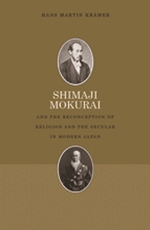
Book Announcement: Shimaji Mokurai and the Reconception of Religion and the Secular in Modern Japan

Via University of Hawai’i Press.

246pp. July 2015
Cloth – Price: $59.00
ISBN: 978-0-8248-5153-8

9780824851538Religion is at the heart of such ongoing political debates in Japan as the constitutionality of official government visits to Yasukuni Shrine, yet the very categories that frame these debates, namely religion and the secular, entered the Japanese language less than 150 years ago. To think of religion as a Western imposition, as something alien to Japanese reality, however, would be simplistic. As this in-depth study shows for the first time, religion and the secular were critically reconceived in Japan by Japanese who had their own interests and traditions as well as those received in their encounters with the West. It argues convincingly that by the mid-nineteenth century developments outside of Europe and North America were already part of a global process of rethinking religion.

The Buddhist priest Shimaji Mokurai (1838–1911) was the first Japanese to discuss the modern concept of religion in some depth in the early 1870s. In his person, indigenous tradition, politics, and Western influence came together to set the course the reconception of religion would take in Japan. The volume begins by tracing the history of the modern Japanese term for religion, shūkyō, and its components and exploring the significance of Shimaji’s sectarian background as a True Pure Land Buddhist. Shimaji went on to shape the early Meiji government’s religious policy and was essential in redefining the locus of Buddhism in modernity and indirectly that of Shinto, which led to its definition as nonreligious and in time to the creation of State Shinto. Finally, the work offers an extensive account of Shimaji’s intellectual dealings with the West (he was one of the first Buddhists to travel to Europe) as well as clarifying the ramifications of these encounters for Shimaji’s own thinking. Concluding chapters historicize Japanese appropriations of secularization from medieval times to the twentieth century and discuss the meaning of the reconception of religion in modern Japan.

Highly original and informed, Shimaji Mokurai and the Reconception of Religion and the Secular in Modern Japan not only emphasizes the agency of Asian actors in colonial and semicolonial situations, but also hints at the function of the concept of religion in modern society: a secularist conception of religion was the only way to ensure the survival of religion as we know it today. In this respect, the Japanese reconception of religion and the secular closely parallels similar developments in the West.

Posted in announcements, culture | Tagged , , , , , | Leave a comment