Job Opening: International Program Advisor, University of New Mexico (2 positions)

job opening - 5Via JET Wit Jobs mailing list.

Employer: University of New Mexico
Location: Albuquerque
Deadline: Jan. 17, 2016
Education: BA required, MA preferred

Department Global Education Office
Posting Number: 0833003

Position Summary: The University of New Mexico (UNM) Global Education Office is pleased to announce the opening of (2) International Program Advisor positions within its International Student & Scholar Services unit. These positions provide a range of administrative/regulatory advisement and informational support services related to international programs for the over 1,500 international students and scholars from 99 countries on UNM’s main campus.

International Program Advisors provide individual advisement to international students regarding regulatory/administrative issues such as maintenance of legal status while holding a student visa, travel outside the US, extensions/changes of status, and bringing family members into the country. International Program Advisors prepare and process official government documents pertaining to incoming international students and scholars; communicate with departments regarding these documents and regulatory requirements; and assist with U.S. Department of Homeland Security tracking and reporting requirements, to include data entry and collecting and analyzing data.

In addition, International Program Advisors play an important role in the development, implementation, and marketing of international student and scholar orientation programs and other practical, social, or cultural activities and workshops. Under supervision, may recommend and process student work authorizations. International Program Advisors will perform other duties as assigned.

Requirements of the position:

  • Candidates must be available for flexible work hours to include occasional evenings and weekends.
  • A position-specific pre-employment background check is a requirement of the position.
  • Candidates must be a U.S. citizen or permanent resident.

Minimum Qualifications: Completed degree(s) from an accredited institution that are above the minimum education requirement may be substituted for experience on a year for year basis.

Bachelor’s degree; at least 1 year of experience directly related to the duties and responsibilities specified.

Preferred Qualifications: Experience:

  • 1 to 3 years of experience working as an international student/scholar advisor
  • 1 to 3 years of experience in an international or multi-cultural setting
  • 1 to 3 years of experience working in a higher education environment
  • 1 to 3 years of experience in public speaking or teaching

Knowledge of:
Federal regulations governing non-immigrant students and visitors
The Department of Homeland Security’s SEVIS system

Education/Skills:

  • Master’s degree
  • Demonstrated ability to efficiently complete detail-oriented work with a high degree of accuracy
  • Demonstrated proficiency using software applications including databases, word processing, online calendars, email, web content management systems and internet applications
  • Demonstrated proficiency in using SEVIS and accurately processing data between databases
  • Proficiency in English and at least one additional language
  • Excellent organizational and time management skills, with ability to independently set priorities, coordinate and complete a number of competing assignments within established deadlines
  • Excellent analytical skills, with the ability to investigate, assemble, analyze, interpret, and apply information from a wide variety of sources

Full details on UNM’s website.

Posted in announcements, job openings, jobs, Uncategorized | Tagged , , , | Leave a comment

Call For Papers: International Communication Association Preconference Panel on Women and Fan Cultures

call for papers [150-2]Dear all,

We are seeking members for a 4-5 person panel on Women and Fan Cultures in Japan at the International Communication Association Preconference (Communicating with Cool Japan: New International Perspectives on Japanese Popular Culture) on June 8th, 2016, hosted by Waseda University.

Our tentative proposal is as follows:

What We Live For: Women, Identity, and Empowerment in Japanese Fan Cultures

Organizer: Adrienne Johnson, University of Tokyo

Current scholars in Japanese studies have produced impressive amounts of research on Japan-specific fan cultures and their expansion overseas; thanks to the internet even niche cultures can find significant audiences at home and abroad. Women’s presence within these fan cultures, however, remains largely under-unexplored, particularly outside of anime and manga fandoms. Despite pressures to marry and produce children, many Japanese women identify through their fannish performance and consumption, delaying or even altogether avoiding restrictive societal roles. As these fandoms and their targets of adulation now span the globe, their further investigation is highly significant to studies of Japanese Popular Culture.

We are primarily looking for works that do not focus solely on anime or manga fandom, but we are open to all ideas related to our general theme. We currently have presentations on Visual Kei and K-pop fan cultures.

The deadline for proposal submission is January 31st.

Please write me at adrienne.edo.johnson@gmail.com if you are interested in participating in this panel, and feel free to contact me with any questions. If participating, please submit your 150-200 word abstracts to me by January 27th to ensure time for editing.

Thank you!

Posted in announcements, conferences | Tagged , , , , , , , | Leave a comment

Job Opening: Postdoctoral fellowships, Weatherhead East Asian Institute

job opening - 5Institution:  Columbia University, Weatherhead East Asian Institute
Location:     New York, United States
Position:      Post-Doctoral Fellow

Four postdoctoral positions available at the Weatherhead East Asian Institute at Columbia University for academic year 2016-2017

The Weatherhead East Asian Institute at Columbia University is pleased to announce four postdoctoral opportunities for the 2016-2017 academic year. All applications are due by February 25, 2016.

Three of these positions are part of the Borg Research Program, a three-year initiative to support teaching, research, and public outreach on issues relating the United States and East and Southeast Asia, funded by the Dorothy Borg Endowment. The fourth position is part of the INTERACT program, a pioneering program that focuses on developing global studies in the undergraduate curriculum through a network of postdoctoral scholars focused on cross-regional, trans-regional and interdisciplinary study.

For specific information on individual positions, including how to apply, please see the links below:

2016-2017 Dorothy Borg Postdoctoral Fellowship in Southeast Asian Studies

2016-2017 Dorothy Borg Postdoctoral Fellowship in the Making of the Modern Pacific World

2016-2017 Dorothy Borg Postdoctoral Fellowship in Modern Japanese Politics

2016-2017 INTERACT Postdoctoral Fellowship

For more information about these opportunities, please contact Jamie Tan, Student Affairs Officer, atweaipostdocs@gmail.com

Website:           http://weai.columbia.edu/


Posted in announcements, graduate school, job openings, jobs | Tagged , , , , , | Leave a comment

Funding: Scholarships available at The University of Sheffield

THE SCHOOL OF EAST ASIAN STUDIES (SEAS) AT THE UNIVERSITY OF
SHEFFIELD WOULD LIKE TO INVITE APPLICATIONS FOR POSTGRADUATE SCHOLARSHIPS FOR 2016/17 ENTRY WITH START DATES FROM 1 OCTOBER 2016.

With a history dating back to 1963, the School of East Asian Studies is one of Europe´s leading centres of academic excellence for the study of contemporary East Asia.

The School’s research activities concentrate on four research clusters:

* East Asian Business Environment
* East Asian Text and Culture
* Human Movement and Development in East Asia
* Power, Cooperation and Competition in East Asia

Each cluster represents an area of existing research strength and priority at Sheffield, and builds on the strong track record of language-based area studies and related multidisciplinary research. SEAS offers single-country supervision on China, Japan and Korea as well as transnational processes and linkages. Applications covering both social science and humanities topics are welcome. Our main focus is the business, politics, societies, cultures, economies and history of modern and contemporary East Asia.

ESRC White Rose Doctoral Training Centre Scholarship
The department is part of the ESRC White Rose Doctoral Training Centre, a collaboration between the Universities of Leeds, Sheffield and York – and through this is able to offer a range of ESRC Postgraduate Scholarships. For 2016 entry we are able to offer 1 ESRC scholarship either as a +3 (PhD) scholarship or a 1+3 (MA + PhD) scholarship
http://www.sheffield.ac.uk/postgraduate/research/scholarships/esrc
DEADLINE – 2 FEBRUARY 2016 5PM

WRoCAH (AHRC) Scholarship
The White Rose College of the Arts & Humanities (WRoCAH) is a Doctoral
Training Partnership of the Universities of Leeds, Sheffield and York.
It is responsible for the distribution of AHRC-funded studentships for
these universities and for the coordination of a doctoral training
programme. For 2016 WRoCAH is able to offer 2 AHRC studentships to
candidates with a place for doctoral study at the University of
Sheffield.
http://www.sheffield.ac.uk/postgraduate/research/scholarships/ahrc
DEADLINE – 2 FEBRUARY 2016 5PM

Sasakawa Foundation Scholarship
The Great British Sasakawa Foundation’s Japanese Studies Postgraduate Studentship Programme was designed to support the development of Japanese studies in the UK. Through this programme we are able to offer 2 PhD scholarships for 2016 entry. Each Scholarship is worth £10,000. Although scholarships are for one year’s study only, successful candidates will be nominated again for the duration of their degree (up to a maximum of three years). http://www.shef.ac.uk/seas/researchdegrees/furtherinfo
Deadline – 2 February 2016 5pm

Doctoral Academy Scholarships
The department is allocated funds on an annual basis to award a number of scholarships (to Home and Overseas candidates) in a fee/half fee/fees+stipend combination of its choosing.

For scholarship application details please see our webpage:

http://www.shef.ac.uk/seas/researchdegrees/furtherinfo

Late applications will not be accepted. Please note that you need to have applied for the PhD course before applying for these scholarships. To enquire whether your research topic fits our areas of study please send your CV and research proposal to Katherine Gallagher at k.gallagher@sheffield.ac.uk. For information on staff specialisms and prospective supervisors please see http://www.sheffield.ac.uk/seas/staff#Academic+Staff [1]
Contact Info:

Katherine Gallagher – Learning and Teaching Team Leadert, School of East Asian Studies

Contact Email:

k.gallagher@sheffield.ac.uk

URL:

http://www.sheffield.ac.uk/seas

Posted in announcements, financial assistance, funding, graduate school | Tagged , , , , , | Leave a comment

Book Announcement: Reading The Tale of Genji: Sources from the First Millennium

genjiReading The Tale of Genji: Sources from the First Millennium
Edited by Thomas Harper and Haruo Shirane
Columbia University Press

http://cup.columbia.edu/book/reading-ithe-tale-of-genjii/9780231166584

The Tale of Genji, written one thousand years ago, is a masterpiece of Japanese literature, is often regarded as the best prose fiction in the language. Read, commented on, and reimagined by poets, scholars, dramatists, artists, and novelists, the tale has left a legacy as rich and reflective as the work itself.

This sourcebook is the most comprehensive record of the reception of The Tale of Genji to date. It presents a range of landmark texts relating to the work during its first millennium, almost all of which are translated into English for the first time. An introduction prefaces each set of documents, situating them within the tradition of Japanese literature and cultural history. These texts provide a fascinating glimpse into Japanese views of literature, poetry, imperial politics, and the place of art and women in society. Selections include an imagined conversation among court ladies gossiping about their favorite characters and scenes in Genji; learned exegetical commentary; a vigorous debate over the morality of Genji; and an impassioned defense of Genji‘s ability to enhance Japan’s standing among the twentieth century’s community of nations. Taken together, these documents reflect Japan’s fraught history with vernacular texts, particularly those written by women.

ABOUT THE AUTHOR

Thomas Harper is retired from the Centre for Japanese and Korean Studies at Leiden University. He is the translator of In Praise of Shadows and other essays by Tanizaki Jun’ichiro, and the author of a number of scholarly articles on the reception of The Tale of Genji.

Haruo Shirane, Shincho Professor of Japanese Literature and Culture at Columbia University, is the author and editor of numerous books on Japanese literature, including, most recently, Japan and the Culture of the Four Seasons: Nature, Literature, and the Arts; Envisioning The Tale of Genji: Media, Gender, and Cultural Production; Traditional Japanese Literature: An Anthology, Beginnings to 1600; Early Modern Japanese Literature: An Anthology, 1600–1900; Classical Japanese: A Grammar;Traces of Dreams: Landscape, Cultural Memory, and the Poetry of Basho; and A Bridge of Dreams: A Poetics of The Tale of Genji.genji

Posted in announcements, culture, Uncategorized | Tagged , , , , , | Leave a comment

Fun Link Friday: New Year’s Greetings from Early 20th-Century Japan

JNStill coming out of your New Year’s haze? I know I am! Here’s a quickie Fun Link Friday– a set of turn-of-the-20th-century Japanese postcards from the collection of U.S. postcard collector Ken Reed first blogged about at Collector’s Weekly.

The aesthetic in the postcards shows some of the fantastic artistic intercourse happening between Japan and the West at the time, which popular culture usually only shows from the European side. Not all of the collection is featured on the site, but click through to see some of the amazing postcards featured! Happy Friday!

Posted in culture, fun links | Tagged , , , , | Leave a comment

How to Change to a Cultural Activities Visa (in Tokyo)

This guide was written from my own experience changing from a student visa to a cultural activities visa in Tokyo after switching research fellowships in 2015. The Shinagawa office, which is the main immigration office for the Tokyo area, recently changed the structure of how and where documents are handled, so older information on the internet may be out of date. I cannot speak to any matters that might complicate this process, such as other employment, marriage, children, etc., or any other details about the immigration process outside of my experience below. The opinions and information presented here are my own do not represent those of the Japan Foundation or any other group or government organization. Information that may not be included here can be found on the Tokyo Immigration Bureau website.

So here we go!

Documents you will need before going to immigration:

  • Passport
  • Application for Change of Status of Residence 在留資格変更許可申請書

The applications for changes in status of residence are specific to the type of work you want to do, so be careful that you actually choose the cultural activities version, which can be found in PDF here, the 芸術・文化活動 form under the list of applicant forms.

This includes:

  1. two page application you must fill out
  2. one page application your host institution must fill out
  • One photo of yourself taken within the last three months size 4 x 3 cm affixed to your application
  • Proof of your specific activities – I was able to bring my Japan Foundation papers, but also needed my host institution to provide something stating the specific nature of my study (research theme, etc.). I combined this with my proof of affiliation, which was not looked upon kindly. I would suggest having something separate drawn up by your institution.
  • Proof of your grant/income – this is any documents related to Japan Foundation, most importantly your grant letter, which includes the amount of money you’re regularly receiving.**
  • Proof of your affiliation with the host institution – You definitely need this, as a separate sheet of paper from the form your host institution will fill out. Things will go most smoothly if it contains your official status (研究員、研究生、), the length of time you will be affiliated, and a description of your activities.

** I also brought my Terms and Conditions booklet, and earmarked the page in Japanese that specifically states I needed to be on a cultural activities visa, because people at the information desk when I first inquired about what counter I should go to kept insisting I wanted a research visa, not cultural activities (which are two different counters), and wouldn’t believe me when I said otherwise. This was also useful because the people approving my documents working at the proper counter were ALSO confused about whether or not I should be allowed a cultural activities visa because they weren’t sure if Japan Foundation counted as a fellowship or income, despite my insistence. Again, I suggest bringing your booklet and marking the Japanese visa page!

The Immigration Office Process:
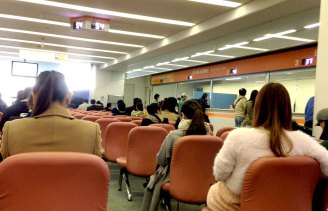
The B counter on the left with numbers.

Now that you have your paperwork together, to proceed with the change of visa/status of residence, you will need Counter B (Orange) on the second floor of the Tokyo Immigration Bureau (Shinagawa). This is confusing because there are two B counters, a short one directly in front of the escalator from the first floor, labeled “B 申請(在留調査)7”, and long one on the left next to the waiting area, labeled “B 申請(在留調査)Application (inspection for status of residence)”. The latter (seen above) will have numbers above each individual inspector.
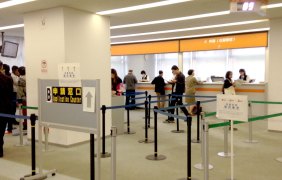
B counter on the right without numbers.

Step 1: First take your completed application materials to the “B 申請(在留調査)7” counter. Here, they will inspect your documents and make sure everything is in order. They will then give you a piece of paper confirming what type of visa you are changing to (cultural activities) and a number, to be used at the second B counter.

Step 2: Take these materials for an extra “Cultural Activities Inspection” at the counter on the FAR LEFT of the “B 申請(在留調査)Application (inspection for status of residence)” counter. It does not have a number, but is labeled “研修・短期滞在審査部門(相談窓口)”. Here, they will confirm your “cultural activities” status and put a stamp of approval on the sheet of paper given to you at the first counter.

Step 3: When this is done, you then wait in the waiting area for your number to be called at one of the adjoining six inspection counters at the “B 申請(在留調査)Application (inspection for status of residence)” counters on the left. When your number is called, they will inspect your documents, and give you a postcard for you to self-address. This postcard will be mailed to you when your visa/change of status is approved, and you will need to return to the immigration office (to A1 counter) promptly with your passport so that they can change your old visa materials out for new ones.

Also note that you will NOT be able to keep any materials you turn in to the application counter, so be sure to make photocopies of your grant letters if you may need them for the future and ask them for your terms and conditions booklet back (which they were fine with).

If you do not fill out part of the form correctly or do not provide the proper letters of affiliation, etc., you will receive a letter by post telling you what is missing and demanding you turn it in to the office within 7 days. You CANNOT fax or email these materials—they must be received via mail or in person in their original forms. I generally found that the high speed of mail by post in Japan meant it was best to just mail the materials directly to them immediately rather than drag myself all the way out to Shinagawa again just to turn in one form.
IMG_4580

Postcard.

===

Now, if you’ve completed everything properly, you should receive your self-addressed postcard in the mail within 1-2 weeks.

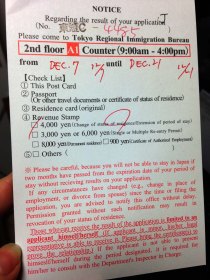
The postcard will tell you to go back to the immigration office to the A1 counter on the second floor. The card lists the documents that you need to bring with you: The card itself, your passport, your zairyū card, and a revenue stamp.

Here’s the tricky part—they say you need the “revenue stamp” to go along with your materials, but the card does NOT tell you what a revenue stamp is or where to get it.

Great, right? So here’s how to proceed:

Standing in line at Family Mart on the 1st floor to buy a revenue stamp.

Standing in line at Family Mart on the 1st floor to buy a revenue stamp.

Step 1: Go back to immigration armed with your passport, zairyū card, and postcard, and buy a revenue stamp. These can be found on the first floor of the building in the Family Mart convenience store. There is a special line just for buying revenue stamps, and there are several kinds available.

Yours should cost whatever they marked on the card—mine was 4,000 yen for change of status, and this seems standard. You will receive a literal stamp, which you take with you up to the A1 counter.

This is what the stamp actually looks like: IMG_4589
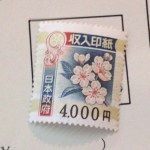

IF YOU GO TO A1 COUNTER WITHOUT A REVENUE STAMP
they will kindly (or maybe not so kindly) tell you to go back downstairs to get one, packaging your materials in a little folder with instructions on how to buy a stamp (just as I told you above). Here they will also fill out your receipt form where you affix your stamp to prove payment. If you chose to bring your materials to A1 counter without your stamp, they will tell you that you can skip the A1 line when you return with your stamp and directly turn everything in at A3 counter.
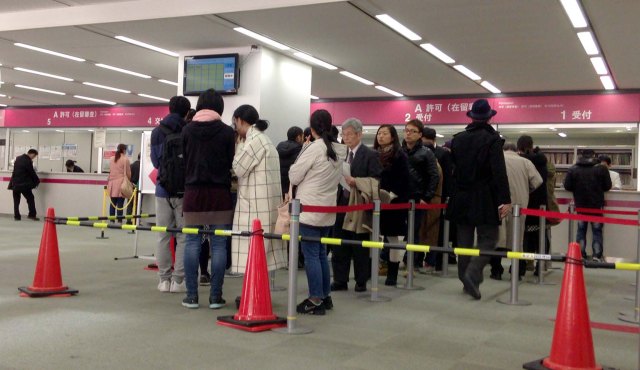
Various A Counters

Various A Counters, with A1 on the right.

This is basically an extra step you shouldn’t have to do. The reason you probably want to purchase your stamp first (aside from avoiding this unnecessary step) is because when you go to A1 counter they will give you a ticket number. This will be the number you wait for (watching the screens posted on the column seen above) once they’ve started processing your materials. So if you get this number and are put into the line rotation before you go get your revenue stamp and for some reason the revenue stamp line is ungodly long, you might start getting anxious about when your number pops up. In any case, save yourself a lot of trouble and just buy your revenue stamp first and bring a book for your wait!

Step 2: Wait for your number to be called, and when it is, go to counter A4 (or A5, if they’re using that one too). Here, they’ll double check that all your information is correct on your passport and new zairyū card, which should reflect your updated visa status/date of expiry.

Step 3: REJOICE! Your epic trips to immigration are finally over.

The second trip took me about an hour to an hour and a half due to the need to buy the revenue stamp. It’s always a good idea to bring a friend or some work to keep you company.

Hope this was a useful guide for people! Best of luck!

 

Posted in applications, living abroad, main posts, study abroad, study tools | Tagged , , , , , | 6 Comments

Call for Applications: Sasakawa Postgraduate Studentship

Sasakawa Postgraduate Studentship in the Department of Social Sciences: Oxford Brookes University, Faculty of Humanities and Social Sciences

Deadline: 29th February 2016

The Department of Social Sciences, Oxford Brookes University is pleased to invite applications for the Sasakawa Postgraduate Studentship in Japanese studies, made possible through the generosity of The Nippon Foundation and the Great Britain Sasakawa Foundation.

The expertise of Oxford Brookes University staff is particularly suited to students wishing to pursue topics of contemporary culture, gender, the family, aging and welfare, death and dying, religions, film, and linguistics. The Department of Social Sciences is home to the Europe Japan Research Centre, and we are one of the only Universities in the UK offering a specialisation in the anthropology of Japan.

The department can nominate candidates for the MPhil/PhD or Masters by Research for a studentship of £10,000. This studentship is initially for one year only, but may be renewable subject to satisfactory progress in subsequent years, up to a maximum of three years, beginning in September of the 2016/17 academic year. Please note that you will be required to reapply for the studentship each year, and that the GBSF will consider these applications on their merits. The GBSF cannot make a recurrent three year commitment to any one PhD candidate from year one.

For the successful MPhil/PhD candidates, Oxford Brookes is able to offer a further studentship of £7000, in addition to the Sasakawa studentship. This is also initially for one year, renewable subject to satisfactory progress, up to a maximum of three years. Please note that this does not apply to Masters by Research students.

Please note that although you may use your studentship to help towards the cost of your fees, you will be responsible for paying your fees each year. International applicants should be aware that they will need to fund their fees at the international rate.

MPhil/PhD

Candidates must have:

  • a good first degree (a good 2:1 or above) or are predicted to obtain one.
  • completed a degree with a substantive anthropology content or in Japanese studies and have a sufficient level of Japanese language ability to engage in fieldwork in Japan (normally this should be equivalent to JLPT level 2 or above).

A Masters is desirable, but we will consider candidates without a Masters who can demonstrate the ability to engage in substantial independent research.

Part-time programmes are not eligible.

Masters by Research

Candidates must have a good first degree (a good 2:1 or above) or are predicted to obtain one.

Applicants may be of any nationality, but Masters degree applicants must be either UK citizens (regardless of their current residency) or settled in the UK or have been ordinarily resident in the UK for at least 3 years immediately preceding the start of their MA course.
How to apply:

You will need to follow the standard university application procedure. Please contact the Research Administrator Terri Morris:  tmorris@brookes.ac.uk for further details.

Candidate Criteria:

  • The research proposal must focus on Japan.
  • It is important that you and your referees comment on your skill in Japanese in the areas of reading, composition and speaking.
  • Interviews may partly be conducted in conversational Japanese.
  • Candidates must have submitted an application for admission by the Studentship application deadline.

Deadline: The closing date for applications is 17:00 on Monday 29th February 2016.

Start date: September 2016.

Posted in announcements, graduate school | Tagged , , , | Leave a comment

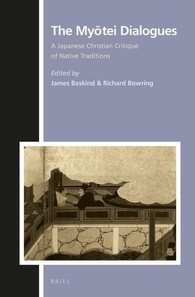
Book Announcement: The Myōtei Dialogues: A Japanese Christian Critique of Native Traditions

myoteiThe Myōtei Dialogues

A Japanese Christian Critique of Native Traditions

http://www.brill.com/products/book/myotei-dialogues

The Myōtei Dialogues is the first complete English translation one of the most important works of early Japanese Christianity. Fukansai Habian’s Myōtei mondō (1605) presents a sharp critique of the three main Japanese traditions, Buddhism, Shintō, and Confucianism, followed by an explanation of the main tenets of Christianity specifically aimed at a Japanese audience. Written by a convert, it is of importance not merely because it shows us how the Christian message was presented by a Japanese to other Japanese, but also for what it reveals about the state of the three native traditions at the beginning of the seventeenth century.

Posted in announcements, culture, Uncategorized | Tagged , , , , , , | Leave a comment

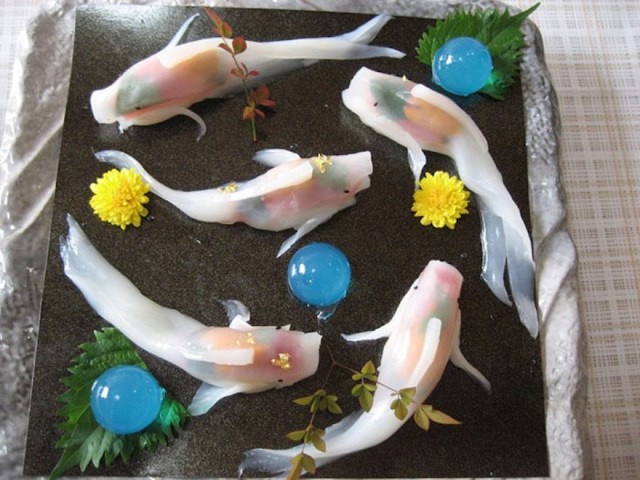
Fun Link Friday: Koi sushi

Happy New Year, everyone! While you’re making your resolutions and reflecting on how to make this the best 2016 ever, don’t forget to treat yourself to some delicious food!

I bookmarked this amazing sushi from Earthables earlier in the year and suggest we all kick off the new calendar with some delicious sushi, taken in a more literal visual way. 🙂 Be sure to visit the original article, because there’s a how-to video guide too! Happy holidays!

koi

Posted in culture, fun links | Tagged , , , , | Leave a comment