Book Announcement: The Revolution Will Not Be Televised: Protest Music After Fukushima

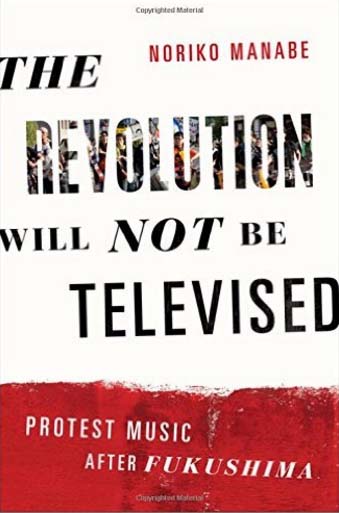
revolThe Revolution Will Not Be Televised: Protest Music After Fukushima, has been published by Oxford University Press.

The book explains the history of nuclear power in Japan, the sociopolitical backdrop of post-3.11 social movements, the censorial pressures that musicians are under, the political roles they have assumed, and the ways in which they have participated in four arenas of musical protest—cyberspace, demonstrations, festivals, and recordings. More information about the book can be found on the Amazon and OUP sites, the latter of which has a companion website with photos, websites, videos, and music clips.

Amazon: http://www.amazon.com/Revolution-Will-Not-Televised-Fukushima/dp/0199334692/ref=tmm_pap_swatch_0?_encoding=UTF8&qid=1444660351&sr=8-1

OUP: http://bit.ly/1PpNXq0

Links to YouTube video playlists to accompany each chapter of the book can be found here:

http://www.norikomanabe.com/publications/the-revolution-will-not-be-televised

Posted in announcements, culture | Tagged , , , , , | Leave a comment

Fun Link Friday: Eating from Miyazaki films

It’s getting extra cold just about everywhere, so it’s time to curl up with some comfort food! Buzzfeed posted an article last year we’ve just stumbled across that definitely gets our stomachs rumbling: Here’s How To Eat Everything You’ve Ever Wanted From A Miyazaki Film. From steamed buns to herring pot-pie, they’ve got you covered with pictures and recipes! Check it out!

fish

Posted in culture, fun links | Tagged , , , , , , | Leave a comment

Resource: Komonjo website

One of the premodern document types that receives the least attention in terms of English-language learning resources is komonjo, documents such as letters or official orders that are outside the purview of more narrative works such as diaries or literary tales. However, these primary sources are receiving more attention in recent years, especially through helpful sites such as Princeton University’s Komonjo website, spearheaded by historian Thomas Conlan.

komonjo

The website as a whole features numerous medieval documents from collections such as the Migita, Uesugi, and Awazu. The homepage contains helpful explanations about the production of komonjo, their size and quality, and other historical details related to how documents were created and used.

There are presently four main sections of the site that each explore a set of related documents, such as three letters sent in 1559 between the Ashikaga and Uesugi families related to a special recipe for gunpowder, or over a dozen documents related to the Awazu family’s rescue of the emperor’s wardrobe during the Ōnin War (1467-77). The subjects all include a written and video introduction by Professor Conlan providing background on the collections and extremely useful demonstrations on how letters were folded and transported. This is especially useful for understanding specialized terminology regarding letter types that one encounters in Japanese source collections.

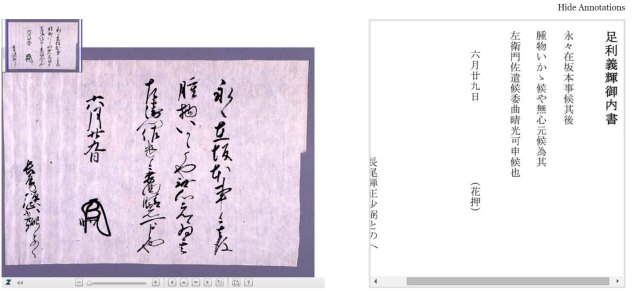
Documents within each of the four sections are also given individual pages with detailed information on their content, below which high resolution photographs of the komonjo are lined up with text transcriptions.

komonjo2

The photographs have convenient zooming options and can also go full-screen for close examination. Underneath, translations of the documents into English are provided. In many cases, these translations are also annotated with further details about the historical context or material nature of the document (such as calligraphic style). These details are extremely helpful for understanding just much information the examination of even a small number of documents can yield in medieval studies.

While this site is a work in progress still in its beginning stages, it will no doubt become a very useful resource for understanding komonjo and their historical relevance. There is much more expected to come from Professor Conlan and his students in the future, so be sure to check it out regularly!

Posted in graduate school, main posts, study tools, undergraduate, useful links | Tagged , , , , , , , , , | Leave a comment

Call For Papers: Narratives of decline: the changing patterns of death and aging in contemporary Japanese religions

call for papers [150-2]CALL FOR PAPERS

‘Narratives of decline: the changing patterns of death and aging in contemporary Japanese religions’
Japanese Studies Workshop, The University of Manchester
Tuesday, 31 May 2016

PhD Student workshop

Narratives of decline are embedded in both academic and popular discourses concerned with religion in today’s Japan. As contemporary Japanese society is faced with serious challenges of rapidly aging population, declining local communities, low fertility rate, and problematic social welfare measures, Japanese religious institutions are equally affected and confronted by stagnation and negativity in the public discourse. This one-day interdisciplinary workshop aims to address the narratives of decline from a range of disciplinary perspectives incorporating sociological and anthropological discourses, and beyond.
The workshop will explore how Japanese religions, including both established religious traditions and “new religions”, address these challenges through reinventing their symbolic practices and adopting new forms of social engagement. Along with highlighting the discussion on narratives of decline in Japanese religious traditions, the event also aims to establish a network of researchers working in the area of religious studies in contemporary Japan. We invite papers addressing, but not limited to, the following topics:

  • rituals and narratives of death and dying
  • aging society and religion
  • faith-based welfare relating to death and elderly care
  • narratives of religious decline

Confirmed Keynote Speakers: Dr. Jason Danely, Oxford Brookes University and Dr. Jessica Main, The University of British Columbia.
Submission of Proposals:
We are looking for current PhD students to present papers. The event itself is open to the public. Please send an abstract of 250 words maximum and a short bio (100 words, including affiliation and area of study) by 1 March 2016 to both Paulina Kolata paulina.kolata@postgrad.manchester.ac.uk and Aura Di Feboaura.difebo@postgrad.manchester.ac.uk.
Successful applicants will be notified by 15 March 2016.
The workshop is funded by the Economic and Social Sciences Research Council (NWDTC), the Arts and Humanities Research Council (NWCDTP), and the School of Arts, Languages and Cultures (Arts Methods at Manchester) at the University of Manchester. Presenters will receive a contribution towards transportation and/or accommodation costs up to £120.

Posted in announcements, conferences, graduate school, Uncategorized | Tagged , , , , , , , , , , | Leave a comment

Freeman-Asia funding for undergrad study abroad Returns!

From a report on the Institute of International Education (IIE)’s own webpage:

The Institute of International Education (IIE) today announced the relaunch of Freeman Awards for Study in Asia (Freeman-ASIA) to help 400 American undergraduates study in East or Southeast Asia. With generous support from the Freeman Foundation, IIE will grant awards averaging $5000 each, depending on length of study abroad (summer, semester or academic year). Students can apply online starting February 1st for awards to study abroad beginning in summer 2016. The Freeman Foundation’s generous support for the relaunch of Freeman-ASIA builds on prior grants to IIE that funded more than 4,500 American undergraduates in Asia from 2001 to 2014.

Freeman-ASIA accepts applications from U.S. citizens or permanent residents studying at the undergraduate level at a two-year or four-year college or university who demonstrate financial need to study abroad in East or Southeast Asia.

The application deadline for Summer travel is March 1, and for Fall 2016 study abroad, April 1.

More information is available here: http://www.iie.org/en/Programs/Freeman-ASIA

Ask your Study Abroad office about it. Study Abroad is an invaluable experience – I cannot recommend it enough. I did study abroad in Tokyo, on a Freeman-Asia fellowship, and it was easily one of the most enjoyable and rewarding experiences of my life. I am so glad the fellowship has been revived, so more students can afford to do study abroad, and to have such experiences as well.

Posted in announcements, applications, financial assistance, funding, study abroad, undergraduate | Tagged , | Leave a comment

Book Announcement: Values, Identity and Equality in Eighteenth- and Nineteenth-Century Japan

vijValues, Identity, and Equality in Eighteenth- and Nineteenth-Century Japan

Edited by Peter Nosco, University of British Columbia, James E. Ketelaar University of Chicago, and Yasunori Kojima, International Christian University, Tokyo

The chapter titles are as follows:

Peter Nosco and James E. Ketelaar                Introduction: Values, Identity, and Equality in Eighteenth- and Nineteenth-Century Japan

PART 1—VALUES IN PRACTICE

Eiko Ikegami                 Waiting for the Flying Fish to Leap: Revisiting the Values and Individuality of Tokugawa People as Practiced

Anne Walthall              Good Older Brother, Bad Younger Brother: Sibling Rivalry in the Hirata School

  1. Puck Brecher          Being a Brat: The Ethics of Child Disobedience in the Edo Period

PART 2—THE CONSTRUCTION OF IDENTITY

Peter Nosco                 The Early Modern Co-Emergence of Individuality and Collective Identity

Gideon Fujiwara          Rebirth of a Hirata School Nativist: Tsuruya Ariyo and HisKaganabe Journal

Gregory Smits              New Cultures, New Identities: Becoming Okinawan and Japanese in Nineteenth-Century Ryukyu


PART 3—EROTIC EMOTIONALITY AND PARODY

James E. Ketelaar        Searching for Erotic Emotionality in Tokugawa Japan

Yasunori Kojima           Laughter Connects the Sacred (sei 聖) and the Sexual (sei 性): The Blossoming of Parody in the Edo Culture

PART 4—EQUALITY AND MODERNITY

  1. William Steele       The Unconventional Origins of Modern Japan: Mantei Ōga vs. Fukuzawa Yukichi

Daniel V. Botsman      Flowery Tales: Ōe Taku (1847–1921), Kōbe and the Making of Meiji Japan’s ‘Emancipation Moment’

Naoki Sakai                   From Relational Identity to Specific Identity: On Equality and Nationality

EPILOGUE—THE HISTORIOGRAPHICAL ISSUES

Jun’ichi Isomae            Epilogue: Reimagining Early Modern Japan—Beyond the Imagined/Invented Modern Nation

For further information, please visit http://www.brill.com/products/book/values-identity-and-equality-eighteenth-and-nineteenth-century-japan

Posted in announcements, culture, Uncategorized | Tagged , , , , , | Leave a comment

Call For Papers: “Emoticons, Emoji and Kaomoji – The Transformation of Communication in the Digital Age”

call for papers [150-2]Call for papers for the international conference “Emoticons, Emoji and Kaomoji – The Transformation of Communication in the Digital Age,” which will be held in June 2016 at the Institute for Japanese Studies, Freie Universität Berlin.

The deadline for the submission of abstracts is February 5th, 2016. Abstracts should be submitted to: elena.giannoulis@fu-berlin.de.

Emoticons, Emoji and Kaomoji – The Transformation of Communication in the Digital Age

The “Face with Tears of Joy”-emoji was chosen as the Oxford Dictionaries Word of the Year 2015 with the argument that emoji have the potential to overcome language barriers. For some, that’s a reason to celebrate, for others a sign of decay or loss of the importance of language.

Emoji 絵文字 (“picture/image character”) are considered to be a further development of emoticons and were invented in the late 1990s by Shigetaka Kurita, who had worked for DoCoMo on the i-mode Project. The term “emoticon” is composed of “emotion” and “icon” and can be understood as a pictorial representation of a facial expression used in Instant Messaging (IM), chats, emails, social networking services (SNS), SMS or blogs. The most commonly used emoticons, smileys, have been an integral part of digital communication for a few years. If smileys are composed of several punctuation characters, they are usually rotated ninety degrees, thus becoming lying images of faces. In Instant Messenger, certain strings of characters produce a certain graphic of a smiley. Meanwhile, there exist also animated emoticons which tell stories and represent scenes, or stickers as emoticons that are a kind of merchandise item. In interaction with a text, emoticons intensify, neutralize or weaken the content and interpret it, for example, in terms of irony; they give the text a certain “tone.”

Forerunners of emoticons, so-called stick-figure faces that were made up of punctuation marks and letters have been in existence since the second half of the nineteenth century. Although they were a marginal phenomenon, they have been used to humorously explain texts by adding a nuance through nonverbal communication. In 1963 there was a kind of rediscovery and transformation of the stick figure faces, as the U.S.-American commercial artist Harvey Ball designed the “smiley.”

While emoticons in written digital communication primarily express mood or emotional states such as joy, sadness, anger, satisfaction or anxiety, emoji as graphic symbols/ideograms not only express emotions, but also refer to animals, food, plants, sports, clothes, transport, or weather. Furthermore, they represent interpersonal relationships and (social) contexts. A special Japanese form of emoji, in which there are no limits to creativity, is called kaomoji 顔文字 (“facial character”). While the image of “conventional” Western emoticons is rotated ninety degrees, this is usually not the case with kaomoji. Since they not only consist of characters of American Standard Code for Information Interchange (ASCII), but also of the second Japanese syllabary “Katakana,” they expand the forms of expression of the Western system of signs.

Japanese mobile phones have saved dozens of emoji for text messages. After entering a relevant keyword, users are able to decide whether they would like to enter an emoji instead of a Chinese character (Kanji), that is to say, whether to convert a word to a Kanji or an emoji. Some of the emoji are used and understood in Western contexts as well, while others are difficult to understand without previous knowledge. Therefore there seem to be both universally comprehensible and culturally coded emoji.

In the meantime, emoji have not only come to play a role in digital communication on the computer, cell phone or IPad, but they have now found their way into literature, manga, and art. Furthermore a blog called “Narratives in Emoji” offers stories and movie plots in emoji shorthand. Moreover, emoji have become a big commercial business.

Although emoticons, emoji and kaomoji are a new complex system of signs in the digital world and beyond, and although they have revolutionized our communication and the relationship between text and image and can even be considered as a new language, research has paid little attention to them so far. “Emoji” as a field of research could be of relevance to cultural studies, affective theory, sociology and linguistics but also to communication studies or literary studies.

With the international Japanese Studies conference on “Emoticons, Emoji and Kaomoji,” a step will be taken toward making the field thematically and methodologically fruitful for various fields of study, especially for Japanese Studies. The conference focuses on Japan, but it also deals with the history, forms and functions of emoji in general. Therefore, contributions with a comparative perspective (Japan/US or Japan/Europe) are welcome.

The following points will be addressed:

  1. History and definition of emoticons, emoji and kaomoji
  2. Systematic description of (communicative) functions and forms of emoji, emoticons, kaomoji
  3. Emoji, emoticons and kaomoji in various media such as chats (Line, What’s app), literature, Email, SNS (such as Facebook and Twitter), blogs, manga, and Graphic Novels
  4. Emoji on the market
  5. Emoji and Emoticons as design/art (= ASCII art)

I invite you to participate in an event that will provide an opportunity to share ideas about a phenomenon that is rapidly changing our modes of communication.

The language of the conference is English. The proceedings of the conference will be published in an anthology.

Applicants will be informed whether their paper has been accepted by the end of February.

Contact Info:

Prof. Dr. Elena Giannoulis
Freie Universität Berlin
Ostasiatisches Seminar – Fachrichtung Japanologie/
Friedrich Schlegel Graduiertenschule für literaturwissenschaftliche Studien
Hittorfstr. 18 – Raum 1.15
14195 Berlin
Tel.: +49 30 838 52749
Fax:  +49 30 838 4 52749

Contact Email:

elena.giannoulis@fu-berlin.de

URL:

http://www.geschkult.fu-berlin.de/en/e/oas/japanologie/institut/mitarbeiter/professoren/giannoulis/index.html

Posted in announcements, conferences, graduate school, Uncategorized | Tagged , , , , , , | Leave a comment

Fun Link Friday: Nihon Eiho (日本泳法)

Screen Shot 2016-01-10 at 9.11.40 PM.png

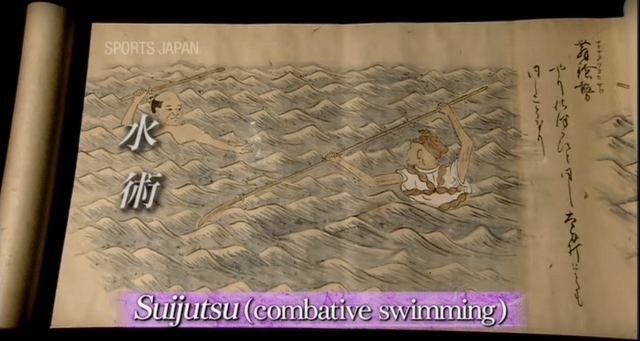
When I lived in Japan, I rediscovered my love of swimming. Tom Baker of Tokyo Tom Baker, also a swimmer, recently posted about his discovery of Nihon Eihô (日本泳法), Japanese swimming techniques:

Not long ago, a member of my sports club noticed that I was swimming sidestroke in the pool. He was curious enough to ask how it was that a foreigner had learned 古式泳法 koshiki eiho. This was a term that I had never heard before, but he told me it’s the way samurai used to swim. The term literally means “ancient way of swimming.”

Check out his post, which includes an English-language video on these techniques, their history, and contemporary competitions.

Posted in culture, fun links | Tagged , , , , | Leave a comment

Job Opening: East Asian history, Gallaudet University

job opening - 5Institution:       Gallaudet University, History, Philosophy, Religion, and Sociology
Location:          District of Columbia, United States
Position:          Assistant Professor, East Asia, South Asia, or Middle East History

Department of History, Philosophy, Religion, and Sociology

Tenure-Track Position in History, Gallaudet University, College of Arts & Sciences

General Information:  The History Program in the Department of History, Philosophy, Religion, and Sociology invites applications for a tenure-track faculty position to teach undergraduate courses in History.  Specific fields of specialization matching current program needs will be considered, as specified below under “Requirements.”  The initial appointment will begin on August 16, 2016.  Fluency in American Sign Language (ASL) is desirable, but not required.  However, applicants who do not know ASL must be willing to learn, and eventually must satisfy the language requirements specified in the university’s Faculty Guidelines.  Candidates must demonstrate potential for competence in teaching and scholarship, and be willing to accept service responsibilities.  Rank and salary is commensurate with experience and qualifications.

Gallaudet University serves deaf and hard of hearing students from many different backgrounds and seeks to develop a work force that reflects the diversity of its student body.  Gallaudet is an equal employment opportunity/affirmative action employer and actively encourages deaf, hard of hearing, members of traditionally underrepresented groups, people with disabilities, women, and veterans to apply for open positions.

Responsibilities:   Candidates should expect to teach introductory level courses in history, as well as upper-level courses in their areas of expertise; teach courses in the General Studies Program (GSR); develop courses for the History and the International Studies Program; engage in scholarly activities and research; and to participate in service activities for the program, department, and university.

Requirements:  Candidates must hold a Ph.D. or be able to document that they are ABD and close to completing their doctorate in History.  Candidates should have a primary field in History with a concentration in East Asia, South Asia, or Middle East History with a responsibility to teach courses based on their specialization and World Civilization survey courses.  Also desirable is the ability to teach World History, Women’s History, Digital, and Deaf History.  College undergraduate teaching experience is required.

Application Information:  Review of applications will begin on March 1, 2016 and will continue until the position is filled.  Please send an electronic copy or hard copy of a letter of application clearly outlining your fit with the job description and requirements, and evidence of teaching effectiveness.  In addition to this letter, please send your curriculum vitae, official graduate transcripts, and three letters of recommendation to:  Ms. Susan Ganz, Department Secretary – susan.ganz@gallaudet.edu

Contact:

Dr. Roberto Sánchez, Associate Professor and Chair
Department of HPRS, Hall Memorial Building, S-235B
Gallaudet University
800 Florida Ave, NE
Washington, DC  20002

Website: http://www.gallaudet.edu

Posted in announcements, job openings, jobs | Tagged , , , , , | Leave a comment

Job Opening: Asian History, Monmouth University

job opening - 5Institution:           Monmouth University
Location:              New Jersey, United States
Position:               Assistant Professor, Asian History

Monmouth University is a private, mid-sized, residential university that is comprehensive in scope, supported by a broad commitment to the liberal arts. Founded in 1933, Monmouth offers 32 undergraduate and 23 graduate degree programs, and a doctoral program in Nursing Practice.  Students benefit from a rigorous academic experience, small classes, and professors who meet the highest standards for scholarship and teaching. They participate in more than 90 active clubs and organizations including 14 fraternities and sororities, six media organizations, and an NCAA Division I athletics program fielding 21 teams, expanded to include swimming in 2015.

Monmouth’s beautiful coastal campus is convenient to New York City and Philadelphia, in a vibrant economic region with dynamic arts programming, American Revolution history sites, and nationally recognized parks and golf courses. The 159-acre campus features 54 buildings, which include a blend of historic landmarks and state-of-the-art facilities.

Through its academic offerings in liberal arts, science, and professional programs, Monmouth provides a highly personalized education that prepares students to realize their potential and to become engaged citizens in a diverse and increasingly interdependent world. Within its student body, 29 states and 28 foreign nations are represented.

Five centers of distinction work to promote awareness of specific issues and meet the needs of local and global communities. Our Centers, run by top experts and professors, provide important services in areas including the environment, global affairs, public policy, the arts, and real estate.

For an eleventh consecutive year Monmouth University has been included in The Princeton Review’s roster of “Best 380 Colleges,” and “Best 296 Business Schools,” and recognized for the fourth consecutive year as a top-40 school (Master’s North) in U.S. News & World Report’s list of “Best Colleges” rankings. Monmouth regularly receives top rankings in veteran-friendly schools and was recently included in Money magazine’s list of “Best Colleges for Your Money.”

Monmouth University is deeply committed to the principles of equity, diversity, and inclusiveness. The University’s policy is to afford equal employment opportunities for all persons without regard to their race, religion, color, national origin, nationality, ancestry, age, sex (including pregnancy and sexual harassment), marital status, domestic partnership or civil union status, affectional or sexual orientation, gender identity or expression, atypical hereditary cellular or blood trait, genetic information, liability for military service, protected veteran status, or mental or physical disability, including AIDS and HIV related illnesses.

Department: History And Anthropology

Position Summary:

The Department of History and Anthropology at Monmouth University is seeking applications for an Assistant Professor in Asian History. This anticipated opening is for the 2016-2017 academic year and is a tenure track appointment.

The course load is 3/3 for faculty members on the tenure track until tenure and then granted thereafter as scholarship release. The successful candidate will demonstrate a strong commitment to dynamic teaching, mentoring, and promoting the study of history to students. The duties of the position include pursuing a scholarly agenda in research and publishing, and participating fully in the life of our academic community though departmental and university service.

The department of History and Anthropology offers graduate and undergraduate degrees in history and anthropology, as well as minors in history, anthropology, geography, archeology, and Geographic Information Systems. It is situated in the Wayne D. McMurray School of Humanities and Social Sciences.

For additional information about the department, please go to: http://www.monmouth.edu/school-of-humanities-social-sciences/history-and-anthropology.aspx

Required Degree, License or Certifications:

Doctoral degree, ABD candidates may be considered with degree completion expected by date of employment

Required Skills or Software:

Excellent interpersonal, organizational and communication skills

Other Requirements:

Doctoral degree in history or a related field.

Ability to offer upper-level undergraduate and master’s level courses in Modern East Asian history, as well as introductory and general education history courses, including western civilization in world perspective, and who has interest and experience in working collaboratively with faculty on other disciplines in Asian studies in order to support the Asian studies minor.

In accordance with the University’s commitment to rigorous general education grounded in the liberal arts, the successful candidate will make a strong contribution to the core courses in Monmouth’s curriculum.

Candidates must be committed to Monmouth’s teaching and scholarship mission, including the mentoring of undergraduate and graduate students and engaging in department activities such as outcomes assessment.

Preferred Qualifications:

Research interests outside of modern historical contexts and/or global in scope. Teaching qualifications and/or research in regional religious history.

Log in to http://apptrkr.com/726617 to apply and see the job duties for this position no later than the deadline date.

Posted in announcements, job openings, jobs | Tagged , , , , , , | Leave a comment