For most, talk of human sacrifice brings to mind the Pre-Columbian Americas, such as Aztec sacrifices to the sun god of war, Huitzilopochtli, but this tradition has taken many forms all over the world. Earlier last year Pink Tentacle featured an article on a Japanese tradition of human sacrifice, the hitobashira 人柱, or human pillar, and it’s consistently one of the most fun legends I come across in my medieval castle research.
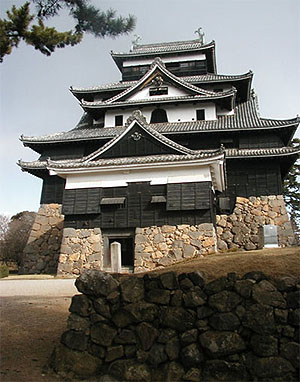
Photo by Japanese Castle Explorer
The idea of hitobashira is a simple one: in order to placate spirits of the earth (upset by construction processes), one makes a human sacrifice inside the hole in which a building’s pillar is to be set, and this will ensure the safe completion of a building. Numerous locations across Japan have legends about hitobashira, and Pink Tentacle describes one of the most famous at Matsue Castle (Shimane prefecture):
According to local legend, the stone wall of the central tower collapsed on multiple occasions during construction. Convinced that a human pillar would stabilize the structure, the builders decided to look for a suitable person at the local Bon festival. From the crowd, they selected a beautiful young maiden who demonstrated superb Bon dancing skills. After whisking her away from the festival and sealing her in the wall, the builders were able to complete the castle without incident.
However, the maiden’s restless spirit came to haunt the castle after it was completed. According to folklorist Lafcadio Hearn, who described the castle’s curse in his 1894 work “Glimpses of Unfamiliar Japan,” the entire structure would shake anytime a girl danced in the streets of Matsue, so a law had to be passed to prohibit public dancing.
Lots of castles, especially, have these types of stories. According to historian Owada Tetsuo in his book Sengoku no shiro (Sengoku Castles), human pillar legends can typically be divided into two patterns:
1) A castle’s stone walls or a building was destroyed, and an onmyouji (a type of diviner or occultist) would divine that a curse from the gods of the land was present, and therefore it was necessary to erect a human pillar.
2) From the beginning of construction a human pillar was erected in order to pray for safe completion of the structure.

Photo by Japan Photo
Some samurai legends also recount either in response to a supernatural event or as a show of loyalty to one’s lord (who was building a residence), a samurai would commit seppuku, slitting his belly and then jumping into the hole to protect his lord even in death.
Sadly for those of us that love when creepy ghost stories are close to reality, substantial evidence of hitobashira is few and far between, although at Kiyosu Castle in Aichi prefecture the remains of severed dog legs have been found. It’s also possible that in lieu of actual people, dolls were thrown into the holes instead of real human sacrifices. Don’t be too disappointed, though, the PT article mentions a few notable examples of bridges and tunnels where bodies have been found and the human sacrifice rumors are still circulating.
If you’re interested in looking up some other locations, PT has listed these notable spots with hitobashira legends:
– Gujo-Hachiman castle (Gifu prefecture)
– Nagahama castle (Shiga prefecture)
– Maruoka castle (Fukui prefecture)
– Ozu castle (Ehime prefecture)
– Komine castle (Fukushima prefecture)
– Itsukushima shrine (Hiroshima prefecture)
– Fukushima bridge (Tokushima prefecture)
– Kintaikyou bridge (Yamaguchi prefecture)
– Hattori-Oike reservoir (Hiroshima prefecture)
– Imogawa irrigation channel (Nagano prefecture)
– Karigane embankment (Shizuoka prefecture)
– Manda levee (Osaka prefecture)
I recommend checking out basic information and photos of the castles here at Japanese Castle Explorer.
And if you’re interested in Owada Tetsuo’s history blog, you can find it (in Japanese only) here.

 What can I do with a B.A. in Japanese Studies?
Pingback: Nothing like human sacrifice to top off a good castle | JapanLike
I just went to Gujo Hachiman Castle, and apparently the castle is haunted by the woman chosen to be the 人柱.
Nice! Nothing like ghost-gender-equality! 😉