Funding: Freeman-ASIA Scholarships for Study Abroad

money [150-2]The Institute of International Education (IIE) is now accepting applications for the Freeman-ASIA spring and calendar year 2017 competition.

The deadline for student applications is October 20, 2016 (11:59pm EST), and the deadline for Adviser Certifications is October 27, 2016 (11:59pm EST.)

The Freeman-ASIA scholarships provide funding to undergraduate US citizens and permanent residents to support them as they study abroad in East and Southeast Asia.

The Freeman-ASIA relaunch is the latest of several steps IIE has taken to increase the number and diversity of Americans studying abroad and their study destinations. Studying in Asia before graduating can give students a competitive advantage in their professional careers, especially when collaborating with international peers. More than half of Freeman-ASIA alumni report being employed in a position related to Asian affairs or requiring knowledge of an Asian language. As more employers seek new hires with meaningful and substantive experience in Asia, it is critical that more Americans learn about and engage with Asian economies, political systems and cultures.

More information:

To learn more about eligibility requirements, the timeline, and to access the application, students should visit the Freeman-ASIA website at http://www.iie.org/Freeman-ASIA.  

Please do not hesitate to reach out to us at freeman-asia@iie.org if you have any questions. 

Posted in announcements, funding | Tagged , , , , , , | Leave a comment

Book Announcement: A Tokyo Anthology: Literature from Japan’s Modern Metropolis, 1850-1920

A Tokyo Anthology: Literature from Japan’s Modern Metropolis, 1850-1920

edited by Sumie Jones and Charles Shirō Inouye.

The volume is available for pre-order on Amazon.

The city of Tokyo, renamed after the Meiji Restoration, developed an urban culture that was a dynamic integration of Edo’s highly developed traditions and Meiji renovations, some of which reflected the influence of Western culture. This wide-ranging anthology―including fictional and dramatic works, essays, newspaper articles, political manifestos, and cartoons―tells the story of how the city’s literature and arts grew out of an often chaotic and sometimes paradoxical political environment to move toward a consummate Japanese “modernity.”

Tokyo’s downtown audience constituted a market that demanded visuality and spectacle, while the educated uptown favored written, realistic literature. The literary products resulting from these conflicting consumer bases were therefore hybrid entities of old and new technologies. A Tokyo Anthology guides the reader through Japanese literature’s journey from classical to spoken, pictocentric to logocentric, and fantastic to realistic―making the novel the dominant form of modern literature. The volume highlights not only familiar masterpieces but also lesser known examples chosen from the city’s downtown life and counterculture.

Imitating the custom of creative artists of the Edo period, scholars from the United States, Canada, England, and Japan have collaborated in order to produce this intriguing sampling of Meiji works in the best possible translations. The editors have sought out the most reliable first editions of texts, reproducing also most of their original illustrations. With few exceptions the translations presented here are the first in the English language. This rich anthology will be welcomed by students and scholars of Japan studies and by a wide general audience interested in Japan’s popular culture, media culture, and literature in translation.

Contributors include: Anthony Chambers, Joel Cohn, Rebecca Copeland, James Dorsey, Peter Duus, Matthew Fraleigh, Howard Hibbett, Charles Shirō Inouye, Ken Ito, Sumie Jones, Matthew Koenigsberg, Aiko MacPhail, Dylan McGee, John Mertz,Scott Miller, Cody Poulton, Laurel R. Rodd, Eiji Sekine, Stephen Snyder, andTakashi Wakui.


A Tokyo Anthology is the third installment in the on-going project of Edo-Meiji period Japanese literature in English translation, published by the University of Hawai‘i Press. The project is edited by Sumie Jones and co-edited by Charles Shirō Inouye, Watanabe Kenji, and Adam L. Kern. Vol. 2, An Edo Anthology: Literature from Japan’s Mega-City, 1750-1850, was published in 2013.

Posted in announcements, culture | Tagged , , | Leave a comment

Call for Papers: International Graduate Historical Studies Conferences

call for papers [150-2]Call for Papers

The International Graduate Historical Studies Conference will host “Crossing Borders, Challenging Boundaries” at Central Michigan University in Mt. Pleasant, Michigan, March 31-April 1, 2017. The key note address will be delivered by Professor John Merriman, Yale University.

We invite graduate students from across the social sciences and the humanities to submit proposals for papers or panels that adopt an interdisciplinary or transnational approach but we are also seeking papers or panels that approach historical topics in more traditional ways. All submissions must be based on original research.

In keeping with the theme of the conference, individual papers will be organized into panels that cross spatial, temporal, and disciplinary boundaries. The IGHSC will present cash prizes for the best papers in several categories.

Send abstract (250-350 words) and a short curriculum vita as an attachment to histconf@cmich.edu. Preference will be given to papers and panels received during the early submission period which ends December 19, 2016. The final deadline for abstract submission is February 8, 2017.

Contact Info:

histconf@cmich.edu

Contact Email:

histconf@cmich.edu

Posted in announcements, conferences, graduate school | Tagged , , , , | Leave a comment

Fun Link Friday: The Art of Tea? Kengo Kuma’s $80K Silver Tea Set

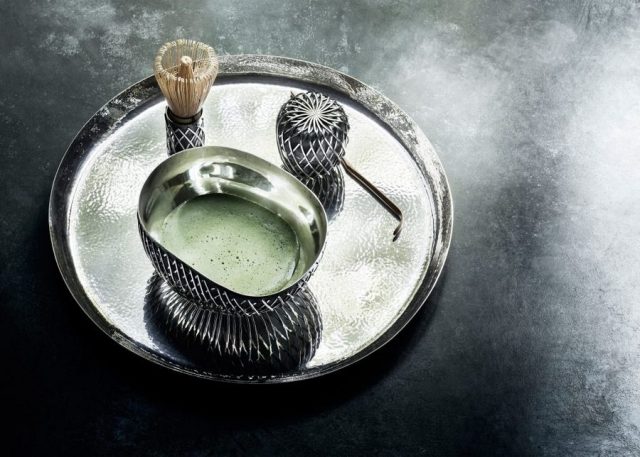
Most people associate tea bowls and tea utensils with rustic, austere aesthetics– earthenware bowls (sometimes cracked and/or repaired) and inherited kettles, objects that carry with them a long history of ownership and use. So what does one make of the famous Japanese architect Kengo Kuma’s silver tea tea, which clocks in at a value of $80,000?

tea-set

Commissioned by David Chu, the head of the Danish silverware and jewelry brand Georg Jensen, this collaboration has rendered a tea set that walks the line between art and traditional aesthetic. But would tea masters purchase it? What do you guys think? 🙂

Check out more photos and information at the original article on Spoon & Tamago.

Posted in culture, fun links | Tagged , , , , , , | Leave a comment

Job Opening: Modern Japanese History, University of Southern California

job opening - 5Institution:       University of Southern California
Location:          California, United States
Position:          Assistant Professor, modern Japanese history

The History Department of the Dana and David Dornsife College of Letters, Arts and Sciences at the University of Southern California (Los Angeles, CA) is seeking a tenure track assistant professor of modern Japanese history.  A Ph.D. in relevant field of study is required at time of appointment.

In order to be considered for this position, applicants are required to submit an electronic USC application; follow this job link or paste in a browser: http://jobs.usc.edu/postings/75489 .

The applicant should upload a CV, a letter of interest, writing sample(s), and the names of three individuals who will be contacted by USC for references.  Application materials are due November 14, 2016.  Inquiries may be sent to Professor Brett Sheehan at bsheehan@usc.edu, but application materials must be submitted online.

USC is an equal-opportunity educator and employer, proudly pluralistic and firmly committed to providing equal opportunity for outstanding persons of every race, gender, creed and background. The University particularly encourages women, members of underrepresented groups, veterans and individuals with disabilities to apply. USC will make reasonable accommodations for qualified individuals with known disabilities unless doing so would result in an undue hardship. Further information is available by contacting uschr@usc.edu .

Contact:Professor Brett Sheehan bsheehan@usc.edu

Website: http://dornsife.usc.edu/hist/


Posted in announcements, job openings, jobs | Tagged , , , , , , , , | Leave a comment

Job Opening: Japanese literature, University of Illinois – Urbana-Champaign

job opening - 5Institution: University of Illinois – Urbana-Champaign
Location: Illinois, United States
Position: Assistant Professor, Japanese Literature, Tenure Track Faculty

~~The Department of East Asian Languages and Cultures at the University of Illinois at Urbana Champaign seeks a full-time, tenure-track Assistant Professor in the field of Japanese literature, with a priority to candidates whose period of specialization is pre-Meiji.  We are particularly interested in candidates with training in visual culture or performance study or expertise in cross-regional literary exchange. PhD in Japanese or related field required.   Applicants must have a promising research agenda and a strong commitment to both undergraduate and graduate teaching.  A PhD in hand by June 1, 2017 for start date of August 16, 2017 required.  Salary is competitive.

Successful candidates are expected to teach effectively at both the undergraduate and graduate levels, establish and maintain an active and independent research program, and provide service to the department, the university and the profession.

To insure full consideration, all required application materials must be submitted by November 15, 2016. To apply, create your candidate profile through https://jobs.illinois.edu and submit application materials. Applicants must submit a letter of application, curriculum vitae, a writing sample (no longer than 20 pages), statement of teaching and research interests, and contact information for three professional references.  Letters of recommendation will be requested electronically from referees after an initial review of the application materials. Only applications submitted through the University of Illinois Job Board will be considered.  Questions about the position or application procedures may be directed to slcl-hr@illinois.edu

The University of Illinois conducts criminal background checks on all job candidates upon acceptance of a contingent offer.

Illinois is an equal opportunity employer and all qualified applicants will receive consideration for employment without regard to race, religion, color, national origin, sex, sexual orientation, gender identity, age, status as a protected veteran, status as a qualified individual with a disability, or criminal conviction history. Illinois welcomes individuals with diverse backgrounds, experiences, and ideas who embrace and value diversity and inclusivity. (www.inclusiveillinois.illinois.edu).

Contact: slcl-hr@illinois.edu

Website: http://www.ealc.illinois.edu/

Posted in announcements, job openings, jobs | Tagged , , , , , | Leave a comment

Get Involved! Volunteering with a Sister City Organization

This article does not necessarily reflect the views of any sister-city organization mentioned and are the sole opinions of the authors. Written with the permission of SKSCA and MSCA.

Introduction

One great way to get involved with your local Japan-related community during college and beyond is to volunteer with your local sister-city organization. Japanese towns and cities have sister cities all over the world, so this post isn’t just limited to our US readers.

Because sister-city activities vary a lot between locations, we’ll be discussing our experiences with working with the Seattle-Kobe Sister City Association (SKSCA), a very active set of major metropolitan areas, and with the Mendocino Sister City Association (MSCA), which pairs the rural town of Mendocino, California with Miasa-Omachi, a rural town in Nagano prefecture.

What does a sister-city organization do?

Sister-city organizations help develop relationships between the two cities and their citizens. They are typically 501(c)3-designated non-profit organizations with a volunteer board of directors. General activities may include student exchange, cultural community events, arranging for delegations or politicians to meet, education programs, scholarships, etc.

img_0184

The Seattle-Kobe Sister City Association and Kobe Kids Camp march together with an SKSCA banner at the 2016 Seafair Parade in Seattle. Photo credit: Brian Chu Photography.

Seattle-Kobe

Seattle and Kobe are both port cities with a history of international trade. In 1957, Seattle and Kobe formed the first sister-city partnership for both cities. Seattle, located on Washington’s Puget Sound, has a population of about 680,000 (3.7 million in the greater metropolitan area); Kobe, located on Osaka Bay, has a population of about 1.5 million.

SKSCA is active in a variety of exchange events. We hold an annual Jazz Vocalist Exchange with the Kobe-Seattle Sister City Association, during which the Kobe Jazz Queen and the Seattle female jazz vocalists travel to Seattle and Kobe respectively to give concerts. SKSCA runs cultural experience booths at Seattle’s Japan-related cultural festivals, including Sakura Matsuri, Japan Fair (formerly Aki Matsuri), and Kodomo no Hi (Children’s Day).

Our board members liaise with the Seattle city government to arrange travel for local government officials to Kobe in anniversary years. We also help maintain the Kobe bell and other gifts from Kobe, welcome short-term exchange students to Seattle and the Kobe Festival Ambassador at Seattle’s Sea Fair, sponsor a Japan-related film for the Seattle International Film Festival (SIFF), and organize a history project for our cities relationship.

Our volunteers help out with staffing our events, such as our yukata dress-up booth and Seafair, and also attend and host our member events, such as our New Year’s Party and members Happy Hour.

Seattle is also lucky to have a large number of other Japan-related volunteer associations and non-profit organizations, and SKSCA benefits from the overlap in membership and event offerings. Our local consulate, for example, hosts Japan nights with the Seattle Storm (WNBA), and the Japan-America Society of the State of Washington (JASSW) holds an annual dinner focused on nihonshu (sake) pairings.

Mendocino-Miasa-Omachi

Mendocino is an unincorporated community located on the Pacific Coast to the north of San Francisco.  Mendocino itself is very small (population 894 at last census), and although the local school district serves a number of other small communities over a large rural area, the overall population of the region is less than 3000. Their sister city, Omachi, sits at the foot of the Japanese Alps, and has a population of just over 29,000 (although many of the events are focused in the Miasa area, a sub-community of Omachi that is home to fewer than 2000 people.) Both towns are rural, scenic, and home to a significant art community. It’s no coincidence that both towns were also appealing destinations for idealistic young people in early 1970s pursuing dreams of rural life. The relationship began as a friendship between two community-minded artists, Toshi Yoshida and Bill Zacha, and continues to be characterized by close personal connections between individuals.

Mendocino Sister Cities Association focuses primarily on two exchange programs, one for students and one for adult artists. The youth exchange has been going strong between Mendocino K-8 School and Miasa Elementary and Junior High School for 25 years, with each school sending students to visit their sister school on alternating years. Students benefit significantly from this program, and learn first hand about cross-cultural communication and international exchange.

The Art Exchange began in 2008, and capitalizes on the large number of artists and craftspeople who call these communities home. This not only gives the artists a chance to exchange knowledge and technique, but also offers an opportunity for community members and visitors to connect over art. In Omachi, the local craft community has successfully tied this exchange in with their new center for the arts, Asagura. As a rural municipality facing serious economic issues as a result of a declining population, they are effectively leveraging the Art Exchange toward a wider revitalization of community and tourism through art.

During visits to both Japan and the United States, students and chaperones visit other cities and tourist sites, but the focus of the trips is on school/studio visits and homestays with families in the sister city. In both towns, this means a huge percentage of the population is participating in the exchange in some way, whether as students, artists, parents/family members, chaperones, host families, or community participants.

Other fundraising activities are carried out throughout the year to support these two important exchanges, and include a Charity Dine-Out and Auction at a local restaurant. In the past, MSCA has also participated in local events, such as the local 4th of July Celebration, in order to raise awareness and ask for donations, but with limited time and resources, focusing on one large fundraiser has ultimately proven more profitable.

A huge amount of community and volunteer support is needed to pull off these exchange programs. Aside from offering to host visitors, volunteers can also participate by helping to prepare and serve meals for a reception, collecting silent auction donations, or providing an experience for visitors (i.e. playing music for and calling a line dance.)
img_1003

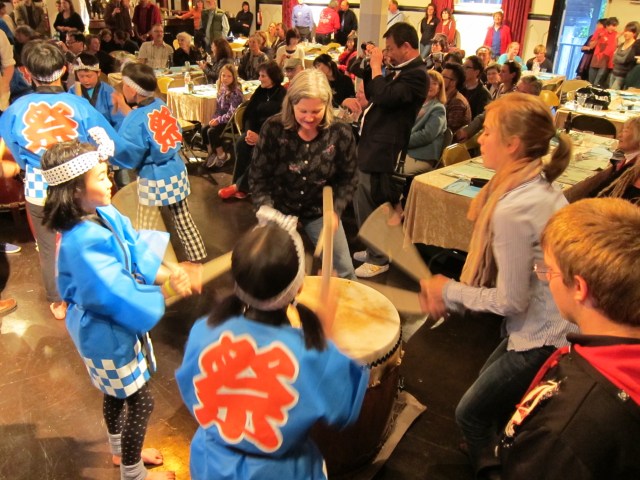
Interactive taiko demonstration by Miasa students in Mendocino, 2012. Photo courtesy of the authors.

Joining a board

Seattle-Kobe

SKSCA board elections are biannual (every other year); we have 13 members. When we have open positions due to members stepping down from the board, we nominate community members that we feel have the experience and vision we want for our organization. For example, we often scout new board members from our volunteer pool and local companies/non-profits with connections to Japan. A knowledge of Japanese language and culture are certainly helpful, which is where people with academic experience come into play, but experience in relevant fields is also desirable: we also have members who are former JETs; members who are employees of or volunteers for other exchange organizations with a Kobe connection, such as the YMCA, Seattle Yacht Club, the local Japanese gardens, and student exchange organizations; members who are Japanese teachers; et al. In my case, my boss encouraged me to get involved with SKSCA and introduced me to the then-president; I got involved as a volunteer that fall and was elected to fill a vacancy in the spring. I now act as board secretary and am a member of the communications team.

Mendocino-Miasa-Omachi

MCSA takes on new board members throughout the year to fill their 10 spaces. They are generally excited to bring in new members, and although there are not always vacancies, they try to incorporate anyone who shows dedication by showing up regularly to monthly meetings. Although most of the board members have been involved for quite some time and have been to Japan with one of the delegations, knowledge of Japan and Japanese language are not a must. Some had no prior Japan-related experience before becoming involved.

Being a volunteer and serving as a director at large has helped me further develop skills I began working on in college and on JET as a CIR: event planning, public speaking, editing, cross cultural communication, networking, organizing volunteers, social media, and community outreach. I really appreciate the opportunity to give back to my adopted community by teaching others about Kobe and Japanese culture and providing opportunities for the exchange of ideas and culture. On a personal note, I love working with SKSCA because the board is so positive, responsible, and caring. It’s exciting to be in a room where others share my dream of sharing knowledge about each other’s cultures and cultural diversity to make our city connected, engaged, prepared, and compassionate. I am currently the board secretary and a member of the social media team.

Mendocino is not home to many Japanese speakers, so I used my language skills a lot as a sister city volunteer. I am particularly grateful for every opportunity I was granted to clock hours in both interpretation and translation. Sister cities events became a fun and supportive venue to practice interpretation in particular, which is a skill I was grateful to have as a CIR with the JET Program, and which I continue to use in my multilingual workplace today. I also enjoyed learning more about the history of my own hometown through working as a chaperone and guide for visiting groups. Mostly, though, I enjoy watching the genuine friendships that develop and grow each time our two communities come together. My first visit to Japan was with the student group when I was 13 years old, and while I think I’m an extreme case in terms of how much the trip changed the course of my life, I know it has a huge effect on all of the people who participate. Particularly for kids from small, relatively homogenous rural communities, having a homestay experience in another country is an extremely valuable opportunity.

Conclusion

Volunteering with a sister city is a great way to put your Japanese background to use wherever you live and to develop valuable career skills. Joining a sister city organization can give you the chance to meet fellow community members, make connections, and make positive contributions to relations between your home country and Japan on a grassroots level. You can find your sister city on Sister Cities International and check in with your chapter to see how active they are. Your local city hall or your closest Japanese Consulate are also good resources for locating pre-existing relationships–or for starting your own!

 

Posted in culture, senior year, social networking | Tagged , , | 1 Comment

Job Opening: East Asian history, Baylor University

call for papers [150-2]Institution: Baylor University
Location: Texas, United States
Position: Assistant Professor of East Asian History

Baylor University is a private Christian university and a nationally ranked research institution, consistently listed with highest honors among The Chronicle of Higher Education’s “Great Colleges to Work For.” Chartered in 1845 by the Republic of Texas through the efforts of Baptist pioneers, Baylor is the oldest continuously operating university in Texas. The university provides a vibrant campus community for over 15,000 students from all 50 states and more than 80 countries by blending interdisciplinary research with an international reputation for educational excellence and a faculty commitment to teaching and scholarship. Baylor is actively recruiting new faculty with a strong commitment to the classroom and an equally strong commitment to discovering new knowledge as we pursue our bold vision, Pro Futuris. (www.baylor.edu/profuturis/).

Baylor seeks to fill the following tenure track faculty position within the Department of History, in the College of Arts & Sciences.

Assistant Professor, East Asia

Candidates should possess an earned doctorate in the appropriate field of study.  You will be asked to provide a letter of interest; curriculum vitae; official transcripts showing highest degree conferred (if ABD, also submit official transcript of completed Ph.D. hours), and a list of three references in the application process.   Salary is commensurate with experience and qualifications.

To learn more about the above position, the College of Arts and Sciences, and Baylor University, please visit the appropriate URL:  http://www.baylor.edu/history; orwww.baylor.edu/hr/facultypositions.

Baylor University is a private not-for-profit university affiliated with the Baptist General Convention of Texas. As an Affirmative Action/Equal Opportunity employer, Baylor is committed to compliance with all applicable anti-discrimination laws, including those regarding age, race, color, sex, national origin, marital status, pregnancy status, military service, genetic information, and disability. As a religious educational institution, Baylor is lawfully permitted to consider an applicant’s religion as a selection criterion. Baylor encourages women, minorities, veterans and individuals with disabilities to apply.

Contact:For questions about the application process, please contactRene_Coker-Prikryl@baylor.edu

Website: http://www.baylor.edu/hr/facultypositions

Posted in announcements, job openings, jobs | Tagged , , , , , , , | Leave a comment

Job Opening: Asian languages (Japanese and Mandarin), Pennsylvania State University-Altoona

job opening - 5Pennsylvania State University – Altoona

Instructor in Asian Languages

Penn State Altoona invites applications for a full-time instructor to teach basic language courses in Japanese and Mandarin as well as general education culture courses for the Fall 2017 semester. Applicant should be competent with current language learning technology so as to serve as a resource person for all faculty members in world languages. Minimum qualifications include at least a master`s degree in the target languages. Native or near-native fluency is desired. Teaching experience at the university level is preferred. Applicants should upload a letter of application establishing their qualifications; a current vita; transcripts (official transcripts required at the time of an interview); and three references. Review of applications will begin immediately and continue until suitable candidates are identified. For additional information about Penn State Altoona, please visit our web page athttp://www.altoona.psu.edu

CAMPUS SECURITY CRIME STATISTICS: For more about safety at Penn State, and to review the Annual Security Report which contains information about crime statistics and other safety and security matters, please go to http://www.police.psu.edu/clery/, which will also provide you with detail on how to request a hard copy of the Annual Security Report.

Penn State is an equal opportunity, affirmative action employer, and is committed to providing employment opportunities to all qualified applicants without regard to race, color, religion, age, sex, sexual orientation, gender identity, national origin, disability or protected veteran status.

Contact: http://apptrkr.com/883727

Posted in announcements, job openings, jobs | Tagged , , , , , | Leave a comment

Funding: The Nippon Foundation Fellows Program at the Inter-University Center for Japanese Language Studies (IUC)

money-150-2Scholarship Opportunity: advanced Japanese language training for graduate students with Japan-focused career goals in academia, business, diplomacy/government service, journalism, translation, and law

The Inter-University Center for Japanese Language Studies (IUC), administered by Stanford University, is pleased to announce a call for applications to The Nippon Foundation Fellows Program at the IUC for the academic year 2017-18. This program aims to provide the most promising students with the deep linguistic and cultural knowledge needed to become leaders in their fields, and to foster strong collegial bonds and intellectual exchange among them and with their IUC senpai.

Fellows will receive a full tuition scholarship plus a modest living stipend to attend the 10-month immersion program in advanced Japanese at the IUC in Yokohama from September 2017 to June 2018.

Over the last half century the IUC has trained more than 2,000 students. Alumni of the school have gone on to teach about Japan at more than 225 universities around the world, and many IUC graduates have distinguished themselves in non-academic careers in which knowledge about Japan has been vital.

Nippon Foundation Fellows participate fully in the program of instruction at the IUC, and in addition they:

  • Meet regularly with each other and the IUC Resident Director to discuss their research interests and experiences in Japan;
  • Meet with distinguished IUC alumni at semiannual lectures held in Tokyo; and
  • Deliver a presentation in Japanese at a Nippon Foundation Fellows conference open to the public.

Eligibility: Ph.D. students in all fields of Japanese studies currently enrolled in universities in North America, Europe, Australia, or New Zealand; M.A./M.S./M.B.A. & J.D. students with Japan-focused career goals in academia, business, diplomacy/government service, journalism, translation, and law currently enrolled in or recently graduated from a North American university. Applicants must pass the IUC proficiency exam.

Application Deadline: December 9, 2016

Complete details and applications are available online.

Webwww.stanford.edu/dept/IUC

Inter-University Center
Encina Hall, Room C334
616 Serra Street
Stanford University
Stanford, CA 94305
Email: iucjapan@stanford.edu

Posted in announcements, funding, graduate school, study tools | Tagged , , , , , , , | Leave a comment