Internship/Fellowship: Institute of Contemporary Asian Studies

Internship/Fellowship for Undergraduate and Graduate Students

Institute of Contemporary Asian Studies

Temple University, Japan Campus
The Institute of Contemporary Asian Studies (ICAS) at Temple University, Japan Campus (TUJ) is currently accepting applications for its summer internship/fellowship program.

Temple University is a large, well-known, highly respected comprehensive public research university located in Philadelphia, Pennsylvania.  The university’s Japan Campus, located in central Tokyo, is the oldest and largest American university in Japan.  In addition to its core undergraduate program with over one thousand students, TUJ offers graduate programs in law, business, and education.

The Institute of Contemporary Asian Studies (ICAS) serves as TUJ’s think tank. Besides its research activities, ICAS hosts numerous public lectures and academic symposia, and has affiliated adjunct fellows in Japan and overseas.

Since 2007, ICAS has hosted summer Interns/fellows from various universities across the world. These summer internships/fellowships for undergraduate and graduate students offer a unique opportunity to spend a productive summer in Tokyo. The basic features of the program are summarized below.


ICAS Internship/Fellowship Program Summary  (25 May – 24 July 2017)

Interns/fellows will work as unpaid research associates with faculty members in collaborative research projects, help with the production of ICAS related events, or work on special projects with TUJ administrators.

For students who have their own research project (such as writing a senior undergraduate or MA thesis), programs may be devised that suit their interests while contributing to the research activities of TUJ faculty.

Interns/fellows will participate in seminars and discussion groups (inside and outside TUJ), visits to embassies, media, businesses, museums and other interesting sights in and around Tokyo. They will also be provided with networking opportunities in the professional communities of Japanese academia and government, and can participate in tours and other activities within Tokyo and across Japan, which TUJ organizes for its own students. Previous interns have described their experiences with ICAS as rich and stimulating.

More details about the program can be found on the ICAS Internship/Fellowship webpage.  Interested students are encouraged to contact ICAS at icas@tuj.temple.edu.

Posted in announcements, graduate school, job openings, jobs, study abroad, study tools, summer program | Tagged , , , , | Leave a comment

Call for Applications: 13th EAJS Workshop for Doctoral Students 2017 in Portugal

call for papers [150-2]Call for Applications: 13th EAJS Workshop for Doctoral Students

Venue: near Lisbon, Portugal (requested venue TBC)
Date: 27–30 August 2017
Project director: Dr Rein Raud

Language for applications and during the workshop: English

Application deadline: 31 March 2017

To apply please use our online application system.

The European Association for Japanese Studies (EAJS) invites doctoral students in all humanities and social sciences to apply for the 13th EAJS Workshop for Doctoral Students (27–30 August 2017). The workshop will take place near Lisbon, Portugal, and precede the 15th International Conference of the EAJS at the Universidade Nova de Lisboa (August 27-30, 2017). EAJS will cover the costs of travel (up to 400 EUR) and accommodation for the duration of the workshop for a group of 18-20 doctoral students and 4-5 senior scholars who will act as advisors. Moreover, EAJS will also waive registration fees of the selected PhD students for the 14th EAJS International Conference.

The EAJS Workshops for Doctoral Students aim to create a European multidisciplinary network of advanced graduate students and senior scholars in Japanese Studies. The informal environment of the workshop provides a unique opportunity for participants to work together intensively to enhance individual projects and engage in in-depth discussions of common themes and methods. Through presentations and focused sessions, students give and receive critical feedback on dissertation projects, fieldwork plans and preliminary results. Students will be asked to read the work of their peers and prepare for workshop presentations linking their own work to the broader international Japanese Studies field. Students will also get one-to-one supervision with a senior scholar in their respective field.

Eligibility

Graduate students working on a dissertation topic related to Japan, regardless of citizenship, who are enrolled at universities in Europe, and students of European nationality who are enrolled in graduate programmes outside Europe are eligible. Students travelling to the workshop from outside Europe should expect no more than 400 EUR to be paid towards their transportation costs. Doctoral Students from European universities that do not have major centres of Japanese Studies are especially encouraged to apply. Applications are particularly welcome from graduate students in the early fieldwork phase through the middle stages of dissertation writing. All applicants are expected to have studied the Japanese language and to use materials written in Japanese as sources for their dissertations. Applicants are expected to provide evidence of Japanese language ability in their applications.


Application and Selection Process

Please be aware that EAJS uses an online system to manage submissions for its workshop for doctoral students.

In the first instance your application should include:

  • A curriculum vitae
  • A short cover letter (maximum 250 words), indicating why you wish to attend the workshop as well as the current state of progress of the doctoral work
  • A summary of the dissertation project (maximum 500 words), explaining topic, relevance, research question, methodology, and current stage of the dissertation project

These documents must be submitted via the application website by 31 March 2017. Selected candidates will be notified by 30 April 2017.

Selected candidates will then be required to send a project report (about 5000 words) to the project director by 31 May 2017.

This project report should have the following structure:

  1. title and author
  2. abstract with keywords
  3. current state of research (empirical findings and theories) and research gap(s)
  4. research question of project and its relevance respectively own motivation
  5. theoretical framework, methodology of project, and schedule
  6. hypotheses and/or preliminary results
  7. (possible) difficulties in realizing research project
  8. quoted literature

It goes without saying that the project report should conform to best academic practice (language, referencing, etc.). It will be the basis for short presentations on the individual research projects, for group presentations and discussions, and for the individual supervision.

Note that the second application stage will not be competitive. Each applicant who receives a request to send in a full project report will be accepted. However, an extension of the deadline for the project report will not be possible since all project reports need to be sent to all participants. Selected candidates who fail to submit their project report by the deadline will not be admitted to the workshop.

All selected candidates will furthermore be required to submit a short report (250-300 words) on their participation in the workshop until 15 October 2017.

Reports by participating scholars will appear on the EAJS website at www.eajs.eu as well as in the EAJS Bulletin.

Successful applicants also have to be members of the European Association for Japanese Studies by the time of the workshop.

For all enquiries please feel free to contact us via email at office[at]eajs.eu.

You can find this CFA online here.

—————————————————————————-

Office of the European Association for Japanese Studies (EAJS)
c/o Freie Universität Berlin
Institute of East Asian Studies
Japanese Studies
Hittorfstr. 18
14195 Berlin, Germany

Phone: +49-30-838 50929
Fax:       +49-30-838450931

Posted in announcements, conferences, graduate school | Tagged , , , , , | Leave a comment

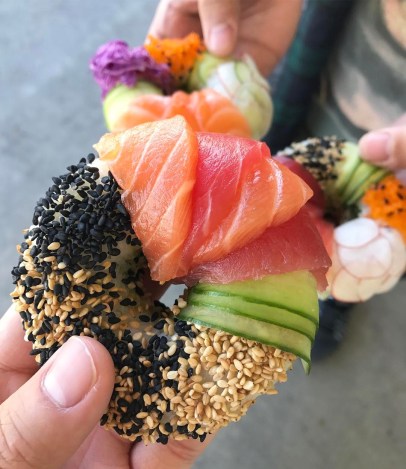
Fun Link Friday: Sushi donuts?

sushidonutNow that you’ve endured or enjoyed some matcha beer, here comes another innovation on the traditional… sushi donuts?

The internet is having a time with this new interpretation of a traditional favorite, and frankly, I’m just as unsure how I feel about this as the green tea beer. Are they worth the hype? Are we just bored with the shape of our usual food? I can’t imagine there’s a new flavor profile being added because of the round shape or a mashup like cronuts adding something new, so what do you think? Another silly fad or a new way to enjoy an old goodie?

Posted in culture, fun links | Tagged , , , | Leave a comment

First Japanese Diaspora Initiative Workshop at Hoover Institution

Institution: Hoover Institution, Stanford University
Location: Stanford, California
Dates: November 13-15, 2017
Call for Papers Deadline: August 21, 2017

(below text from the official Call for Papers)

The Hoover Institution at Stanford University is hosting the first Japanese Diaspora Initiative (JDI) Workshop. We plan on bringing an international roster of leading scholars in modern Japanese history and Japanese American Studies to the home of rich Japanese and Japanese American archival collections so as to discuss the Japanese diaspora from a global perspective. The forum of discussion offered by this workshop will allow scholars to consider the history of Japanese migrant workers and immigrants as interactive processes between homeland and host countries. In addition to invited scholars, we call for papers that encourage interdisciplinary participation and fresh ideas to widen the scope of the field.

Paper Presentation Format: Twenty minute oral presentation, followed by Q&A. Forum of discussion is planned for the afternoon of Day 3.

The Japanese Diaspora Initiative welcomes submissions of papers from a wide range of disciplines related to the Japanese diaspora that will be presented at the inaugural JDI workshop. We aim to encourage innovative epistemology to study the history of the Japanese diaspora so as to open up avenues for exchanges of ideas and perspectives. Papers using the Hoji Shinbun Digital Collection, recently created by the Hoover Institution, will be given priority. This open access digital collection contains fourteen titles and nearly half a million pages of Japanese newspapers published in North America and Hawaii through 1945. At the closing of the first JDI Workshop, the Japanese Diaspora Initiative Award from the Hoover Institution, Stanford University, in the amount of US $2500, will be given to a paper that helps shape the course of the field, opens up broader dialogues in modern Japanese history, and to study the diaspora from a global perspective. That paper will be published under the auspices of the Japanese Diaspora Initiative Occasional Series by the Hoover Press and Yale Press. Below are the requirements for submission:

*Paper Title
*Abstract (up to 500 words)
*Biographical paragraph or CV summary (up to 250 words)
*Email address
*Affiliation, city, state, country

Please submit your application online at http://apply.interfolio.com/40606. For inquiries, please contact the JDI curator Kaoru “Kay” Ueda at kueda@stanford.edu.

Posted in conferences | Tagged , , , , | Leave a comment

Call for Papers: Queering the Transpacific: Asian American, American and Asian Queer Studies

call for papers [150-2]In an era of neo-nationalism and the waning of Pax Americana, Asia ascends and transpacific tensions rise,evident in both Obama’s Pivot to Asia and Trump’s America First policies.  A post-national Asian/American studies is thinking more robustly about transpacific relations that pay more attention to histories of Afro-Asian solidarity and methods of comparison beyond Asian nationalism and economic relations alone.  What this means for queer critique is less clear, however.  Critiques of homonationalism as well as formulations of queer international studies have pushed for critical approaches to Western international policy and its racial and gendered legacies.  For example, Petrus Liu has discussed how queer liberalism and homonationalism inhere white ascendancy and Asian belatedness, and thus have limited application when thinking about Asian queerness.  Queer studies in Asia takes intra-national and regional approaches that provincialize the West, including questioning the “origin-copy” relations between US and Asian queer studies; yet, in many Asian academic contexts, feminist and queer studies are still marginalized and often regarded as “Western” as a reflection of the Euro-American-centrism or assumed universalism of feminist and queer studies in the West.  Seldom is the transpacific considered as an historical genealogy and theoretical possibility that cuts across the aforementioned disciplinary formations.

The growth, maintenance, and potential clash of US, Japanese, and Chinese international ambitions, as well as transpacific complicity with the postwar liberal-pluralist framework through economic and military partnerships like ASEAN, (an almost defunct) Trans-Pacific Partnership and the US-Japan Alliance means that East-West critical discourse is both imperative but inadequate without a rigorous theorizing of the transpacific.  What is needed is more productive inter-regional dialogue.  This is a call to bring Asian queer studies and queer Asian/American studies in better conversation with one another to develop queer transpacific critique.  Possible themes include bridging insights of “queer of color,” transatlantic, diasporic and regional methods; theorizing the confluence of racialization and queer critique in sites and times of transpacific cooperation and conflict; queer critique of racial politics in Asia, e.g., racism generated by more economically powerful Asian nation-states towards “other” Asians, or in terms of ethnic and religious difference; considerations of queer (im)mobility across borders, e.g., queer tourism and medical tourism; considerations of queer transpacific historiography and archive; queer transpacific critique on the production/consumption of subcultural media (cinema, TV dramas, manga, anime); queer temporalities that territorialize homonationalism and queer liberalism in relation to Asian universalisms and/or particularisms, e.g., disruptions of Asian nationalist historiographies and Eurocentric capital; queer transpacific critique on nationalism, neo-conservatism, neoliberalism, illiberalism; (im)possibilities of queer transpacific solidarity under the new militarism in Asia; reflections on queer transpacific disciplinarity, affect, aesthetics; repressed queer voices under Asian economic, political and military growth.
Potential contributors should send 250-word abstracts to queer.transpacific@gmail.com by 31 March 2017.  Queries are also welcome!  We are in contact with a journal, and a proposal will be drawn up for a themed issue once abstracts are collected.  First drafts of 5000-7000 word essays would be due 15 November, with the expectation that all contributors will workshop each other’s papers for submission by 31 December 2017.

Contact Info:

Kazuyoshi Kawasaka (University of Sussex)

Alan Williams (University of Washington)

Contact Email:

queer.transpacific@gmail.com


Posted in announcements, conferences, graduate school | Tagged , , , , , | Leave a comment

Workshop: Reading Kuzushiji, University of Chicago

call for papers [150-2]The Japan Committee of the University of Chicago is pleased to announce the 2017 Early Modern Japan Summer Workshop: Reading Kuzushiji. The workshop will meet from June 12th to June 17th.   This year’s workshop will feature two tracks. Professor Ken’ichiro Aratake of Tohoku University’s Northeast Asia Center will instruct the intermediate group in the reading of manuscript materials from the Tokugawa and early Meiji period, while Dr. Nobuko Toyosawa (former UofC postdoctoral fellow, now Fellow at the Czech Republic’s Oriental Institute) will lead a two-day introductory workshop focusing on print materials.  Participants in Dr. Toyosawa’s group will be prepared to join the intermediate group from day 3 of the workshop.  The workshop will conclude with a symposium on Saturday, June 17th that features presentations by participants on their research projects.

The workshop is open to faculty, graduate students, librarians, and curators.  Please note that the workshop will be conducted in Japanese and participants should have a working knowledge of classical grammar and some familiarity with hentaigana.  There is a $100 program fee that covers copy costs and lunch each day.

For more information and to apply, please see the workshop website:  https://lucian.uchicago.edu/blogs/kuzushiji/

Posted in announcements, conferences, graduate school, study tools | Tagged , , , , , , , | Leave a comment

Workshop: PENDULUM 3 (Japanese music)

KYOTO CITY UNIVERSITY OF ARTS

RESEARCH CENTRE FOR TRADITIONAL JAPANESE MUSIC

PENDULUM 3

邦楽 HŌGAKU @ KYOTO GEIDAI 京都芸大

AN INTENSIVE THREE-DAY COURSE IN JAPANESE MUSIC

AUGUST 15-17, 2017

This three-day intensive course in Japanese music PENDULUM 3 is being offered for the third time in August 2017.

The course introduces many of the genres of traditional Japanese music that have been transmitted to the present and are still actively performed. We discuss the varied ways of experiencing musical modernity in the context of the overwhelming dominance of western music in Japan. The course provides an accessible overview of Japanese music culture for non-Japanese participants, including performers, composers and musicologists. It is also open to Japanese participants who are interested in an international perspective on Japanese music.

The genres to be covered include gagaku, shōmyō, and shakuhachi and koto music. The narrative genres of heike and jōruri and their place in the nō, bunraku and kabuki theatres are introduced. Participants have hand-on encounter with a choice of koto, shamisen, shakuhachi or utai (noh singing) during practical learning sessions. Guest performers will contribute mini-recitals as an adjunct to the lectures.


Location:        Kyoto City University of Arts

Schedule:      Morning session 10:00-13:00   Afternoon session 14:00-17:00

Cost:                 10,000 yen

Lecturer and convenor: Alison Tokita, Director, Research Centre for Japanese Traditional Music, with guest lecturers to be confirmed

HOW TO APPLY

Registrations will be received by Friday July 14, 2017 through the following website:

http://w3.kcua.ac.jp/jtm/pendulum3.html

Payment will be made in cash on the first day of the course, between 9:00 and 10:00.

Unfortunately, we are not able to provide accommodation assistance.

Enquiries can be made to the course convenor, Alison Tokita: tokita@kcua.ac.jp

Posted in announcements, culture | Tagged , , , , , | Leave a comment

Job Opening: Summer course lecturers, UC Santa Barbara (incl. East Asian civilizations)

job opening - 5Institution:  UC Santa Barbara
Location:  California
Position:  Lecturer

The Department of History at the University of California, Santa Barbara, invites applications for temporary, part-time lecturer positions for Summer 2017. Courses needed may include:

• World History Survey, (pre-history to 1000 CE; 1000-1700 CE; 1700 CE to Present)
• Western Civilization Survey, (pre-history to 1050 CE; 1050-1715 CE; 1715 to Present)
• The American People, (US survey, all Periods)
• East Asian Civilization Survey
• Latin American History (pre-contact to present)

Interested candidates should submit a cover letter-which clearly indicates which course or courses best fit their qualification; most recent CV; teaching evaluations, if applicable; a description of proposed courses, or syllabi, if applicable; and the names and telephone/email addresses for three professional references. Interested candidates should apply to the following link: https://recruit.ap.ucsb.edu/apply/JPF00939

The salary is based on UC’s salary scales and depends on qualifications. Applicants should possess a PhD in History or related field by time of appointment, and have one year of teaching experience. The department is especially interested in candidates who can contribute to the diversity and excellence of the academic community through teaching and service.

The University of California is an Equal Opportunity/Affirmative Action Employer and all qualified applicants will receive consideration for employment without regard to race, color, religion, sex, sexual orientation, gender identity, national origin, disability status, protected veteran status, or any other characteristic protected by law.

Contact: Questions about the position may be directed to the Search Chair, Harold Marcuse, marcuse@history.ucsb.edu. More information about the UCSB History Department may be found at our website, www.history.ucsb.edu.

Website: http://www.history.ucsb.edu/

Posted in announcements, job openings, jobs, Uncategorized | Tagged , , , | Leave a comment

Job Opening: Japanese/Asian studies, Earlham College

job opening - 5Institution: Earlham College, Japanese Studies
Location: Indiana, United States
Position: Non-Tenure Track Faculty, Visiting Assistant Professor

Position Announcement: 

Visiting Assistant Professor of Japanese and East Asian Studies

Earlham College invites applications for a full-time one-year visiting assistant professor position in Japanese Studies with a specialization in any academic discipline to begin in fall 2017. Pending approval a national search will be conducted in 2017-2018 for a tenure-track appointment to begin fall 2018.

Responsibilities 

Teaching responsibilities will include a full-time teaching load of 6 courses, 3 per semester. We are especially interested in adding courses in literature, art history, film/media studies, or popular/visual culture. Courses may be comparative in nature, but each course should include at least 50% Japan content in the form of lectures, readings, and assignments. Courses that include other East Asian content, particularly related to China and other Chinese-speaking areas in Asia, are especially welcome.

Qualifications 

Applicants should have earned a doctorate or terminal degree. Although the academic discipline is not specified, significant graduate coursework and research experience must be in Japanese Studies.

Japanese Studies at Earlham 

Earlham has one of the oldest and best-known undergraduate programs in the country for the study of Japan. About 9% of Earlham students enroll in Japanese language study, and each year 15 – 20 students study in Japan through one of Earlham’s two off-campus programs.

http://www.earlham.edu/japan-at-earlham/

To Apply 

A complete application will include the following:

  1. Letter of application
  2. Curriculum vitae
  3. Name and contact information for three references
  4. Statement of teaching philosophy
  5. Selection or summary of student or course evaluations from previous teaching appointments, if available
  6. Description of teaching interests (Candidates selected for an interview will be asked to bring a brief course syllabus for 2 courses).

Send application materials by email in a SINGLE PDF file to: leama@earlham.edu with the subject: “Japanese Studies VAP Position.”

Review of applications will begin immediately and continue until March 10, 2017. Initial interviews will be held at the Association for Asian Studies annual conference in Toronto (March 16-19), as well as online.

For Inquiries and Additional Information 

Contact: Search Chairperson, Eric J Cunningham, cunnier@earlham.edu

About Earlham 

Earlham College, an independent, residential college, aspires to provide the highest quality undergraduate education in the liberal arts, including the sciences, shaped by the distinctive perspectives of the Religious Society of Friends (Quakers). Earlham emphasizes the pursuit of truth, lack of coercion, respect for others, openness to new truth, integrity and application of what is known to improving our world.

Contact:

Contact: Search Chairperson, Eric J Cunningham, cunnier@earlham.edu

Send application materials by email in a SINGLE PDF file to: leama@earlham.edu with the subject: “Japanese Studies VAP Position.”

Website: http://www.earlham.edu/human-resources-and-business-operations/current-openings/?job=45222


Posted in announcements, job openings, jobs | Tagged , , , , , , | Leave a comment

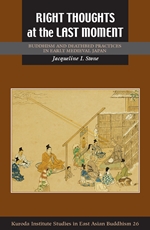
Book Announcement: Right Thoughts at the Last Moment: Buddhism and Deathbed Practices in Early Medieval Japan

rightJacqueline I. Stone

University of Hawai`i Press
616pp. November 2016
Cloth – Price: $68.00ISBN: 978-0-8248-5643-4

http://www.uhpress.hawaii.edu/p-9704-9780824856434.aspx

Description

Buddhists across Asia have often aspired to die with a clear and focused mind, as the historical Buddha himself is said to have done. This book explores how the ideal of dying with right mindfulness was appropriated, disseminated, and transformed in premodern Japan, focusing on the late tenth through early fourteenth centuries. By concentrating one’s thoughts on the Buddha in one’s last moments, it was said even an ignorant and sinful person could escape the cycle of deluded rebirth and achieve birth in a buddha’s pure land, where liberation would be assured. Conversely, the slightest mental distraction at that final juncture could send even a devout practitioner tumbling down into the hells or other miserable rebirth realms. The ideal of mindful death thus generated both hope and anxiety and created a demand for ritual specialists who could act as religious guides at the deathbed. Buddhist death management in Japan has been studied chiefly from the standpoint of funerals and mortuary rites. Right Thoughts at the Last Moment investigates a largely untold side of that story: how early medieval Japanese prepared for death, and how desire for ritual assistance in one’s last hours contributed to Buddhist preeminence in death-related matters. It represents the first book-length study in a Western language to examine how the Buddhist ideal of mindful death was appropriated in a specific historical context.

Practice for one’s last hours occupied the intersections of multiple, often disparate approaches that Buddhism offered for coping with death. Because they crossed sectarian lines and eventually permeated all social levels, deathbed practices afford insights into broader issues in medieval Japanese religion, including intellectual developments, devotional practices, pollution concerns, ritual performance, and divisions of labor among religious professionals. They also allow us to see beyond the categories of “old” versus “new” Buddhism, or establishment Buddhism versus marginal heterodoxies, which have characterized much scholarship to date. Enlivened by cogent examples, this study draws on a wealth of sources including ritual instructions, hagiographies, doctrinal writings, didactic tales, courtier diaries, historical records, letters, and relevant art historical material to explore the interplay of doctrinal ideals and on-the-ground practice.


Posted in announcements, culture | Tagged , , , , , , | Leave a comment