
Translation Workshop: Murakami, Contemporary Japanese Writing and the English-reading Marketplace

Murakami, Contemporary Japanese Writing and the English-reading Marketplace

Translation Workshop at Newcastle University, March 6-7, 2018

The School of Modern Languages, Newcastle University (UK) is hosting an Arts and Humanities Research Council (AHRC) funded project on Murakami Haruki. Available in translations into more than 50 languages, Murakami’s texts are read around the world. Translating from one language into another is rarely straightforward, but a complicated process in which translators, editors and publishers make choices that inevitably impact the new text. Professional and aspiring translators of Japanese literature are invited to participate in a two-day translation workshop that will seek to explore issues in the processes of literary translation.

Application deadline: 30-11-2017 

Intended as a practice-based space, the workshop will be led by two established translators of Japanese literature, Dr Michael Emmerich (UCLA) and Dr David Karashima (Waseda University) in collaboration with translation editor and publishing consultant Elmer Luke. Limited to approximately 10 participants, the workshop will look at the process of translating Murakami’s texts and other contemporary Japanese writing for the English-reading marketplace.

In addition to the practice-based sessions, there will also be several public lectures by translators and scholars of Japanese literature, including two translators of Murakami, Emeritus Professor Jay Rubin (Harvard University) and Dr Anna Zielinska-Elliott (Boston University).

Participants will also be able to attend events related to the Murakami project that are scheduled to take place the same week as the workshop. These include the academic conference 40 years with Murakami Haruki, film screenings and an art exhibition. The full program and further information about the entire AHRC-funded project is available at http://research.ncl.ac.uk/murakami/.

The workshop is free of charge and the School of Modern Languages is generously offering to reimburse accepted participants up to £200 towards travel and accommodation. To apply, please fill in the application form available at http://forms.ncl.ac.uk/view.php?id=12668 by November 30, 2017. Applicants will be notified of the outcome in due course after this date.

Contact Info:

Please contact Dr Gitte Marianne Hansen (gitte.hansen@ncl.ac.uk) with any inquiries.
Posted in announcements, conferences, graduate school | Tagged , , , , , , , , | Leave a comment

Book Announcement: FROM CHINESE CHAN TO JAPANESE ZEN: A Remarkable Century of Transmission and Transformation

FROM CHINESE CHAN TO JAPANESE ZEN: A Remarkable Century of Transmission and Transformation, Steven Heine
(New York: Oxford University Press, 2017),

304 Pages | 27 illus., ISBN: 9780190637507

  •      Examines the transformation of Chan Buddhism into Zen Buddhism from 1225 to 1325
  •      Synthesizes materials and perspectives from across national and sectarian divisions
  •      Written especially for students or specialists looking for a refresher

Table of Contents

Preface

Part One. Transnational Studies of Maritime Transfers
1. Traditions: Shifts in East Asian Society Affecting the Formation and Reception of Zen
2. Transitions: Social Influences on Zen’s Legend of Living Buddhas

Part Two. Troubling At First, Then Turning Into the Establishment
3. Transmissions: When Dogen Attained Enlightenment in China in 1225
4. Transplantations: How Émigré Monks Overcame Mid-Century Challenges
5. Transformations: Why Daito Did Not Go to China, Yet Won a Debate in 1325

Part Three. Techniques for Attaining and Maintaining Enlightenment
6. Teachers: Testing the Authenticity and Authority of Zen Masters
7. Temples: Training Disciples While Mitigating Transgressions
8. Tones: Triggering Spirituality Through Literary and Fine Arts

Glossary of Names, Titles, and Terms
Recommended Readings

“This book is a scholarly expedition that follows Zen Buddhism from China to Japan, and through all points in between. Through his erudition, his familiarity with Zen and East Asian Buddhism, and his comprehensive knowledge of related literature, Steven Heine succeeds in evoking the vibration of Zen Buddhism in his readers while enriching and renewing their understanding of the tradition.”–Jin Y. Park, author of Women and Buddhist Philosophy

From Chinese Chan to Japanese Zen showcases Steven Heine’s mastery of an array of primary and secondary sources, as well as his outstanding ability to communicate clearly to both scholarly and general audiences. It will be readily appreciated by scholars working in fields such as East Asian Buddhism and Japanese history, as well as by general readers interested in learning about the rich history of Zen.” –Mario Poceski, Professor of Buddhist Studies and Chinese Religions, University of Florida

“This is a book that has needed to be written, and we are fortunate that it was Steven Heine who chose to write it. Drawing on his impressive expertise, Heine skillfully illuminates how the Chan school was transplanted into Japan and became the Zen sect. Readers will appreciate his close attention to the cultural and socio-political dimensions of that transmission.”–Christopher Ives, author of Imperial-Way Zen

Posted in announcements, culture | Tagged , , , , , , , , , | Leave a comment

Resource: Hoji Shinbun Digital Collection – Japanese Diaspora Initiative

Stanford University’s Hoover Institution Library & Archives recently launched the Hoji Shinbun Digital Collection as a part of their Japanese Diaspora Initiative, which aims to make the Hoover Institution the leading center for archive-based research and analysis on the historical issues of war, revolution, and peace as they relate to Japan. With a focus on Japan’s modern diaspora—especially Japanese Americans and overseas Japanese communities— the efforts of this initiative have resulted in an absolutely incredible resource of digitized materials, including the half a million+ pages of rare Japanese newspapers like the Hoji Shinbun, which were published in the U.S. from the late nineteenth century through WWII.

From the website:

The Hoji Shinbun Digital Collection is currently the world’s largest online archive of open-access, full-image newspapers published by overseas Japanese and their descendants. All content reproduced in this collection is full image, with enhancements added where possible, and rendering the text maximally searchable. The holdings of each title are also browsable by date, and each title is cross searchable with other titles on the platform. This collection currently contains fourteen newspapers published in Hawaii and North America. Most publications present a mix of content in the Japanese and English languages, with formats and proportionality of Japanese/English often changing as a reflection of shifting business and social circumstances.

As stated above, there’s multiple searching methods, including title, date, keywords, or advanced options for individual newspapers. The entire site can also be navigated in either English or in Japanese. Some newspapers are Stanford access only, but the majority are open to the public and do not require any logins.
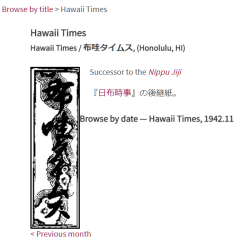
Once you select a newspaper (such as the Hawaii Times, seen on the right, then you can search that individual paper by calendar date for a specific entry of interest, which is enormously helpful if you are cross-referencing another historical date with these materials. It’s also possible to look by date and list the various newspapers with entries for that specific date, rather than browsing one title at a time.

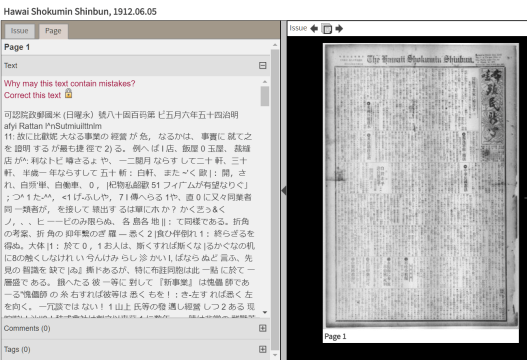
One of the most interesting parts of the entire collection, though, may be their OCR (Optical Character Recognition) system. The some 500,000 materials have been through OCR processing to render the difficult visuals into text, and though it leaves much to be desired in terms of accuracy, Stanford has set it up so that users can sign up to be OCR correctors.

So if you happen to be using these materials for your research (or fun) and have transcribed parts of them, you can submit it to the system to improve the overall content of the collection. This is a great step towards bridging the gap between private and public scholarship/resources.

Even if you’re not a researcher, this collection is a fascinating glimpse into Japanese/Japanese American/U.S. history, so be sure to check it out!

Posted in graduate school, main posts, study tools, undergraduate, useful links | Tagged , , , , , , , | 2 Comments

Job Opening: Dartmouth College, Assistant Professor, Asian Religions

Institution: Dartmouth College
Location: New Hampshire, United States
Position: Assistant Professor

DARTMOUTH COLLEGE, Hanover. The Department of Religion at Dartmouth College invites applications for a full-time, tenure-track position in Asian Religions. Appointment to begin as early as July 1, 2018. We especially encourage applications from candidates who specialize in Japanese, Tibetan/Himalayan, or Southeast Asian religions, whose academic specialization lies in religion or in an academic discipline relating to the study of religion. The successful candidate will be grounded in both theoretical and methodological approaches to the study of religion, as well as the relevant primary languages.

Qualifications include Ph.D., along with a record of outstanding scholarship and effective teaching. Requirements include teaching four courses per year (0-2 per quarter over 3 quarters) and normal department service. Competitive salary, benefits and research support. The successful candidate will be expected to teach a broad range of introductory, intermediate-level, and advanced courses within his or her specialization, as well as contributing to the Department’s theoretical and methodological offerings.

Since its inception in 1949, the Religion Department has been committed to a multidisciplinary, globally diverse curriculum grounded in the academic study of religion as engaged through a variety of methodological approaches. The Department offers instruction, from the introductory to the advanced level, in most of the world’s major religious traditions: Buddhism; Christianity; Hinduism; Islam; Judaism; the religions of the ancient Near East; the religions of ancient and modern China; religious life in the Americas; and the religions of Africa. The Department offers an undergraduate major and minor.

Dartmouth College is an outstanding research institution of 4300 undergraduates, half of whom are women and approximately a third of whom are members of minority groups. Dartmouth College is an equal opportunity/affirmative action employer with a strong commitment to diversity and inclusion. We prohibit discrimination on the basis of race, color, religion, sex, age, national origin, sexual orientation, gender identity or expression, disability, veteran status, marital status, or any other legally protected status. Applications by members of all underrepresented groups are encouraged. We are especially interested in candidates with demonstrated ability to contribute to Dartmouth’s undergraduate diversity initiatives.

Review of applications will begin immediately and will continue until the position is filled. To ensure fullest consideration, dossiers should be received by October 15, 2017. Candidates whose applications are received by October 15, 2017, will be considered for a preliminary interview at the annual meetings of the American Academy of Religion (November 18-21, 2017), or by Skype for those unable to attend the conference.

To APPLY, visit: http://apply.interfolio.com/43693

Posted in announcements, job openings, jobs | Tagged , , , , , , , , | Leave a comment

Job Opening: Assistant Professor – East Asian Cinema

Institution: University of Toronto Mississauga, Department of Visual Studies
Location: Ontario, Canada
Position: Assistant Professor – East Asian Cinema

The Department of Visual Studies at the University of Toronto, Mississauga campus invites applications for a full-time, tenure-stream appointment at the rank of Assistant Professor in the field of East Asian Cinema. The expected start date will be July 1, 2018.

The Department welcomes applications from scholars of East Asian Cinema working in any area of the field. We encourage applicants with an emphasis on film philosophy and/or critical theory but other approaches are also welcomed.

Applicants must have earned a PhD in Cinema Studies, East Asian Studies, or a closely related discipline by the date of appointment or shortly thereafter, with a demonstrated record of excellence in teaching and research. The successful candidate will play an important role in undergraduate teaching in the Department of Visual Studies and at the graduate level in the Cinema Studies Institute. The candidate will also be affiliated with the Department of East Asian Studies. The candidate will supervise and mentor students, participate in the affairs of the Department of Visual Studies and the Cinema Studies Institute, and conduct innovative research at the highest international level.

Evidence of excellence in teaching will be demonstrated through teaching accomplishments, strong letters of reference, and teaching materials, including a teaching dossier, submitted with the application. Excellence in research is demonstrated by the quality of the writing sample, publications in (or forthcoming in) top-ranked and field-relevant academic journals, presentations at major conferences, awards and accolades, evidence of an innovative research program, and strong endorsements by referees of high standing.

Salary will be commensurate with qualifications and experience.

The University of Toronto offers the opportunity to teach, conduct research, and live in one of the most diverse metropolitan areas in the world.

All qualified applicants are invited to apply online by clicking on the following link: https://utoronto.taleo.net/careersection/10050/jobdetail.ftl?job=1701397 .

Applications should include a cover letter, curriculum vitae, teaching dossier (including a statement of teaching philosophy, sample syllabi, and teaching evaluations), a statement outlining current and future research interests, and a writing sample (c. 30 pages). If you have questions about this position, please contact dvschair.utm@utoronto.ca. All application materials should be submitted online. Materials must be received by October 18, 2017. If you have any questions about this position, please contact Debra Burrowes at dvschair.utm@utoronto.ca.

The UofT application system can accommodate up to fifteen attachments (8.3MB per attachment) per candidate profile; please combine attachments into one or two PDF/MS Word format files. Submission guidelines can be found at: http://uoft.me/how-to-apply.

Applicants should also ask three referees to send letters (signed and on institutional letterhead) directly to the department via e-mail to dvschair.utm@utoronto.ca by the closing date, October 18, 2017.

For more information about the Department of Visual Studies, please visit https://www.utm.utoronto.ca/dvs/.

The University of Toronto is strongly committed to diversity within its community and especially welcomes applications from racialized persons / persons of colour, women, Indigenous / Aboriginal People of North America, persons with disabilities, LGBTQ persons, and others who may contribute to the further diversification of ideas.

As part of your application, you will be asked to complete a brief Diversity Survey. This survey is voluntary. Any information directly related to you is confidential and cannot be accessed by search committees or human resources staff. Results will be aggregated for institutional planning purposes. For more information, please see http://uoft.me/UP .

All qualified candidates are encouraged to apply; however, Canadians and permanent residents will be given priority.

Contact: dvschair.utm@utoronto.ca

https://www.utm.utoronto.ca/dvs/

Posted in announcements, job openings, jobs | Tagged , , , , , , , , , | Leave a comment

Book Announcement: Chinese Literary Forms in Heian Japan: Poetics and Practice

Chinese Literary Forms in Heian Japan: Poetics and Practice
Brian Steininger

Written Chinese served as a prestigious, cosmopolitan script across medieval East Asia, from as far west as the Tarim Basin to the eastern kingdom of Heian period Japan (794–1185). In this book, Brian Steininger revisits the mid-Heian court of the Tale of Genji and the Pillow Book, where literary Chinese was not only the basis of official administration, but also a medium for political protest, sermons of mourning, and poems of celebration.

Chinese Literary Forms in Heian Japan reconstructs the lived practice of Chinese poetic and prose genres among Heian officials, analyzing the material exchanges by which documents were commissioned, the local reinterpretations of Tang aesthetic principles, and the ritual venues in which literary Chinese texts were performed in Japanese vocalization. Even as state ideology and educational institutions proclaimed the Chinese script’s embodiment of timeless cosmological patterns, everyday practice in this far-flung periphery subjected classical models to a string of improvised exceptions. Through careful comparison of literary and documentary sources, this book provides a vivid case study of one society’s negotiation of literature’s position—both within a hierarchy of authority and between the incommensurable realms of script and speech.

For more information: http://www.hup.harvard.edu/catalog.php?isbn=9780674975156

Posted in announcements, culture | Tagged , , , , , , , , , | Leave a comment

Job Opening: Japanese, Part-time Instructor

Mott Community College
Japanese Instructor (part time)

Position Summary

Purpose, Scope & Dimension of Job: Faculty facilitate student learning and initiate and participate in efforts to consistently improve the level of student success. As learning facilitators, faculty consistently assess learning outcomes and their own teaching effectiveness (pedagogy). As professionals, faculty adhere to the ethical standards of their profession as outlined, for example, by the NEA and the State of Michigan. Where applicable, faculty maintain licensure and certifications.

Specific Teaching Assignment:

Faculty member will be responsible for teaching 100 and 200 level classes in Japanese, adhering to the stated course objectives, content and delivery.

Minimum Requirements

To perform this job successfully, an individual must be able to perform each essential duty satisfactorily. The requirements listed below are representative of the knowledge, skill, and/or ability required.
1. Master’s degree in Japanese, or a Master’s degree in a related field plus a minimum of 18 graduate hours in Japanese.
2. Teaching experience in Japanese. (Tutoring and/or Language Lab experience can be considered as equivalent to teaching experience.)
3. Understanding of and commitment to community college teaching, mission and philosophy.
4. Innovative, flexible and positive teaching style and understanding the needs of students from diverse backgrounds.
5. Language Skills: Ability to read, analyze, and interpret general business periodicals, professional journals, technical procedures, or governmental regulations. Ability to write reports, business correspondence, and procedure manuals. Ability to effectively present information and respond to questions from groups of managers, clients, customers, and the general public.
6. Mathematical Skills: Ability to apply concepts such as fractions, percentages, ratios and proportions to practical situations. Ability to work with mathematical concepts such as probability and statistical inference.
7. Reasoning Ability: Ability to solve practical problems and deal with a variety of concrete variables in situations where only limited standardization exists. Ability to interpret a variety of instructions furnished in written, oral, diagram or schedule form.
8. Technology Skills: Ability to integrate computer applications into teaching.
9. Other Skills and Abilities: Ability to apply knowledge of current research and theory to instructional program; ability to plan and implement lessons based on division and college objectives and the needs and abilities of students to whom assigned. Ability to establish and maintain collegial relationships with students, peers, staff, and administrators; skill in oral and written communication.

  • A foreign degree must be certified, at the candidate’s expense, by a professional evaluation service.

Additional Desirable Qualifications1. A minimum of two years of post-secondary teaching experience in Japanese. (Tutoring and/or Language Lab experience can be considered as equivalent for a portion of the teaching experience.)

For more information:

https://mcc.peopleadmin.com/postings/921

Posted in announcements, job openings, jobs | Tagged , , , , | Leave a comment

Call for Papers: Media Culture and Race Matters in Asia: Convergences and Divergences

Call for Papers

Media Culture and Race Matters in Asia: Convergences and Divergences 

Deadline for Abstract Submission: September 15th, 2017

The media—digital platforms, webisodes, multilingual media, mobile media, vlogs and other social media, film, radio, and TV—are essential to our everyday life. While it is true globally (with varying degrees) that the media impact and are intricately interwoven into what we do, think, and feel, the media are also a specifically regional phenomenon situated in time and place. These specificities of the media, however, are simultaneously transferrable and transformable across borders as they are built out of idiomatic and shared visual and verbal aesthetic systems. Since the development of the Internet and mobile communications in particular, it has, for example, become common for people in India to watch popular Korean television shows and vice versa, while adaptations across geographic and national boundaries have become a popular practice. Such global practices are re-constituting the boundedness of regions while the flow of media across borders challenges the very stability of categories of identity.

We in Media Culture and Race Matters in Asia examine the era of the media through two particular lenses, that is, Asia and race as they inform and are informed by the production and consumption of media. Contributors might explore the following or any other related questions:

  1. How do the media in different Asian countries attend to issues of construction, consumption, and representation of race?
  2. To what degree do the media from script to production and policy feed into or challenge racialized or anti-racist scenarios in Asia affecting the sociocultural and political landscapes more broadly?
  3. How might the varied levels of economic development, cultural diversity, and political regimes in Asia renew our understanding of the relation between race and media?
  4. How does the recent development of technology impact diversity and coherence of media cultures across Asia?
  5. What are the implications and limitations of the inter-Asian approach to media and race studies and how might this approach reconceptualize Asia as a dynamic and interconnected formation?

While each contributor will bring his or her own analytical methodology, expertise, and interest to bear on the exploration of media and their relation to race in each distinct Asian country, the book as a whole pays close attention to the ways in which Asia collectively creates media and race cultures that are uniquely Asian and universally global simultaneously.

If interested, please send an abstract of 300 words to Maya Dodd (maya@flame.edu.in) or Hyesu Park (hyesu.park@bellevuecollege.edu) by September 15th, 2017.  Actual essays will be in around 6,000 words each. 

Posted in announcements, conferences, graduate school | Tagged , , , , , , | Leave a comment

Book Announcement: Playing War: Children and the Paradoxes of Modern Militarism in Japan

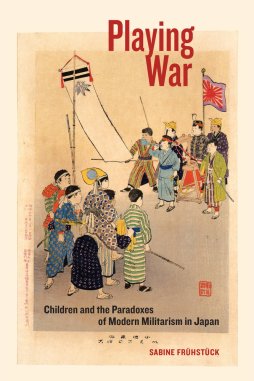
Playing War
Children and the Paradoxes of Modern Militarism in Japan
Sabine Frühstück

Published by the University of California Press.

In Playing War, Sabine Frühstück makes a bold proposition: that for over a century throughout Japan and beyond, children and concepts of childhood have been appropriated as tools for decidedly unchildlike purposes: to validate, moralize, humanize, and naturalize war, and to sentimentalize peace. She argues that modern conceptions of war insist on and exploit a specific and static notion of the child: that the child, though the embodiment of vulnerability and innocence, nonetheless possesses an inherent will to war, and that this seemingly contradictory creature demonstrates what it means to be human. In examining the intersection of children/childhood with war/military, Frühstück identifies the insidious factors perpetuating this alliance, thus rethinking the very foundations of modern militarism. She interrogates how essentialist notions of both childhood and war have been productively intertwined; how assumptions about childhood and war have converged; and how children and childhood have worked as symbolic constructions and powerful rhetorical tools, particularly in the decades between the nation- and empire-building efforts of the late-nineteenth and early twentieth centuries up to the uneven manifestations of globalization at the beginning of the twenty-first.

Sabine Frühstück is Professor of Modern Japanese Cultural Studies at the University of California, Santa Barbara. Her publications include Colonizing Sex: Sexology and Social Control in Modern Japan and Uneasy Warriors: Gender, Memory, and Popular Culture in the Japanese Army.

Posted in announcements, culture | Tagged , , , , , , , | Leave a comment

Fun Link Friday: Cultural Icon Kokeshi

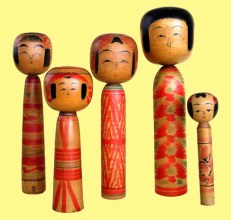
Kokeshi (こけし) are a kind of traditional Japanese doll, typically created from a single block of wood with a long, cylindrical body and bulbous head.

Although their origins are not known, you’ll find them as a staple in souvenir shops in northern areas of Japan. These dolls are typically painted with patterned designs in red and black to suggest clothing and feature simplified faces with rounded eyes.

Many Japanese woodworkers also create modern cultural figures in the style of kokeshi to attract visitors, and a recent article from Hint magazine has highlighted how an English artist, too, has taken to making kokeshi with well-known people as her inspiration.

Becky Kemp creates custom kokeshi of pop icons, historical figures, and even her customers! If it wasn’t enough to get traditional kokeshi on your trip to Japan, you might consider this modern twist for yourself or as a gift to a friend who loves Japan. Check out a huge number of photographs of these neat kokeshi at the original Hint article, on her instagram, or website.

Photo from Hint.com

Posted in culture, fun links, Uncategorized | Tagged , , , , , | Leave a comment