

Call for Papers: Workshop – Reproductive Labor and Gynocentric Technologies in East Asia, 1800s-2000s

CALL FOR PAPERS – EARLY CAREER SCHOLAR WORKSHOP

“Reproductive Labor and Gynocentric Technologies in East Asia, 1800s-2000s”

ORGANIZERS:

Jacob Eyferth (Chicago), Suzanne Gottschang (Smith), Gonçalo Santos (HKU)
Date: October 12-14, 2018
Venue: Smith College

INTRODUCTION TO GYNOCENTRIC TECHNOLOGY WORKING GROUP

The starting point of this Working Group is the idea that social life is fundamentally about “people-making.” Following David Graeber, we recognize that “while any society has to produce food, clothing, shelter, and so forth,” in most societies the production of material objects “is very much seen as a subordinate moment in larger productive processes aimed at the [creation and] fashioning of humans.” Industrial societies obfuscate the primacy of “people making” by separating material production in the workplace from social reproduction at home, marking the former as male, public, and important, and the latter as female, private, and unimportant. An earlier generation of feminist scholars challenged this doctrine of separate spheres and its explicit devaluation of women’s work. Our working group draws significant inspiration from this earlier scholarship to call for a re-appreciation of the centrality of reproductive labor in modern industrial societies. We argue that reproductive labor is not just a basic precondition of “production” (i.e., the replenishing of the labor force so that the production of goods can go on); the work involved in the reproduction of life in its social and biological dimensions is also an end result that remains important even where it is denigrated and overlooked.

We refer to the goals of reproductive labor as “gynocentric” because in most societies – including East Asian societies – women tend to play a central role in the work of creating and fashioning humans. Such work relies on a variety of tools, techniques, and practices (which we call “gynocentric technologies”, drawing on Francesca Bray’s notion of “gynotechnics”) that are often spatially dispersed and involve many different actors and institutions. Children are not simply raised by mothers in households; they are moved around from caretaker to caretaker, or people move around to take care of children, or outside agents are called in to help. Similarly, the reproduction of life at home – the cooking, feeding, cleaning, etc, that is the precondition for all social life – depends on networks of cooperation between women who help each other in these tasks. If one adds technology to the mix, one gets complex, spatially dispersed assemblages of people, techniques, and artifacts that come together in the work of creating and fashioning humans. These infrastructures can have many different scales (local, national, and global) and they have become more complex in recent times, with increased transnational mobility, and the growing significance of law, state policy, science, medicine, industry, and the media.

There is an important historical question here. The work of human reproduction always involved dispersed networks of people that were gynocentric in the sense that they could include men but were basically built around the labor of women, linked to each other through kinship or other ties. In the old agrarian order, everyday survival depended on a number of skills — textile manufacture, garment manufacture, food processing, healing, childcare, midwifery, etc. — that were important sources of prestige and dignity for women, even in the most oppressive circumstances. After the industrial revolution, many of these skills were gradually incorporated into the factory system and the logic of the market. Historians working on Western societies have drawn attention to a dynamics of de-skilling, whereby women either forgot old skills or else continued performing their old labor subject to the authority of experts and no longer in control of the productive process. This research tends to overstate the extent to which these transformations have led to a demise of women’s work. In contrast, we start from the assumption that gynocentric work did not disappear but was transformed and obscured. In East Asia as elsewhere, a modern focus on “production” – understood as commodity production outside the home – led to an understanding of women’s work as “reproductive chores,” with the effect that work that reproduced life at home often ceased to be seen as work at all. At the same time, women’s work became the object of attention of state regulators, reformist elites, and commercial providers, and was subjected to increased controls.

We ask questions about the transformation of reproductive labor and gynocentric technologies in East Asia from the 1800s onwards, when processes of industrialization and globalization were significantly accelerated. Throughout the region, we see a transition from an agrarian economy rooted in gendered divisions of labor in small producing households, to a modern political economy in which productive work is defined as taking place outside the household, in offices and factories. In the agrarian economy, women’s efforts were seen as subordinate but also complementary to men’s work. Ideally, “men tilled and women wove;” if either of them stopped performing their gendered work, people would starve or freeze. Beginning in the late nineteenth century, Japanese, Chinese, and Korean intellectuals began to think of “the economy” as a distinct realm, separate from the household and populated by male income earners. In this new model, domestic work performed by women became invisible, even though women, as artisans, cash croppers, and small commodity producers, continued to contribute to their households in the same way as men. Yet the ideological erasure of gynocentric work should not be confused with its actual disappearance. Precisely because such work was typically construed as private and unimportant, it could escape systematic transformation.

Rather than assuming a straightforward process in which women were progressively deskilled, their autonomy undermined by male experts, their work made redundant by industrially produced commodities, we assume an uneven transformation in which new skills and technologies interacted with older cultures of cooperation. We trace this transformation by focusing on changes in the everyday technologies that are involved in the work of “people-making.” We are thinking, for example, of how breast pumps, formula, and plastic bottles make it possible to disperse the work of nursing across time and space, or how cell phones and tracker wristbands allow Chinese migrant parents to be involved in child raising from a distance. Such arrangements are part of larger material and organizational infrastructures that have become increasingly transnational and commercialized as we entered the 21st century. An important part of this project is to show how these emerging infrastructures vary across East Asia, and how these variations are shaped by long-term socio-cultural and politico-economic processes, linked to a number of different projects of gender equality and female emancipation.


CALL FOR PAPERS, EARLY CAREER SCHOLAR WORKSHOP

We invite proposals from PhD students and early career scholars working on topics related to gynocentric work and technology in East Asia. We welcome proposals focusing on historical and/or contemporary issues, and drawing on one or several of the following disciplinary approaches (anthropology, history, sociology, STS). We are particularly interested in inter-disciplinary and cross-disciplinary perspectives that speak to larger issues in East Asian and global history and society.

The selection of specific topics for the workshop will ultimately depend on the availability of speakers, but we are interested in paper proposals focusing on one or several of the following key interconnected themes:

  • Biological reproduction. Traditional and modern techniques that regulate and aid the reproduction of biological life, including fertility treatments, contraception, abortion, pre- and postnatal care, midwifery, and infant nursing.
  • Homemaking includes the “three C’s” (caring, cooking, and cleaning), but also (in pre-industrial environments) hauling water, gathering fuel, spinning, weaving, sewing, raising animals, preserving food, etc. We also include commercial or public services (restaurants, canteens, laundry services, etc.) that supplement or replace domestic work.
  • Intimacy and connection. Techniques that maintain and shape social bonds in the family and beyond. These include, among others, the exchange of gifts and other objects, the creation of intimacy (and sometimes control) through cell phones and social media.
  • Healing and care include techniques ranging from routine “maintenance” of bodies to healing and caring for the sick, aged, and dying.

Abstracts (500 words max) should be submitted to the organizers by January 25th 2018 at the latest.

We will announce the shortlist of selected abstracts in early February 2018. Invited speakers will be expected to submit a full-length paper (8,000 words max) by September 1st 2018 to be presented and discussed at the workshop. We will provide assistance for costs of travel and accommodation of invited speakers.

Contact:           Jacob Eyferth (Chicago), email: eyferth@uchicago.edu

Suzanne Gottschang (Smith), email: szhang@smith.edu

Gonçalo Santos (HKU), email: santos@hku.hk

Posted in announcements, conferences, graduate school | Tagged , , , , , , , | Leave a comment

Job Opening: Assistant Professor of Asian History, Georgia College & State University

The Georgia College Department of History and Geography seeks to hire a tenure track assistant professor of Asian history with specialties in China, Japan, India and/or the Indian Ocean World. Desirable thematic sub-fields include religion, migration, gender, environment, and imperialism/colonialism. Special consideration will be given to candidates whose research is comparative and/or interdisciplinary. The successful applicant will teach world history survey courses and upper levels in their area of expertise. In addition, they will contribute to the teaching of the department’s historical methodology course, and will have the opportunity to develop an original, topical “Critical Thinking Course” for the core curriculum.

Screening of applications will begin February 12, 2018 and continue until filled. Questions should be directed to the search committee chair, Dr. Stephanie Opperman, at stephanie.opperman@gcsu.edu. Dr. Opperman will be attending the American Historical Association Annual Meeting and available to answer questions related to the position there. Check the Job Board at the conference for more details.

Website and further information: www.gcsujobs.com

Posted in announcements, job openings, jobs | Leave a comment

Funding: Visit and Study Japan Program (VSJapan)
Visit and Study Japan Program (VSJapan)

The America-Japan Society (AJS) is a long-standing private organization based in Tokyo for the promotion of relations between the U.S. and Japan. Earlier this year we celebrated our centennial anniversary.

In order to commemorate this milestone, the Society is starting a grant program which may be potential interest to your students. The name of the project is the AJS “Visit & Study Japan Grant Program (VS JAPAN)”. It is designed to give air fare and staying fee support to American graduate students who are studying Japan or Japan-US relations. It is intended to help students to finish their theses by visiting Japan.


Applicants should submit their completed application form to AJS via E-Mail by Saturday January 20, 2018 (Japan time).

For more information and application form: http://ajstokyo.org/en-news/visit-and-study-japan-program-vsjapan/

Posted in announcements, funding, graduate school | Tagged , , , , | Leave a comment

Job Opening: History Lecturer (Asia), University of Florida

The University of Florida invites applications for a full-time, non-tenure track appointment in modern Asian history at the rank of lecturer to begin August 16, 2018. Area of specialization/region is open, but the candidate will be expected to teach regional surveys as well as more topical courses. The ideal candidate will also build on the Department of History’s strengths in such subfields as the history of empires, law and society, religion, and trans-national/world history. Candidates must hold the Ph.D. by the starting date.

The successful candidate will teach approximately three courses per semester and provide service to the department, the university, and the profession.

The role of lecturers is highly valued by the college and the university. To encourage and facilitate their professional development, lecturers at the University of Florida are eligible for promotion through the ranks of Lecturer, Senior Lecturer, and Master Lecturer. Lecturer appointments are for 9 months per year and are annually renewable. Salary is competitive, commensurate with qualifications and experience and includes a full benefits package.

The Department is committed to creating an environment that affirms diversity across a variety of dimensions, including ethnicity/race, gender identity and expression. We particularly welcome applicants who can contribute to such an environment through their scholarship, teaching, mentoring, and professional service. The university and greater Gainesville community enjoy a diversity of cultural events, restaurants, year-round outdoor recreational activity, and social opportunities.

For full consideration, applications must be submitted online at http://explore.jobs.ufl.edu/cw/en-us/listing/ and must include: (1) a cover letter; (2) a CV; and (3) a teaching portfolio (including statement of teaching philosophy, sample syllabi, and course evaluations). Candidates who advance in consideration may be requested to send additional materials. In addition, names and email address for three references must be provided on the application. An email will be sent automatically to your references, requesting them to upload their letters. Review of applications begins January 15, 2018 and will continue until the position is filled. To ensure full consideration applications should be completed by that date.

The final candidate will be required to provide an official transcript to the department upon hire. A transcript will not be considered “official” if a designation of “Issued to Student” is visible. Degrees earned from an educational institution outside of the United States require evaluation by a professional credentialing service provider approved by the National Association of Credential Evaluation Services (NACES), which can be found at http://www.naces.org/.

The University of Florida is an Equal Opportunity Employer dedicated to building a broadly diverse and inclusive faculty and staff. The University of Florida invites all qualified applicants, including minorities, women, veterans, and individuals with disabilities to apply. The University of Florida is a public institution and subject to all requirements under Florida Sunshine and Public Record laws.

Contact:  Sean Adams, Chair and Professor; spadams@ufl.edu

Welcome to the Department of History

Posted in announcements, job openings, jobs | Tagged , , , , , | Leave a comment

Summer program: Buddhist East Asia: The Interplay of Religion, the Arts and Politics

NEH Summer Institute ~ May 28 to June 22, 2018

This multidisciplinary program, funded by the National Endowment for the Humanities, will offer four weeks of context-rich engagement with Buddhist teachings, practices and primary texts (in translation), examining how they have shaped and been shaped by the cultures and societies of East Asia. The program will consider how Buddhism addressed both personal and social needs in ways that were inseparable from the dynamics of intellectual exchange, artistic production, trade and politics. Designed to strike a balance between the needs both for breadth and depth in engaging traditions that are culturally and historically distant, Buddhist East Asia will provide abundant resources for developing pedagogically-effective course materials across a wide range of humanities and social science disciplines. Applications will be welcomed from eligible fulltime and adjunct faculty, as well as qualified graduate students. Participants will receive a stipend of $3300 to defray costs for travel, housing, meals and incidentals. Lodging will be available at the East-West Center guesthouse, Lincoln Hall.

http://www.asdp-buddhisteastasia.org/

Application deadlineMarch 1, 2018.

Contact Info:
Posted in announcements, conferences, graduate school | Tagged , , , , , , , , | Leave a comment

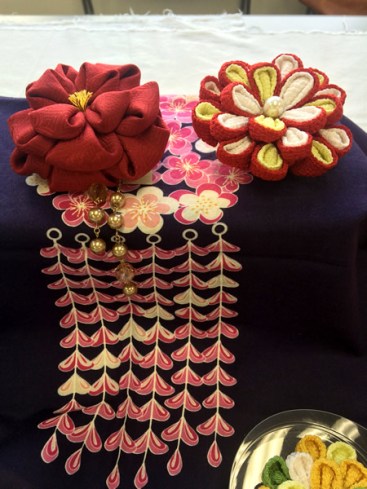
Fun Link Friday: Tsumami Zaiku/Kanzashi crafts

Ever wonder how your tiny flower or animal ornament omiyage in Japan are made? The art of tsumami zaiku  or tsumami kanzashi, in which a person carefully folds and glues tiny squares of cloth into elegant designs dates back to the Edo period (1603-1868) and is still popular today. Ikidane Nippon recently posted a video showing the process of creating these carefully placed little treats, which require a much steadier hand than I have!

Their video features artisans from a well-known shop, Tsumami Kanzashi Ayano, who have a lovely instagram and shop website where you can see these delightful, tiny treasures, both completed as well as during the process of creature.

Maybe you’ll be inspired for your next round of holiday gift-buying! 🙂 Happy Friday!

Posted in culture, fun links | Tagged , , , , | Leave a comment

Workshop: 2018 Jangseogak Hanmun (Classical Chinese) Summer Workshop

Call for Applications: 2018 Jangseogak Hanmun Summer Workshop (Intensive Literary/Classical Chinese Training Course for Students and Junior Scholars)

The Jangseogak Archives at the Academy of Korean Studies is accepting applications for 2018 Jangseogak Hanmun (Classical Chinese) Summer Workshop, a three-week intensive on-campus language course from 2nd July to 20th July, 2018. We welcome application from undergraduate students, graduate students or advanced degree holders of Korean Studies and/or East Asian Studies. Applicants must have studied at least one year of Classical Chinese or completed comparable course in Asian Studies.

The workshop will run for 6 hours from Monday to Friday for three weeks (morning lectures and afternoon practicum for translation), and will also include field trips to explore historic sites related to the reading materials addressed in the workshop.

The workshop aims at creating a global knowledge-building community of Korean studies. All lectures and discussions at the workshop will be conducted in English; at the same time, it will require translation of the original sources into English. Apart from the translation project, each participant will write a no more than ten-to fifteen-page introductory article on one primary source of his/her own choice from a list of fifty texts derived from the Archives (to be completed within six months from the completion of the workshop). The fifty texts will be carefully selected by the scholars of the Archives in consideration of the participants’ expertise and interests. The authorship of each translated piece and article will be accredited to the individual contributor; however, both the translated sources and the introductory articles will belong to the public domain of Korean studies and be published online for academic purposes

The Academy of Korean Studies will provide the participants with round-trip airfare (no more than 1,800 USD), tuition, and board and lodging. Undergraduate and graduate students are required to submit a letter of recommendation from their advisors.

Deadline: February 14th, 2018 (6pm Korean Standard Time)
The application results will individually be notified by March 7th, 2018
Please send the following materials in single PDF file to hanmun@aks.ac.kr (email application only)
1)    Current CV (including language proficiency)
2)    Statement of Purpose (no more than five pages, double spaced). Please include the following

a.    Academic background and interests
b.    Previous experience in East Asian Languages
c.    Objectives and expectations for attending the workshop
d.    Description of how the study of hanmun and/or Joseon (Chosŏn) source materials will contribute to your research

3)    an unofficial transcript OR a copy of your institutional certificate/degree certificate

Undergraduate and graduate students only: One confidential recommendation letter addressing the importance of hanmun to your study should be sent directly by the referee by February 14th, 2018 to hanmun@aks.ac.kr.

Question may be directed to hanmun@aks.ac.kr.


Contact Info:

Wonhee Cho (Researcher, Jangseogak Archives, Academy of Korean Studies)

Contact Email:
Posted in announcements, conferences, graduate school | Tagged , , , , , , , , | Leave a comment

Book Announcement: Assembling Shinto: Buddhist Approaches to Kami Worship in Medieval Japan

Assembling Shinto: Buddhist Approaches to Kami Worship in Medieval Japan

Anna Andreeva

http://www.hup.harvard.edu/catalog.php?isbn=9780674970571

HARDCOVER

ISBN 9780674970571, Harvard East Asian Monographs 396

420 pages, 9 color illustrations, 1 halftone, 14 line illustrations, 3 maps

During the late twelfth to fourteenth centuries, several precursors of what is now commonly known as Shinto came together for the first time. By focusing on Mt. Miwa in present-day Nara Prefecture and examining the worship of indigenous deities (kami) that emerged in its proximity, this book serves as a case study of the key stages of “assemblage” through which this formative process took shape. Previously unknown rituals, texts, and icons featuring kami, all of which were invented in medieval Japan under the strong influence of esoteric Buddhism, are evaluated using evidence from local and translocal ritual and pilgrimage networks, changing land ownership patterns, and a range of religious ideas and practices. These stages illuminate the medieval pedigree of Ryōbu Shintō (kami ritual worship based loosely on esoteric Buddhism’s Two Mandalas), a major precursor to modern Shinto.

In analyzing the key mechanisms for “assembling” medieval forms of kami worship, Andreeva challenges the twentieth-century master narrative of Shinto as an unbroken, monolithic tradition. By studying how and why groups of religious practitioners affiliated with different cultic sites and religious institutions responded to esoteric Buddhism’s teachings, this book demonstrates that kami worship in medieval Japan was a result of complex negotiations.

TABLE OF CONTENTS

Introduction

Part I. Mt. Miwa and the Yamato Landscape

1. The Ancient Cultic Site

2. Temple Networks in Southern Yamato

Part II. Holy Men and Buddhist Monks at Miwa

3. Miwa Bessho

4. Saidaiji

5. From Ise to Miwa and Beyond

Part III. Assembling Shinto

6. Enlightenment for the “Country Bumpkins”

7. Miwa-ryu Shinto

Conclusion

Posted in announcements, culture | Tagged , , , , , , , , , | Leave a comment

Job Opening: Associate professor or lecturer, Japanese Studies, Tsuda University

The Department of English at Tsuda University is looking for applicants for a full-time (tenured) position in Japan Studies in English as specified below.

Title of position: Associate professor (junkyōju) or lecturer (sennin kōshi)

Starting date: 1 April, 2019

Classes to be taught: Courses on “Japan Studies in English”; Seminars of “Japan Studies in English (project)”; Lectures on History of “Japanology”; thesis writing, and English language courses

Deadline for applications: 11/January, 2018 (delivery deadline)

Website: http://www.tsuda.ac.jp

Posted in announcements, job openings, jobs, Uncategorized | Tagged , , , , , | Leave a comment

Job Opening: Lecturer/Senior Lecturer, Victoria University of Wellington

Applications are invited for two positions in Japanese, one at the level of Lecturer and the other at either Lecturer or Senior Lecturer. These are permanent full-time positions and expected to commence in either February or June 2018.

Both appointees will maintain a high quality research record consistent with the research strategy of the School and of the University and enhance the School’s capacity to supervise MA and PhD theses.

Please complete the online application form and submit your CV and cover letter by attachment at http://www.victoria.ac.nz/about/careers/current-vacancies

Posted in announcements, job openings, jobs, Uncategorized | Tagged , , , , , | Leave a comment